
Skin tags and HPV warts can look similar enough to cause real confusion, but they are fundamentally different conditions with different causes, different risks, and different next steps. Understanding the difference between skin tags and HPV warts explained clearly can save you from unnecessary worry or, equally important, from dismissing something that warrants a closer look.
Skin tags are benign, non-infectious growths. HPV warts are caused by specific strains of the human papillomavirus and, in the case of genital warts, are sexually transmissible. That single distinction changes almost everything about how each one is managed.
Key Takeaways
- Skin tags are not caused by a virus and cannot be passed to another person
- Genital warts are caused by low-risk HPV types 6 and 11, and are among the most common sexually transmitted infections
- The two conditions look different on close inspection, skin tags are smooth and stalked; HPV warts are rough and often clustered
- Neither skin tags nor genital warts caused by HPV 6 or 11 are directly linked to cervical cancer, that risk comes from high-risk HPV types like 16 and 18
- A dermatologist or clinician can usually distinguish between the two on visual examination alone, though a biopsy is sometimes needed
What Are Skin Tags, Exactly?
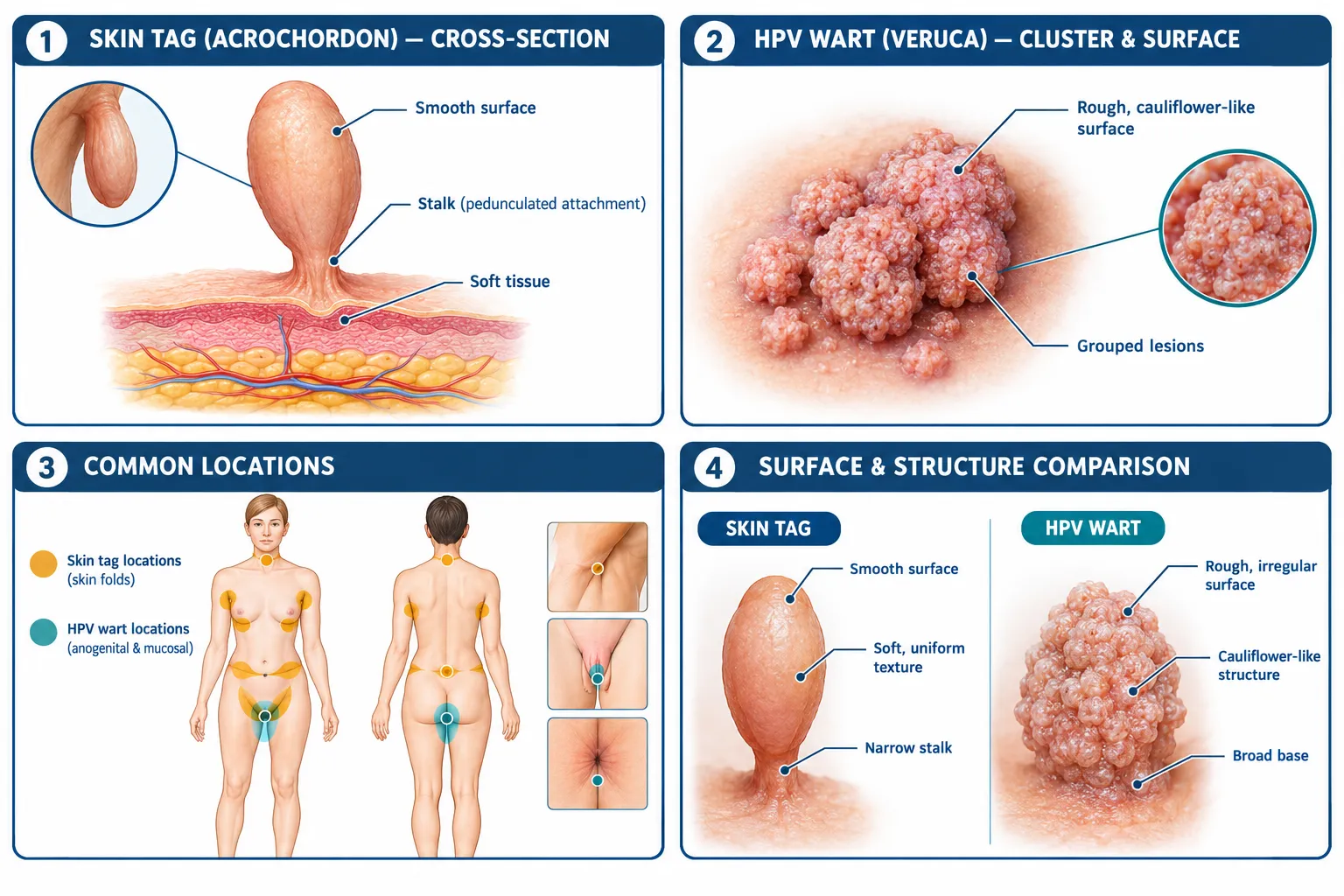
A skin tag, medically called an acrochordon, is a small, soft growth attached to the skin by a thin stalk. They are made of loose collagen fibers and blood vessels surrounded by skin. They are not caused by a virus, bacteria, or any infectious agent. You cannot give one to another person, and another person cannot give one to you.
Skin tags tend to develop in areas where skin rubs against skin or clothing: the neck, armpits, groin folds, under the breasts, and around the eyelids. They are extremely common, estimates suggest that roughly half of all adults will develop at least one during their lifetime. They are more frequent in people with obesity, type 2 diabetes, or during pregnancy, likely because of hormonal shifts and increased skin friction.
Visually, a skin tag is smooth, soft, and flesh-colored. It hangs from the surface on a narrow stalk, moves freely if you touch it, and rarely causes symptoms unless it gets caught on clothing or jewelry. It does not grow in clusters. It does not have a rough or irregular surface.
They carry no cancer risk. Removal is elective and cosmetic unless the tag becomes irritated or infected.
What Are HPV Warts and How Are They Different?
HPV warts are caused by the human papillomavirus. There are more than 200 HPV types, and different types cause warts in different locations. The HPV types explained guide covers the full breakdown of low-risk versus high-risk strains, but the short version is this: genital warts are caused almost exclusively by HPV types 6 and 11, which are classified as low-risk because they are not linked to cervical or anal cancer.
Common warts on the hands and feet are caused by different HPV types, typically types 1, 2, and 4. The question of whether all warts are caused by HPV is worth reading if you have warts in non-genital areas and are trying to understand whether HPV is involved.
Genital warts look and behave differently from skin tags. They tend to be rough or bumpy on the surface, sometimes described as cauliflower-like. They often appear in clusters rather than as a single isolated growth. They can develop on the vulva, vagina, cervix, penis, scrotum, anus, or surrounding skin. They may cause itching, mild discomfort, or occasional bleeding, though many people have no symptoms at all.
Genital warts are a sexually transmitted infection. They spread through skin-to-skin genital contact, not through blood, shared towels, or toilet seats. Condoms reduce transmission risk but do not eliminate it because HPV can be present on skin that a condom does not cover.
The Difference Between Skin Tags and HPV Warts Explained: A Side-by-Side Look
| Feature | Skin Tag | HPV Wart (Genital) |
|---|---|---|
| Cause | Friction, collagen overgrowth | HPV types 6 and 11 |
| Contagious? | No | Yes, skin-to-skin contact |
| Texture | Smooth, soft | Rough, bumpy, cauliflower-like |
| Attachment | Narrow stalk, hangs freely | Broad base or flat |
| Typical location | Neck, armpits, groin folds | Genitals, anus, surrounding skin |
| Clustering | Usually single | Often in groups |
| Cancer risk | None | Low (HPV 6/11 are not high-risk types) |
| Requires STI management? | No | Yes, partner notification applies |
Where Each One Appears, and Why Location Matters
Location is one of the most reliable clues in distinguishing these two conditions. A smooth, soft, stalked growth in a skin fold, the armpit, under the breast, around the neck, is almost always a skin tag. A rough or clustered growth on the genitals, around the anus, or on mucosal surfaces is almost always an HPV wart until proven otherwise.
That said, skin tags can develop in the groin area, and HPV warts can occasionally appear in locations that cause confusion. If you have a growth in or near the genital area and you are unsure what it is, a clinician should evaluate it. Self-diagnosis in that region is genuinely unreliable.
Genital warts can also appear internally, inside the vagina, on the cervix, or inside the anal canal, where they are not visible without examination. A growth you can see and touch in a skin fold is far more likely to be a skin tag than an internal HPV lesion.
Who’s at Higher Risk for HPV Warts Specifically?
Genital warts are common across the adult population, but some groups face a meaningfully higher risk of acquiring HPV or developing more extensive warts:
- Immunocompromised individuals, people living with HIV, organ transplant recipients on immunosuppressive therapy, or anyone with a weakened immune system are more likely to develop persistent or widespread warts
- Unvaccinated adults, HPV vaccination (Gardasil 9) protects against types 6 and 11 specifically; those who have not been vaccinated have no immune protection against these strains
- People with multiple sexual partners, not a moral judgment, simply a transmission-probability factor; more exposures increase the likelihood of encountering HPV
- Pregnant people, hormonal changes during pregnancy can cause existing warts to grow more rapidly or become more numerous, and treatment options are more limited during this period
How a Clinician Tells Them Apart
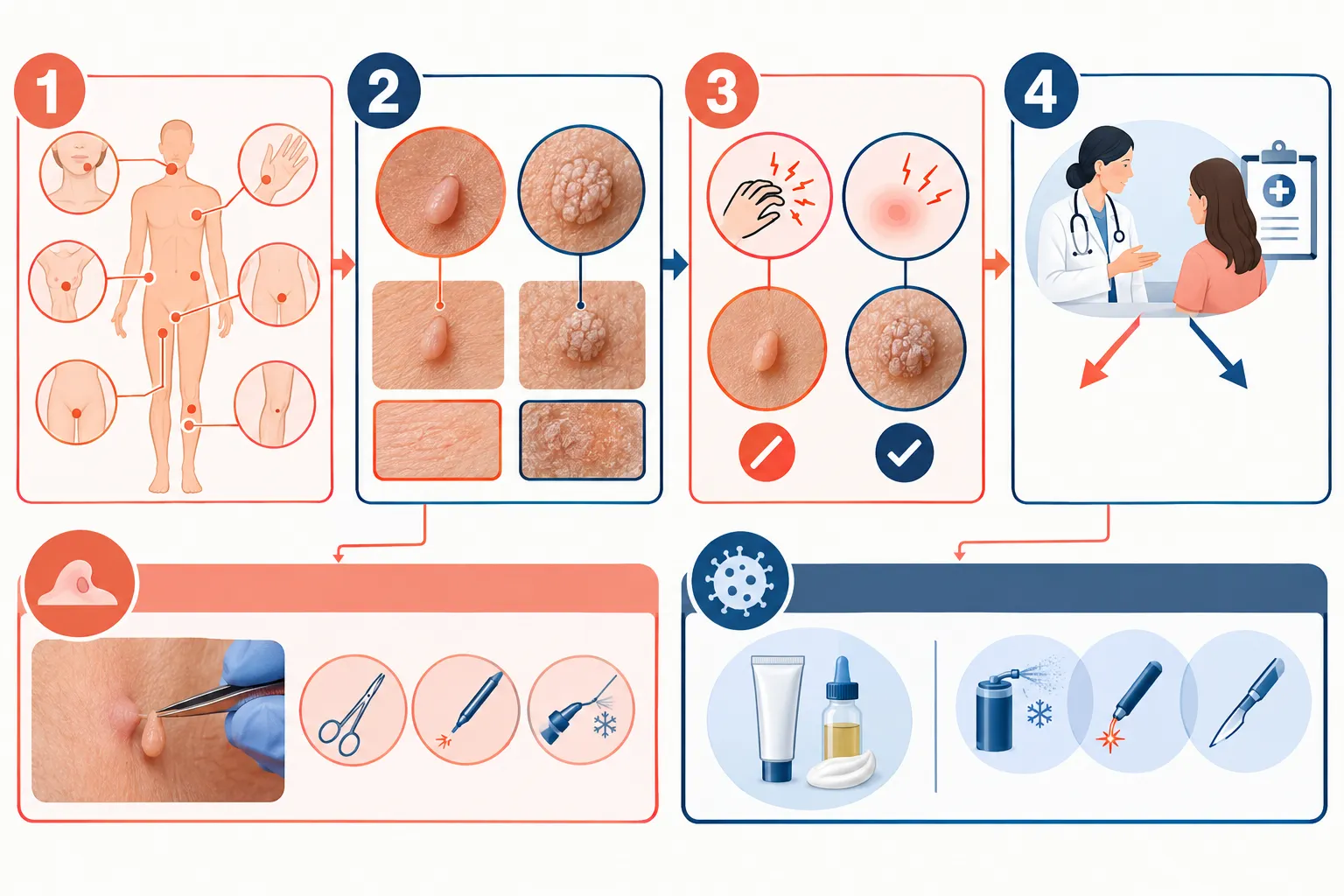
Most experienced clinicians can distinguish a skin tag from a genital wart on visual examination alone. The stalk, texture, and location are usually enough. A biopsy is not routine for either condition but may be ordered if the appearance is atypical, if the growth does not respond to standard treatment, or if there is any concern about an underlying diagnosis.
Acetowhitening, applying dilute acetic acid to the skin, is sometimes used to highlight HPV-affected tissue, which turns white. Skin tags do not react this way. This is occasionally used in clinical settings but is not a standard home test.
If you have any growth in the genital area that is new, changing, or causing symptoms, the right step is a clinical evaluation. The genital warts category covers what to expect from that process.
Treatment Options: Different Conditions, Different Approaches
Skin tags require no treatment unless they are cosmetically bothersome or repeatedly irritated. When removal is desired, options include cryotherapy, snip excision, or electrocautery, all minor outpatient procedures.
Genital warts have a broader range of treatment options because the goal is not just removal but managing an active viral infection. The genital warts treatment guide covers the current options in detail, including patient-applied topicals like imiquimod and podophyllotoxin, and provider-administered procedures like cryotherapy and trichloroacetic acid.
An important distinction: treating visible warts does not eliminate HPV from the body. The virus can remain present even after warts have cleared. Genital warts can go away on their own in some people, the immune system clears both the visible lesion and, over time, often the underlying infection. This varies person to person and depends significantly on immune status.
Skin tag removal, by contrast, is permanent. There is no underlying infection to manage.
Are Genital Warts Contagious After Treatment?
This is one of the most common follow-up questions, and it matters for anyone in a sexual relationship. Genital warts are contagious even when visible warts are not present, because HPV can be shed from skin that appears normal. Treatment reduces but does not eliminate transmission risk. Skin tags carry zero transmission risk at any point.
If you have been vaccinated against HPV, it is worth knowing that the vaccine does not treat an existing infection, it prevents new ones. The HPV vaccine and genital warts guide explains whether vaccination still makes sense after a diagnosis.
Frequently Asked Questions
Can a skin tag in the genital area be mistaken for an HPV wart?
Yes, and it happens more often than most people expect. A single, smooth, stalked growth in the groin or near the genitals can look like a skin tag but could be an early or atypical wart. The only reliable way to know is a clinical examination. Do not attempt to remove any genital growth at home before it has been evaluated.
Do skin tags mean anything is wrong with my immune system?
No. Skin tags are associated with friction, weight, and hormonal factors, not immune function. HPV warts, by contrast, can become more extensive in people with compromised immunity, because the immune system normally suppresses viral replication and wart growth.
Can HPV warts appear on the hands, and are those the same as genital warts?
No. Hand warts are caused by different HPV types (most commonly types 1, 2, and 4) than genital warts (types 6 and 11). They are not the same infection, and the transmission routes are different. The question of whether warts on the hands can transfer to the genital area is addressed separately, but the short answer is that it is theoretically possible but uncommon.
If I have genital warts, do I need to worry about cervical cancer?
HPV types 6 and 11, which cause genital warts, are not the strains linked to cervical cancer. Cervical cancer is primarily associated with high-risk types 16 and 18. However, it is possible to carry multiple HPV types simultaneously, so having genital warts does not rule out co-infection with a high-risk type. Regular Pap smears and HPV co-testing remain important regardless.
How long after exposure do genital warts appear?
The incubation period for HPV warts is typically one to eight months, but it can be longer. Some people carry HPV for years before warts develop, or never develop visible warts at all. This makes it genuinely impossible to determine exactly when or from whom a specific infection was acquired.
Is there a home test to tell a skin tag from an HPV wart?
No reliable home test exists. The acetowhitening method used in clinics is not accurate enough for self-use and can cause skin irritation. If you are uncertain about a growth, especially in or near the genital area, a clinician’s visual examination is the appropriate first step.