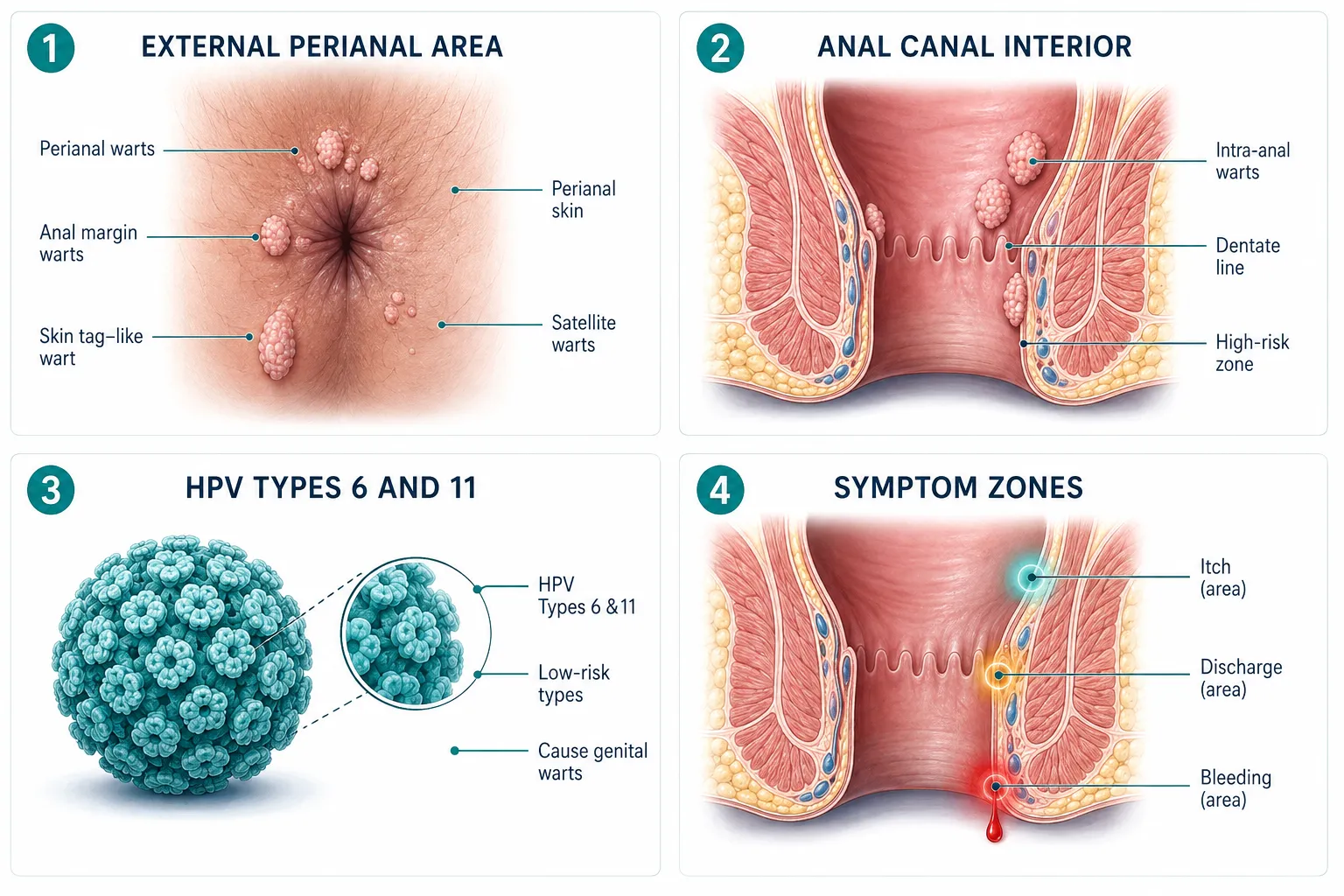
Anal warts are caused by HPV, specifically low-risk types 6 and 11, which together account for roughly 90% of cases. They are not a sign of cancer, and they are not a sign that something has gone seriously wrong. They are a common, treatable skin condition caused by a virus that spreads through sexual contact.
This guide gives you anus genital warts: straight answers, what they look like, how they spread, what treatment involves, and when to see a specialist.
Key Takeaways
- Anal warts are caused by HPV types 6 and 11, low-risk strains that do not cause cancer
- They spread through skin-to-skin sexual contact, not through toilet seats or shared towels
- Most cases are diagnosed by visual exam; warts inside the anal canal need specialist assessment
- Several effective treatments exist, both at-home topical options and in-clinic procedures
- Recurrence is common; clearing warts does not always mean the virus is gone
- The HPV vaccine protects against types 6 and 11 and is the most effective prevention available
What Are Anal Warts and Where Do They Appear?
Anal warts, also called perianal warts or condylomata acuminata, are soft, flesh-colored growths that appear on or around the anus. They can be flat or raised, single or clustered, and range from barely visible to several centimeters across when multiple warts merge.
They appear most often on the skin immediately surrounding the anal opening. They can also develop inside the anal canal itself, which is a separate situation requiring a different approach to both diagnosis and treatment.
Some people notice them immediately. Others have no symptoms at all and only find out during a routine sexual health check. Itching, mild discomfort, or a feeling of moisture around the anus are the most commonly reported symptoms, but none of these are guaranteed.
How Do Anal Warts Spread?
Anal warts spread through direct skin-to-skin contact during sexual activity. Penetrative anal sex is the most common route, but the virus can also spread through external genital contact without penetration. How HPV spreads, and how it doesn’t is worth reading if you have questions about specific transmission routes.
The incubation period, the time between exposure and visible warts, is typically one to eight months, but it can be longer. This makes it genuinely difficult to pinpoint when or from whom you acquired the infection. That’s not a diplomatic way of avoiding the question; it’s the medical reality of how HPV behaves.
HPV does not spread through toilet seats, towels, or casual contact. Anal warts are classified as a sexually transmitted infection because sexual contact is the route of transmission, not because of anything else it implies about behavior.
Who Is at Higher Risk for Anal Warts?
Anyone sexually active can develop anal warts, but certain groups face a higher likelihood of infection or more persistent disease:
- People living with HIV or other immunocompromising conditions, the immune system’s reduced ability to suppress HPV means warts are more likely to appear, recur, and progress
- Organ transplant recipients on immunosuppressive therapy, same mechanism; HPV reactivation is more common
- People with multiple sexual partners or early sexual debut, higher cumulative exposure to HPV increases the probability of encountering types 6 and 11
- Unvaccinated individuals, those who have not received the HPV vaccine have no protection against the strains that cause the majority of anal warts
What Does a Diagnosis Actually Involve?
External perianal warts are usually diagnosed by visual examination. A clinician looks at the affected area; no biopsy is typically needed for straightforward cases.
Warts inside the anal canal are a different matter. These require anoscopy, a brief in-office procedure using a small lighted instrument to examine the anal canal directly. This is important because internal warts cannot be treated with at-home topical creams, and their presence changes the treatment plan.
If you are immunocompromised or have had anal warts for a long time without treatment, your clinician may also discuss anal dysplasia screening. Anal dysplasia refers to cell changes in the anal lining, not cancer, but changes that warrant monitoring. The HPV types that cause warts (6 and 11) are low-risk and are not the same types linked to anal cancer (those are high-risk types 16 and 18). Still, co-infection is possible, and a thorough exam accounts for that. The relationship between HPV and cancer risk is explained in more detail separately.
What Are the Treatment Options for Anal Warts?
Treatment depends on where the warts are, how many there are, and your overall health. No single option works for everyone, and recurrence after treatment is common, that’s not a treatment failure, it’s how HPV behaves.
At-Home Topical Treatments
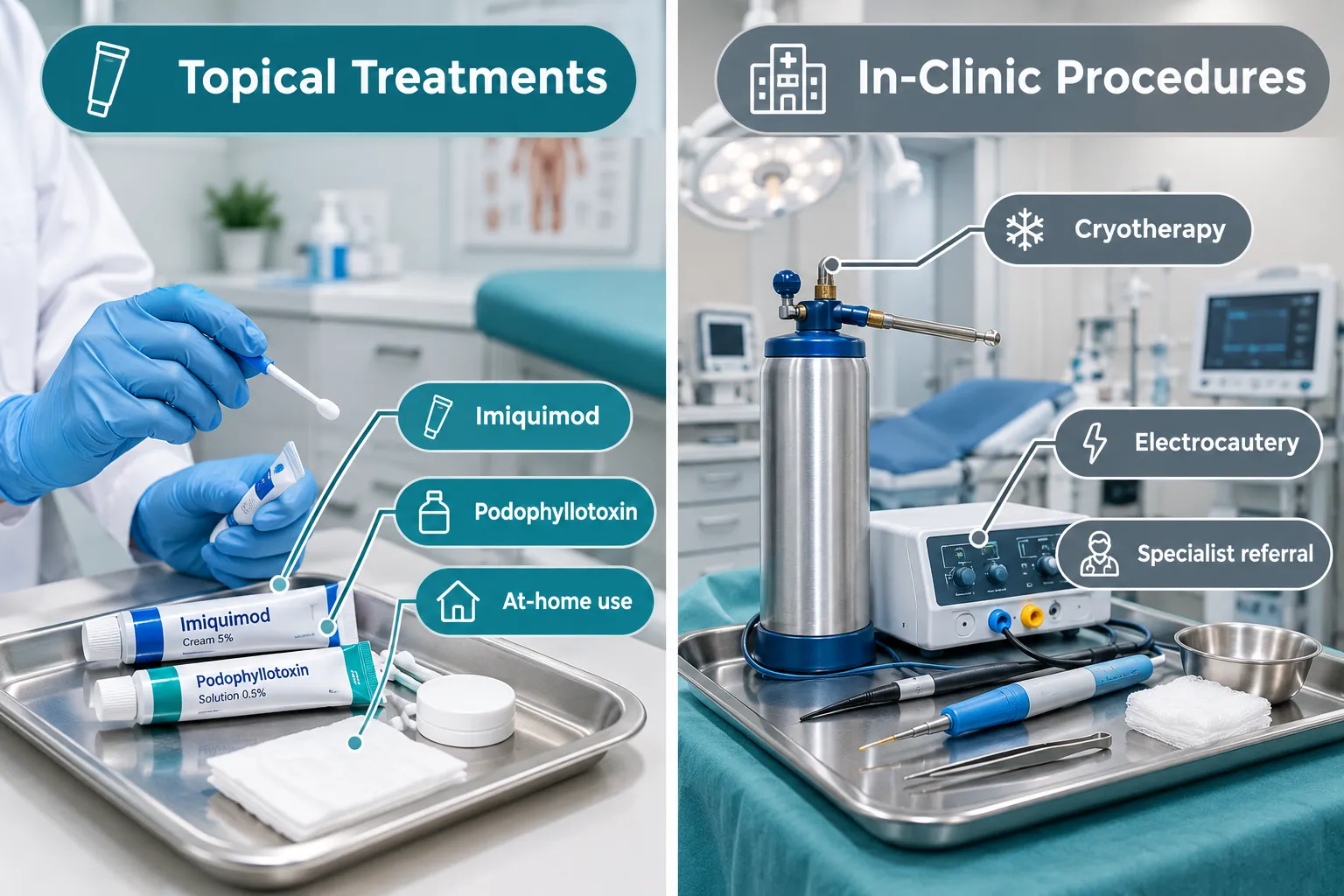
Two prescription creams are commonly used for external perianal warts:
- Imiquimod (Aldara), stimulates the immune system to attack HPV-infected cells; applied three times a week for up to 16 weeks
- Podophyllotoxin (Condyline, Warticon), directly destroys wart tissue; applied in cycles over several weeks
Neither of these should be used inside the anal canal. They are for external skin only. A detailed breakdown of topical medications for genital warts covers how each one works and what to expect during use.
In-Clinic Procedures
For warts that are large, internal, or not responding to topical treatment, clinic-based options include:
- Cryotherapy, freezing warts with liquid nitrogen; effective for smaller external lesions
- Electrocautery or surgical excision, used for larger or internal warts; performed under local anesthesia
- Trichloroacetic acid (TCA), a chemical treatment applied by a clinician, suitable for both external and internal warts
The full range of genital wart treatment options and what to expect is covered in a dedicated guide, including what follow-up typically looks like.
Does Having Anal Warts Mean the Virus Is Gone After Treatment?
Treating warts removes the visible growths. It does not necessarily clear the HPV virus from your body. The virus can remain in surrounding skin cells without producing visible warts, which is why recurrence happens, sometimes within weeks, sometimes months later.
For most people with healthy immune systems, HPV does eventually become undetectable. That process takes time, often one to two years from initial infection, and it happens without any specific antiviral treatment. Clearing warts speeds up the visible symptom burden; it does not reliably accelerate viral clearance.
This is also why partners are worth informing. If you have anal warts, your sexual partner has likely already been exposed to HPV types 6 and 11. That doesn’t mean they will develop warts, many people are exposed and never show symptoms, but it does mean they may benefit from vaccination if they haven’t already received it.
Can the HPV Vaccine Help?
If you haven’t had warts yet, the vaccine is highly effective at preventing them. Gardasil 9 protects against HPV types 6 and 11, the two strains responsible for the vast majority of anal and genital warts, along with several high-risk types.
If you already have warts, the vaccine won’t treat the current infection. It can still protect against HPV types you haven’t yet been exposed to, which is a genuine benefit, especially if you haven’t been infected with all strains covered by the vaccine.
The HPV vaccine: how it works and who should get it covers the full schedule, age recommendations, and evidence base. For men specifically, the HPV vaccine for men addresses whether vaccination is worthwhile after an existing diagnosis.
What to Do If You Notice Anal Warts
See a clinician. That’s the direct answer. A sexual health clinic, a GUM (genitourinary medicine) clinic, or your primary care provider can all assess external perianal warts. If internal warts are suspected, a referral to a colorectal or sexual health specialist is the next step.
Don’t use over-the-counter wart treatments designed for hands or feet on anal warts, these products are formulated for different skin and can cause significant irritation or chemical burns in the perianal area.
Cell changes are easiest to treat before they progress, that’s what early assessment is for. Waiting doesn’t make the warts go away on their own in most cases, and it does give them time to spread to a larger area of skin.
For a broader picture of what genital warts look like and how they’re managed across different body sites, the overview of genital warts is a useful starting point.
Frequently Asked Questions
Can anal warts go away without treatment?
Some do, particularly in people with strong immune function. Small warts can occasionally resolve on their own over several months. Larger clusters, warts in people who are immunocompromised, or warts that have been present for a long time are less likely to clear without intervention. A clinician can help you weigh whether watchful waiting is appropriate in your specific situation.
Are anal warts the same as anal cancer?
No. Anal warts are caused by low-risk HPV types 6 and 11, which do not cause cancer. Anal cancer is linked to high-risk HPV types, primarily type 16. It’s possible to have both low-risk and high-risk HPV at the same time, which is one reason a thorough examination matters, but having anal warts does not mean you have or will develop anal cancer.
Can I have anal warts without ever having anal sex?
Yes. HPV types 6 and 11 can spread through external genital contact, digital contact, or any close skin-to-skin sexual activity involving the genital and perianal area. Penetrative anal sex is a common route but not the only one.
How long are anal warts contagious?
HPV is transmissible even when no visible warts are present, this is called subclinical infection. Treating and clearing visible warts reduces but does not eliminate the risk of passing the virus to a partner. Condoms reduce transmission risk but don’t eliminate it entirely, since HPV spreads through skin contact beyond what a condom covers.
Will my partner automatically develop warts if I have them?
Not necessarily. Many people are exposed to HPV types 6 and 11 and never develop visible warts. Immune response, vaccination status, and the viral load at the time of exposure all affect whether warts appear. Your partner should be aware of the exposure and consider vaccination if they haven’t had it.
Is it safe to have sex while being treated for anal warts?
Most clinicians recommend avoiding sexual contact with the treated area during active treatment, particularly with topical creams, to reduce irritation and the risk of passing the virus. Talk to your doctor about specific timing, the answer depends on which treatment you’re using and how the area is healing.