
An anal HPV test is a brief, outpatient procedure, a soft swab, less than a minute of collection, and no sedation required. If your doctor has recommended one, or if you’re trying to understand whether you need one, here’s what the visit actually involves, who the screening is designed for, and what your results mean.
Key Takeaways
- The anal HPV test uses a soft swab inserted briefly into the anal canal to collect cells, most people describe mild pressure, not pain
- No FDA-cleared anal HPV test currently exists; results are only reliable from labs that have validated their assay for anal specimens under CLIA certification
- Screening is recommended for specific high-risk groups, not the general population, starting as early as age 35 for HIV-positive men who have sex with men
- A positive high-risk HPV result does not mean you have cancer; it means closer follow-up, typically with high-resolution anoscopy (HRA)
- As of 2026, large reference laboratories now offer anal HPV testing with genotyping, with results typically available within 3 to 6 days
Why Anal HPV Screening Exists
Anal cancer is not common in the general population. In specific groups, however, particularly people living with HIV, the rates are high enough to justify routine screening, comparable to cervical cancer rates before Pap smear programs were introduced. That comparison is the reason anal screening guidelines exist at all.
The goal is to detect high-grade squamous intraepithelial lesions (HSIL), precancerous cell changes in the anal canal, before they progress to invasive cancer. Cell changes are easiest to treat before they advance, and that’s exactly what screening is designed to catch. The International Anal Neoplasia Society (IANS) issued the first international consensus guidelines on anal cancer screening in 2024, formalizing what many HIV specialty clinics had been doing for years.
Understanding what HPV is and how it behaves helps frame why screening targets specific groups rather than everyone. Most anal HPV infections clear on their own. Persistent infection with high-risk types, particularly HPV 16, is what drives the small fraction of infections that progress to precancer or cancer.
Who’s at Higher Risk for Anal HPV and Anal Cancer?
Anal HPV testing is not a general-population screening tool. It targets people whose risk is meaningfully elevated:
- HIV-positive men who have sex with men (MSM) and transgender women, the highest-risk group; screening is recommended starting at age 35
- Other people with HIV (including cisgender women and MSM who are HIV-negative), screening generally recommended starting at age 45
- People with a history of cervical, vaginal, or vulvar HSIL or cancer, anal cancer risk is substantially elevated in this group
- People with persistent HPV-16 infection or prior perianal warts, may qualify for screening through shared decision-making, particularly when high-resolution anoscopy is available
For a broader picture of how HPV affects men specifically, the HPV in men guide covers symptoms, risks, and what testing options exist.
What Happens During an Anal HPV Test
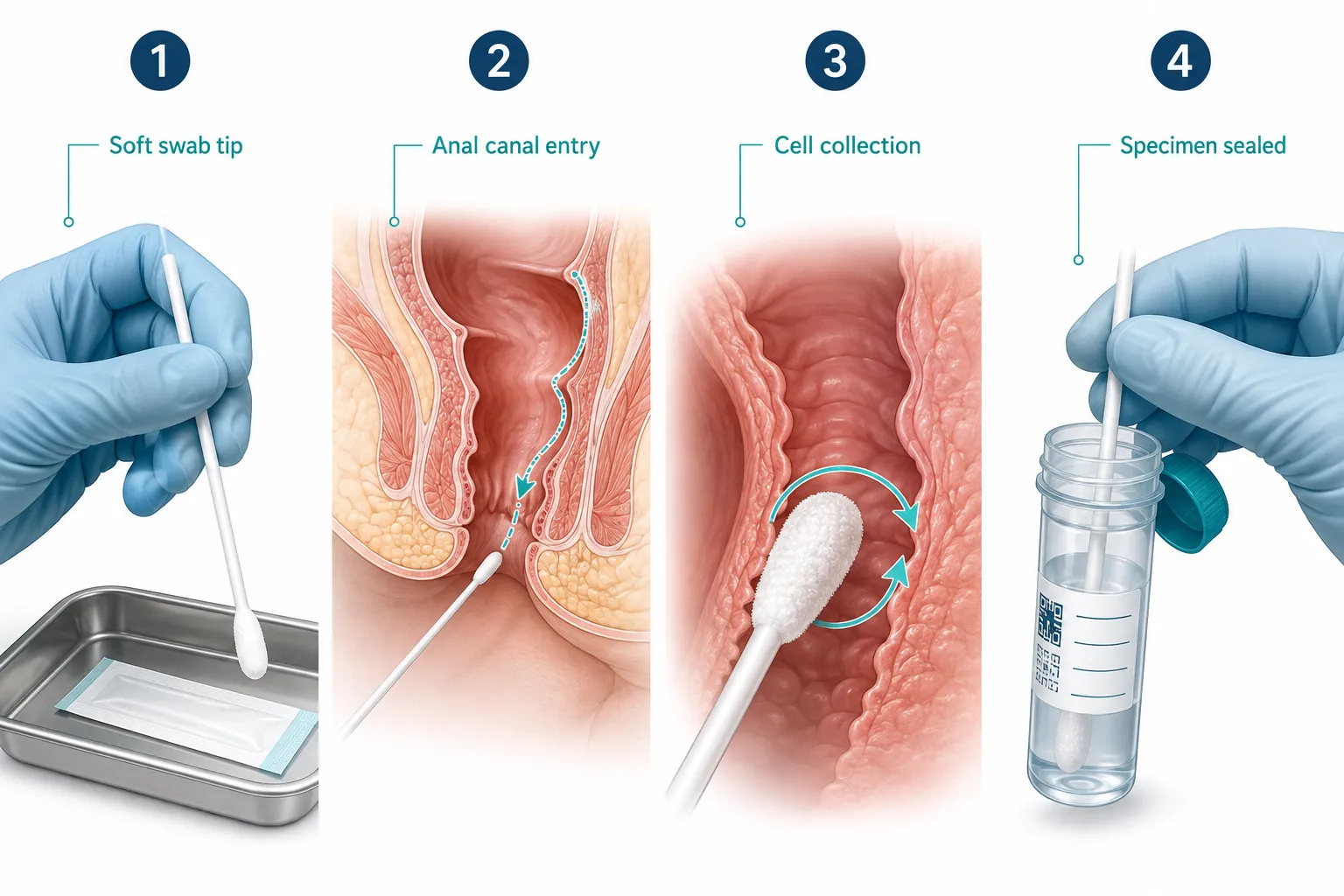
The visit is straightforward. No bowel prep, no fasting, and no sedation. A typical anal cancer screening appointment includes three components:
Digital anorectal exam (DARE): A gloved, lubricated finger checks the anal canal for lumps, irregularities, or tender areas. This takes about 30 seconds.
Anal cytology (anal Pap test): A soft swab, similar in size to a long cotton swab or small brush, is inserted gently into the anal canal, rotated to collect surface cells, and withdrawn. Most people feel brief pressure. The collection itself takes under a minute.
Anal HPV testing: The same swab, or a second one, collects cells for HPV genotyping. The sample goes into a liquid vial and is sent to a laboratory. In some clinics, you may be offered a self-collected swab, which research shows is acceptable to most people and may be more comfortable.
Preparation is minimal. Most clinics advise avoiding receptive anal sex and rectal products for 24 to 48 hours before the test to ensure a clean sample. Your clinic will give you specific instructions beforehand, follow those over any general guidance.
A Note on the Test’s Regulatory Status
No FDA-cleared anal HPV test currently exists. This is worth knowing, not because it makes the test unreliable, but because it means the quality of your result depends entirely on the laboratory running it.
Reliable anal HPV testing requires a CLIA-certified lab that has specifically validated its HPV assay for anal specimens. The same HPV test used for cervical samples cannot simply be applied to anal cells without that validation step. When your doctor orders the test, it’s reasonable to ask which laboratory processes it and whether the assay has been validated for anal use.
As of February 2026, Mayo Clinic Laboratories launched a new anal Pap HPV test with genotyping, with results typically returned within 3 to 6 days of the lab receiving the specimen. This kind of large-reference-lab availability improves standardization for clinicians who previously had limited options for send-out testing.
The HPV testing overview explains how HPV test results are read more broadly, useful context if this is your first time seeing HPV test terminology.
How Results Are Interpreted
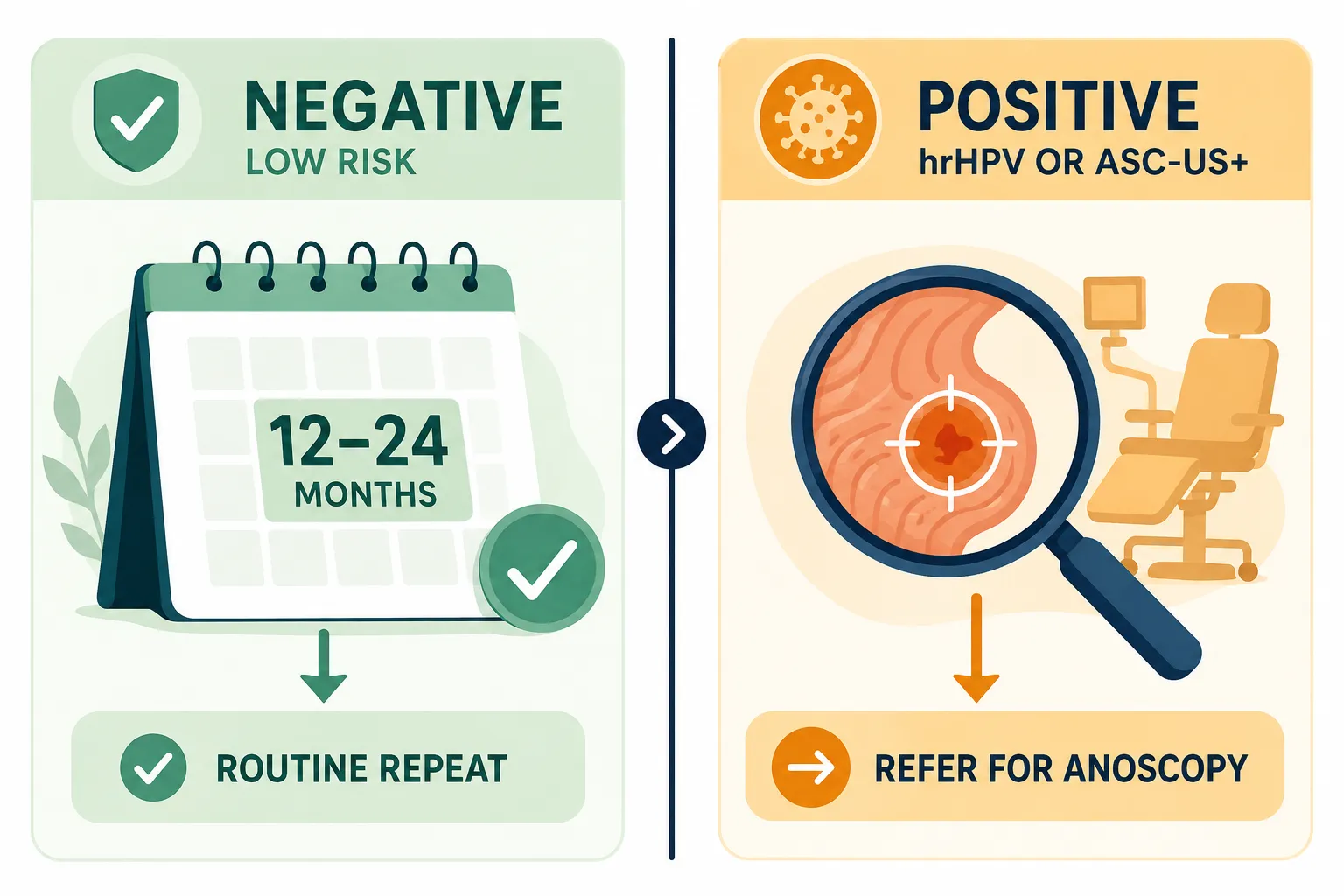
Results fall into a few categories, and each has a defined next step.
Negative cytology (NILM) and/or negative hrHPV: Repeat screening in 12 to 24 months, depending on your risk profile.
ASC-US (atypical squamous cells of undetermined significance) with negative hrHPV: Repeat screening in about 12 months. No immediate referral needed.
ASC-US or worse with a positive hrHPV test: Referral for high-resolution anoscopy (HRA). HRA is a magnified examination of the anal canal that can identify and biopsy abnormal areas.
HPV-16 detected: Immediate referral for HRA, regardless of cytology result. HPV 16 carries the highest risk of progression among all high-risk types.
A positive hrHPV result does not mean you have cancer. It means the cells need a closer look. HRA can distinguish between low-grade changes, which are often monitored rather than treated, and high-grade changes (HSIL) that benefit from treatment.
If you’ve had an abnormal cervical result before, the process after an abnormal anal result follows similar logic. The guide to what happens after an abnormal Pap smear walks through how abnormal results are managed step by step.
Ongoing Debates Among Expert Groups
Not all guidelines agree on the best approach, and it’s worth knowing where the differences lie.
The IANS supports primary high-risk HPV testing, with or without cytology, as a sensitive option for detecting anal precancer in high-risk groups. The NIH/CDC/IDSA HIV opportunistic infection guidelines take a more cautious position: because anal hrHPV is so prevalent in people with HIV, using HPV testing alone produces many positive results that don’t reflect true precancer, reducing the test’s practical usefulness in that population. Their guidance does not recommend primary anal HPV screening without cytology for people with HIV.
A 2025 systematic review found that different professional societies favor different primary screening tools, cytology alone, hrHPV alone, co-testing, or HPV-16, specific testing, reflecting genuine uncertainty about the optimal balance of sensitivity and specificity.
What all groups agree on: people at elevated risk should receive at least an annual digital anorectal exam, even when cytology or HPV testing is not locally available. The exam itself catches palpable lesions that tests might miss.
Understanding HPV types and what the numbers mean is useful here, particularly the distinction between high-risk and low-risk types, and why HPV 16 is treated differently from other high-risk genotypes.
Frequently Asked Questions
Does the anal HPV test hurt?
Most people describe brief pressure or mild discomfort, not pain. The swab is soft and the collection takes under a minute. No anesthesia or sedation is used. If you have hemorrhoids, fissures, or other anorectal conditions, let your provider know beforehand, they can adjust their approach.
Can I do an anal HPV test at home?
Self-collected anal swabs are an active area of research and are used in some clinical studies. A number of participants in these studies found self-collection more acceptable than in-clinic collection. However, most current screening guidelines are still built around clinician-collected samples, and home-based anal HPV testing is not yet widely available outside research settings.
How is anal HPV different from genital HPV?
It’s the same family of viruses, the same high-risk types (including HPV 16 and 18) that cause cervical dysplasia can also cause anal dysplasia. Anal HPV is transmitted through anal sexual contact. The HPV types guide covers how the same genotypes behave differently depending on the tissue they infect.
I’m a woman with a history of cervical HSIL. Do I need anal screening?
Women with a history of cervical or vaginal HSIL, vulvar precancer, or persistent HPV-16 infection are considered a priority group for anal screening, particularly when high-resolution anoscopy is available. The recommendation is typically to start screening around age 45, using shared decision-making with your provider. If you’ve had an abnormal cervical result, the abnormal Pap smear guide explains the cervical side of that history in more detail.
What happens if my anal HPV test is positive for HPV 16?
HPV 16 is the genotype most strongly associated with progression to anal cancer. A positive HPV-16 result, regardless of what the cytology shows, is generally an indication for immediate referral to high-resolution anoscopy. That doesn’t mean cancer is present; it means the threshold for a closer look is lower because the risk associated with HPV 16 is higher than with other high-risk types.
How often do I need to repeat the test?
Frequency depends on your results and your risk category. A negative result in a high-risk person typically means repeat testing in 12 to 24 months. An abnormal result moves you into a follow-up pathway, either HRA referral or a shorter repeat interval. Your provider will set the schedule based on your specific situation.
What to Do Next
If you’re in a high-risk group and haven’t had an anal HPV test or digital anorectal exam, the practical next step is to ask your HIV specialist, gynecologist, or gastroenterologist whether anal screening is appropriate for you. Bring your history, any prior HPV results, cervical or vaginal dysplasia, or perianal warts, so your provider can apply the right screening threshold.
If you’ve already had the test and are waiting on results, the 3-to-6-day window is typical for labs running genotyping assays. A positive result is a starting point for evaluation, not a diagnosis.