Roughly 1 in 4 men in the United States has a genital HPV infection at any given time. So yes, do guys have HPV? Absolutely, and at rates that make it one of the most common sexually transmitted infections in men worldwide. Most of those men have no idea, because HPV rarely causes symptoms and there is currently no approved routine screening test for men.
That doesn’t mean there’s nothing to know. The virus can cause genital warts, and certain high-risk HPV types drive real cancer risks in men, including cancers of the penis, anus, and throat. Understanding what HPV actually does in men, and what can be done about it, is more useful than either dismissing it or catastrophizing.
Key Takeaways
- Men can and do get HPV, it is extremely common, and most infections produce no symptoms
- There is no approved HPV screening test for men; most infections are discovered only if visible warts appear or a cancer-related test is run
- High-risk HPV types (especially types 16 and 18) cause several cancers in men, including oropharyngeal, anal, and penile cancers
- The HPV vaccine is recommended for boys starting at age 11-12, with catch-up vaccination available through age 26 and shared decision-making for ages 27-45
- Men can transmit HPV to partners, understanding how a man can give a woman HPV is part of the full picture
How Does HPV Affect Men?
HPV, human papillomavirus, is a group of more than 200 related viruses, roughly divided into low-risk and high-risk genotypes. In men, the virus infects the skin and mucous membranes of the genitals, anus, and throat through direct skin-to-skin contact, most commonly during sexual activity.
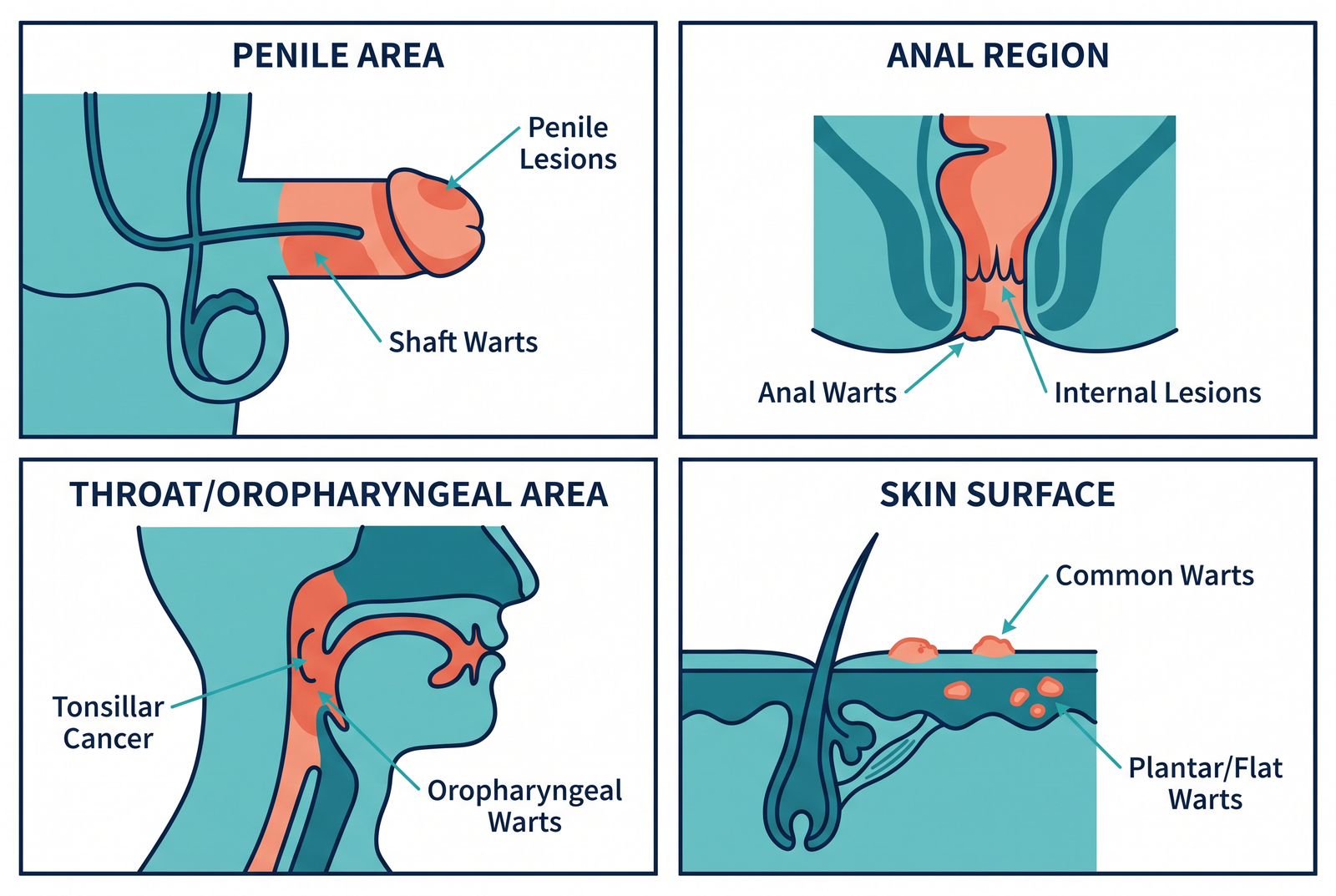
Low-risk types, primarily HPV 6 and HPV 11, are responsible for most genital warts. These are not cancer-causing, but they are contagious and can recur. High-risk types, especially HPV 16 and HPV 18, can integrate into cell DNA and, over years, drive abnormal cell changes that may progress to cancer.
Most men who contract HPV clear the infection through their immune system within one to two years. But “most” is not “all.” Persistent infection with a high-risk type is what creates cancer risk, and persistence is more likely in men who are immunocompromised or who smoke.
What Sites Can HPV Infect in Men?
- Penis (shaft, glans, foreskin)
- Scrotum
- Anal canal and perianal skin
- Urethra (less common)
- Throat and back of the mouth (oropharyngeal region)
Oropharyngeal HPV infection, driven almost entirely by type 16, now accounts for the majority of HPV-related cancers in men in the U.S., more than penile or anal cancers combined. This is a meaningful shift in the epidemiology of HPV-related disease in men.
For a broader look at HPV symptoms in men and women, and why most people have none, that guide covers what to expect across different infection types.
Do Guys Have HPV Without Knowing It?
Yes, and this is the norm, not the exception. The vast majority of HPV infections in men are asymptomatic. There is no approved HPV test for routine use in men the way there is for women (Pap smears and HPV co-testing). A man with HPV will typically not know he has it unless genital warts appear, or unless an HPV-related cancer or precancer is diagnosed.
This creates a practical challenge: men can transmit HPV to partners without any awareness of carrying the virus. The timing of any specific infection is often impossible to trace, HPV can remain dormant for months or years before any sign appears, if it ever does. Understanding whether HPV can come back without being sexually active explains the dormancy piece in more detail.
What About Genital Warts?
Genital warts are the most common visible sign of HPV in men. They are caused by low-risk types 6 and 11, not the same types that cause cancer. Warts may appear on the penis, scrotum, around the anus, or on the inner thighs. They can be flat or raised, single or clustered.
Genital warts are treatable. They are not a cancer diagnosis. The genital warts treatment options page covers what current approaches look like and what “curable” actually means in this context.
Who’s at Higher Risk for HPV in Men?
HPV is common across all sexually active men, but certain groups carry a meaningfully higher burden of infection and HPV-related disease:
- Unvaccinated men, the single most modifiable risk factor; vaccination before first sexual exposure provides the strongest protection
- Men living with HIV or other immunosuppressive conditions, immune impairment reduces the body’s ability to clear HPV, increasing the risk of persistent infection and cancer progression
- Men who have sex with men (MSM), face higher rates of anal HPV infection and anal cancer, particularly if HIV-positive
- Men with a history of multiple sexual partners or early sexual debut, greater cumulative exposure increases the likelihood of encountering high-risk genotypes
Can Men Transmit HPV to Partners?
Yes. Men transmit HPV through genital skin-to-skin contact, penetrative sex is not required for transmission. This applies to male-female, male-male, and any other pairing. Condoms reduce transmission risk but do not eliminate it, because HPV can be present on skin that a condom doesn’t cover.
A woman can also pass HPV to a man. The transmission from women to men article covers that direction in detail. Transmission is bidirectional, and neither partner should assume they know the source of any specific infection, the incubation period makes that determination unreliable in most cases.
HPV Vaccination for Men: What the Evidence Shows

The HPV vaccine, currently Gardasil 9 in the U.S., protects against nine HPV genotypes, including types 6, 11, 16, and 18. For boys and men, that means protection against the types most responsible for genital warts and the high-risk types most linked to oropharyngeal, anal, and penile cancers.
The standard recommendation: vaccination at age 11-12, before likely HPV exposure. Two doses are sufficient when the first dose is given before age 15. Three doses are required if the series starts at 15 or older.
Catch-up vaccination is recommended through age 26 for anyone not previously vaccinated. For men aged 27-45, the vaccine is not universally recommended, but it may still be beneficial, and a conversation with a doctor about individual risk is worthwhile. Research published in 2026 continues to strengthen the evidence that vaccination in males reduces cancer incidence beyond the well-established cervical cancer prevention story.
The HPV vaccine is not recommended during pregnancy. If you’re in that situation, vaccination should wait until after delivery.
For questions about whether vaccination is still useful after an HPV diagnosis, the HPV vaccination after diagnosis guide addresses that directly.
What Can Men Do About HPV Right Now?
There is no antiviral treatment that clears HPV itself. What medicine can do is treat the conditions HPV causes, warts, precancerous cell changes, and cancers, and prevent future infections through vaccination.
For men with visible genital warts, treatment options include topical prescription creams, cryotherapy, and other in-office procedures. The HPV treatment overview covers how the virus and its symptoms are managed across different presentations.
For men at higher risk of anal HPV-related disease, particularly MSM and HIV-positive men, anal Pap testing and high-resolution anoscopy are available at some clinics and are worth discussing with a doctor. Cell changes are easiest to treat before they progress; that’s what screening is for.
The most concrete steps available to men in 2026:
- Get vaccinated if not already, within the recommended age range
- Discuss anal cancer screening with a doctor if you’re in a higher-risk group
- Know that genital warts are treatable and not a cancer diagnosis
- Understand that a partner’s HPV diagnosis does not establish infidelity, the virus can be dormant for years
Frequently Asked Questions
Can a man find out if he has HPV?
There is no approved HPV test for men in routine clinical use. A man may learn he has HPV if genital warts appear, if a sexual partner is diagnosed and prompts a conversation, or if an HPV-related cancer or precancerous lesion is found. Research into male HPV testing continues, but no standard screening test is currently available.
Does HPV in men always go away on its own?
In most cases, yes, the immune system clears the infection within one to two years. But this varies depending on immune status, HPV genotype, and other factors. Persistent high-risk infection is what drives cancer risk, which is why vaccination and awareness of risk factors matter.
Can men get HPV from oral sex?
Yes. Oropharyngeal HPV, infection in the throat and back of the mouth, is primarily transmitted through oral sex. HPV type 16 is responsible for the majority of HPV-related throat cancers, which are now more common in men than in women in the U.S.
If my partner has HPV, does that mean I have it too?
Not necessarily, but it’s possible. HPV is highly transmissible through skin-to-skin contact, and if you’ve been sexually active with a partner who has HPV, exposure is likely. Because there’s no routine test for men, there’s often no way to know for certain. The HPV types guide explains the difference between low-risk and high-risk genotypes if you want to understand what type your partner has.
Is HPV more dangerous for men than women?
The risks are different, not simply more or less. Women face higher rates of HPV-related cervical cancer, which has well-established screening pathways. Men face rising rates of oropharyngeal cancer from HPV 16, with fewer screening tools currently available. Neither sex should treat HPV as trivial or as a certainty of serious disease.
The Practical Picture for Men
Do guys have HPV? Yes, commonly, silently, and often transiently. The absence of a routine screening test means most men will never have a definitive answer about their own status. What that means practically: vaccination before exposure is the most effective tool available, treating visible symptoms promptly matters, and men in higher-risk groups should ask their doctor about targeted screening options.
HPV in men is not a crisis, and it is not nothing. It sits somewhere in between, a common virus that clears in most cases, causes treatable symptoms in others, and in a smaller number of persistent, high-risk infections, can drive cancers that are worth preventing. The vaccine exists precisely because prevention works better than waiting to see what develops.