Oral HPV is real, and kissing is one plausible route, but the risk is meaningfully lower than most people assume when they first ask this question. Most HPV infections, including oral ones, clear on their own without causing any symptoms or lasting harm.
Key Takeaways
- HPV can be present in saliva and oral tissue, and deep kissing has been associated with oral HPV in epidemiologic studies, but transmission through kissing alone appears to be uncommon.
- The primary route for oral HPV infection is oral-genital sexual contact, not casual or even open-mouth kissing.
- Most oral HPV infections resolve without treatment; a small subset of persistent infections with high-risk types like HPV 16 are linked to oropharyngeal cancer.
- Public health guidelines do not recommend restricting kissing as an HPV prevention measure.
- Vaccination with Gardasil 9 protects against the HPV types most responsible for oral and genital cancers.
What Does the Research Actually Say About Getting HPV from Kissing?
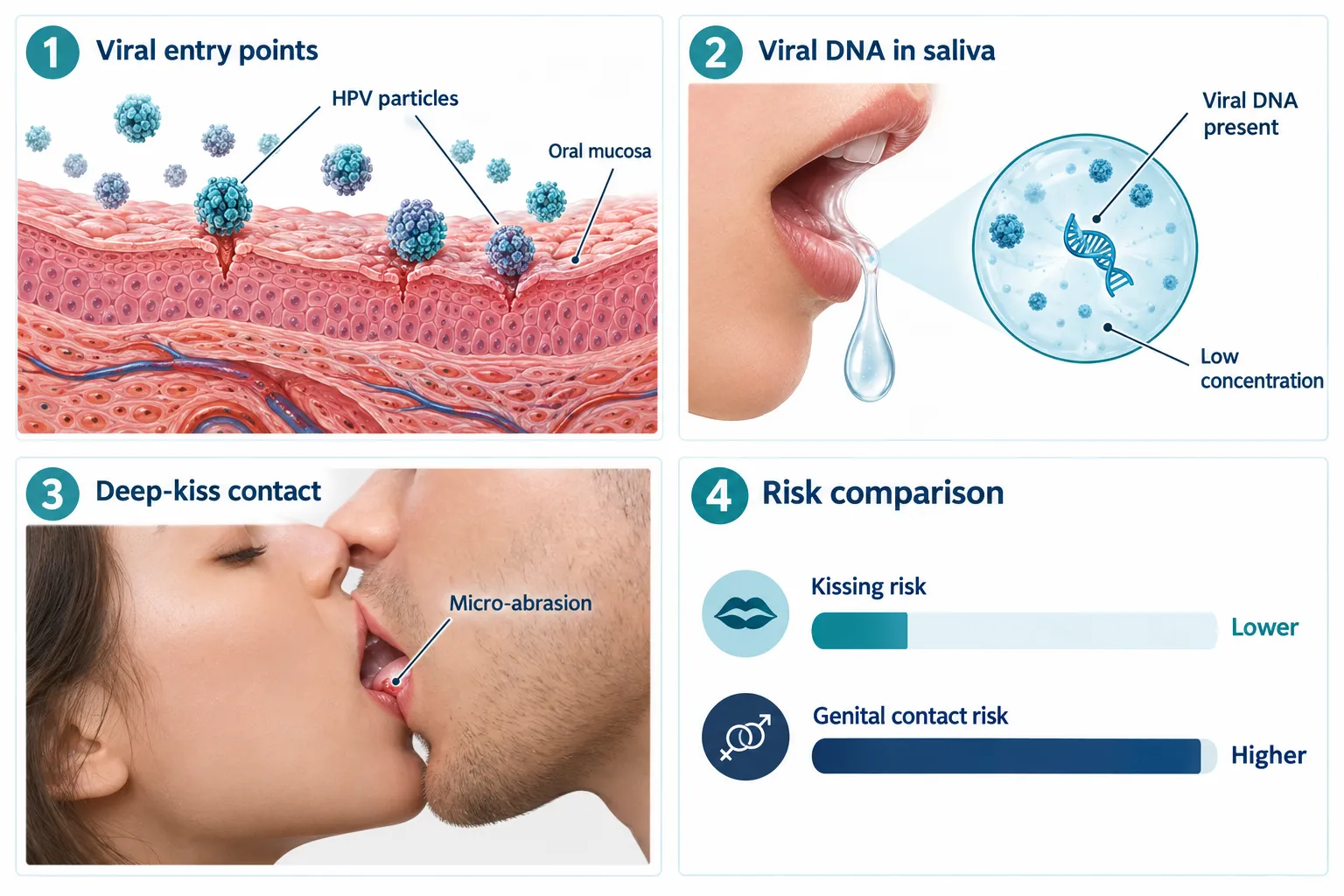
HPV DNA has been detected in saliva samples, and studies looking at couples have found that oral HPV concordance, meaning both partners carrying the same genotype, is higher among people who kiss frequently. That association is real. The question is what it means.
Epidemiologic data suggests that deep, open-mouth kissing is associated with a modestly elevated likelihood of sharing oral HPV genotypes compared to couples who do not kiss. But association is not the same as efficient transmission. Researchers note that saliva may carry HPV viral particles at concentrations too low to reliably establish a new infection in a healthy immune system. Mucosal contact during kissing is brief and typically involves intact tissue, the virus needs a foothold, usually through micro-abrasions or compromised epithelium, to take hold.
The honest answer is that kissing can transmit HPV in theory, and probably does in some cases, but it is not an efficient transmission route. Oral-genital contact, specifically receiving oral sex from a partner who carries genital HPV, carries a substantially higher risk for oral HPV acquisition than kissing does.
For a broader look at how HPV moves between people, the guide to how HPV spreads and how it doesn’t covers the full transmission picture.
Which HPV Types Are Involved in Oral Infections?
More than 200 HPV genotypes exist, but only a handful are commonly detected in oral tissue. HPV 16 is the most clinically significant, it is the type most strongly linked to oropharyngeal squamous cell carcinoma, a cancer of the back of the throat and tonsil area. HPV 18, while prominent in cervical disease, is less commonly found in oral samples. Low-risk types like HPV 6 and 11, which cause genital and oral warts, can also be transmitted through oral contact.
Oral HPV 16 prevalence in the general adult population is estimated at roughly 1%, though it is higher among men and among people with a history of multiple oral-sexual partners. Most people who acquire oral HPV never know it, the infection clears, produces no symptoms, and leaves no trace.
The HPV types overview explains the difference between high-risk and low-risk genotypes in more detail.
Can You Get HPV from Kissing a Partner Who Has Genital HPV?
This is the question most people are actually asking. If a partner has been diagnosed with genital HPV, whether that is warts caused by HPV 6 or 11, or a high-risk type found on a Pap result, the risk of acquiring that same type orally through kissing is low but not zero.
The virus is primarily present at the site of infection. A partner with genital HPV has the virus concentrated in genital tissue, not necessarily in their mouth or saliva. Kissing that partner does not directly expose you to their genital infection. The scenario with meaningful risk is oral-genital contact, not mouth-to-mouth kissing.
That said, if a partner has an active oral HPV infection, which most people would not know about, since it rarely causes symptoms, open-mouth kissing could plausibly transfer the virus. There is no routine oral HPV test available in clinical practice to screen for this.
Who Is at Higher Risk for Oral HPV Infection?
Not everyone faces the same likelihood of acquiring or retaining an oral HPV infection. The groups below face meaningfully higher risk:
- Immunocompromised individuals, people living with HIV, organ transplant recipients on immunosuppressive therapy, or anyone with a significantly weakened immune system clear HPV less efficiently, making persistent infection more likely.
- People with a history of multiple oral-sexual partners, this is the strongest behavioral predictor of oral HPV prevalence in population studies.
- Unvaccinated adults, particularly those who did not receive the HPV vaccine before becoming sexually active, since vaccination before exposure is what provides protection.
- Smokers, tobacco use is associated with impaired oral mucosal immunity and higher rates of persistent oral HPV infection.
Does Oral HPV Cause Symptoms You Would Notice?
Usually not. Oral HPV is overwhelmingly asymptomatic. The majority of infections, even with high-risk types, resolve within one to two years without any intervention.
A small number of people develop oral warts (papillomas) from low-risk types like HPV 6 or 11. These are benign growths that can appear on the tongue, inner cheeks, or soft palate. They are treatable.
The more serious concern is oropharyngeal cancer linked to persistent HPV 16 infection. This is a real risk, but it affects a small minority of people with oral HPV 16, and it typically takes years to decades to develop. Early detection through awareness of persistent symptoms, a sore throat that does not resolve, a lump in the neck, difficulty swallowing, matters here. These symptoms warrant medical evaluation; they do not automatically mean cancer.
The HPV symptoms guide covers what signs actually look like across different infection sites.
Can You Get HPV from Kissing a Child, or Pass It to One?

This question comes up often for parents who have been diagnosed with HPV and worry about everyday contact. The evidence does not support transmission of genital HPV types through routine kissing or caregiving contact with children. The HPV types that cause genital infections are not efficiently transmitted through saliva or casual oral contact.
Recurrent respiratory papillomatosis, a rare condition where HPV 6 or 11 causes warts in the airway, can occur in young children, but this is typically acquired during birth from a mother with active genital warts, not through kissing.
The dedicated page on whether you can give a child HPV by kissing addresses this concern in full.
Does the HPV Vaccine Protect Against Oral HPV?
Yes, with an important caveat: the vaccine works best before exposure. Gardasil 9 covers HPV types 6, 11, 16, 18, 31, 33, 45, 52, and 58. Since HPV 16 is responsible for the majority of HPV-linked oropharyngeal cancers, vaccination provides meaningful protection against the most consequential oral HPV outcomes.
The CDC recommends vaccination at age 11-12, with catch-up vaccination available through age 26 for most people, and shared decision-making for adults aged 27-45. Getting vaccinated after some sexual activity has begun is still beneficial if you have not been exposed to all types covered by the vaccine.
The HPV vaccine is not recommended during pregnancy. If you are pregnant and unvaccinated, the schedule should be completed after delivery.
The HPV vaccine overview covers the full schedule, safety data, and who benefits most.
What Should You Actually Do If You’re Worried About Oral HPV?
There is no approved routine screening test for oral HPV in clinical practice as of 2026. Unlike cervical HPV, which is caught through Pap smears and co-testing, oral HPV has no equivalent standard screening tool. That is not a gap you can personally close through testing.
What you can do:
- Get vaccinated if you have not already, and are within the eligible age range.
- Mention any persistent oral or throat symptoms to your doctor, a sore that does not heal, a lump, hoarseness lasting more than a few weeks.
- If you have been diagnosed with genital HPV and want to understand your oral risk, a conversation with your clinician is more useful than self-directed anxiety. The timing of HPV infection is often unknowable, and having one type does not tell you whether you have oral exposure.
If you are wondering whether HPV can stay hidden for years before showing up, the page on whether HPV can be dormant explains how latency works.
Frequently Asked Questions
Can you get HPV from a single kiss?
A single brief kiss carries extremely low risk. The studies associating kissing with oral HPV involve frequent, deep kissing over time, not isolated contact. Viral transmission requires sufficient exposure at a mucosal surface, and a single kiss is unlikely to meet that threshold in a healthy immune system.
Is oral HPV the same as genital HPV?
The same genotypes can infect both sites, HPV 16, for example, is found in both oropharyngeal and cervical cancers. But the infection at each site is distinct. Having genital HPV does not mean you automatically have oral HPV, and vice versa.
Can HPV be transmitted through sharing drinks or utensils?
This is not considered a meaningful transmission route. HPV is not efficiently transmitted through inanimate objects or casual saliva contact. The virus requires direct mucosal-to-mucosal contact to establish infection, and it does not survive well outside of living tissue.
If my partner has oral HPV, should we stop kissing?
Public health guidelines do not recommend stopping kissing as an HPV prevention measure. The risk from kissing is low, there is no reliable way to know whether either partner currently has an active oral HPV infection, and the psychological and relational cost of that restriction is not supported by the evidence.
Does having oral HPV mean I will get throat cancer?
No. Most oral HPV infections, including HPV 16, clear on their own without causing cancer. Persistent infection with HPV 16 over many years raises risk, but most people with oral HPV 16 do not develop oropharyngeal cancer. The HPV and cancer overview explains how that progression works and what factors influence it.
Can men get oral HPV from kissing?
Yes, men can acquire oral HPV through the same routes as anyone else. Men are actually diagnosed with HPV-linked oropharyngeal cancer at higher rates than women, which is partly why the HPV vaccine recommendation now covers males. The HPV in men guide covers the full picture of how HPV presents and is managed in men.
This article is for informational purposes only and does not constitute medical advice. See the medical disclaimer for full details.