Kissing your child on the cheek or the top of the head does not meaningfully transmit HPV. That is the short answer to “can I give my child HPV by kissing them?”, and it holds even if you have an active oral HPV infection. The virus spreads through intimate skin-to-skin contact, most reliably during vaginal, anal, or oral sex, not through the kind of routine affection that happens in every household every day.
Key Takeaways
- Casual parent-child kissing, a peck on the cheek, a kiss on the forehead, is not a recognized HPV transmission route.
- HPV requires entry through microscopic breaks in skin or mucous membranes, conditions that do not occur during gentle, routine kissing.
- Deep, open-mouth kissing between adults may carry a low transmission risk, but this is distinct from ordinary parental affection.
- HPV DNA can sometimes be detected in saliva, but detection is not the same as a transmission event.
- The most effective protection for your child is the HPV vaccine, recommended routinely at ages 11-12 (series can start at age 9).
How HPV Actually Spreads
HPV, human papillomavirus, is a group of more than 200 related viruses. Roughly 40 of those types infect mucosal surfaces and are transmitted through intimate contact. Understanding what HPV is and how it behaves helps clarify why casual kissing sits in a completely different category from the contact that actually transmits it.
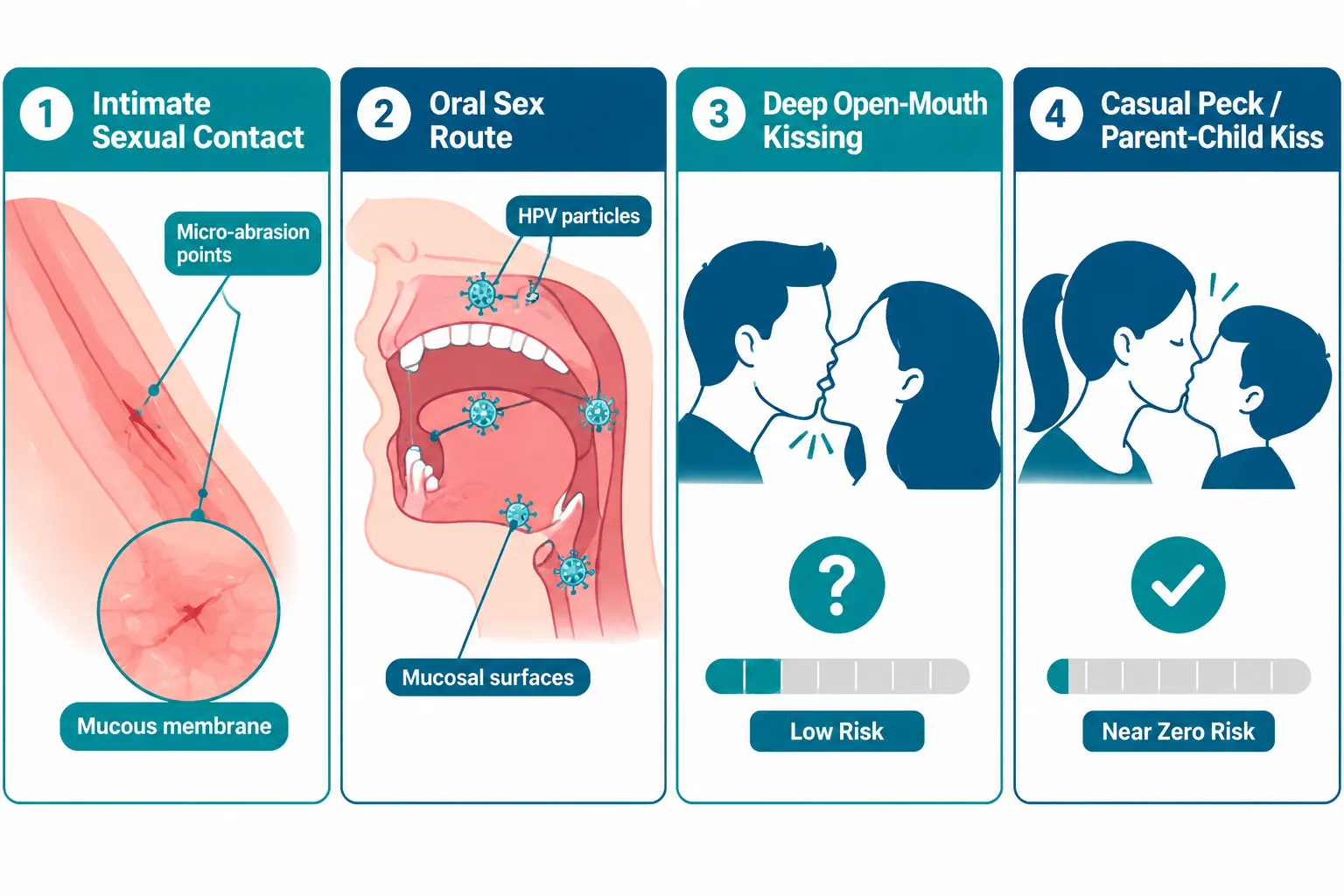
The virus needs two things to establish infection: viral particles at a mucosal surface or broken skin, and a route of entry, typically a microscopic abrasion. Vaginal, penile, anal, and oral sex create those conditions reliably. A quick kiss on a child’s forehead does not.
HPV does not spread through:
- Hugging or non-sexual touching
- Sharing plates, cups, or cutlery
- Toilet seats
- A peck on the cheek or lips
This is why public health guidance consistently frames HPV as sexually transmitted and does not advise parents to limit ordinary physical affection with their children.
What About Oral HPV Specifically?
Oral HPV, infection in the mouth or throat, is real and relatively common. High-risk types, particularly HPV 16, are linked to oropharyngeal cancers. Low-risk types 6 and 11 can cause oral warts.
Oral HPV is acquired primarily through oral sex. Deep, open-mouth kissing may play a minor role in transmission between adult partners, though the evidence on this is mixed and no studies have established a clear, definitive link. What the research does consistently show is that a light kiss, the kind a parent gives a child, does not carry meaningful transmission risk. HPV particles can occasionally be detected in saliva, but saliva detection alone does not equal an infectious event in everyday family interactions.
Can I Give My Child HPV by Kissing Them? What the Evidence Shows
The Children’s Hospital of Philadelphia Vaccine Education Center addresses this question directly: if you have an oral HPV infection, kissing your child is not likely to spread the virus to them. The key distinction is between intimate oral contact, which involves sustained mucosal friction and micro-abrasions, and a routine parental kiss, which does not.
The risk from a light kiss or peck between parent and child is considered negligible by clinical experts. Casual physical interactions, including non-sexual kissing, are not recognized HPV transmission routes. The virus generally requires entry through microscopic breaks in skin or mucous membranes, and those conditions are associated with sexual contact, not everyday gentle affection.
What About Rare Non-Sexual Transmission?
HPV transmission does extend beyond sexual contact in some circumstances. Vertical transmission, from mother to child around the time of birth, is documented and can lead to a rare condition called recurrent respiratory papillomatosis, caused by HPV types 6 and 11. Some household transmission through close physical contact has also been described in the literature.
These events are uncommon. They are also distinct from routine parent-child kissing. When non-sexual household transmission has been reported, it tends to involve persistent lesions in the adult carrier and prolonged, repeated close contact, not symptom-free parents giving their children a goodnight kiss.
How HPV spreads, and how it doesn’t covers the full transmission picture, including the sexual routes that account for the vast majority of infections.
Who’s at Higher Risk for Oral HPV?
A few groups carry a higher baseline risk of oral HPV infection, which is worth knowing separately from the kissing question:
- People who have oral sex with multiple partners, this is the dominant transmission route for oral HPV types, including high-risk HPV 16.
- Immunocompromised individuals, those living with HIV, or organ transplant recipients on immunosuppressive therapy, are less able to clear HPV infections naturally and may carry higher viral loads.
- Unvaccinated adults, people who did not receive the HPV vaccine before becoming sexually active have no immune priming against the types the vaccine covers.
- Smokers, tobacco use is associated with impaired mucosal immune response and higher persistence of oral HPV infections.
Does HPV in Saliva Mean You Can Spread It by Kissing?
HPV DNA has been detected in saliva samples in research settings. This finding sometimes alarms parents who read about it. Here is what that actually means: detecting viral DNA is not the same as confirming an active, transmissible infection capable of establishing itself in another person’s oral mucosa through casual contact.
Transmission requires the virus to reach susceptible tissue in sufficient quantity and find a route of entry. A closed-mouth kiss or a peck on the cheek does not create those conditions. This is why clinical guidance does not recommend that parents with HPV avoid kissing their children, the biological mechanism for transmission simply is not present in that type of contact.
The Real Protection: HPV Vaccination
The question “can I give my child HPV by kissing them?” often comes from a parent who has just learned they have HPV and wants to protect their child. That instinct is right, but the protection that actually matters is the vaccine, not limiting affection.
The HPV vaccine is recommended routinely at ages 11-12, with the series able to start as early as age 9. It protects against the high-risk types most responsible for cervical, oropharyngeal, anal, and other HPV-related cancers, primarily types 16 and 18, as well as the low-risk types 6 and 11 that cause genital and oral warts. The HPV vaccine: how it works, who should get it, and whether it’s safe covers the schedule, efficacy data, and safety record in detail.

Vaccination before exposure, before sexual activity begins, produces the strongest immune response. That is the medical reason for vaccinating in early adolescence rather than waiting.
If your child has already had close contact with someone who has HPV, that is not a reason to skip the vaccine. It still protects against the types they have not yet encountered.
What If My Child Already Has an Oral or Skin Wart?
Common skin warts and plantar warts are caused by non-genital HPV types, types 1, 2, and 4 are the most frequent culprits. These are not the same types involved in sexual transmission or cancer risk. Whether all warts are caused by HPV explains the distinction between common skin warts and the mucosal HPV types that public health guidance focuses on.
Oral warts in children are rare. When they do occur, they are usually caused by HPV types 6 or 11 and are most often linked to perinatal transmission rather than kissing.
Frequently Asked Questions
If I have genital HPV, can I spread it to my child through kissing?
Genital HPV types are adapted to genital and anal mucosal tissue. Transmission to the oral cavity requires the kind of sustained mucosal contact that occurs during oral sex, not a routine kiss. There is no documented evidence that a parent with genital HPV spreads it to a child through ordinary affection.
Can my child get HPV from someone else’s kiss, a grandparent or relative?
The same principle applies. Casual kissing from any family member is not a recognized transmission route. If a family member has visible oral lesions or warts in or around the mouth, it is reasonable to avoid direct contact with those lesions specifically, but this applies to any skin-to-skin contact with an active lesion, not kissing in general.
Should I tell my child’s pediatrician that I have HPV?
You do not need to disclose your own HPV status to your child’s pediatrician to get your child appropriate care. What is worth discussing with their doctor is the HPV vaccination schedule, making sure your child receives the vaccine at the recommended age is the most evidence-based step you can take.
Can HPV cause symptoms in children who were exposed non-sexually?
Recurrent respiratory papillomatosis is the most documented non-sexual HPV manifestation in children, caused by types 6 and 11 and typically acquired during birth. It is rare. Common skin warts in children are caused by non-genital HPV types and are not related to sexual transmission. HPV symptoms, signs in men and women, and why most people have none covers what HPV does and does not look like across different populations.
Does having HPV mean I should change how I interact physically with my child?
No. Public health guidance does not recommend limiting normal physical affection, hugging, kissing, holding, between parents with HPV and their children. The focus of prevention is vaccination and, for adults, regular cervical screening and safe sexual practices.