
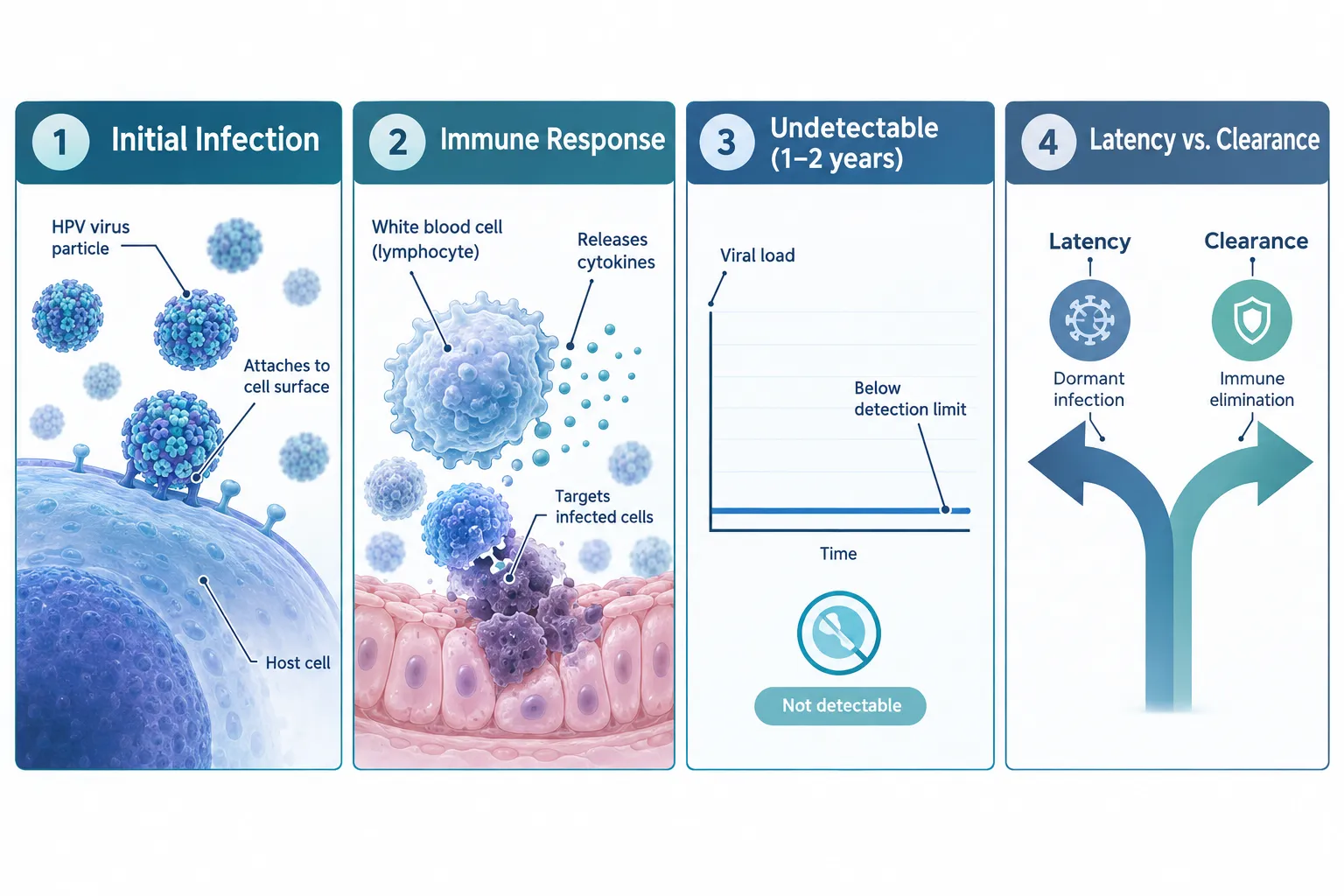
HPV infections become undetectable in most people within one to two years, but that is not quite the same as saying the virus disappears completely. Most experts now draw a careful distinction between an infection becoming undetectable and a true biological cure, and that distinction matters for how you think about your own situation.
Key Takeaways
- In most people, HPV becomes undetectable within one to two years of infection without any treatment.
- “Undetectable” and “cured” are not the same thing, the virus may persist at very low levels in some people, a concept called latency.
- High-risk HPV types (16 and 18) persist longer on average than low-risk types (6 and 11).
- Persistent infection, not initial infection, is what drives the risk of cell changes and, over time, cancer.
- Regular screening catches cell changes early, when they are easiest to manage.
Does HPV Go Away on Its Own?
For most people, yes, the immune system suppresses HPV to undetectable levels without any treatment. Large population studies consistently show that roughly 70-90% of new HPV infections become undetectable within one to two years. That applies to both high-risk and low-risk genotypes, though the timeline varies.
Low-risk types like HPV 6 and 11, the ones associated with genital warts, tend to clear faster. High-risk types like HPV 16 and 18, which are linked to cervical, oropharyngeal, and other cancers, take longer on average and are more likely to persist beyond two years.
The phrase “HPV clears” is actually contested among virologists. The International Papillomavirus Society has moved toward more careful language, noting that what standard testing detects as “clearance” may in some cases reflect the virus dropping below detectable thresholds rather than being fully eliminated. The practical implication: a negative HPV test result is genuinely good news, but it does not guarantee the virus is gone at a cellular level.
What this means for you is straightforward. A negative result after a positive one is the goal of monitoring, and it is the result most people get within a couple of years.
How Long Does HPV Typically Persist?
The honest answer is: it varies, and immune status is the biggest factor.
In people with healthy immune systems, the median time to undetectable status is around 8-14 months for most genotypes. A 2024 meta-analysis of cervical HPV persistence found that roughly 10-20% of infections remained detectable beyond two years, with HPV 16 showing the highest persistence rates of any single genotype studied.
Persistence in men follows a broadly similar pattern, though data is less complete because routine HPV testing is not available for most men. A 2026 meta-analysis on HPV clearance in males found median clearance times of 6-12 months for penile and scrotal sites, with anal HPV taking somewhat longer, consistent with findings in women. If you want more detail on how HPV affects men specifically, the page on whether HPV can be detected in men covers what testing options exist.
Persistence matters because it is the driver of risk. A single HPV 16 infection that resolves in a year carries a very different risk profile than one that remains detectable for five or more years. Persistent high-risk infection is what leads to the cell changes, ASC-US, LSIL, HSIL, that cervical screening is designed to catch.
Who Is at Higher Risk for Persistent HPV?
Some people are significantly more likely to have HPV that stays detectable longer:
- People with HIV or other immunosuppressive conditions, including organ transplant recipients on immunosuppressant drugs, have substantially higher rates of persistent infection and faster progression to cell changes.
- Smokers, tobacco use impairs local immune response in cervical tissue and is associated with both longer persistence and higher rates of high-grade dysplasia.
- People with a history of abnormal Pap or smear results, prior LSIL or HSIL suggests the immune system has already had difficulty controlling a previous infection.
- Unvaccinated individuals, vaccination does not treat existing infection, but unvaccinated people remain susceptible to additional high-risk genotypes, which compounds persistence risk over time.
Does HPV Ever Go Away After Treatment?
Treatment does not eliminate HPV itself. Procedures like LEEP (loop electrosurgical excision procedure), cryotherapy, and laser ablation remove abnormal cells, they do not remove the virus from surrounding tissue.
Post-treatment persistence is real and clinically significant. Studies consistently show that 10-30% of people who undergo treatment for high-grade cervical lesions (HSIL) will have a recurrence within two years, and HPV DNA remains detectable in a meaningful proportion of those cases. This is why follow-up testing after treatment is not optional, it is the mechanism by which recurrence is caught early. The colposcopy step-by-step guide explains what happens during and after that follow-up process.
For genital warts caused by HPV 6 or 11, the situation is different. Warts can be treated and removed, and many people do not experience recurrence. But the low-risk virus may remain in skin cells nearby. If you have been told your warts are gone and want to understand what that actually means for your status, the page on whether genital warts are curable addresses that question directly.
Does HPV Ever Go Away Completely, or Does It Stay Dormant?
This is the question that has shifted most in clinical thinking between 2024 and 2026. The older framing, “your immune system clears HPV”, is giving way to a more precise model: the virus may persist in a latent state in basal epithelial cells, below the threshold of current PCR-based detection.
The concept of HPV latency is not new, but its clinical relevance is better understood now. It helps explain why some people test positive for HPV again years after a negative result, without any new sexual exposure. If you have wondered about that possibility, the page on whether HPV can come back without being sexually active covers the latency question in more depth.
What latency does not mean: that you are continuously infectious, or that you will inevitably develop cell changes. Latent virus that is not replicating does not appear to drive dysplasia. The immune system’s ability to keep the virus suppressed, rather than whether every last viral particle is gone, is what determines your clinical outcome.
Emerging research into genetic factors (including HLA type and specific immune gene variants) is beginning to explain why some people suppress HPV easily and others do not. This is an active area of study, not yet at the point of clinical testing.

What Screening Actually Does About This
Screening does not prevent HPV infection. What it does is catch the cell changes that persistent high-risk HPV can cause, before those changes become something harder to treat.
The current approach in most countries involves co-testing (HPV test plus Pap/smear) or primary HPV testing at defined intervals, typically every three to five years for people with normal results. An abnormal result triggers closer monitoring: a repeat test, a colposcopy, or both. The cervical smear HPV test guide explains how results are read and what the different categories mean.
Cell changes are easiest to manage before they progress, that is the entire logic of screening intervals. An ASC-US result with high-risk HPV is not a cancer diagnosis; it is an early signal that warrants watching. An abnormal Pap smear result at that stage has a well-established management pathway, and most people who follow it do not develop anything more serious.
Frequently Asked Questions
If my HPV test came back negative, does that mean I never had it?
Not necessarily. A negative result means HPV was not detected at the level current tests can measure. You may have had an infection that became undetectable, or you may never have had the specific genotypes tested. Either outcome is clinically the same: no action needed beyond your regular screening schedule.
Can I pass HPV to a partner even after a negative test?
The honest answer is that the risk is very low but not definitively zero, given what is known about latency. Most transmission studies track active infection, not latent virus. Using condoms reduces transmission risk, though they do not eliminate it entirely, the condoms and HPV guide covers what the evidence actually shows.
Does the HPV vaccine help if I already have the virus?
The vaccine does not treat an existing infection or speed up clearance of types you already have. It does protect against the high-risk and low-risk genotypes it covers that you have not yet been exposed to. Getting vaccinated after a diagnosis still has value if you have not been exposed to all vaccine-covered types.
How do I know if my HPV is high-risk or low-risk?
Standard HPV tests used in cervical screening detect high-risk genotypes (a panel that includes types 16, 18, 31, 33, 45, and others). Some tests specifically identify HPV 16 and 18 separately because they carry the highest cancer risk. Low-risk types like 6 and 11 are not typically included in cervical screening panels, they are more relevant when genital warts are present.
Does having HPV mean my partner was unfaithful?
HPV can remain dormant for years before becoming detectable, so a new positive result cannot be traced to a specific exposure or timeframe. There is no medical basis for drawing conclusions about a partner’s behavior from an HPV diagnosis.