A colposcopy referral after an HPV result doesn’t mean cancer has been found. It means your doctor wants a closer look at your cervix to find out whether any cell changes are present, and if so, how significant they are.
This is a diagnostic step, not a treatment. Understanding exactly what happens, and why each step exists, makes the whole process less intimidating.
Key Takeaways
- Colposcopy is a magnified visual examination of the cervix, triggered by specific HPV results or abnormal Pap findings, not by cancer itself.
- HPV types 16 and 18 are the most common reasons for direct colposcopy referral, even when cytology looks normal.
- The procedure takes about 15-20 minutes; a dilute acetic acid solution is applied to the cervix to highlight abnormal cells.
- Biopsies are taken only from areas that look suspicious, mild cramping and light spotting afterward are expected.
- Most people with high-risk HPV who undergo colposcopy are found to have low-grade changes or no visible lesion at all.
Why HPV Results Lead to Colposcopy
Most HPV infections clear on their own. The immune system eliminates the virus, usually within one to two years, without any treatment. But certain HPV genotypes, particularly types 16 and 18, carry a higher likelihood of causing cell changes that can progress if they go unmonitored.
That’s the reason for referral. It isn’t panic, it’s precision.
Current U.S. screening guidelines specify that a positive result for HPV 16 or HPV 18 warrants direct colposcopy referral, even when cytology (the Pap smear) comes back normal. HPV 18 in particular has a relatively strong association with cervical adenocarcinoma, a cancer type that can be harder to detect on cytology alone. Waiting for an abnormal Pap before acting would miss a meaningful window.
For other high-risk HPV types, the group sometimes labeled “non-16/18 hrHPV,” which accounts for roughly 7% of screening tests, the pathway is slightly different. Triage cytology is done first. If cytology shows ASC-H or HSIL, colposcopy follows. If cytology is low-grade or normal, a repeat test at 12 months is the standard approach, with colposcopy triggered if HPV remains positive at that follow-up.
The HPV types guide on HPVGuide.org explains the difference between low-risk and high-risk genotypes in plain language if you want background on why certain types are tracked more closely than others.
Who’s at Higher Risk for Needing Colposcopy After HPV Testing?
Some people are more likely to have persistent HPV or to develop cell changes that require colposcopic evaluation:
- Immunocompromised individuals, including people living with HIV and organ transplant recipients, clear HPV more slowly, so persistent high-risk infection is more common in this group.
- Smokers, tobacco use is independently associated with a higher risk of cervical dysplasia, even when HPV type is the same.
- People with a prior history of abnormal Pap results or previous cervical treatment, prior HSIL or a history of LEEP/cone biopsy raises the threshold for more intensive follow-up.
- Unvaccinated people, those who haven’t received the HPV vaccine remain susceptible to types 16 and 18, the two genotypes most likely to trigger direct colposcopy referral.
Colposcopy HPV Virus: A Step-by-Step Look at the Procedure Itself
The procedure is done in a clinic or outpatient gynecology office. It doesn’t require general anesthesia, and you go home the same day.
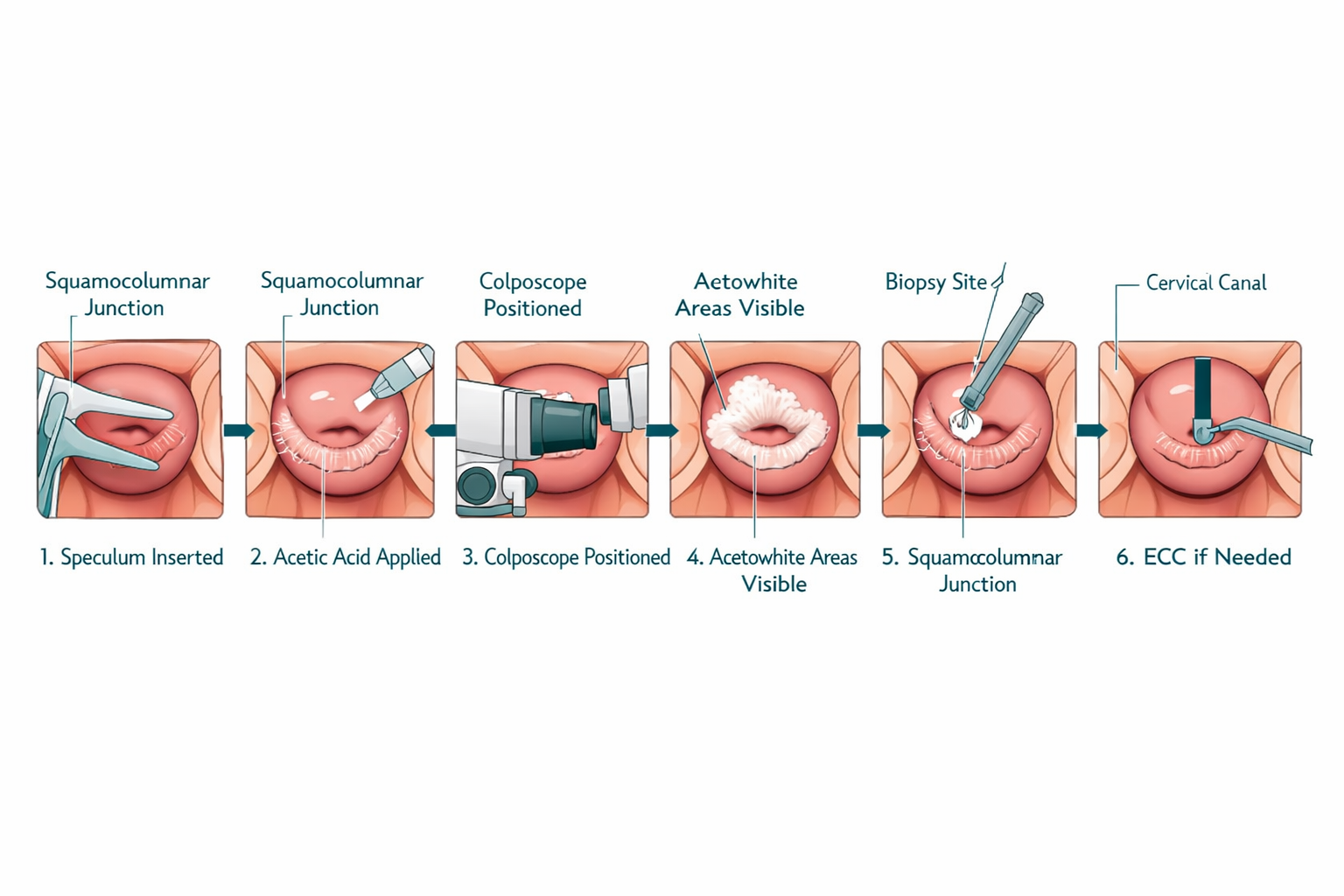
Here is what actually happens, in order:
Step 1, Positioning and speculum insertion. You lie on an exam table in the same position as a Pap smear. A speculum is inserted to hold the vaginal walls open so the cervix is visible. This part feels the same as a routine pelvic exam.
Step 2, Visual inspection. The clinician first examines the vulva, vagina, and cervix with the naked eye to note anything obvious before magnification.
Step 3, Acetic acid application. A dilute solution of acetic acid, essentially a 3-5% vinegar solution, is applied to the cervix with a swab or spray. You may feel mild stinging. The solution causes abnormal cells to temporarily turn white, a reaction called acetowhitening. Normal cells stay pink.
Step 4, Colposcope examination. The colposcope is a large magnifying instrument that stays outside your body entirely, it doesn’t enter the vagina. It magnifies the cervix by approximately 6 to 15 times. The clinician examines the transformation zone and squamocolumnar junction carefully, often using a green or blue filter to improve contrast of blood vessel patterns.
Step 5, Targeted biopsy. If any areas look abnormal, acetowhite patches, irregular vessel patterns, or visible lesions, a small biopsy is taken from each suspicious site using a punch biopsy forceps. This causes a brief sharp cramp. Most people describe it as a strong pinch.
Step 6, Endocervical curettage (ECC), when indicated. If you tested positive for HPV 16 or 18, have high-grade cytology, or if the squamocolumnar junction isn’t fully visible, an ECC is typically recommended. This involves gently scraping the endocervical canal to collect cells from inside the cervix that the colposcope can’t directly visualize. It adds about two minutes to the procedure.
After the instruments are removed, the clinician will tell you when to expect biopsy results, usually within one to two weeks. Light spotting or a dark discharge (from a solution used to reduce bleeding) is normal for a day or two.
If you’ve recently had an abnormal Pap smear result and want to understand what the follow-up process looks like, that guide covers the full sequence from cytology to colposcopy referral.
What Colposcopy Results Actually Mean
The biopsy result, not the colposcopy itself, determines what happens next. Results are reported using cervical intraepithelial neoplasia (CIN) grading:
| Result | What it means | Typical next step |
|---|---|---|
| No lesion found | No abnormal cells visible | Repeat HPV test in 12 months |
| CIN 1 (low-grade) | Mild cell changes, often clear on their own | Active surveillance, repeat testing |
| CIN 2 (moderate) | Moderate changes; treatment often recommended | LEEP or ablation, depending on age and preferences |
| CIN 3 (high-grade) | Severe precancerous changes | Treatment recommended promptly |
CIN 1 frequently resolves without intervention, this is one of the most common colposcopy outcomes for people with non-16/18 high-risk HPV. The evidence shows that most CIN 1 lesions regress within two years, particularly in younger people with intact immune function.
CIN 2 and CIN 3 are treated because cell changes are easiest to manage before they progress, that’s precisely what this level of screening is designed to catch.
Colposcopy HPV Virus Follow-Up: What Happens After the Procedure
Follow-up depends on both your HPV genotype and your biopsy result. This is where the step-by-step look extends beyond the procedure room.
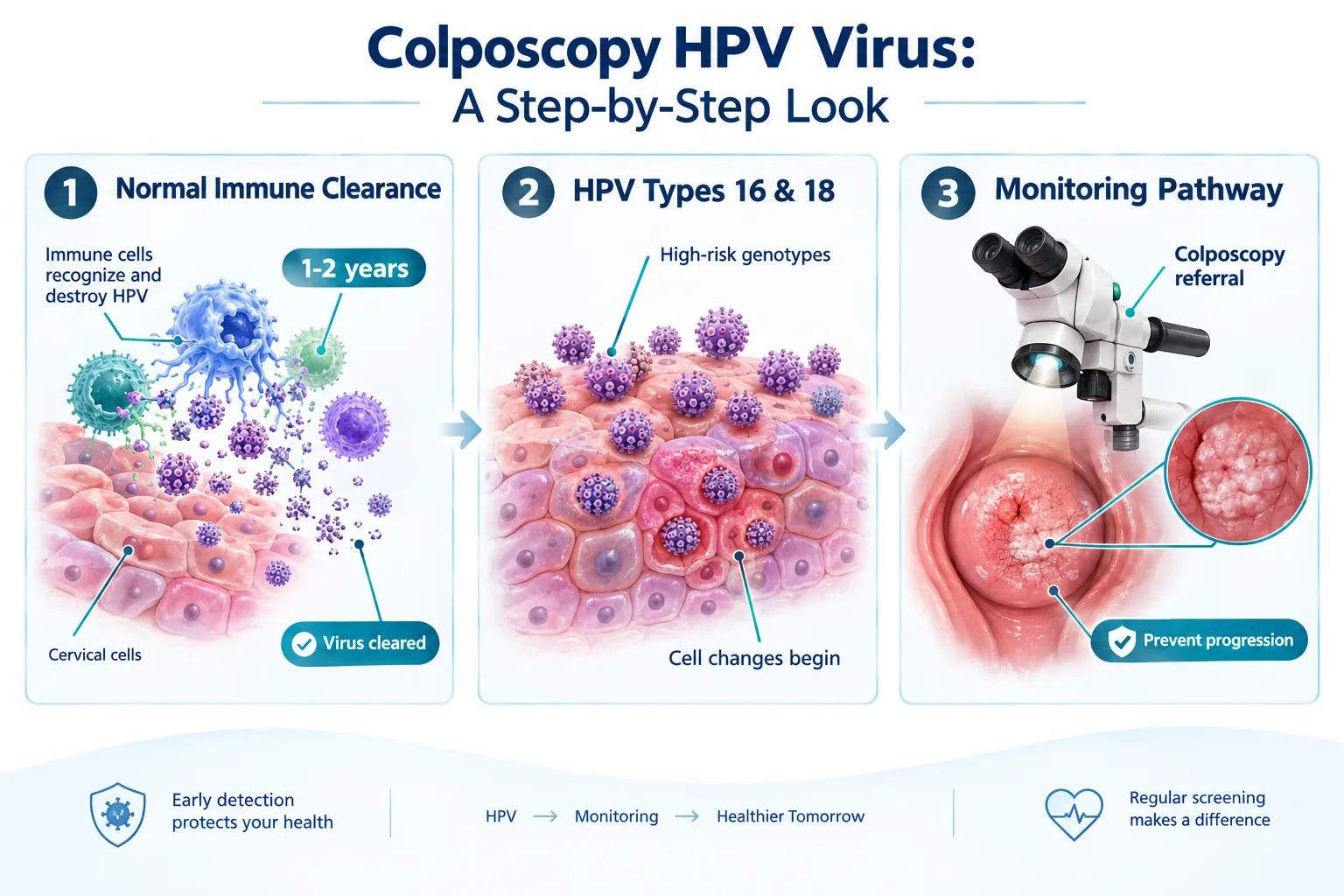
For HPV 16 or 18 positive results, most guidelines recommend a repeat colposcopy at 12 months if no lesion was found or if CIN 1 was identified. Persistent HPV 16/18 or any high-grade cytology at follow-up triggers renewed colposcopic examination.
For non-16/18 high-risk HPV, a repeat colposcopy is typically scheduled every one to two years as long as HPV remains detectable, with more intensive evaluation if cytology escalates to ASC-H or HSIL.
Some national programs, including Canada’s BC Cancer Cervix Screening Program, continue colposcopic surveillance until HPV is no longer detected, regardless of how many cycles that takes. Persistent high-risk HPV without a visible lesion still warrants monitoring, because the absence of a visible change doesn’t mean the risk has resolved.
If treatment is needed, the HPV treatment overview at HPVGuide.org explains the options, from LEEP excision to ablative procedures, and what recovery looks like.
The HPV testing guide covers how HPV test results are interpreted and what the difference between a co-test and a primary HPV screen means for your follow-up pathway.
Frequently Asked Questions
Does a colposcopy hurt?
Most people experience mild to moderate cramping during the biopsy portion, similar to strong period cramps. The acetic acid application may cause a brief stinging sensation. The colposcope itself doesn’t enter the body, so that part is painless. Taking an over-the-counter pain reliever about an hour before the appointment can reduce discomfort.
Can I have a colposcopy if I’m pregnant?
Yes. Colposcopy is considered safe during pregnancy and is performed when there’s a concern about high-grade cell changes. Biopsies are still taken if clearly indicated, though ECC is generally avoided during pregnancy because of the risk of disrupting the cervical canal. Management decisions are adjusted based on how far along the pregnancy is.
If my colposcopy is normal, does that mean my HPV is gone?
Not necessarily. A normal colposcopy means no visible lesion was found at that point in time, it doesn’t confirm viral clearance. HPV status is confirmed through a follow-up HPV test, typically at 12 months. That’s why ongoing surveillance is recommended even after a negative colposcopy result in someone with persistent high-risk HPV.
How is colposcopy different from a Pap smear?
A Pap smear collects cells from the cervix to look for abnormal changes under a microscope, it’s a screening test. Colposcopy is a diagnostic procedure: the clinician directly examines the cervix under magnification and takes biopsies from any areas that look abnormal. The Pap smear flags a concern; the colposcopy investigates it.
Will I need treatment after colposcopy?
Not always. Many people who undergo colposcopy are found to have CIN 1 or no visible lesion, both of which are managed with surveillance rather than immediate treatment. Treatment is typically recommended for CIN 2 or CIN 3. The decision also depends on your age, immune status, and whether you’ve had prior treatment, your clinician will walk through the options specific to your result.
Can HPV come back after colposcopy and treatment?
HPV isn’t removed by colposcopy or by treatment of cell changes, the procedure removes abnormal tissue, not the virus itself. The immune system is responsible for clearing the virus over time. Some people do have detectable HPV at follow-up visits after treatment, which is why post-treatment surveillance continues for several years. The information on whether HPV can return without new sexual activity explains this in more detail.
What to Do Next
If you’ve been referred for colposcopy, the most useful thing you can do is go. Cell changes are easiest to manage at the earliest stage, that’s the entire point of the screening pathway that led to your referral.
Bring a list of your recent test results if you have them, including your HPV genotype result and any cytology findings. Ask the clinician which areas were biopsied and when results will be available. If ECC was performed, ask whether that result will be reported separately.
After the procedure, avoid penetrative sex, tampons, and swimming for about a week to allow the biopsy sites to heal. Light spotting is expected; heavy bleeding or signs of infection, fever, increasing pain, foul-smelling discharge, warrant a call to your provider.
Understanding the full picture of what HPV is and how the immune system responds to it can also help you make sense of why monitoring continues even after a reassuring colposcopy result.