A small, rough bump on your finger or knuckle is easy to dismiss. But if it persists, feels gritty to the touch, or starts multiplying, it may be an early-stage HPV wart, and understanding what that means is the first step toward managing it. Early stage HPV on hands explained simply: these are benign skin growths caused by specific low-risk HPV genotypes that infect the outer skin layers, not the internal tissues linked to cancer.
Key Takeaways
- Hand warts are caused by low-risk HPV genotypes (most commonly types 1, 2, 4, and 27), not the same types associated with cervical or other cancers.
- Many early-stage hand warts clear on their own within months to a couple of years in people with healthy immune systems.
- First-line treatment is topical salicylic acid applied consistently over 8-12 weeks; cryotherapy is the next step if that fails.
- Immunocompromised people are significantly more likely to develop persistent or widespread warts.
- Hand warts are contagious through direct skin contact and minor cuts or abrasions, but they are treatable and common.
What HPV on Hands Actually Is
HPV on the hands is a cutaneous (skin-surface) infection, entirely different in mechanism and risk from the mucosal HPV types that affect the cervix or genitals. The HPV types guide covering low-risk and high-risk genotypes explains this distinction clearly: genotypes like HPV 1, 2, 4, and 27 are adapted to infect keratinized skin, while high-risk types like HPV 16 and 18 target mucosal tissue.
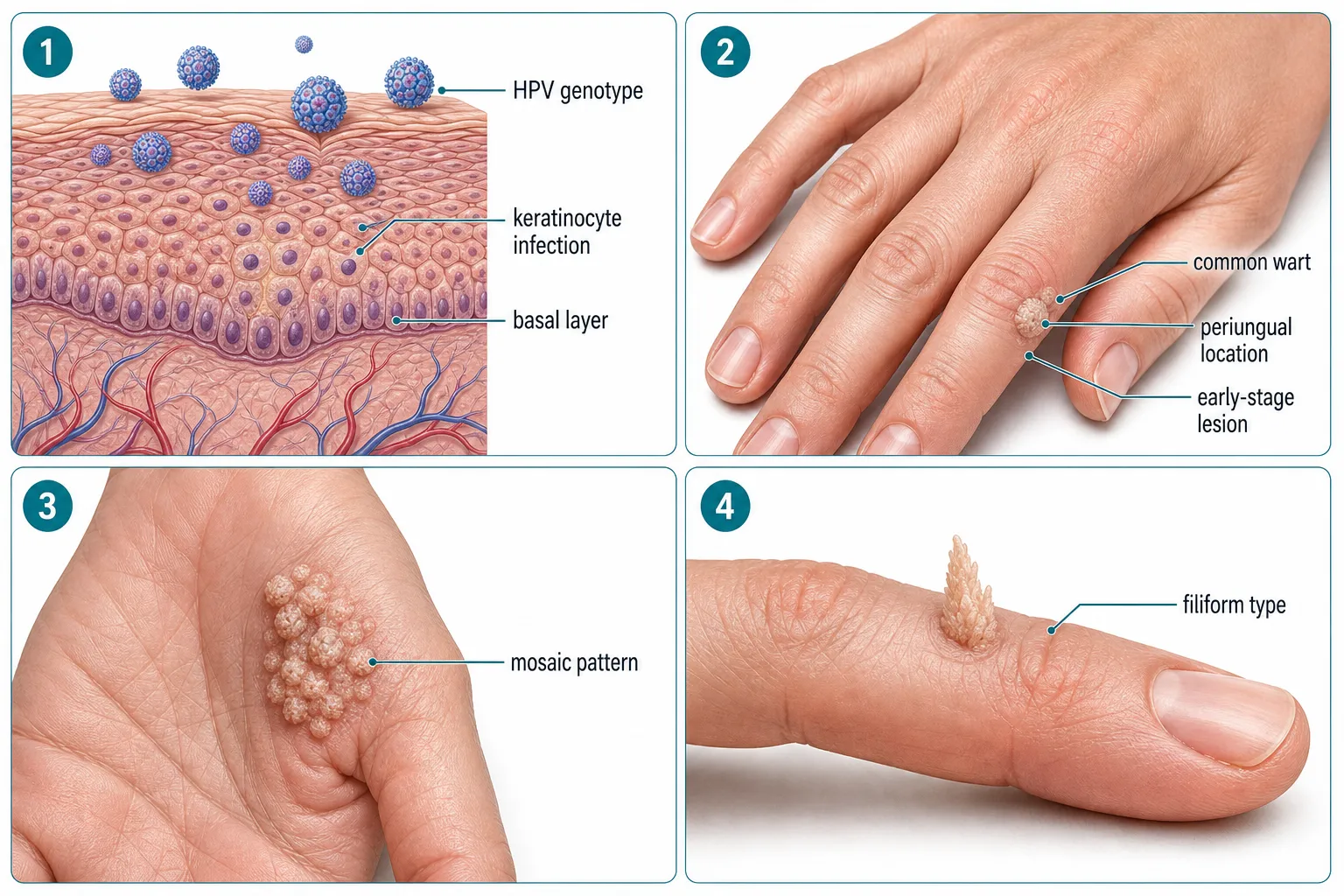
The virus enters through tiny breaks in the skin, a hangnail, a small cut, or dry cracked skin around the nails. Once inside, it infects keratinocytes in the basal layer of the epidermis and triggers abnormal cell proliferation. The result is a wart: a raised, rough papule that is essentially a cluster of infected skin cells.
This is not a systemic infection. HPV on the hands does not travel to your cervix, your bloodstream, or your internal organs. The risk profile of cutaneous hand HPV is low, the concern is cosmetic, functional (warts near nails can be painful), and contagious, not oncological.
What Early-Stage Hand Warts Look Like
Early warts are often small enough to be mistaken for a callus or dry skin patch. They tend to appear on the fingers, around the nails (periungual warts), and on the backs of the hands. A few distinguishing features help identify them:
- Rough, gritty texture, unlike smooth skin tags or calluses
- Disrupted skin lines, normal fingerprint ridges stop at the wart’s edge
- Small black dots, these are thrombosed capillaries, sometimes called “seeds,” visible on the surface
- Firm, raised papule, typically 1-10 mm in early stages
Common warts (verruca vulgaris) caused by HPV 2 and 4 are the most frequently seen type on the hands. Flat warts (verruca plana), associated with HPV 3 and 10, appear as slightly raised, flesh-colored lesions and are more common on the face and backs of hands in younger people. Mosaic warts form when multiple lesions cluster together, usually on the palm or fingers.
If you’re unsure whether what you’re seeing is a wart or something else, the comparison of skin tags and HPV warts covers the visual and structural differences in detail.
Who’s at Higher Risk for Hand Warts?
Hand warts can affect anyone, but certain groups are more likely to develop persistent or widespread infections:
- Immunocompromised people, those living with HIV, on immunosuppressive therapy after organ transplant, or receiving chemotherapy often develop multiple, treatment-resistant warts because their immune systems cannot clear the virus as effectively.
- Children and young adults, cutaneous HPV warts are most prevalent in school-age children and teenagers, likely due to frequent minor skin trauma and close physical contact.
- People who bite their nails or pick at hangnails, these habits create repeated micro-abrasions that give the virus an entry point, and can spread existing warts to new sites on the same hand.
- Meat handlers, butchers, and fish workers, occupational exposure to wet, abraded skin significantly increases cutaneous HPV infection rates.
Does HPV on Hands Go Away on Its Own?
Many early-stage hand warts do resolve without treatment, but “on their own” can mean a wait of months to over two years. In people with healthy immune systems, spontaneous clearance is well-documented. The immune system eventually recognizes the infected cells and mounts a response.
That said, waiting is not always the right call. Warts around the nails can become painful as they grow. Warts on the fingers spread easily to other parts of the hand or to other people through direct skin contact. And in immunocompromised people, spontaneous clearance is much less likely.
The full explanation of whether HPV goes away on its own covers clearance rates across different HPV types and immune contexts, it’s worth reading if you’re deciding whether to treat or wait.
How Early-Stage Hand Warts Are Treated
Treatment is stepwise. The goal at the early stage is to destroy the infected tissue with minimal scarring.
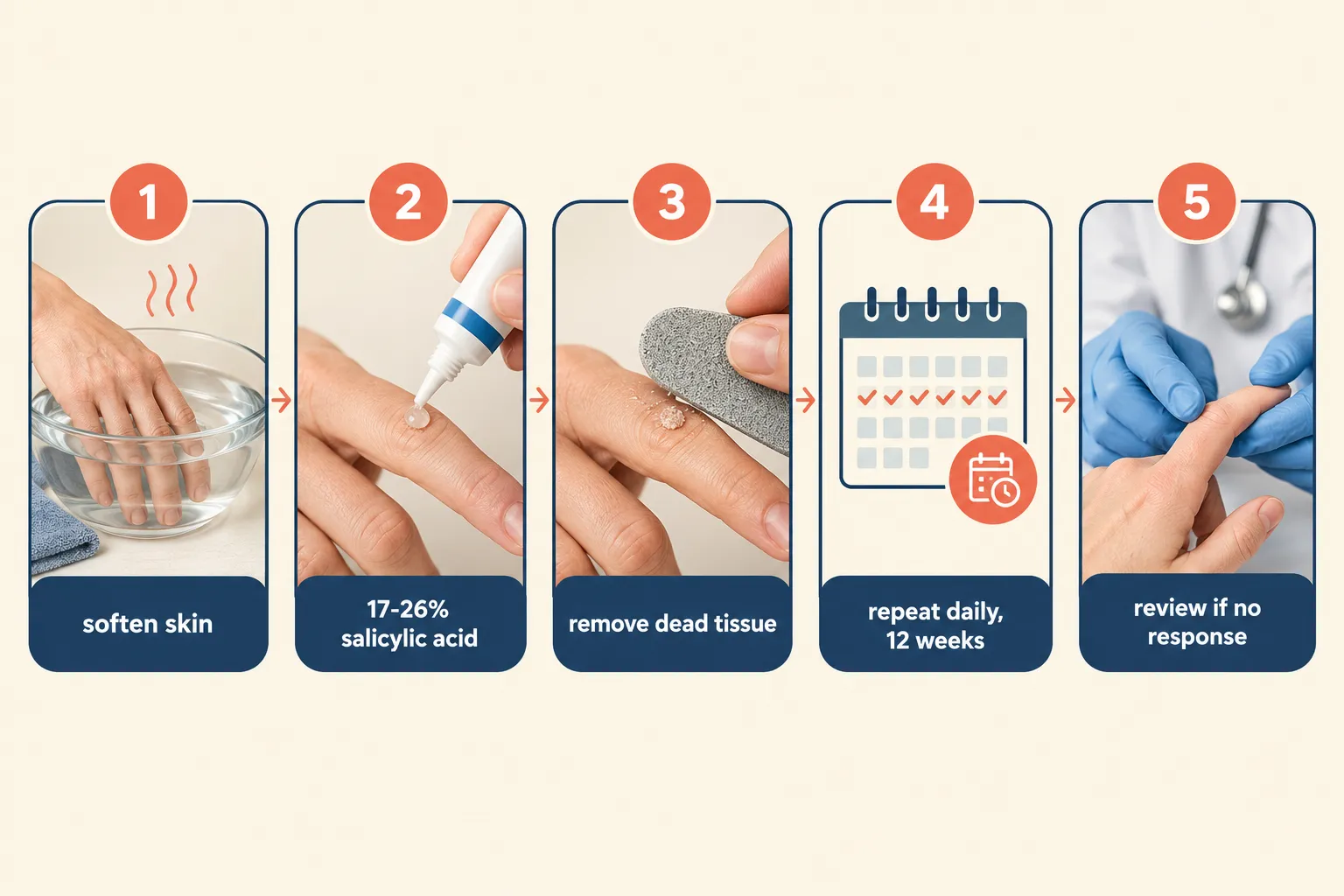
Topical salicylic acid is the standard first-line option. Concentrations between 17% and 26% are applied once or twice daily after soaking the area in warm water and filing away dead skin. Consistent use over 8-12 weeks is required. Cure rates vary widely, from negligible in some cases to over 80% in others, which reflects how much individual immune response matters.
Cryotherapy (liquid nitrogen freezing) is the next step if salicylic acid fails after three months. It destroys the wart tissue through rapid freeze-thaw cycles. Multiple sessions are usually needed. The cryotherapy overview for HPV explains what to expect from the procedure and how many treatments are typically required.
Other options used in resistant cases include:
- Duct tape occlusion (evidence is mixed, but low-risk to try)
- Intralesional immunotherapy (candida antigen injections)
- Laser ablation for periungual warts that don’t respond to other methods
When to see a specialist: If warts have persisted for two or more years despite consistent topical treatment and cryotherapy, if there is any diagnostic uncertainty (especially in adults over 50, where a persistent rough lesion should be examined to rule out squamous cell carcinoma), or if you are immunocompromised and developing multiple new warts, a dermatology referral is the right move.
Some people explore immune-support supplements alongside conventional treatment. The evidence on AHCC for hand warts reviews what the research currently shows about this approach.
Can Hand Warts Spread to Other Parts of the Body?
Cutaneous HPV types on the hands do not spontaneously travel to genital tissue, the genotypes are different and the tissue environments are incompatible. However, autoinoculation (spreading to a new site on the same person) is possible through scratching, nail-biting, or touching a wart and then touching broken skin elsewhere on the body.
The specific question of whether hand warts can spread to genital areas is addressed in detail on the can hand warts spread to genitals page, the short answer is that it is biologically unlikely but not impossible in specific circumstances involving direct contact and skin breaks.
Transmission to other people happens through direct skin-to-skin contact, particularly when the other person has a cut or abrasion. Shared surfaces (towels, gym equipment) carry a lower but real transmission risk.
Preventing Spread While You Have Hand Warts
You do not need to withdraw from daily life while you have hand warts. A few practical steps reduce the chance of spreading them:
- Keep warts covered with a bandage during activities involving close skin contact
- Do not pick at or scratch warts, this spreads the virus to new sites
- Wash hands after touching a wart
- Avoid sharing towels, nail files, or clippers
Warts are contagious, but the risk to healthy adults with intact skin is relatively low. Children and immunocompromised contacts are more susceptible.
Frequently Asked Questions
Are warts on hands a sign of genital HPV?
No. Hand warts are caused by cutaneous HPV genotypes, primarily types 1, 2, 4, and 27, which are entirely different from the mucosal high-risk types (HPV 16, 18) linked to cervical and other cancers. Having a wart on your hand does not mean you have a sexually transmitted HPV infection, and it does not increase your cervical cancer risk.
How long does it take for early-stage hand warts to clear?
It varies considerably. With consistent topical salicylic acid treatment, some warts respond within 6-8 weeks. Others take the full 12-week course or longer. Without any treatment, spontaneous clearance in immunocompetent people can take anywhere from a few months to two years. Immune status is the biggest variable.
Can the HPV vaccine prevent hand warts?
The current HPV vaccines (including the 9-valent Gardasil 9) target high-risk mucosal genotypes and the low-risk types 6 and 11, which cause genital warts. They do not cover the cutaneous genotypes responsible for common hand warts. The evidence on whether the HPV vaccine prevents warts explains which wart types the vaccine does and does not address.
Should a child with hand warts see a doctor?
Not necessarily for the first few weeks, hand warts in children are extremely common and often resolve on their own. Over-the-counter salicylic acid is appropriate for children over 2 years old when used as directed. A GP or dermatologist visit makes sense if the wart is painful, growing rapidly, near the eye or face, or not responding after three months of consistent home treatment.
Is it safe to use salicylic acid on warts near the fingernail?
Periungual warts (around the nail) can be treated with salicylic acid, but care is needed to avoid applying the acid directly to healthy surrounding skin or the nail plate repeatedly, as it can cause irritation. Protecting the surrounding skin with petroleum jelly before application helps. If a periungual wart is causing nail distortion or pain, a dermatologist can assess whether a stronger intervention is needed.
A Practical Next Step
Early stage HPV on hands explained comes down to this: a low-risk, cutaneous infection that is common, contagious, and treatable. The warts themselves are not dangerous, but they do not always go away quickly on their own. Starting with consistent topical salicylic acid for 8-12 weeks is a reasonable first move for most early lesions. If that fails, cryotherapy is the next step. If you are immunocompromised, or if a lesion looks unusual or has been present for more than two years without change, a dermatologist should examine it, not because hand warts are dangerous, but because cell changes are easiest to address before they become complicated.