Hand warts cannot give you genital warts. That is the short answer, and it holds up across the medical literature. The HPV types that cause common hand warts, primarily HPV 2 and HPV 4, are biologically distinct from the types that cause genital warts, which are HPV 6 and HPV 11. Different viruses, different tissue preferences, different transmission routes.
That said, the question is worth unpacking carefully, because there is a related, and genuinely different, scenario that does carry some risk: genital HPV spreading via hands. That is not the same thing as hand-wart HPV spreading to genitals, and conflating the two leads to unnecessary worry in one direction and missed caution in another.
Key Takeaways
- Common hand warts (HPV 2, 4) and genital warts (HPV 6, 11) are caused by different HPV types that do not convert into one another.
- Major sexual health organizations state that hand warts are not sexually transmitted to the genitals.
- Autoinoculation, spreading a wart to another skin site on your own body, is possible with hand warts, but almost exclusively on similar keratinized skin, not on genital mucosa.
- Genital HPV can theoretically spread via hands to a partner’s genitals; this is a separate risk from hand-wart HPV.
- If genital warts appear, they should be treated as sexually acquired unless there is a clear reason to think otherwise.
Why Hand Warts Don’t Become Genital Warts
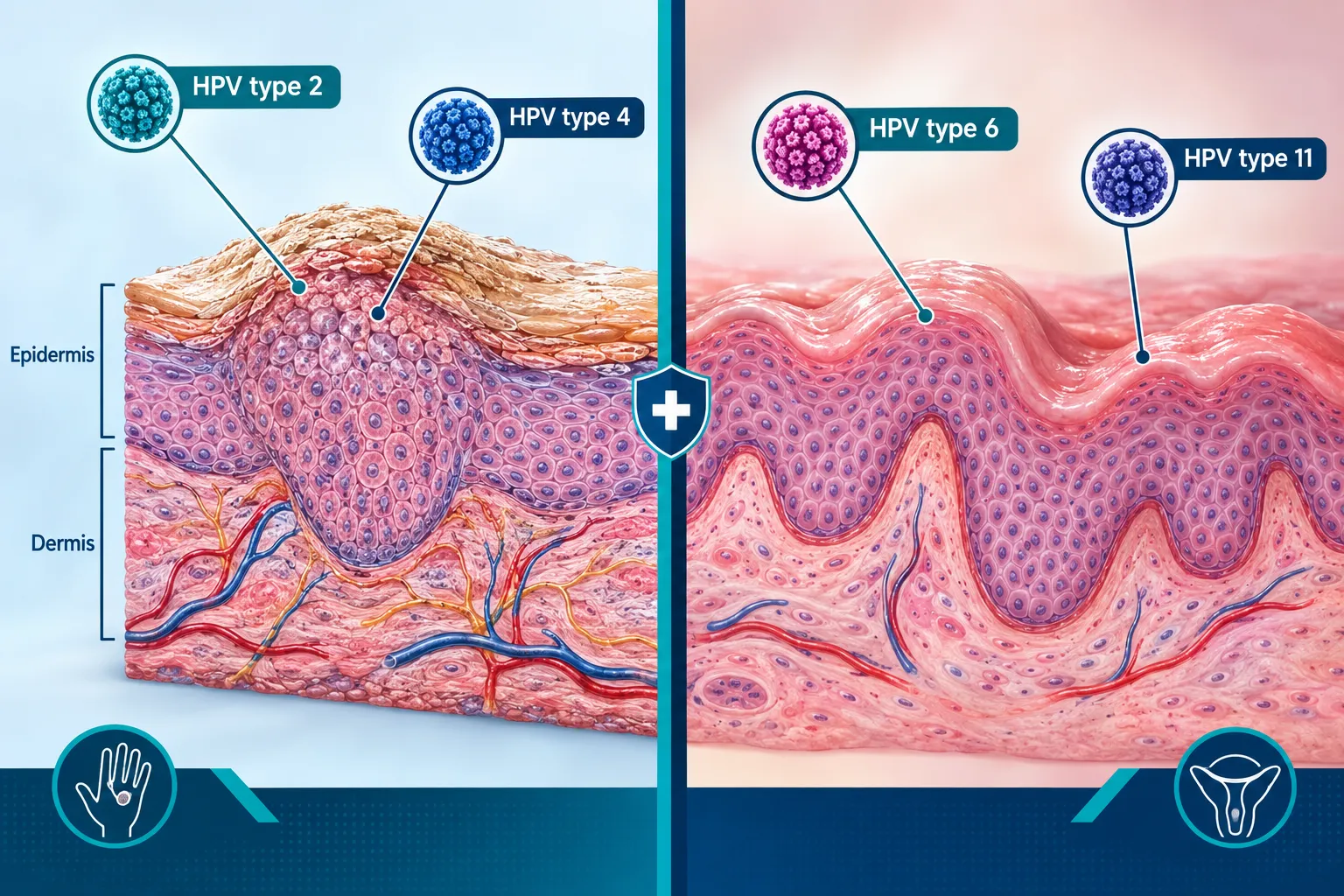
HPV is not a single virus, it is a family of more than 200 related but distinct types, each with a strong preference for specific tissue. This preference is called tropism, and it is the core reason hand warts and genital warts stay in their respective territories.
Common warts on the hands are caused by cutaneous HPV types, primarily HPV 2 and HPV 4. These types thrive in thick, keratinized skin, the kind found on fingers, knuckles, and the soles of feet. Genital tissue is mucosal: thinner, more permeable, and governed by a completely different cellular environment. Cutaneous HPV types are not adapted to establish infection there.
Genital warts are caused by mucosal HPV types 6 and 11. These types are sexually transmitted and have no meaningful presence in the common hand wart. So even if HPV 2 from a hand wart somehow made contact with genital skin, the biological conditions for infection are not there.
The evidence supports this clearly. Sexual health organizations, including the CDC, draw a firm line between cutaneous and mucosal HPV infections. Hand warts are not classified as sexually transmitted infections. They spread through direct skin-to-skin contact or contact with contaminated surfaces, a shared towel, a gym floor, a handshake, not through sexual contact.
If you have a wart on your hand and are worried about passing genital warts to a partner, that specific concern does not apply. Understanding how genital warts differ from other wart types helps clarify why the two conditions are treated so differently.
The Scenario That Is Different: Genital HPV Spreading via Hands
This is where the picture becomes more nuanced, and it matters to be precise.
Genital HPV, including the types that cause genital warts, can potentially be transferred from one person’s genitals to another person’s genitals via hands. This is not the same as hand-wart HPV spreading to genitals. The virus in this scenario originates in the genital region, not in a hand wart.
The practical risk is considered low but not zero. Mucosal HPV types are fragile outside the body and do not survive well on skin surfaces for long. Most experts frame hand-to-genital transmission of genital HPV as theoretically possible, particularly if there is direct contact between an infected genital area and a partner’s genitals via unwashed hands, but extremely unlikely compared to direct genital-to-genital contact.
This distinction matters for two reasons:
- If you have common hand warts, you are not a risk to a partner’s genital health through touch.
- If you or a partner has a known genital HPV infection, basic hygiene, washing hands before and after genital contact, is a reasonable, low-effort precaution.
How HPV spreads and how it doesn’t covers the full transmission picture, including which routes carry the most and least risk.
Can Hand Warts Spread to Other Parts of Your Own Body?
Yes, but with important limits. Autoinoculation is the process by which a wart spreads to another skin site on the same person, usually through scratching, picking, or shaving over an existing wart. It is the reason someone with a wart on one finger sometimes develops one on an adjacent finger.
Autoinoculation of cutaneous HPV types almost always stays on similar tissue: keratinized skin on hands, feet, or legs. The virus does not readily cross from thick skin to mucosal surfaces like the genitals, mouth, or eyes. The tissue environment is too different.
There are rare documented cases of cutaneous HPV types appearing at mucosal sites in people with severely compromised immune systems, organ transplant recipients on long-term immunosuppression, for example. In typical immune function, this does not happen.
The practical upshot: having a hand wart does not mean you need to take special precautions to avoid touching your own genitals. The risk of self-transferring a hand wart to genital tissue is, in clinical terms, negligible for most people.
Who Is at Higher Risk for HPV-Related Wart Complications?
Most people with hand warts or genital warts have straightforward, manageable infections. A few groups face a more complex picture:
- Immunocompromised individuals, people living with HIV, organ transplant recipients on immunosuppressive therapy, or those undergoing chemotherapy, are more prone to persistent, treatment-resistant warts at any site.
- People with active genital HPV infections who have multiple partners face a higher cumulative exposure risk, making transmission via any route, including indirect hand contact, more worth discussing with a provider.
- Unvaccinated adults under 45 who have not had prior HPV exposure lose the protection the vaccine would have offered against HPV 6 and 11, the genital wart types.
What to Do If Genital Warts Appear

If you notice new growths in the genital area, do not assume they came from a hand wart. Genital warts should be treated as sexually acquired by default, meaning the most likely source is genital-to-genital contact with a partner who carries HPV 6 or 11, even if that partner had no visible symptoms.
HPV 6 and 11 can remain dormant for months to years before warts appear. The timing of an outbreak does not reliably tell you when or from whom you acquired the virus. How genital warts are classified as an STD explains why the sexually transmitted classification applies even when the source seems unclear.
A healthcare provider can confirm a diagnosis visually in most cases. Treatment options range from topical prescription creams to in-office procedures, genital warts treatment options covers what each approach involves and what to expect from it. Genital warts caused by HPV 6 and 11 are low-risk types, they are not associated with cervical cancer or other malignancies. Whether HPV can cause both genital warts and cervical cancer addresses that distinction directly.
For hand warts specifically, some people explore immune-support approaches while waiting for warts to resolve. Whether AHCC can help clear hand warts looks at what the current evidence says about that option.
Frequently Asked Questions
If I touch my hand wart and then touch my genitals, will I get genital warts?
No. The HPV types that cause hand warts (primarily HPV 2 and 4) are cutaneous types that do not establish infection in genital mucosal tissue. Genital warts require mucosal HPV types 6 or 11, which are not present in a common hand wart. Direct contact between a hand wart and genital skin does not create a pathway for genital wart infection.
Can hand warts spread to genitals through oral sex?
No. The same type-specificity applies. Oral mucosal tissue, like genital tissue, is not a suitable environment for cutaneous HPV types. Oral HPV infections that do occur are caused by mucosal HPV types transmitted through oral-genital or oral-oral contact, not from common skin warts.
My partner has hand warts. Should I be concerned about getting genital warts from them?
No. Your partner’s hand warts pose no risk of genital wart transmission to you. Genital warts require sexual transmission of mucosal HPV types, which are separate from the virus causing their hand warts. If either of you has concerns about genital HPV specifically, that is a separate conversation worth having with a provider.
Are all warts caused by the same type of HPV?
No. Different HPV types cause different wart presentations. Common warts on hands and feet, flat warts, plantar warts, and genital warts each have their own associated HPV types. Whether all warts are caused by HPV covers which types cause which presentations and where the distinctions matter clinically.
Can genital warts go away without treatment?
Yes, in many cases. The immune system clears genital wart outbreaks without intervention in a significant proportion of people, though the timeline varies. Whether genital warts can go away on their own covers what to expect and when treatment makes sense.
What to Do Next
Hand warts spreading to genitals is not a realistic clinical concern. The biology does not support it. If you have hand warts, you do not need to change how you care for yourself or interact with a partner based on that worry.
If genital warts have appeared, regardless of whether you have hand warts, the right move is a clinical evaluation. A provider can confirm the diagnosis, rule out other conditions, and walk you through treatment options that match your situation. Cell changes and wart recurrences are easiest to manage when caught and addressed early, which is what follow-up care is for.
If you have not been vaccinated against HPV and are under 45, ask your provider whether the vaccine is still an option for you. It covers HPV 6 and 11, the types responsible for genital warts, along with the high-risk types linked to cancer.