Most HPV infections in men clear on their own. The immune system eliminates the virus in roughly 90% of cases within two years, often without any symptoms at all. That said, clearance is not guaranteed, and whether yours resolves, persists, or causes problems depends on the HPV type involved and how well your immune system responds.
Key Takeaways
- Most HPV infections in men resolve without treatment within one to two years.
- There is no approved HPV test for men and no antiviral drug that clears the virus, clearance is entirely immune-driven.
- High-risk types like HPV 16 and 18 can persist and, over many years, raise the risk of penile, anal, and oropharyngeal cancers.
- Low-risk types like HPV 6 and 11 cause genital warts, which are treatable even when the virus itself cannot be “cured.”
- Vaccination significantly reduces the risk of acquiring the HPV types most likely to cause lasting harm.
What HPV Actually Does in the Male Body
HPV, human papillomavirus, is a group of more than 200 related viruses. Most men who carry it never know. The virus lives in skin and mucosal cells, and in the majority of cases the immune system clears it quietly before it ever causes a visible sign or a detectable problem.
The definition of HPV virus and what it means for you covers the basics in more depth, but the short version is this: HPV is not a single virus with a single outcome. There are low-risk types and high-risk types, and they behave very differently.
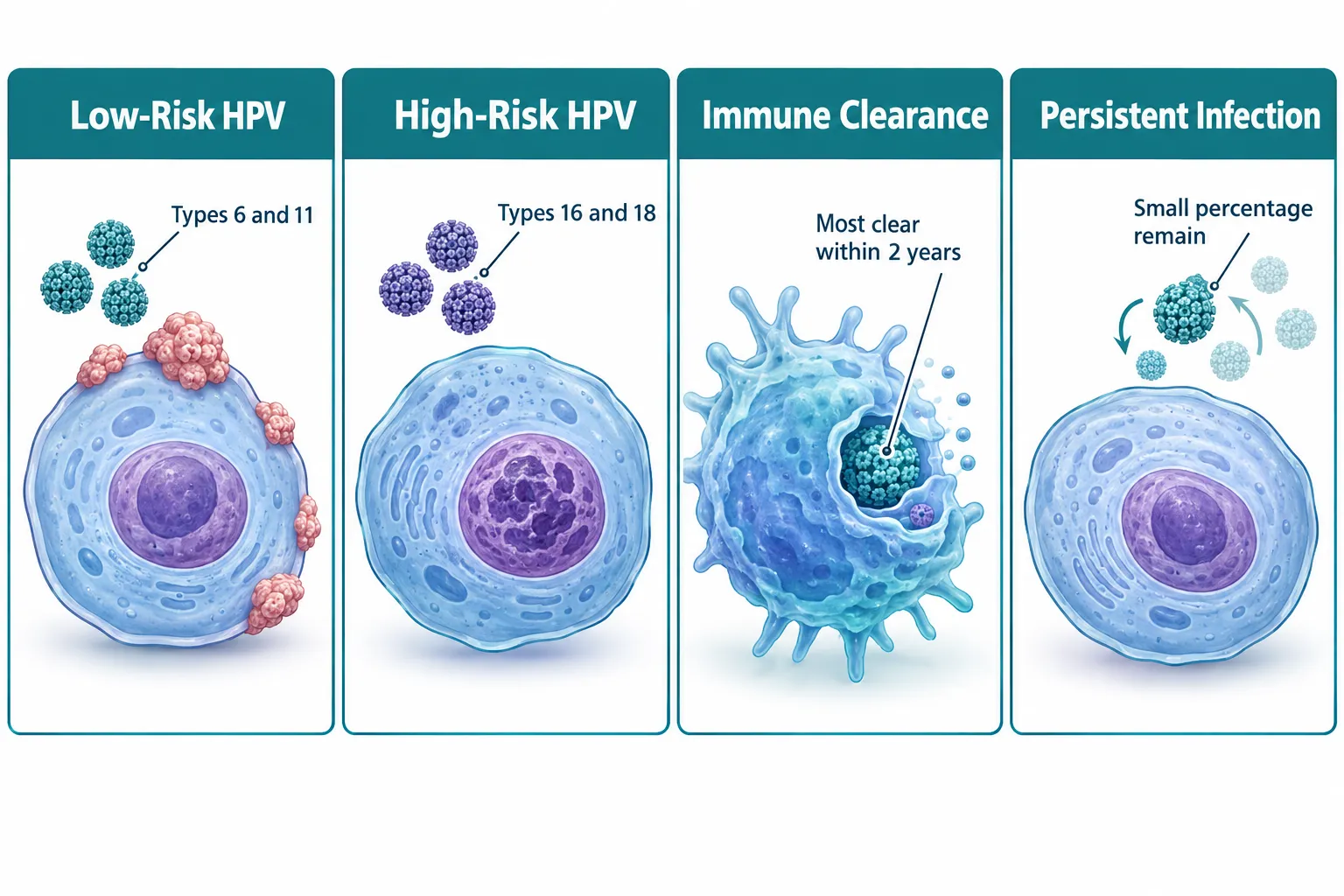
Low-risk types, primarily HPV 6 and 11, cause genital warts. High-risk types, primarily HPV 16 and 18, can integrate into cell DNA and, if they persist long enough without immune clearance, drive the kind of cellular changes that can eventually become cancer. Understanding HPV types: low-risk, high-risk, and what the numbers mean helps clarify which type matters most in your specific situation.
HPV is transmitted primarily through skin-to-skin sexual contact. It does not require penetrative sex to spread, and it does not require a visible wart or sore to be passed on. The guide on how HPV spreads and how it doesn’t explains the transmission routes in plain terms.
Does HPV Go Away on Its Own in Men?
Yes, in most cases. Studies consistently show that around 90% of HPV infections in men clear within one to two years. The immune system recognizes the infected cells and eliminates the virus without any medical intervention.
But “most” is not “all.” A meaningful minority of infections persist beyond two years. Persistent infection, not initial infection, is what drives cancer risk. A single positive HPV result is not a cancer diagnosis. It is the starting point of a process that, in most men, ends with clearance.
There is no approved antiviral treatment that clears HPV directly. No pill, no cream, no supplement has been shown in rigorous clinical trials to reliably eliminate the virus from the body. What can be treated are the symptoms the virus causes: genital warts can be removed, and precancerous cell changes can be monitored and treated before they progress.
What Happens If HPV Doesn’t Clear?
Persistent high-risk HPV infection, particularly HPV 16, is the primary driver of HPV-related cancers in men. These include penile cancer, anal cancer, and oropharyngeal (throat) cancer. The risk is real but, in absolute terms, still relatively low for most otherwise healthy men. The concern rises significantly in men with weakened immune systems.
Persistent low-risk HPV, such as types 6 and 11, does not cause cancer. It can cause recurring genital warts, which are frustrating but not dangerous. Cryotherapy for genital warts is one of the standard removal options when warts do appear.
Who’s at Higher Risk for HPV Persistence in Men?
Most men clear HPV without issue, but certain groups are more likely to experience persistent infection.
- Immunocompromised men, including those living with HIV or who have had an organ transplant, have a substantially higher risk of HPV persistence and HPV-related cancer. Their immune systems are less equipped to suppress the virus.
- Unvaccinated men, particularly those not vaccinated before first sexual exposure, are more vulnerable to acquiring and retaining the high-risk types.
- Men with anal HPV exposure, especially men who have sex with men, face a higher baseline risk of anal HPV persistence and anal cancer; anal HPV symptoms, screening, and prevention covers what monitoring looks like for this group.
- Smokers, tobacco use is associated with impaired local immune response in mucosal tissue, which may reduce the body’s ability to clear HPV efficiently.
Can HPV Be Detected or Tested in Men?
This is where the picture for men differs significantly from women. There is no FDA-approved HPV test for routine use in men. In women, HPV testing is integrated into cervical cancer screening because there is a clear, accessible site to sample. In men, no equivalent screening protocol exists for the general population.
What this means practically: most men will never know they had HPV. They carry it, their immune system clears it, and there is no test result to mark the event. The question of whether HPV can be detected in men and what testing options actually exist is worth reading if you’ve been told you may have been exposed.
A visible diagnosis, genital warts, for example, is usually made by clinical examination, not by a lab test.
Does HPV Go Away After Vaccination?
The HPV vaccine does not treat an existing infection. It will not clear a strain you already carry. What it does is protect against the types you haven’t yet been exposed to, and since most people are not infected with every high-risk type at once, vaccination after diagnosis still offers meaningful protection.

The current 9-valent vaccine (Gardasil 9) covers HPV types 6, 11, 16, 18, 31, 33, 45, 52, and 58. In the United States, it is recommended for males through age 26, and shared decision-making with a doctor is advised for men aged 27 to 45. The evidence on vaccination in men is clear: it reduces the risk of genital warts, anal dysplasia, and HPV-related cancers.
Some men ask about supplements like AHCC as a way to support immune clearance. The research on AHCC and HPV is still limited and preliminary, it is not a substitute for vaccination or medical monitoring.
What Men Should Actually Do
There is no treatment protocol for “HPV in men” the way there is for women with an abnormal Pap result. That gap is real, and it can feel frustrating. Here is what the evidence supports:
- Get vaccinated if you haven’t, or if you’re within the recommended age range. Even partial protection matters.
- Tell your doctor if you notice any unusual growths, sores, or changes in the genital, anal, or throat area. Genital warts are diagnosable on examination.
- If you are immunocompromised, discuss HPV-related cancer screening with your doctor, anal Pap tests and high-resolution anoscopy are available for high-risk individuals.
- Use condoms consistently. They don’t eliminate transmission risk, but condoms do reduce HPV transmission meaningfully when used correctly and consistently.
- Be honest with partners. The guide on whether a man can give a woman HPV addresses transmission between partners directly.
Frequently Asked Questions
How long does HPV last in men before it clears?
Most infections clear within one to two years. Some resolve faster; some take longer. A small percentage persist beyond two years, and persistent high-risk infection is what carries the most clinical significance. There is no reliable way to know exactly when or whether a specific infection will clear.
Can men spread HPV even if they have no symptoms?
Yes. HPV can be transmitted without any visible warts or symptoms. Most people who pass HPV on have no idea they are carrying it. This is why HPV is so common, it spreads silently, and neither partner may ever know.
Is there anything that helps the immune system clear HPV faster?
No supplement or drug has been proven to reliably accelerate HPV clearance in men. General immune health, not smoking, managing chronic conditions, getting enough sleep, supports the immune system broadly, but there is no specific intervention with strong clinical evidence for HPV clearance in men.
Does having HPV mean my partner cheated?
No. HPV can remain dormant for months or years before any sign appears, and most people carry it without knowing. It is genuinely impossible to determine when or from whom a specific infection was acquired. The timing of an HPV result tells you nothing reliable about the timing of transmission.
Should men worry about HPV-related cancer?
The absolute risk for most healthy men is low, but it is not zero, particularly for anal cancer in men who have sex with men, and for oropharyngeal cancer, which is rising in incidence. Men with HIV or other immunocompromising conditions face meaningfully higher risk. Cell changes are easiest to manage before they progress, which is why screening matters for higher-risk groups.
Can HPV cause fertility problems in men?
Some research suggests HPV may affect sperm motility in certain cases, but the evidence is not conclusive and this is not a well-established clinical concern for most men. If fertility is a specific worry, the full picture on whether HPV can cause infertility covers what is and isn’t known.
The Practical Reality in 2026
Does HPV go away in men? For most, yes, and without any intervention. The immune system does the work. But “most” still leaves room for persistence, and persistent high-risk HPV is a real concern for specific groups. The absence of a routine male HPV test makes this harder to track, which is exactly why vaccination, honest conversations with your doctor, and awareness of your own risk factors matter more, not less.