AHCC has real clinical trial data behind it, that’s not something you can say about most supplements marketed for HPV. Whether that data is strong enough to change what your doctor recommends is a different question, and the honest answer to “AHCC and HPV: does it actually work?” is: it shows genuine promise in early trials, but it hasn’t yet cleared the bar for a formal treatment recommendation.
Here’s what the evidence actually shows, and what it means for you.
Key Takeaways
- A randomized, double-blind phase II trial found that 63.6% of women taking 3 g of AHCC daily cleared a persistent high-risk HPV infection, compared to 10.5% in the placebo group.
- The effect appears dose-dependent, higher doses (3 g/day) outperformed lower doses (1 g/day) in earlier pilot data.
- AHCC is a nutritional supplement, not an antiviral drug. It works by modulating immune function, not by directly targeting the HPV virus.
- No serious adverse events were reported in clinical studies at the 3 g/day dose over six months.
- Larger phase III trials are still needed before AHCC can be integrated into standard HPV treatment guidelines.
What Is AHCC, and Why Is It Being Studied for HPV?
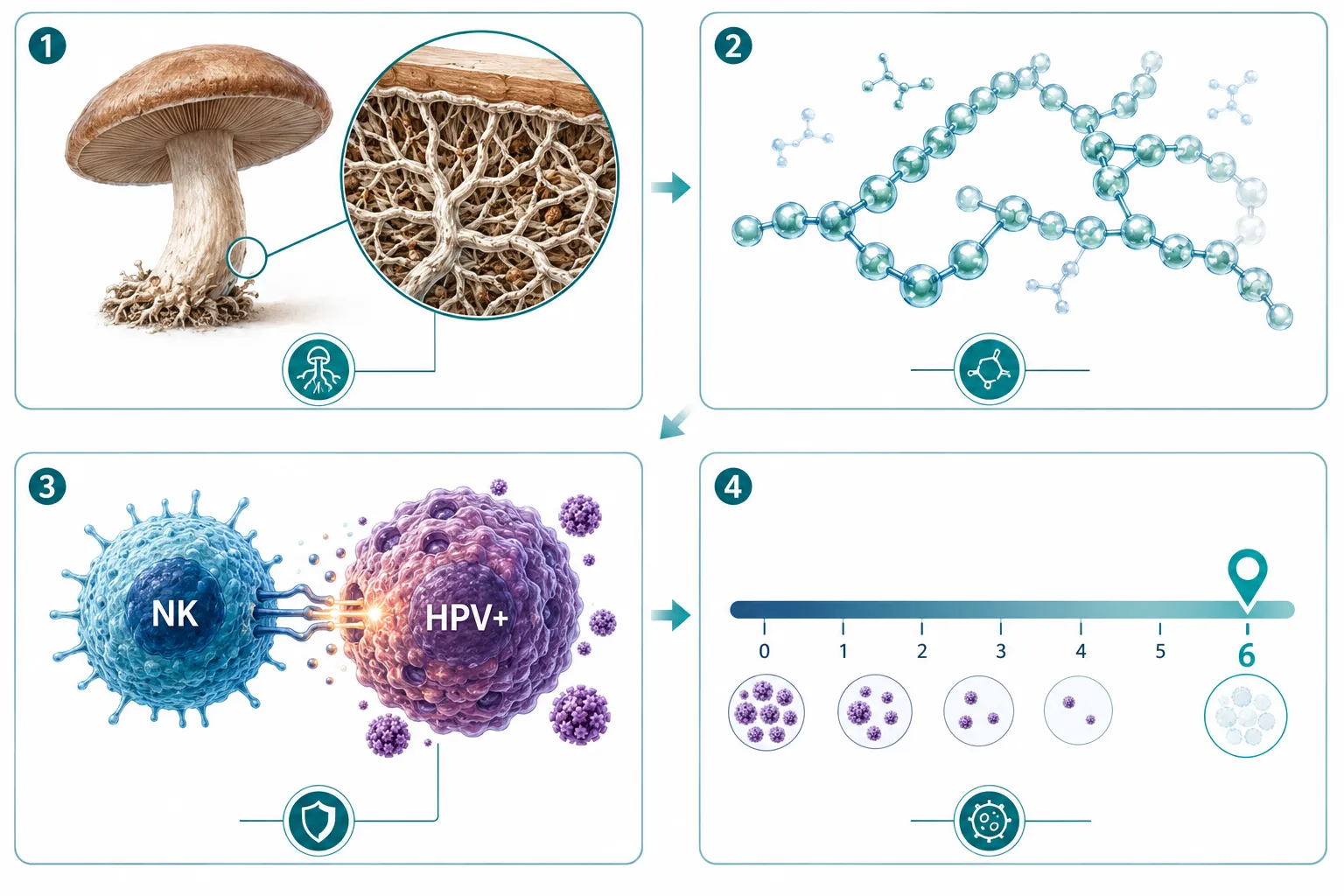
AHCC stands for Active Hexose Correlated Compound. It’s a standardized extract derived from the mycelia of Lentinula edodes, the same mushroom species used to produce shiitake. The active component is a proprietary mixture of alpha-glucans, which are polysaccharides thought to modulate the activity of natural killer (NK) cells, dendritic cells, and T-lymphocytes.
That immune-modulating profile is exactly why researchers started looking at it for HPV. Persistent high-risk HPV infection, the kind caused by genotypes like HPV 16 and HPV 18, persists precisely because the virus suppresses the immune response that would normally clear it. The hypothesis is that AHCC may restore enough immune surveillance to tip the balance toward clearance.
For a deeper look at how AHCC works at the cellular level, the AHCC overview on HPVGuide covers the mechanism in more detail.
This is not a fringe theory. It’s the rationale that led to a formal, registered clinical trial, and that trial produced results worth taking seriously.
What Does the Clinical Evidence Actually Show?
The most important study to date is a randomized, double-blind, placebo-controlled phase II trial (registered as NCT02405533) conducted in women over age 30 with persistent high-risk HPV infections lasting more than two years. Fifty women were enrolled. Those in the treatment arm took 3 g of AHCC daily for six months, followed by six months of placebo. Those in the control arm received placebo throughout.
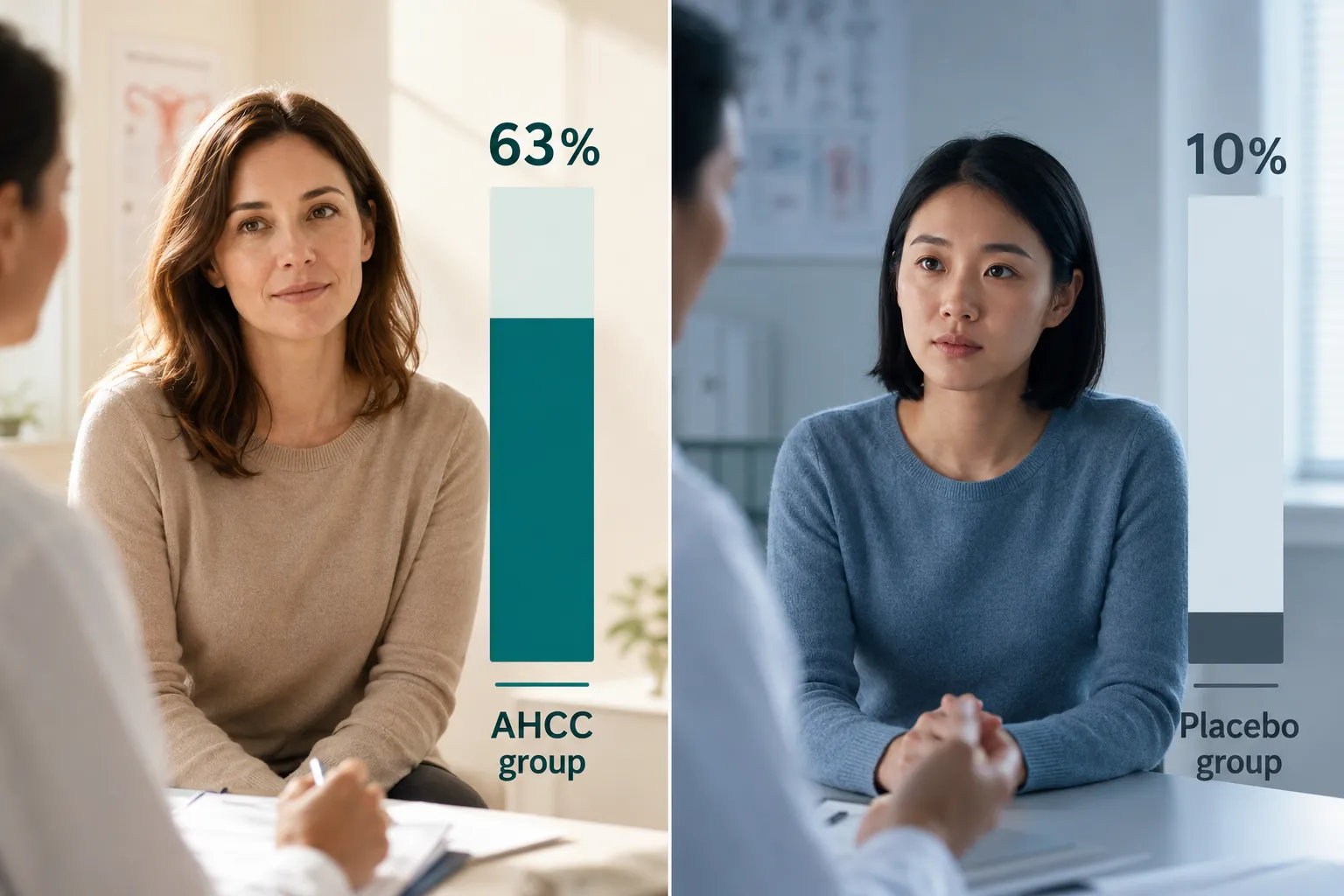
The results were statistically significant. HPV RNA/DNA negativity was achieved in 63.6% of treated participants (14 out of 22) versus 10.5% of placebo participants (2 out of 19). That’s not a marginal difference.
Durability mattered too. Among women who cleared HPV while on AHCC, 64.3% maintained HPV negativity 12 months after stopping supplementation. Across all women who received the 3 g daily dose, the overall clearance rate was 58.8%.
Earlier pilot data from Houston Methodist pointed in the same direction. In a small clinical evaluation, 4 of 6 women (66.7%) taking 3 g AHCC for three to six months cleared their infection, compared to 4 of 9 (44%) taking a lower 1 g dose for approximately seven months. That dose-response pattern gave researchers the rationale to standardize on 3 g/day in the formal trial.
A broader clinical series of 41 patients with persistent high-risk HPV infection also reported approximately 60% resolution after six months of AHCC use, consistent with the phase II findings.
For a full breakdown of the trial data and what it means clinically, see the detailed AHCC for HPV evidence review on this site.
Who’s at Higher Risk for Persistent HPV Infection?
Not every HPV infection becomes persistent. These groups are more likely to have an infection that doesn’t clear on its own, and are the population in whom AHCC research has been most focused:
- Immunocompromised individuals, including people living with HIV and organ transplant recipients on immunosuppressive therapy, have significantly reduced capacity to clear HPV naturally.
- Smokers, tobacco use is associated with impaired local cervical immunity, making it harder for the body to resolve high-risk HPV infections.
- People with a history of abnormal Pap results, prior ASC-US, LSIL, or HSIL findings indicate the immune system has already struggled to contain the infection.
- Unvaccinated adults, those who did not receive the HPV vaccine before exposure to high-risk genotypes like HPV 16 or 18 have no vaccine-primed immune response to draw on.
Is AHCC Safe to Take?
Safety data from the phase II trial is reassuring. At 3 g per day over six months, AHCC was well tolerated. No serious adverse events were reported, and there were no clinically significant laboratory abnormalities in blood work. The side effect profile was comparable to placebo.
That said, “well tolerated in a six-month trial” is not the same as a long-term safety certification. The trial population was relatively healthy women with persistent HPV, it did not include people with autoimmune conditions, those on immunosuppressive medications, or pregnant women.
The HPV vaccine is not recommended during pregnancy, and the same caution applies to any unproven supplement, if you’re pregnant or trying to conceive, discuss AHCC with your doctor before starting it.
For anyone with abnormal Pap results, active dysplasia, or a history of cervical cell changes, AHCC should be considered alongside, not instead of, standard monitoring and treatment. Cell changes are easiest to manage before they progress, and HPV testing and what your results mean explains what your doctor will be watching for.
What Trials Are Still Ongoing?
The phase II trial was a meaningful step, but it was small, 50 women, a single center, a specific population. The research community knows this.
A multicenter, randomized, double-blind, placebo-controlled trial (NCT04633330) is actively evaluating AHCC’s ability to clear high-risk HPV across a broader population of women. A separate retrospective multicenter study (NCT06752083), registered in late 2024, is comparing three groups: unvaccinated patients receiving AHCC alone, vaccinated patients receiving AHCC plus the HPV vaccine, and vaccinated patients receiving the vaccine alone. That design will help clarify whether AHCC adds anything meaningful on top of vaccination.
Beyond cervical HPV, the U.S. National Cancer Institute is sponsoring a phase II trial evaluating AHCC given alongside standard chemoradiation for HPV-positive head and neck squamous cell carcinoma, testing whether immune modulation can improve treatment response in an HPV-related cancer context. The AHCC and cancer research overview covers what’s known in that area.
These trials matter because phase III data, larger, more diverse, longer follow-up, is what moves a treatment from “promising” to “recommended.”
AHCC and HPV: Does It Actually Work for Everyone?
The honest answer is: the evidence shows it works for a meaningful proportion of women with persistent high-risk HPV, under specific conditions. It does not work for everyone, and the research has not yet extended to men, adolescents, or people with HPV-related conditions other than cervical infection.
The 63.6% clearance rate in the phase II trial is clinically significant. It’s also not 100%. Roughly a third of treated participants did not clear their infection. That’s not a failure of the research, it’s a realistic picture of how immune modulation works. Individual immune status, HPV genotype, duration of infection, and other factors all influence the outcome.
AHCC is not a replacement for the HPV vaccine, for Pap screening, or for colposcopy and biopsy when your doctor recommends them. It’s a supplement with a plausible mechanism and early-phase trial support. AHCC benefits for women covers the broader context of what’s been studied in female populations specifically.
If you’re considering AHCC because you have a persistent high-risk HPV result, the most useful next step is a direct conversation with your gynecologist or the clinician managing your HPV follow-up, not a supplement purchase made independently of your care plan.
Frequently Asked Questions
How long does AHCC take to clear HPV?
In the phase II trial, participants took 3 g of AHCC daily for six months before HPV status was assessed. Some earlier pilot data showed clearance in as few as three months at the same dose. There’s no evidence that shorter courses at lower doses produce the same results, this varies person to person and likely depends on immune status and duration of infection.
Can AHCC be taken alongside the HPV vaccine?
There’s no known interaction between AHCC and the HPV vaccine, and one ongoing trial is specifically studying the combination. The vaccine protects against future infection with specific HPV genotypes; AHCC is hypothesized to help clear an existing infection. They address different problems. How the HPV vaccine works and who should get it explains what the vaccine does and doesn’t do.
Does AHCC work for HPV in men?
Current clinical trial data is almost entirely from women with cervical HPV infections. There’s no published randomized trial data specifically in men. The immune mechanism is not sex-specific, but whether the same clearance rates apply to anal, penile, or oropharyngeal HPV in men is genuinely unknown at this point.
Where can I get AHCC, and do I need a prescription?
AHCC is sold as a nutritional supplement and does not require a prescription. The dose used in clinical trials is 3 g daily, taken on an empty stomach. Product quality varies between manufacturers, look for products that specify the standardized alpha-glucan content and have third-party testing. Discuss the decision with your doctor, particularly if you have any immune-related conditions or are taking other medications.
Is AHCC the same as taking a general immune supplement?
No. AHCC has a specific molecular profile, primarily short-chain alpha-glucans, that differs from general immune supplements like vitamin C, zinc, or echinacea. The clinical trials showing HPV clearance used a specific standardized AHCC formulation at a specific dose. Substituting a different mushroom extract or immune supplement is not equivalent, and there’s no evidence those alternatives produce the same outcomes.
What This Means for You in 2026
AHCC has more clinical evidence behind it than almost any other supplement studied for HPV clearance. The phase II trial data is real, peer-reviewed, and statistically significant. That matters.
What it doesn’t mean is that AHCC is a proven treatment ready to replace standard care. The trials are early-phase. The populations studied are specific. Phase III data is still pending.
If you have persistent high-risk HPV, particularly if it’s been present for more than two years and your Pap results have been abnormal, AHCC is a reasonable conversation to have with your doctor. Bring the trial data. Ask whether it makes sense alongside your current monitoring plan. Don’t use it as a reason to delay a colposcopy or skip a follow-up Pap.
The evidence shows AHCC can support immune clearance of HPV in a meaningful proportion of people. Standard screening and monitoring is what catches the cases where clearance doesn’t happen in time.