
Testing positive for HPV does not automatically mean you need a colposcopy. Whether you do depends on which HPV type was found, what your Pap smear showed, and how long the infection has been present, not on the HPV result alone.
That distinction matters, because many people who receive an HPV-positive result go on to clear the infection without any cell changes developing. The question “do I need a colposcopy if I have HPV?” has a real, evidence-based answer, and it starts with understanding how clinicians actually use that result.
Key Takeaways
- An HPV-positive result alone does not trigger colposcopy in most screening guidelines.
- HPV16 and HPV18 carry the highest cervical cancer risk and almost always lead directly to colposcopy, regardless of Pap smear findings.
- Other high-risk HPV types are usually managed with repeat testing or cytology first, unless the Pap smear is also abnormal.
- Persistent HPV infection, the same high-risk type present on two consecutive tests, raises the threshold for referral significantly.
- Immunocompromised people follow different, more aggressive referral thresholds.
What a Colposcopy Actually Is
A colposcopy is a close-up examination of the cervix using a magnifying instrument called a colposcope. The clinician applies a dilute acetic acid solution, essentially weak vinegar, to the cervical surface, which causes abnormal cells to turn white and become visible. If anything looks concerning, a small biopsy is taken and sent to a lab.
The procedure takes about 15 to 20 minutes. It is not a treatment, it is a diagnostic step that answers a specific question: are the cells on your cervix changing in a way that needs intervention?
For a deeper look at what happens during the procedure itself, the colposcopy HPV virus step-by-step overview covers the process in detail.
When an HPV-Positive Result Does, and Doesn’t, Lead to Colposcopy
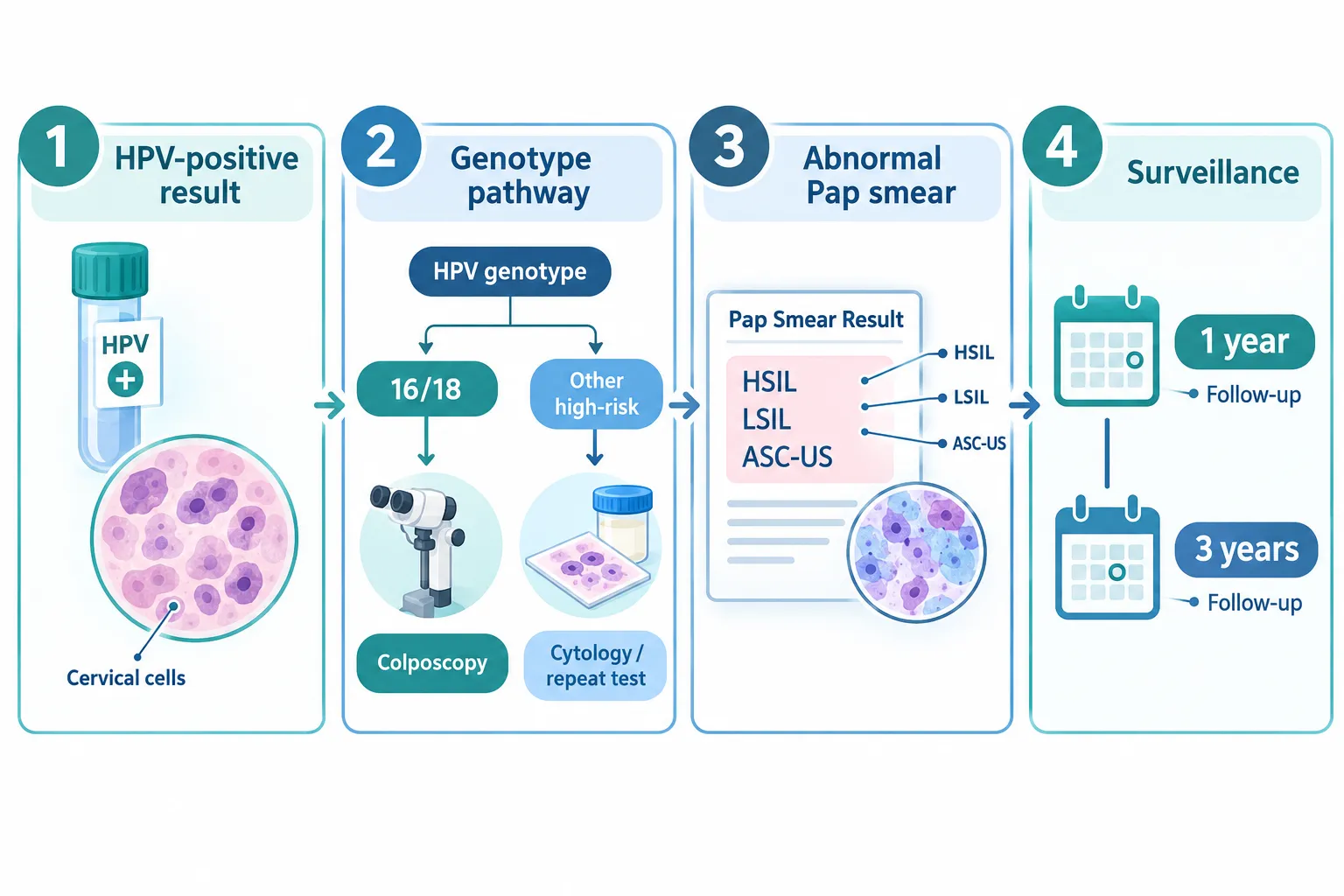
This is the core of the question, and the answer is risk-based, not binary.
HPV16 and HPV18: Colposcopy Is Almost Always Recommended
HPV16 and HPV18 are responsible for approximately 70% of cervical cancers. When either of these genotypes is identified, even with a normal Pap smear, current guidelines in the United States and most of Europe recommend colposcopy rather than watchful waiting. The cancer risk associated with these two types is high enough that waiting a year to repeat the test is not considered appropriate management.
If you have been told your HPV result is positive for type 16 or 18, a colposcopy referral is the expected next step.
Other High-Risk HPV Types: It Depends on the Pap Result
There are 12 other HPV genotypes classified as high-risk (including types 31, 33, 45, 52, and 58). A positive result for one of these types, with a normal Pap smear, typically leads to repeat co-testing in one year rather than immediate colposcopy. The rationale: most of these infections will clear on their own, and the added information from a repeat test helps identify the minority of people whose infection is persisting and whose cells are beginning to change.
If the Pap smear is abnormal, particularly at the LSIL (low-grade squamous intraepithelial lesion) or HSIL (high-grade squamous intraepithelial lesion) level, colposcopy is recommended regardless of which high-risk type is present.
An ASC-US (atypical squamous cells of undetermined significance) result combined with a high-risk HPV positive test also typically triggers colposcopy referral. The ASCUS HPV research overview explains what that result means and what the evidence shows about next steps.
Low-Risk HPV Types: Colposcopy Is Not Indicated
Low-risk types, primarily HPV6 and HPV11, which cause most genital warts, do not cause cervical cancer. A positive result for a low-risk type does not lead to colposcopy. Standard cervical screening guidelines do not even test for low-risk types; if you have been told you have a low-risk HPV type, the management is different and focused on any visible lesions rather than cervical surveillance.
Persistent HPV and When Repeat Colposcopy Becomes Necessary

A single positive HPV test is not the same as a persistent infection. Persistence, defined as the same high-risk HPV type detected on two tests at least one year apart, is what drives cervical cell changes toward precancer. This is the scenario that most warrants colposcopy if one has not already been performed.
After a colposcopy that finds no significant abnormality (a result sometimes called CIN1, or no CIN), follow-up testing is still required. Most guidelines recommend a repeat co-test at 12 months. If the HPV infection has cleared by then, you return to routine screening intervals. If it persists, a repeat colposcopy is usually recommended.
Cell changes are easiest to treat before they progress, that’s exactly what this follow-up structure is designed to catch.
Who Is at Higher Risk for Needing Colposcopy with HPV?
Some groups face a higher likelihood that an HPV infection will persist and require more active monitoring:
- Immunocompromised people, including those living with HIV, organ transplant recipients, and anyone on long-term immunosuppressive therapy, clear HPV infections more slowly and develop cell changes at higher rates. Guidelines for this group often recommend colposcopy at lower thresholds, sometimes after any high-risk HPV positive result regardless of Pap findings.
- People with a history of previous abnormal Pap results or treated precancer, prior CIN2 or CIN3 raises the baseline risk that a new or persistent HPV infection will progress more quickly.
- Smokers, smoking impairs local cervical immunity and is associated with higher rates of HPV persistence and progression to high-grade dysplasia.
- People with long-standing high-risk HPV infection, the longer a high-risk type has been present without clearing, the higher the cumulative risk of cell change.
If any of these apply to your situation, discuss them directly with your clinician, they affect the threshold at which colposcopy is recommended.
New Triage Tools Changing How Colposcopy Decisions Are Made in 2026
Not everyone with a high-risk HPV positive result needs a colposcopy right away, and researchers have been working to sharpen the triage process so that the procedure is reserved for people who genuinely need it.
Two developments are reshaping this in 2026:
Dual-stain cytology tests cervical cells for two proteins, p16 and Ki-67, that are expressed when HPV has begun to interfere with normal cell cycling. A positive dual-stain result in someone with a high-risk HPV infection is a stronger predictor of underlying CIN2 or CIN3 than a conventional Pap smear alone. Several health systems are now using dual-stain as a triage step between a high-risk HPV positive result and a colposcopy referral.
Self-collected HPV testing, where you collect your own vaginal sample rather than having a clinician-collected cervical sample, is now validated and increasingly available. Self-collected samples detect high-risk HPV with accuracy comparable to clinician-collected samples. When a self-collected test returns a positive result, the follow-up pathway mirrors that of a standard HPV test: genotyping for HPV16/18, and cytology or dual-stain triage for other high-risk types.
The direction of travel is toward more precise risk stratification, fewer unnecessary colposcopies for people with transient infections, and faster referral for those with genuinely elevated risk.
What to Do If You Have an HPV-Positive Result Right Now
The practical answer depends on what your result actually says.
If your result specifies HPV16 or HPV18: contact your clinician to arrange a colposcopy. This is not an emergency, but it should not be deferred for months.
If your result shows other high-risk HPV types with a normal Pap: your clinician will likely recommend a repeat co-test in 12 months. Keep that appointment, it is the point at which persistence can be identified.
If your result shows high-risk HPV with an abnormal Pap (any grade): expect a colposcopy referral. The abnormal Pap smear guide covering what to expect explains what each result category means before you go in.
Understanding your HPV type is a useful starting point, the HPV types guide explaining low-risk and high-risk genotypes breaks down what the numbers mean in plain terms.
For a broader picture of how HPV affects cervical health specifically, the HPV in women overview covering symptoms, screening, and cervical risk covers the full context.
Frequently Asked Questions
Can I have a colposcopy if I’m not sure which HPV type I have?
Yes. If your HPV test did not include genotyping, meaning it returned a positive result without specifying the type, your clinician will use your Pap smear result and any other clinical factors to guide the decision. An abnormal Pap combined with any high-risk HPV positive result is typically sufficient to recommend colposcopy without needing to know the exact genotype.
Does a normal colposcopy mean the HPV is gone?
Not necessarily. A normal colposcopy means no significant cell changes were found at that point in time. The HPV infection may still be present. Follow-up testing, usually a repeat co-test at 12 months, is still required to confirm whether the infection has cleared or persisted.
Does having HPV affect my sexual activity before or after a colposcopy?
After a colposcopy with biopsy, most clinicians recommend avoiding penetrative sex, tampons, and swimming for about a week while the biopsy site heals. Before a colposcopy, there are no specific restrictions related to HPV itself. The guide to sex and HPV covers what the evidence shows about transmission and activity during an active infection.
Is colposcopy recommended for men with HPV?
Standard colposcopy is a cervical procedure, so it does not apply to people without a cervix in the same way. Men and people with a penis who have high-risk HPV may be monitored for anal or penile cell changes through different procedures, such as high-resolution anoscopy for anal HPV. Routine HPV testing for men is not universally recommended, but screening exists for higher-risk groups.
If my HPV clears after a colposcopy, do I still need regular Pap smears?
Yes. Clearing one HPV infection does not prevent future infections or guarantee that previously affected cells have fully normalized. Most guidelines recommend continued cervical screening on a standard schedule, typically every three to five years depending on age and test type, after a treated or resolved HPV episode.
Can the HPV vaccine help after a positive result?
The vaccine does not treat an existing infection, but it may protect against HPV types you have not yet been exposed to. Whether vaccination makes sense after a positive result depends on your age and vaccination history. The HPV vaccination guide covering whether you can get vaccinated if you already have HPV covers the current recommendations in detail.
What This Means for You
An HPV-positive result is a data point, not a diagnosis of cancer or precancer. The question of whether you need a colposcopy has a specific, answerable answer, and it hinges on your HPV genotype, your Pap smear result, and your individual risk factors.
HPV16 or HPV18 positive: arrange a colposcopy. Other high-risk HPV with a normal Pap: follow up in 12 months and keep that appointment. Abnormal Pap at any grade combined with high-risk HPV: expect a colposcopy referral and go. Immunocompromised: discuss lower-threshold referral criteria with your clinician directly.
The screening system is designed to catch cell changes before they become something harder to treat. Following through on the recommended next step, whether that is a colposcopy now or a repeat test in a year, is how that system works in your favor.