An ASC-US result on a Pap smear is one of the most common abnormal findings in cervical screening, and one of the most misunderstood. It does not mean you have cancer. It means a small number of cervical cells looked slightly unusual under a microscope, and the lab couldn’t classify them with certainty. What happens next depends almost entirely on whether HPV is present.
That single question, HPV positive or negative?, now drives nearly every management decision for ASC-US. Here is what the research actually shows about why that matters, what the numbers mean, and what the latest evidence says about smarter ways to follow up.
Key Takeaways
- An ASC-US result alone is not a diagnosis of cancer or precancer, it is a prompt to investigate further.
- HPV testing after ASC-US is the most reliable way to separate low-risk from higher-risk cases; HPV-negative ASC-US carries roughly a 1.4% chance of developing CIN3 or worse over two years.
- HPV-positive ASC-US carries a meaningfully higher risk, around 15% for CIN3 or worse, and warrants closer follow-up or colposcopy.
- Newer triage tools, including extended HPV genotyping and DNA methylation assays, are showing strong results for reducing unnecessary colposcopy referrals without missing high-grade lesions.
- Management is not one-size-fits-all; your age, HPV type, and immune status all influence what your doctor will recommend.
What ASC-US Actually Means
ASC-US stands for atypical squamous cells of undetermined significance. The name is deliberately cautious: the cells are abnormal, but not abnormal enough to classify as a clear precancerous change. This is the most frequently reported abnormal Pap result, accounting for roughly half of all cervical cytology abnormalities.
The finding itself does not tell you much. Some ASC-US results reflect a passing HPV infection that will resolve on its own. Others sit above a genuine low-grade lesion, and a smaller fraction overlie a high-grade change that needs attention. The cytology result cannot distinguish between these scenarios, which is exactly why HPV testing became central to ASC-US management.
For a broader grounding in how HPV works and why certain types matter more than others, the plain-English guide to HPV types covers the difference between low-risk and high-risk genotypes in detail.
ASCUS HPV: What Research Shows About the HPV-Negative Result
If your ASC-US result comes back with a negative HPV test, the research is reassuring, and specific. Long-term data from the ASCUS-LSIL Triage Study (ALTS) show that only about 1.4% of women with HPV-negative ASC-US developed CIN3 or worse over a two-year follow-up period. That is a low number.
HPV-negative ASC-US is treated as a very low-risk result in most current guidelines. The standard recommendation is to return to routine screening intervals, no colposcopy, no accelerated repeat testing in most cases. The cell changes that triggered the ASC-US finding were almost certainly unrelated to an active HPV infection.
This is a meaningful distinction. It means a negative HPV test after ASC-US is genuinely good news, not just a temporary reprieve. The evidence supports treating it that way.
ASCUS HPV: What Research Shows About the HPV-Positive Result
HPV-positive ASC-US is a different picture. In the same ALTS dataset, roughly 15.2% of women with HPV-positive ASC-US developed CIN3 or worse within two years. That is a real risk, not catastrophic, but high enough that it cannot be managed with routine screening alone.
Because of this, HPV-positive ASC-US is treated similarly to LSIL (low-grade squamous intraepithelial lesion) in many protocols. The options typically include colposcopy, or a more refined triage step before deciding whether colposcopy is needed.
Earlier randomized trial data, including results from the ALTS trial, showed that reflex HPV testing for ASC-US is at least as effective as repeating cytology, and can reduce colposcopy referrals by roughly 50% compared with sending every ASC-US case straight to colposcopy. That finding formed the foundation of modern HPV-centered management algorithms.
The HPV testing guide explains how HPV test results are read and what the different result categories mean in practice.
Who’s at Higher Risk for Complications with HPV-Positive ASC-US?
Not everyone with HPV-positive ASC-US faces the same level of risk. Several factors push the probability of an underlying high-grade lesion higher:
- Immunocompromised individuals, including people living with HIV and organ transplant recipients, clear HPV infections more slowly and are more likely to develop persistent high-grade lesions.
- Smokers, tobacco use is associated with reduced local immune response in cervical tissue, making it harder for the body to clear high-risk HPV types.
- People with a prior history of abnormal Pap results, a previous LSIL, HSIL, or treated lesion raises the baseline risk that a new ASC-US finding reflects something significant.
- Unvaccinated individuals, particularly those exposed to HPV 16 or HPV 18, the two genotypes responsible for the majority of cervical cancers and the highest-risk subgroup within HPV-positive ASC-US.
How Genotyping Is Changing ASC-US Management
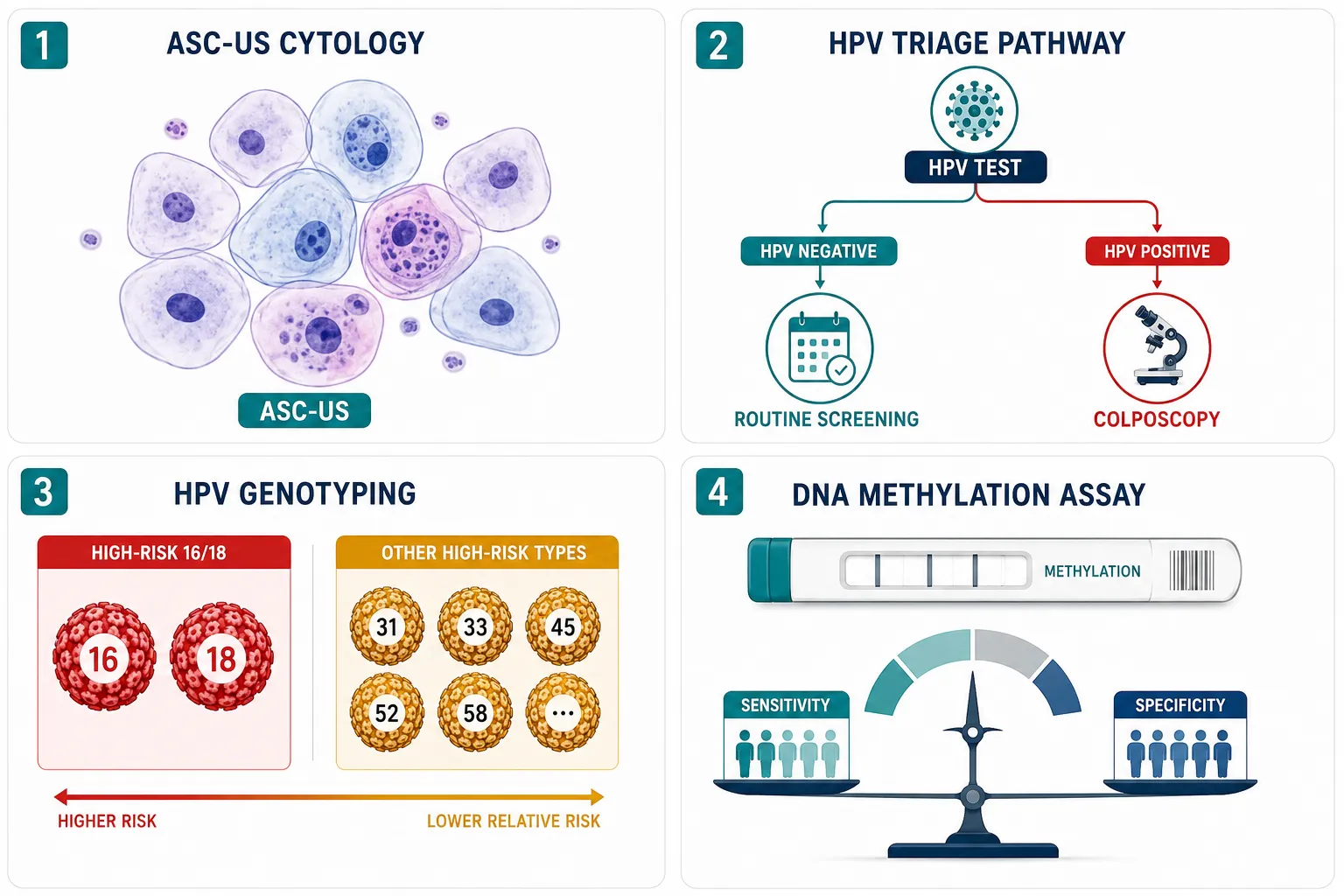
Not all high-risk HPV types carry equal risk. HPV 16 alone accounts for the majority of HPV-related cervical cancers, and HPV 18 is the second most common type in invasive disease. Research published in late 2025 on extended HPV genotyping for ASC-US showed that conventional triage, referring all HPV-positive ASC-US cases directly to colposcopy, can be significantly refined by identifying which specific high-risk type is present.
A genotype-informed strategy aims to maintain or improve detection of CIN2+ and CIN3+ while reducing the total number of women sent to colposcopy. Studies combining HPV 16/18 genotyping with cytology thresholds show that using HPV 16 or HPV 16/18 positivity as a direct trigger for colposcopy, while applying cytology-based triage for other high-risk types, improves sensitivity without dramatically increasing procedure volume.
This is a meaningful shift. The old approach was binary: HPV positive meant colposcopy. The emerging approach asks which HPV type, and uses that answer to make a more targeted decision.
DNA Methylation Testing: A Promising Second-Line Tool
One of the more significant recent developments in ASCUS HPV research is the use of host DNA methylation assays as a triage tool for HPV-positive cases. A 2025-2026 study found that a multigene DNA methylation panel achieved high specificity with good sensitivity, allowing a substantial reduction in colposcopy referrals without missing high-grade cervical lesions.
The performance was consistent across different high-risk HPV types and was particularly effective in women aged 30 and older. The principle is straightforward: when high-risk HPV persists long enough to drive precancerous change, it leaves chemical marks on the host cell’s DNA. Detecting those marks is a more direct signal of genuine disease progression than cytology alone.
Methylation testing is not yet standard in most national guidelines, but expert commentary within recent publications indicates that DNA methylation panels and extended genotyping are likely to be incorporated into more protocols over the next few years as evidence accumulates.
The Layered Triage Model: Where the Research Is Heading
The clearest theme across recent analyses and updated guidelines is that ASC-US management is moving toward multi-step, layered triage. Rather than a single decision point, the emerging model looks like this:
- Primary HPV testing to separate negative (low risk, return to routine screening) from positive (requires further evaluation).
- For HPV-positive results: genotyping to identify HPV 16/18 versus other high-risk types.
- For non-16/18 high-risk types: cytology, dual immunostain (p16/Ki-67), or methylation assay to further stratify risk before committing to colposcopy.
April 2026 updated clinical practice guidelines from a cervical cancer screening consortium explicitly prefer HPV triage over routine immediate colposcopy for initial ASC-US management, noting that HPV testing is comparable to colposcopy for screening performance while reducing invasive procedures and resource use.
Cost-effectiveness analyses support this direction. HPV triage identifies the majority of women with significant cervical neoplasia while directing HPV-negative women back to routine screening. The trade-off, broader HPV positivity leading to more colposcopy referrals, is exactly what genotyping and methylation assays are designed to address.
For context on what an abnormal result means in practice and what follow-up typically involves, the guide to what happens after an abnormal Pap smear covers the colposcopy process and what to expect.

What This Means for Your Follow-Up
If you have received an HPV-positive ASC-US result, the next step depends on your specific situation, your age, which HPV type was detected, your screening history, and your immune status. Cell changes are easiest to treat before they progress, which is what the triage process is designed to catch.
If you have an HPV-negative ASC-US result, the evidence supports returning to routine screening. That is not a dismissal of the finding, it is the medically appropriate response to a genuinely low-risk result.
The overview of HPV in women covers how HPV interacts with cervical health across different life stages, including during pregnancy and in the context of prior abnormal results.
Some people with persistent HPV-positive results explore whether nutritional or immune-support strategies might help. The evidence on supplements like AHCC is still developing, the AHCC for HPV evidence review summarizes what current research does and does not support.
Frequently Asked Questions
Does ASC-US mean I have a precancerous lesion?
Not necessarily. ASC-US means the cells looked mildly atypical, but the finding alone does not confirm a precancerous change. Many ASC-US results, especially HPV-negative ones, reflect transient changes with no underlying lesion. HPV testing is the most reliable next step for clarifying what the result actually means.
If I’m HPV-positive with ASC-US, do I automatically need a colposcopy?
Not always, though it depends on your specific situation and which guidelines your provider follows. Some protocols recommend immediate colposcopy for HPV-positive ASC-US, while others use genotyping or dual stain testing to decide whether colposcopy is necessary. HPV 16 or HPV 18 positivity generally warrants more urgent evaluation than other high-risk types.
How long does it take for HPV-positive ASC-US to resolve on its own?
There is no fixed timeline, and it varies person to person. Many HPV infections clear within one to two years, and when they do, ASC-US findings typically resolve as well. Immune status, HPV genotype, and age all influence how quickly or slowly the body clears an infection.
Can I have ASC-US without ever having had symptoms?
Yes. ASC-US is almost always detected through routine Pap smear screening, most people have no symptoms at all. HPV infections that cause cervical cell changes rarely produce noticeable symptoms in early stages, which is why regular cervical screening exists.
What is the difference between ASC-US and LSIL or HSIL?
ASC-US is the most ambiguous category, cells are atypical but not clearly abnormal. LSIL (low-grade squamous intraepithelial lesion) reflects mild but identifiable dysplasia, typically associated with an active HPV infection. HSIL (high-grade squamous intraepithelial lesion) indicates more significant cell changes that have a higher probability of progressing to cancer if untreated. HPV-positive ASC-US is managed similarly to LSIL in many current protocols.
Should I be worried if my ASC-US result keeps coming back on repeat testing?
Persistent ASC-US, especially with ongoing HPV positivity, warrants closer evaluation. A single ASC-US result is not alarming, but repeated findings suggest the underlying cause has not resolved. Your doctor will likely recommend colposcopy or more detailed triage testing if the result recurs.