Yes, HPV can spread without penetrative intercourse, though sexual contact remains by far the most common route. Non-sexual transmission is real and documented, but it accounts for a small fraction of infections. Understanding exactly how it happens, and how it doesn’t, matters whether you’re trying to make sense of a diagnosis, protect a partner, or decide about vaccination.
Key Takeaways
- HPV spreads primarily through skin-to-skin genital contact, but penetrative sex is not required for transmission
- Oral contact, self-inoculation, and mother-to-child transmission during birth are all documented non-sexual routes
- HPV has been detected in infants and people who have never had sex, confirming non-sexual routes exist
- Fomite (surface) transmission is theoretically possible but considered a low-probability route
- Vaccination protects against the most harmful HPV types regardless of how exposure occurs
How HPV Actually Spreads, Sexual and Otherwise
HPV is a skin virus. It spreads through direct contact with infected skin or mucous membranes, which is why genital-to-genital contact, with or without penetration, is the primary transmission route. You don’t need intercourse for genital HPV to pass from one person to another.
That distinction matters. Someone can acquire genital HPV types through close genital contact, manual contact, or oral sex without ever having penetrative sex. This is one reason HPV is so common: the behaviors that transmit it are broader than most people assume. The HPV types guide on HPVGuide.org explains how different genotypes, including high-risk types 16 and 18, and low-risk types 6 and 11, behave differently in the body.
What the evidence shows is that most HPV infections, including those acquired through non-penetrative contact, clear on their own within one to two years. Having HPV doesn’t mean you’ll develop lasting complications.
Non-Sexual Routes: What the Evidence Actually Shows
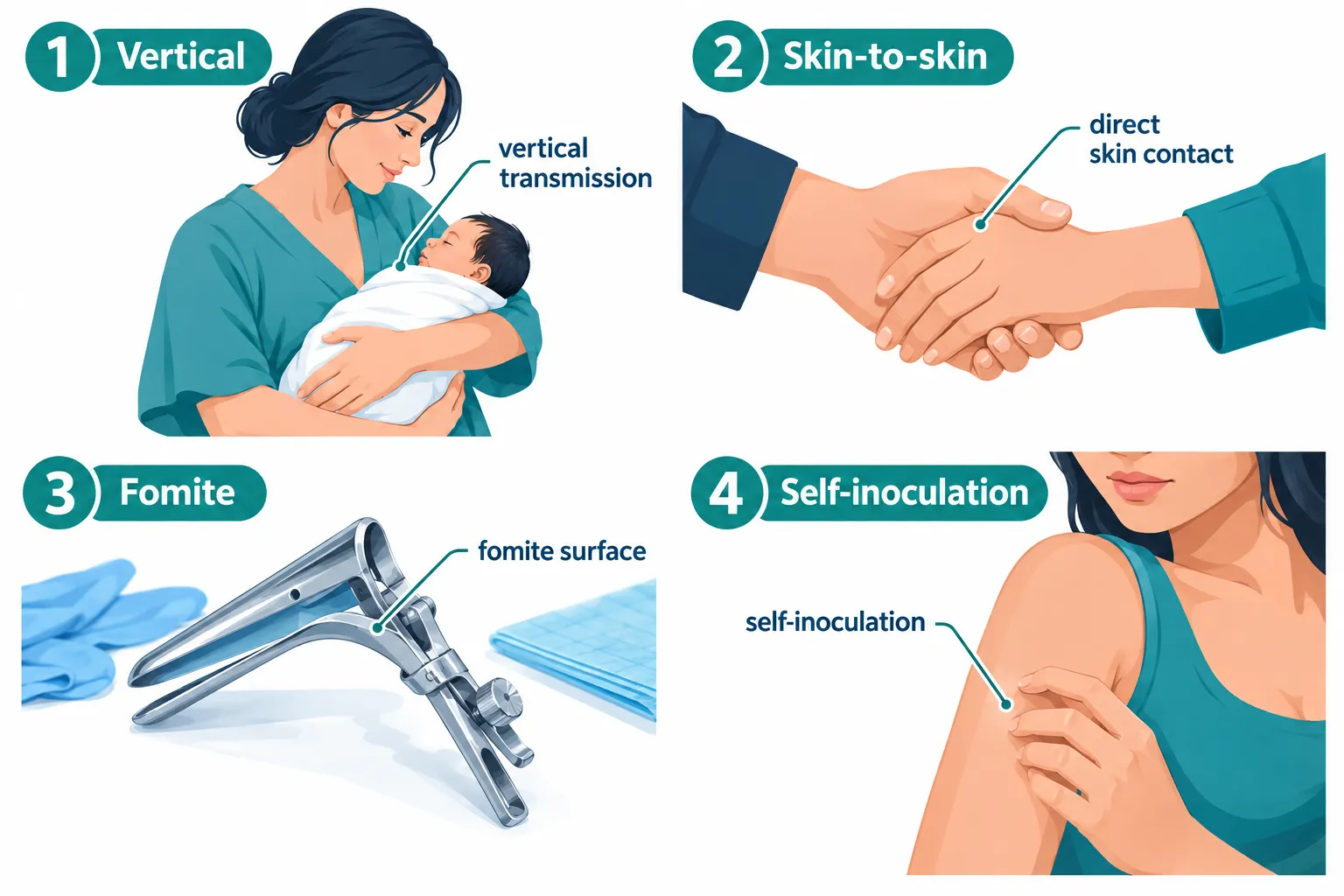
Can you get HPV without having sex in any traditional sense? Yes. Several non-sexual transmission routes are documented, though their overall contribution to HPV prevalence is small.
Vertical Transmission (Mother to Child)
HPV can pass from a birthing parent to a newborn during delivery. The virus has been detected in the throats and genital areas of infants born to HPV-positive parents. This can occasionally lead to recurrent respiratory papillomatosis, a condition where HPV types 6 or 11 cause wart-like growths in a child’s airway. The absolute risk is low, but it is a genuine non-sexual transmission pathway.
Self-Inoculation
If you have a cutaneous (skin) HPV infection, a common wart on your hand, for example, it’s possible to transfer the virus to another part of your own body through scratching or touching. This is called self-inoculation. It’s one reason common warts and genital warts share a viral family, though they are caused by different HPV genotypes.
Caregiver-Mediated Transfer
In children, HPV has been found in anogenital areas without any evidence of sexual abuse. Researchers have documented caregiver-mediated transfer, where a parent or caregiver with a cutaneous HPV infection inadvertently transmits the virus during routine care like diapering or bathing. This is considered a rare but real route.
Fomite Transmission
HPV DNA has been detected on medical equipment, examination table paper, and other surfaces. Whether this translates into actual infection is less clear. The virus appears to survive briefly on surfaces, but the true risk of acquiring HPV from an inanimate object is considered low by most researchers. It’s not zero, but it’s not a route that drives population-level transmission.
HPV in People Who Have Never Had Sex
HPV has been detected in virgins, people who report no sexual contact of any kind. Studies have found genital HPV in a small percentage of sexually inexperienced individuals, including adolescents. This supports the existence of non-sexual routes, though researchers note that self-reported sexual history is not always complete.
The takeaway is not that non-sexual transmission is common. It isn’t. The takeaway is that a positive HPV result does not automatically imply a specific sexual history, and it cannot be used to draw conclusions about a partner’s behavior. The timing of HPV infection is often unknowable, the virus can remain dormant for months or years before any test detects it.
Who’s at Higher Risk for Non-Sexual HPV Exposure?
A few groups face a meaningfully higher chance of HPV transmission through non-sexual routes:
- Newborns delivered vaginally when the birthing parent has an active HPV infection, particularly with types 6 or 11
- Immunocompromised individuals, including those living with HIV or on immunosuppressive therapy after organ transplant, who are less able to clear HPV after any exposure, sexual or not
- Infants and young children in close daily contact with caregivers who have active cutaneous HPV infections
- Unvaccinated people of any age, since vaccination blocks the most clinically significant genotypes regardless of transmission route
Does Oral Contact Count as “Sex” for HPV Purposes?
This is where the question of whether you can get HPV without having sex gets complicated. Oral HPV, including high-risk types like HPV 16, which is linked to oropharyngeal cancers, is primarily transmitted through oral-genital or oral-anal contact. Many people don’t classify that as “sex.”
Whether or not you call it sex, the biology is the same: HPV spreads through mucosal contact. The HPV transmission through kissing and oral contact question is addressed separately, but the short answer is that deep oral contact carries some transmission risk, while casual kissing carries very little.
Vaccination Matters Regardless of Transmission Route
Whether HPV enters the body through sexual contact, vertical transmission, or any other route, the same strains cause the same outcomes. Gardasil 9 protects against nine HPV types, including types 16, 18, 31, 33, 45, 52, and 58 (high-risk) and types 6 and 11 (which cause most genital warts). The vaccine works by preventing initial infection, not by clearing an existing one.
This means vaccination is relevant even if you’re asking about non-sexual transmission. A child born to an HPV-positive parent, or an immunocompromised adult exposed through non-sexual skin contact, still benefits from the immune protection the vaccine provides. The HPV vaccine overview at HPVGuide.org covers the full schedule and eligibility.

What This Means If You’ve Been Diagnosed
A positive HPV test does not tell you when you were infected, how you were infected, or who you got it from. Genital HPV types are overwhelmingly transmitted through sexual or intimate contact, that’s the medical reality, but the exact timing and source are rarely traceable. If you’re trying to understand a recent diagnosis in the context of a relationship, the HPV transmission and sexual activity guide covers what that means practically.
Most HPV infections, including high-risk types, clear without treatment. If you have a high-risk type that persists, your doctor will monitor for cell changes, that’s what Pap smears, HPV co-tests, and colposcopy are designed to catch early. Cell changes are easiest to manage before they progress, which is exactly what routine screening is for.
Frequently Asked Questions
Can HPV spread through a toilet seat or shared towel?
It’s theoretically possible, HPV DNA has been found on surfaces, but the actual infection risk from toilet seats or shared linens appears to be very low. The virus needs to contact vulnerable skin or mucous membranes in sufficient quantity to establish infection, and surface survival is limited. This is not considered a meaningful transmission route in practice.
Can a child get genital HPV without being abused?
Yes, in rare cases. Caregiver-mediated transfer during routine care and vertical transmission at birth are both documented. Finding HPV in a child’s anogenital area does not automatically indicate sexual abuse, though abuse must always be considered and properly evaluated by a clinician. Non-sexual routes exist but are uncommon.
If my partner has HPV and I test negative, does that mean I didn’t get it from them?
Not necessarily. HPV testing in people with a cervix is done via Pap smear or co-test; there is no approved routine HPV test for people with a penis. A negative result can also reflect an infection that has cleared, or one that hasn’t yet been detected. The HPV testing guide explains how results are read and what follow-up looks like.
Can HPV come back after it’s cleared without sexual re-exposure?
Yes. What appears to be a new infection may be a reactivation of a latent infection that was suppressed rather than fully eliminated. This is more likely in immunocompromised individuals. The question of whether HPV can come back without sexual activity is covered in detail separately.
Does getting vaccinated protect against non-sexually transmitted HPV too?
Yes. The vaccine targets specific HPV genotypes regardless of how they’re transmitted. If you’re exposed to HPV 6, 11, 16, or 18 through any route, sexual or not, prior vaccination significantly reduces the chance of infection taking hold.
What to Do Next
If you’ve tested positive for HPV and you’re not sure how or when you were exposed, that uncertainty is normal, and medically, it often doesn’t change what happens next. Talk to your doctor about which HPV type was found, what monitoring or follow-up is appropriate, and whether vaccination is still relevant for you. If you’re unvaccinated and under 45, it’s worth asking. If you’re a parent wondering about a child’s diagnosis, a pediatrician or specialist can evaluate the full picture.
The most useful thing you can do right now is make sure any recommended screening is up to date. That’s true whether the exposure was sexual, non-sexual, or unknown.