AHCC is not a cancer treatment. That distinction matters, because if you’re asking whether it can help, you deserve a straight answer before anything else. The evidence shows AHCC may support immune function and could reduce some side effects of conventional cancer therapy, but no clinical trial has yet proven it treats or prevents cancer in humans.
Here’s what the research actually shows, where the gaps are, and what talking to your oncologist about AHCC actually looks like.
Key Takeaways
- AHCC is a dietary supplement derived from cultured shiitake mushroom mycelia, not an approved cancer drug.
- Animal studies show immune-modulating and anti-tumor effects, but human trial data is still limited and preliminary.
- Several phase II clinical trials are currently running, including studies in head and neck cancer, ovarian cancer, and immunotherapy patients, with key results expected between late 2025 and 2027.
- AHCC appears generally well-tolerated and may reduce chemotherapy-related side effects, but it should not replace conventional cancer care.
- Any decision to use AHCC alongside cancer treatment should involve your oncology team.
What Is AHCC, and Why Are Researchers Studying It for Cancer?
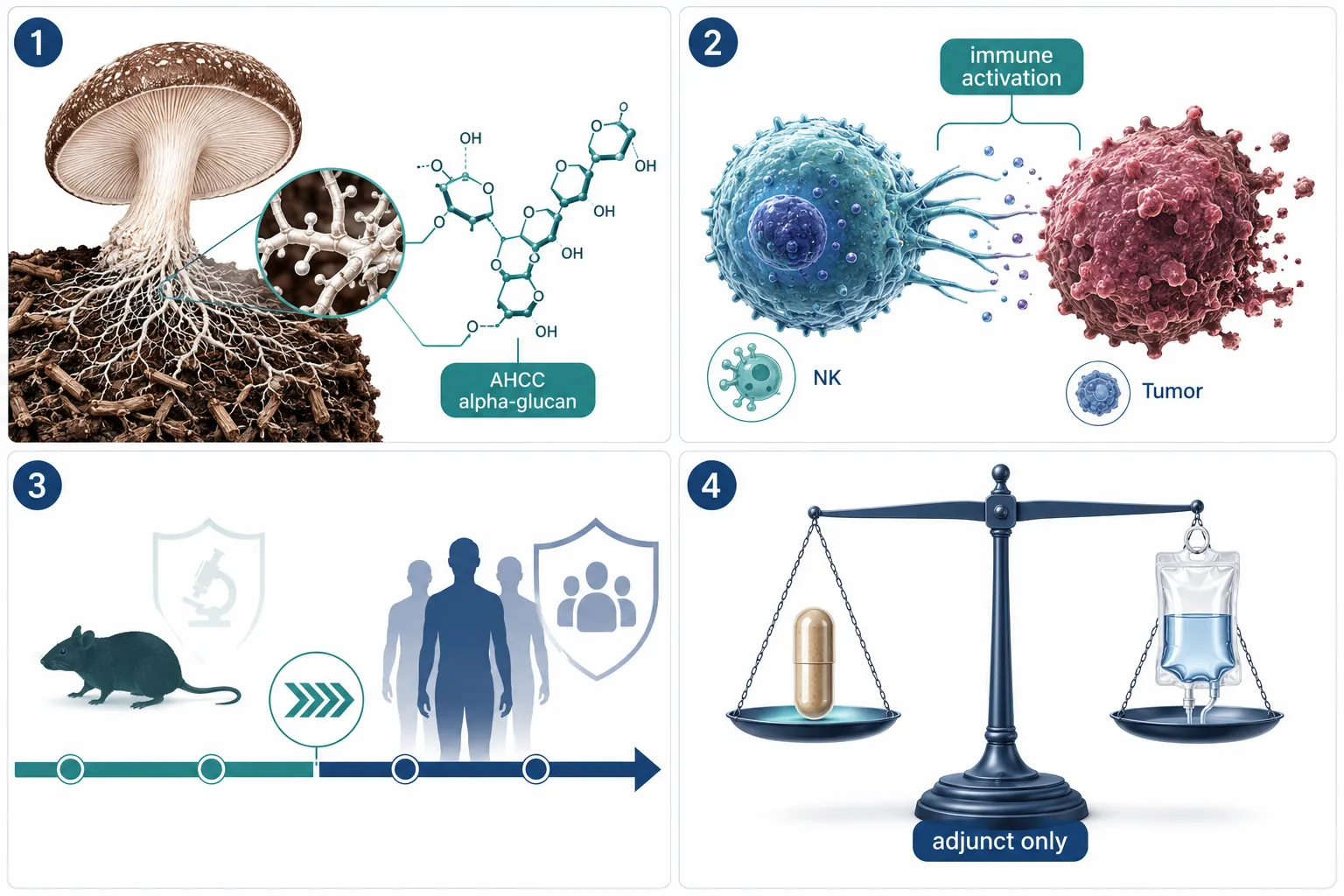
AHCC stands for Active Hexose Correlated Compound. It’s a standardized extract made from the cultured mycelia, the root-like threads, of Lentinula edodes, the shiitake mushroom. The manufacturing process breaks down the cell walls and concentrates specific carbohydrate molecules called alpha-glucans, which are thought to be the biologically active component.
Researchers became interested in AHCC for cancer-related reasons because of how it interacts with the immune system. Preclinical studies showed it could activate natural killer (NK) cells and T-cells, two types of immune cells that play a role in identifying and destroying abnormal cells, including tumor cells. In mouse models of melanoma and lymphoma, AHCC appeared to enhance tumor immune surveillance by modulating both innate and adaptive immune responses.
A more recent murine study found that long-term AHCC ingestion reduced the incidence of spontaneous breast and liver cancers and suppressed the growth of transplanted tumors. The authors concluded that continuous ingestion maintained health and prevented spontaneous carcinogenesis in the animal model.
These findings matter because they establish biological plausibility. They don’t prove AHCC works in humans, but they explain why clinical researchers are now running trials.
For a broader overview of what AHCC is and how it’s used, the AHCC, What to Know page covers the fundamentals.
Can AHCC Help With Cancer? What Human Studies Show So Far
This is where the evidence gets more cautious, and more honest.
Human studies on AHCC and cancer are small. Two early studies in liver cancer patients suggested possible improvements in outcomes, but neither was large enough or rigorous enough to draw firm conclusions. What the available data does suggest more consistently is that AHCC is well-tolerated and may reduce some side effects associated with chemotherapy.
Memorial Sloan Kettering Cancer Center’s integrative medicine team has reviewed AHCC and stated plainly that there isn’t enough research to say it works for its claimed indications. That’s not a dismissal of the compound, it’s an accurate description of where the evidence sits right now.
A prospective observational study published in Annals of Research in Oncology in March 2024 found that combining AHCC with Lactobacillus crispatus M247 enhanced clearance of high-risk HPV and supported regression of low-grade squamous intraepithelial lesions (LSIL). The authors noted this could reduce future cancer risk, particularly cervical cancer, but the study was non-randomized, and AHCC was used as part of a combination regimen, so it’s not possible to isolate its effect. The AHCC for HPV: what it is, what the evidence shows, and what it doesn’t page goes deeper on that specific research.
The pattern across human studies is consistent: AHCC looks promising, tolerability is good, and the immune effects are real. What’s missing is large, well-controlled randomized trial data with robust endpoints like survival and tumor response.
Active Clinical Trials: Where the Research Stands in 2026
Several phase II trials are now running, and this is where the most meaningful data will come from.
Head and neck cancer with chemoradiation A phase II trial sponsored by UC Irvine is studying AHCC given daily alongside standard chemoradiation in patients with HPV-positive head and neck squamous cell carcinoma. Patients are followed every three months for up to five years. The primary goal is evaluating whether AHCC acts as a supportive or radiosensitizing agent during treatment.
Immunotherapy combination A double-blind, randomized, placebo-controlled trial in Tainan City, Taiwan is testing AHCC at 3 g/day as an add-on immune modulator in cancer patients already receiving immunotherapy. The trial is assessing progression-free survival, overall survival, and immune response markers. It was initiated in August 2025 and is ongoing.
Ovarian cancer and chemotherapy side effects A randomized controlled feasibility trial is testing AHCC versus placebo in women with ovarian, fallopian tube, or peritoneal cancer undergoing adjuvant chemotherapy. The focus here is supportive care, whether AHCC reduces side effects and supports quality of life during treatment. Primary completion is expected in December 2025, with overall completion in March 2027.
Pediatric solid tumors An open-label exploratory study in Japan is evaluating AHCC’s immunostimulatory effects in children and adolescents aged 3-18 with refractory solid tumors, enrolling shortly after completion of prior anticancer therapy.
Analysts expect that meaningful data from these trials will begin emerging between late 2025 and 2027. That window will clarify whether AHCC has clinical benefits or remains an experimental adjunct.
For more on how AHCC intersects with specific cancer types, the AHCC Cancer, What to Know page covers that in detail, and the AHCC Cervical Cancer, What to Know page addresses the cervical cancer angle specifically.

Who Might Be Considering AHCC Alongside Cancer Care?
Not everyone asking about AHCC is in the same situation. The question looks different depending on where you are in a cancer journey.
- People currently in active treatment, chemotherapy, radiation, or immunotherapy, who want to know whether AHCC could reduce side effects or support immune function during treatment. The ovarian cancer and head and neck trials are directly relevant here.
- People with HPV-related precancerous changes, such as LSIL or high-grade squamous intraepithelial lesions (HSIL), who are looking for ways to support clearance or reduce cancer progression risk. The HPV-related evidence is the most developed in humans so far.
- Immunocompromised individuals, including those living with HIV or those who have received organ transplants, for whom immune support is a specific clinical concern and for whom HPV-related cancers carry elevated risk. The HPV and Cancer: which cancers are linked, how it happens, and how it’s prevented page explains that connection.
- People who have completed cancer treatment and are in surveillance, looking for evidence-based ways to support immune health going forward.
Each of these situations calls for a different conversation with your care team. AHCC’s role, if any, is not the same across all of them.
What AHCC Is Not
AHCC is sold as a dietary supplement. In the United States, that means it is not regulated as a drug, has not been approved by the FDA to treat or prevent cancer, and does not go through the same pre-market efficacy review that pharmaceutical drugs do.
That’s not a reason to dismiss it. It is a reason to be precise about what you’re taking and why.
Taking AHCC does not replace surgery, chemotherapy, radiation, immunotherapy, or any other evidence-based cancer treatment. The clinical trials currently running are testing it as an add-on, not as a substitute. If someone suggests using AHCC instead of conventional treatment, that advice is not supported by any current evidence.
The AHCC benefits, What to Know page covers the broader range of uses being studied, including immune support outside of cancer contexts.
Talking to Your Oncologist About AHCC
Bring it up. Oncologists are used to patients asking about supplements, and the conversation is more useful than you might expect.
Tell your care team the dose you’re considering, most human studies have used 3 g/day, and ask specifically whether there are any known interactions with your current treatment protocol. Some supplements can affect drug metabolism or interact with immunotherapy in ways that aren’t yet fully characterized.
Your oncologist may not have strong data to give you either way. That’s an honest answer, not a dismissal. Cell changes and immune function are easiest to monitor when your care team has the full picture of what you’re taking, that’s what the conversation is for.
For women specifically, the AHCC benefits for women, What to Know page addresses how the evidence applies to female-specific cancers and HPV-related conditions.
Frequently Asked Questions
Is AHCC safe to take during chemotherapy?
Available data suggest AHCC is generally well-tolerated, and at least one ongoing clinical trial is specifically testing it alongside adjuvant chemotherapy in ovarian cancer patients. That said, safety data from large randomized trials is not yet available. Always disclose any supplement to your oncology team before starting it during active treatment.
Does AHCC shrink tumors?
No human trial has demonstrated that AHCC shrinks tumors. Animal studies showed suppression of tumor growth in mouse models, but those findings cannot be directly applied to humans. The current human trials are measuring survival, immune response, and quality of life, not tumor shrinkage as a primary endpoint.
How is AHCC different from other mushroom supplements like beta-glucan?
AHCC is specifically derived from cultured shiitake mycelia and standardized to contain alpha-glucans. Other mushroom supplements, reishi, turkey tail, maitake, contain different compounds and have different research profiles. They are not interchangeable, and the evidence for each needs to be evaluated separately.
Can AHCC prevent HPV-related cancers?
The most relevant human evidence involves AHCC combined with a probiotic supporting HPV clearance and regression of low-grade lesions. Whether that translates to reduced cancer incidence over time is not yet established. It’s a reasonable hypothesis under investigation, not a proven outcome.
Where can I buy AHCC, and are all products the same?
AHCC is available as an over-the-counter supplement. Product quality varies, and not all formulations use the same standardization as those studied in clinical trials. If you’re considering it, look for products that specify the alpha-glucan content and match the dosage used in research settings, and discuss the choice with your care team.