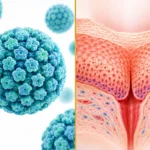
Kissing can transmit HPV, but the risk is much lower than most people assume, and it is not considered a major route of transmission. The real picture is more nuanced than either “kissing is safe” or “kissing spreads HPV.” What the evidence actually shows depends on the type of kissing, the HPV types involved, and a few other factors worth understanding clearly.
Key Takeaways
- Brief, closed-mouth kissing carries very low risk of HPV transmission; deep, open-mouth kissing carries a possible but still uncommon risk.
- Oral sex remains the strongest documented behavioral risk factor for oral HPV infection, kissing adds a smaller, additional risk.
- The HPV types most linked to oral and throat cancers are HPV 16 and HPV 18, the same high-risk types targeted by the HPV vaccine.
- Most oral HPV infections clear on their own without causing symptoms or cancer.
- Vaccination is the most effective prevention strategy, more protective than changing kissing behavior.
What the Evidence Actually Says About HPV and Kissing
HPV is primarily transmitted through direct skin-to-skin or mucous membrane contact. The virus lives in the cells lining the mouth, throat, genitals, and anus, not in saliva itself. That distinction matters.
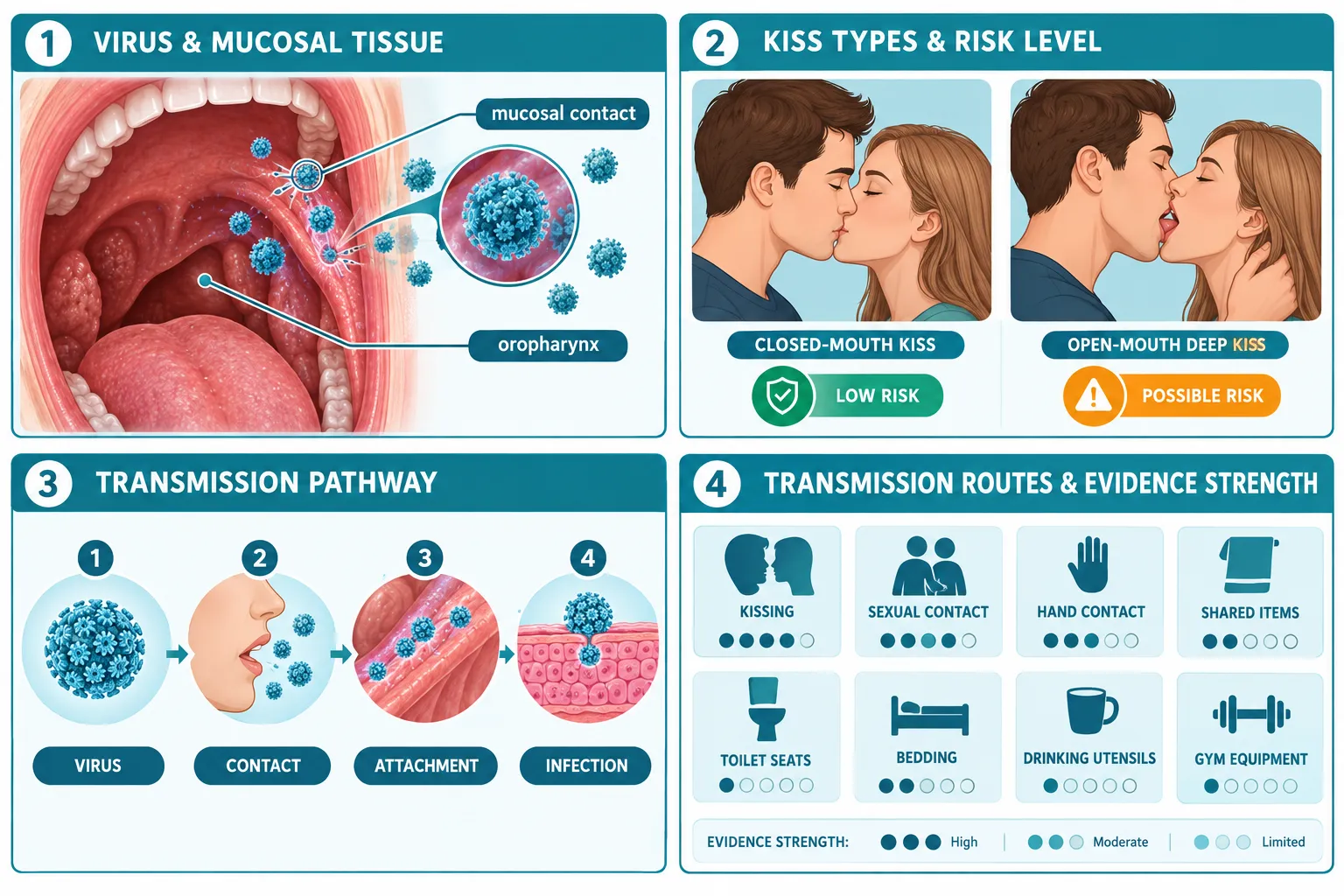
Closed-mouth kissing, where contact is brief and lip-to-lip, is considered very unlikely to spread HPV. The virus needs direct mucosal contact to establish infection, and a quick kiss does not typically provide that in a meaningful way.
Deep, open-mouth kissing, sometimes called French kissing, is a different situation. Extensive tongue-to-tongue contact brings the mucosal surfaces of two people into prolonged, direct contact. Research on college-aged men found that the number of recent open-mouth kissing partners was independently associated with oral HPV infection, even after accounting for oral sex history. Men who reported never having oral sex but who had 10 or more lifetime open-mouth kissing partners showed a significantly higher rate of oral HPV infection than those with fewer partners.
That finding matters. It suggests deep kissing can transmit HPV on its own, not just as a proxy for sexual activity.
Still, the absolute risk from kissing alone is low for most people. Oral HPV infection is relatively uncommon compared to genital HPV, and the majority of oral HPV infections clear without causing cancer. The HPV and cancer overview explains the full spectrum of cancer risk by HPV type and site.
Does the Type of HPV Matter for Kissing Transmission?
Yes. Not all HPV types behave the same way in the oral cavity.
HPV 16 is the type most strongly associated with oropharyngeal cancers, cancers of the back of the throat, base of the tongue, and tonsils. It is also the type most commonly detected in oral HPV studies involving kissing and sexual behavior. HPV 18, another high-risk type, is less commonly found in the oral cavity but still relevant. The HPV types guide covers how high-risk and low-risk types differ and what those distinctions mean clinically.
Low-risk types like HPV 6 and HPV 11, the types responsible for most genital warts, can also appear in the mouth and throat, where they are associated with a condition called recurrent respiratory papillomatosis rather than cancer. Transmission of these types through kissing is possible in principle, though less studied than high-risk types.
The key point: if deep kissing does transmit HPV, it is most likely to transmit whichever type the other person carries in their oral cavity. High-risk types in that location are the ones with cancer potential, which is why HPV vaccination matters even for people whose primary concern is oral health.
Can HPV Be Transferred Through Saliva Alone?
This is a fair question, and the honest answer is: probably not in any meaningful way. Research has not proven that HPV transmits through saliva alone, meaning through sharing drinks, utensils, or casual contact with someone’s saliva without direct mucosal contact.
The virus needs to reach living mucosal tissue to establish infection. Saliva as a fluid carrier is not an efficient vehicle for that. The detailed breakdown of HPV and saliva transmission covers the specific evidence on this question.
What does appear to matter is the intimacy and duration of contact, not the presence of saliva per se. Partners of people with persistent oral HPV infection have roughly ten times the risk of developing persistent oral HPV themselves compared to the general population. That pattern supports mouth-to-mouth contact as a transmission route, but it does not mean every kiss with an HPV-positive person will result in infection.
Who Is at Higher Risk for Oral HPV from Kissing?
A few groups face meaningfully higher risk:
- People with many kissing or oral sex partners. Both behaviors independently increase exposure. Having five or more recent open-mouth kissing partners, or a history of multiple oral sex partners, is the most consistently documented behavioral risk factor.
- Immunocompromised individuals. People living with HIV, those on immunosuppressive therapy after organ transplants, and others with reduced immune function are less able to clear HPV infections, oral or otherwise, once acquired.
- Smokers. Tobacco use is associated with impaired mucosal immunity and higher rates of persistent oral HPV infection, increasing the chance that an exposure leads to a lasting infection rather than clearing.
- Unvaccinated people. Those who have not received the HPV vaccine lack protection against the types most likely to cause oropharyngeal cancer, making any oral HPV exposure more consequential.
Can You Give a Child HPV by Kissing Them?
Parents often ask this, and it is a reasonable concern. The short answer is that transmission through a normal parental kiss, a quick, closed-mouth kiss on the cheek or forehead, is not a documented risk. Casual household contact, including affectionate kissing, is not considered a standard transmission route for HPV.
That said, there is evidence of what researchers call “horizontal” transmission in children, spread through close household contact, including mouth-to-mouth kissing and digital (finger-to-mouth) contact. This is thought to account for some HPV infections in children that are not sexually acquired. The full discussion of kissing and HPV transmission to children addresses this question with the nuance it deserves.
What Reduces the Risk?

The HPV vaccine is the most effective tool available. Gardasil 9 protects against HPV 16, 18, 6, 11, and five additional high-risk types. Vaccination before exposure to those types prevents infection at any site, including the oral cavity and oropharynx. The HPV vaccine guide for men covers eligibility, timing, and whether vaccination still helps after a prior HPV diagnosis.
Beyond vaccination, the evidence does not support recommending that people avoid open-mouth kissing as a standalone prevention strategy. The absolute risk from kissing is low enough that experts do not advise restricting it beyond standard safer-sex practices. What does reduce risk meaningfully:
- Vaccination (ideally before first sexual contact, but beneficial up to age 45 for many people)
- Limiting the number of oral sex partners
- Not smoking
- Regular medical follow-up for anyone with a history of HPV-related findings
If you have been diagnosed with oral HPV or have symptoms like a persistent sore throat, hoarseness, or a lump in the neck that does not resolve, those warrant evaluation, not because cancer is likely, but because cell changes are easiest to address before they progress.
Frequently Asked Questions
Can you get HPV through kissing if there are no visible sores?
Yes, it is possible. HPV does not require visible lesions to transmit. The virus can be present in the mucosal lining of the mouth and throat without any symptoms or visible signs. Deep kissing with an infected person can result in transmission even when neither person has any visible abnormality.
Does having oral HPV mean you will develop throat cancer?
No. Most oral HPV infections, including infections with high-risk types like HPV 16, clear on their own within one to two years. Only a small fraction of persistent high-risk oral HPV infections progress to oropharyngeal cancer, and that process typically takes many years. Regular medical follow-up matters if you have known risk factors or persistent symptoms.
Can you get HPV through kissing if you are vaccinated?
The HPV vaccine significantly reduces the risk of acquiring the types it covers, including HPV 16 and 18, the types most associated with oral and throat cancers. It does not protect against every HPV type, so it reduces but does not eliminate risk entirely. Vaccination remains one of the most protective steps available.
Is the risk of HPV from kissing the same for everyone?
No. Risk varies based on immune status, vaccination history, smoking, and the number of kissing and oral sex partners. Immunocompromised individuals and smokers face higher risk of persistent infection if exposed. The HPV symptoms overview explains why most people with HPV, oral or genital, have no symptoms at all.
Should I tell a partner I have oral HPV before kissing them?
There is no universal medical guidance requiring disclosure of oral HPV before kissing, partly because most people do not know their oral HPV status and because the risk from kissing alone is low. If you have a known oral HPV infection, talking to your doctor about what that means for your specific situation, including any relevant conversations with partners, is a reasonable next step.
What to Do Next
Deep kissing carries a possible but low risk of HPV transmission. Oral sex carries a higher, better-documented risk. Neither risk is zero, and neither is cause for significant alarm for most people.
If you are not vaccinated and are under 45, talk to your doctor about the HPV vaccine, it is the most concrete step you can take to reduce oral HPV risk. If you have had a recent diagnosis of oral HPV or an abnormal finding in the throat or mouth, ask specifically about monitoring frequency and what signs would warrant further evaluation. Cell changes caught early are far more manageable than those found late.
For questions about HPV transmission in other contexts, including sexual contact, the guide to HPV and sexual activity covers what is and is not known about transmission risk and how to have that conversation with a partner.