
There is no approved, routine HPV test for men, not in the way a cervical swab works for people with a cervix. That’s not a gap in your doctor’s knowledge; it’s the current state of clinical guidelines in 2026. But “no routine test” doesn’t mean “no options,” and it doesn’t mean HPV in men goes unaddressed.
What actually happens depends on your anatomy, your risk profile, and what you’re trying to find out.
Key Takeaways
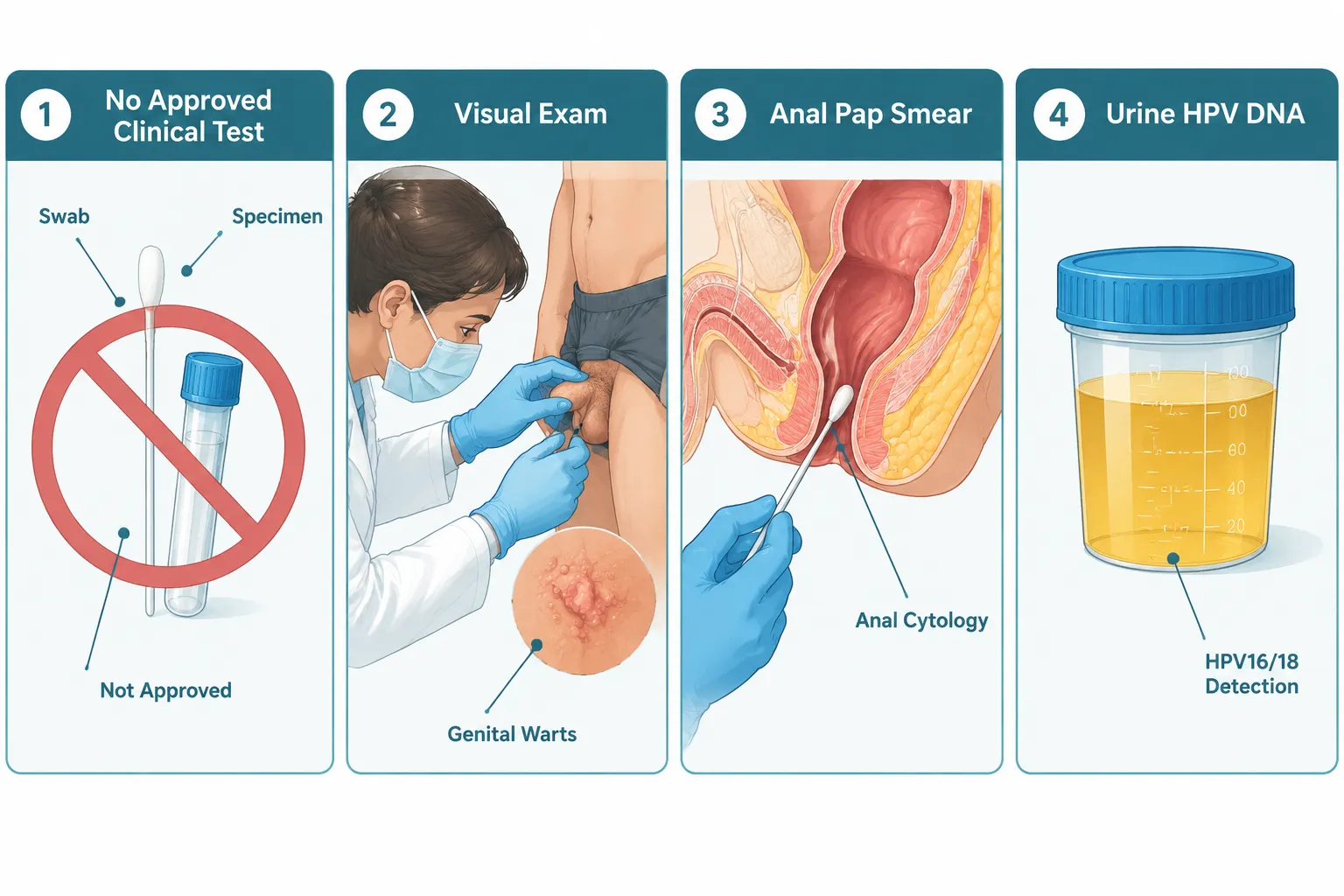
- No FDA-approved clinical HPV test exists for men as a routine screening tool; current tests are validated only for cervical cells.
- Doctors assess HPV in men primarily through visual examination of the genitals and, when needed, biopsy of suspicious tissue.
- Men who have sex with men (MSM) and men living with HIV have a meaningfully higher anal cancer risk, anal Pap smears and anal HPV DNA testing are used as targeted screening in these groups.
- Genital warts caused by low-risk HPV types 6 and 11 are diagnosable on sight; they don’t require a lab test to confirm.
- A urine-based HPV DNA test detecting high-risk types including HPV 16 and 18 has entered the commercial market in 2026, though it is not yet part of any clinical guideline.
Why There’s No Standard HPV Test for Men
The HPV tests used in cervical cancer screening, including liquid-based cytology and tests like the Aptima HPV assay, are validated specifically for cervical cells. The cervix provides a consistent, accessible sampling site with well-understood cellular changes that correlate with cancer risk. There is no equivalent anatomical site in men where HPV-related cell changes follow a predictable, screenable pattern across the general male population.
This matters because HPV testing isn’t just about detecting the virus, it’s about detecting it in a context where the result changes what a clinician does next. In men, most HPV infections are transient. The majority clear on their own within one to two years without causing any detectable cell changes or symptoms. A positive result from a penile swab, for example, would rarely alter clinical management, because there’s no established follow-up pathway tied to it the way colposcopy is tied to a positive cervical result.
Four reasons consistently cited in clinical literature explain why routine screening hasn’t been adopted:
- No standardized, validated sampling method for male genital HPV
- Most male infections are asymptomatic and self-clearing
- No proven treatment that reduces transmission once HPV is detected
- No clear evidence that routine testing reduces cancer outcomes in the general male population
For a broader look at how HPV affects men specifically, symptoms, risks, and what the evidence shows, the HPV in Men overview covers the full picture.
How HPV Is Actually Assessed in Men
Visual Examination
For most men, the clinical approach to HPV is a physical exam. A doctor looks for genital warts, soft, flesh-colored growths caused by low-risk HPV types 6 and 11, on the penis, scrotum, perineum, or around the anus. These are diagnosable by appearance. No swab, no lab result required.
If a lesion looks atypical or doesn’t respond to treatment, a biopsy can confirm whether HPV is involved and whether any cellular changes are present. That’s the exception, not the routine.
Anal Pap Smears and Anal HPV Testing
This is where targeted screening does exist, and where the answer to “can men get tested for HPV?” becomes more nuanced.
Men who have sex with men, particularly those living with HIV, have substantially elevated rates of anal HPV infection and a significantly higher risk of anal cancer compared to the general population. For this group, anal cytology (an anal Pap smear) and anal HPV DNA testing are used as screening tools in clinical settings equipped to follow up abnormal results with high-resolution anoscopy.
The anal HPV symptoms, screening, and prevention guide explains how anal HPV behaves and what the screening process involves. If you want to understand what the anal Pap procedure itself looks like step by step, the anal HPV test: what to expect page walks through it directly.
This screening is not universally recommended for all men, it depends on individual risk and whether appropriate follow-up care is available. But for high-risk men, it’s a meaningful clinical tool.
Emerging Urine-Based Testing
A urine-based HPV DNA test detecting high-risk genotypes including HPV 16 and HPV 18 has become commercially available in 2026. It requires no clinical swab and can identify the presence of high-risk HPV from a male urine specimen.
This is not yet incorporated into any national screening guideline. Its clinical utility, meaning whether a positive result should change how a man is managed, hasn’t been established through large outcome studies. That doesn’t make it worthless, but it does mean a positive result currently raises more questions than it answers without a clear follow-up protocol attached to it.
Who’s at Higher Risk and Should Consider Discussing Testing
Most men with HPV will never know they have it, and most will clear the infection without any intervention. But some groups carry meaningfully higher risk and have more reason to discuss screening options with a doctor:
- Men who have sex with men (MSM): Anal HPV infection and anal cancer risk are substantially higher in this group, particularly for those without prior HPV vaccination.
- Men living with HIV or other immunocompromising conditions: A weakened immune system makes it harder to clear HPV naturally, and harder to suppress progression from infection to cell changes to cancer.
- Unvaccinated men: HPV 16 and 18 together account for the majority of HPV-related cancers in men. Men who haven’t received the vaccine and are still within the recommended age range have a concrete reason to discuss it, the HPV vaccine for men page covers who benefits and what the evidence shows.
- Men with a history of genital warts or prior HPV-related lesions: Prior infection with one HPV type doesn’t protect against others; ongoing monitoring for new lesions is reasonable.
What Men Can Actually Do in 2026

The absence of a routine test doesn’t mean nothing can be done. Here’s what the evidence supports:
Get vaccinated if you’re eligible. The HPV vaccine covers high-risk types 16 and 18 as well as low-risk types 6 and 11. It’s approved through age 45 in the U.S. for adults who weren’t vaccinated earlier, though it’s most effective before exposure.
Have a visual genital exam as part of routine STI screening. This is the standard clinical approach for detecting warts or suspicious lesions.
If you’re MSM or HIV-positive, ask specifically about anal Pap screening. Not every clinic offers it, but it’s a legitimate and evidence-supported option for high-risk men.
Understand that HPV is common. Most sexually active adults will have HPV at some point. The how HPV spreads page explains transmission clearly, including what’s known and what isn’t about timing and source.
If genital warts are present, they’re treatable. Warts don’t require a lab test to manage. Treatment options range from topical prescriptions to in-office procedures. The genital warts treatment options page covers what’s available and how each approach works.
Understanding the broader link between HPV and cancer, which types carry real risk and what monitoring does about it, is covered in detail on the HPV and cancer page.
Frequently Asked Questions
Can a man find out if he has HPV right now?
Not through a standard lab test. A doctor can identify genital warts visually, and men in high-risk groups can access anal Pap smears and HPV DNA testing in appropriate clinical settings. A urine-based commercial test is now available in 2026 but isn’t part of any screening guideline yet. For most men, the honest answer is that HPV often goes undetected because it causes no symptoms and clears on its own.
If there’s no test, how does a man know if he’s putting a partner at risk?
This is genuinely difficult, and the medical reality is that HPV transmission can occur even when there are no symptoms and no visible lesions. Condoms reduce transmission risk but don’t eliminate it. Vaccination is the most reliable protective measure for both partners. The can a man give a woman HPV page addresses this question directly.
Does a negative anal Pap mean a man doesn’t have HPV?
No. An anal Pap tests for abnormal cell changes in the anal canal, it’s a cancer precursor screen, not a direct HPV detection test. A normal result means no concerning cell changes were found at that time. It doesn’t confirm the absence of HPV infection.
Should a man get tested if his partner was diagnosed with HPV?
Current guidelines don’t recommend routine HPV testing for male partners of people diagnosed with HPV, because there’s no approved test and no clinical action that follows from a positive result in this context. The more useful steps are vaccination (if eligible), a visual exam for any lesions, and ongoing STI screening.
Are penile or oral HPV swabs available anywhere?
Research settings have used penile swabs and oral rinse samples to study HPV prevalence in men, but these are not validated clinical tools and aren’t offered as part of standard care. Results from these methods aren’t currently actionable in a clinical context.
What to Do Next
If you’re asking whether men can get tested for HPV, you’re likely in one of a few situations: a partner was diagnosed, you have symptoms, or you’re trying to understand your own risk. All of those are reasonable reasons to talk to a doctor.
The practical next steps depend on your situation. If you have visible warts or lesions, a visual exam is the right starting point. If you’re MSM or HIV-positive, ask directly about anal Pap screening, it’s a legitimate clinical conversation. If you’re unvaccinated and under 45, vaccination is the most evidence-backed protective step available right now. And if you’re simply trying to understand HPV better before that conversation, the what is HPV guide is a solid place to start.
Cell changes are easiest to address before they progress, that’s what screening is designed to catch. Knowing which screening applies to you is the first step.