Yes, guys can absolutely catch HPV. Human papillomavirus does not discriminate by sex, it spreads through skin-to-skin sexual contact, and men are infected at rates that rival or exceed those seen in women. Nearly one in three men over age 15 worldwide carries at least one genital HPV type at any given time, and about one in five carry a high-risk type linked to cancer. Can guys catch HPV? The short answer is yes, commonly, and often without knowing it.
Key Takeaways
- HPV is one of the most common sexually transmitted infections in men, with global genital prevalence around 30%.
- Most infections cause no symptoms and clear on their own within one to two years.
- High-risk HPV types, particularly types 16 and 18, can cause penile, anal, and oropharyngeal cancers in men.
- Low-risk types 6 and 11 cause the majority of genital warts cases.
- The HPV vaccine is effective in men and is recommended through age 26, with shared clinical decision-making up to age 45.
How Do Men Get HPV?
HPV spreads through direct skin-to-skin contact, primarily vaginal, anal, or oral sex. A condom reduces risk but does not eliminate it, because the virus lives on skin surfaces not covered by a condom.
You don’t need penetrative sex to transmit HPV. Genital skin-to-skin contact is enough. That’s one reason the virus is so widespread: the exposure window is broad, and most people who carry it have no idea they do.
How HPV spreads and the routes it does not take covers the transmission mechanics in detail, including what counts as a risk and what doesn’t.
Infection can happen after a single sexual encounter, or it may take years of exposure before the immune system registers a detectable infection. There is no reliable way to know exactly when or from whom you acquired HPV, the virus can remain dormant for months or years before any sign appears, if one ever does.
Where Does HPV Show Up in Men?
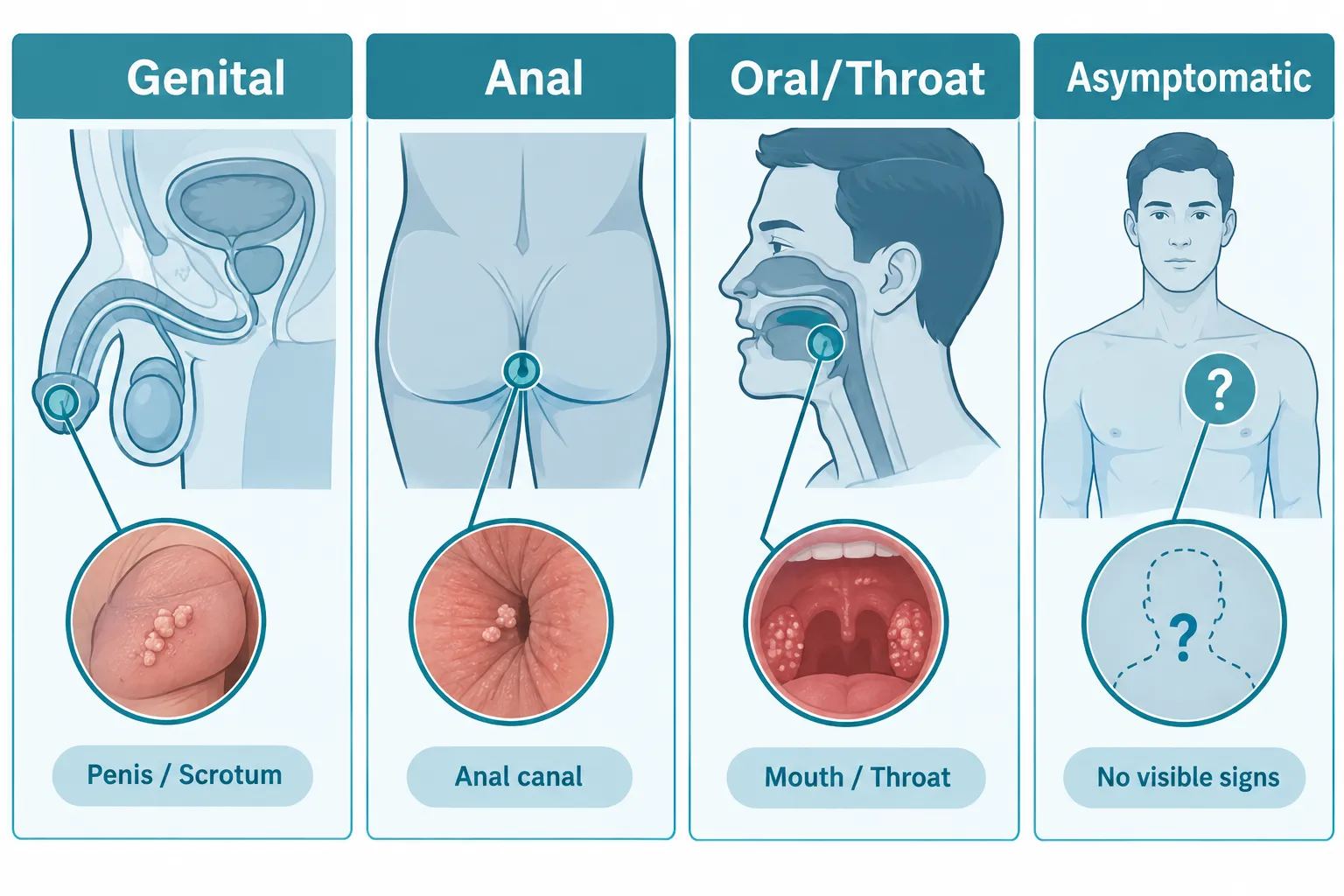
Men can carry HPV at multiple anatomical sites simultaneously. Research shows genital HPV prevalence in men at roughly 30%, anal HPV at around 48%, and oral HPV at approximately 12%. Those numbers are not small.
Anal prevalence is particularly high among men who have sex with men (MSM), reaching close to 50% in some studies. But heterosexual men also show substantial genital and oral HPV rates, around 31% and 11% respectively, which means this is not a risk confined to any one group.
Most of these infections are asymptomatic. The virus is present, potentially transmissible, and in most cases completely invisible without targeted testing.
The full overview of HPV in men covers symptoms, testing options, and what a positive result actually means for your health.
What Are the Symptoms of HPV in Men?
Most men with HPV have no symptoms at all. That is not a reassuring platitude, it is the actual clinical picture.
When symptoms do appear, the most common presentation is genital warts: soft, flesh-colored growths that can appear on the penis, scrotum, anus, or inner thighs. These are caused by low-risk HPV types 6 and 11, which are not the same types linked to cancer. Genital warts are treatable, though recurrence rates run around 50%, meaning they can come back after treatment.
High-risk types like HPV 16 and 18 typically cause no visible symptoms in men. They are detected only through specific testing, and in most cases the immune system clears them before any cell changes occur. The HPV symptoms guide explains what to look for and why the absence of symptoms doesn’t mean the absence of infection.
For a detailed look at what genital warts look like and how they’re managed, the genital warts overview is a useful starting point.
Who’s at Higher Risk for HPV Infection in Men?
Some groups carry a meaningfully higher burden of HPV infection:
- Men who have sex with men (MSM): Anal HPV prevalence approaches 50%, and high-risk type incidence runs significantly higher than in heterosexual men.
- Men living with HIV: Studies report high-risk HPV type incidence at 68% in HIV-positive men versus 43% in HIV-negative men, and multiple simultaneous HPV infections in nearly 79% of HIV-positive men compared to 45% of HIV-negative men.
- Unvaccinated men: The HPV vaccine substantially reduces acquisition of the types most likely to cause cancer and warts; unvaccinated men lose that protection entirely.
- Men with multiple sexual partners or early sexual debut: Both factors increase cumulative exposure and are consistently associated with higher HPV prevalence across studies.
Can HPV in Men Cause Cancer?
It can. This is the part that deserves a calm, direct answer rather than either alarm or minimization.
High-risk HPV types, especially type 16, are linked to anal cancer, penile cancer, and oropharyngeal (throat) cancers in men. Oropharyngeal cancer is now the most common HPV-related cancer in men in the United States, and its incidence has been rising for decades. A large study following more than 3,000 men confirmed substantial rates of newly acquired oral HPV infection, including high-risk types, over a multi-year follow-up period.
The risk of any individual HPV infection progressing to cancer is low. Most infections clear. But persistent high-risk infection, particularly at anal or oral sites, carries real long-term risk, especially in immunocompromised men. The HPV and cancer overview lays out which cancer types are linked, how the progression works, and what the evidence says about prevention.
Does HPV Clear on Its Own in Men?
In most cases, yes. The immune system clears most HPV infections within one to two years without treatment.
A large systematic review found an overall clearance rate of 71 per 1,000 person-months for any HPV in men. Genital and anal infections tend to clear faster than oral infections, oral HPV clears at roughly half that rate, which is one reason oral HPV’s link to throat cancer gets particular attention.
Clearance is not guaranteed, and it’s slower or less complete in men who are immunocompromised. About 20% of infections show some progression within 12 to 24 months rather than clearing. Recurrence of genital warts after treatment runs around 50%, so “cleared” does not always mean “gone for good.”
The HPV Vaccine and Men: Does It Help?
Yes. The 9-valent HPV vaccine (Gardasil 9) covers the two high-risk types most linked to cancer (16 and 18) plus five additional oncogenic types, and the two low-risk types (6 and 11) responsible for most genital warts. It is recommended for all males through age 26, ideally starting at age 11 or 12 before sexual debut.
For men aged 27 to 45 who were not previously vaccinated, the vaccine is available through shared clinical decision-making with a doctor. Its effectiveness is highest before first exposure to the types it covers, but partial protection is still possible if you haven’t been exposed to all included types.

The HPV vaccine for men guide addresses whether the vaccine still offers benefit if you already have HPV, and what the current evidence says about vaccinating after diagnosis.
For a broader look at how the vaccine works and who it’s designed for, the complete HPV vaccine overview covers the full schedule, safety data, and clinical recommendations.
Is There an HPV Test for Men?
This is where men’s HPV management differs significantly from women’s. There is no FDA-approved routine HPV screening test for men equivalent to the cervical Pap smear or co-test used in women.
For men at high risk, particularly MSM and HIV-positive men, anal Pap testing and high-resolution anoscopy are used in some clinical settings to detect precancerous anal cell changes. These are not universally available, and guidelines vary by setting.
If you have visible genital warts, a clinical diagnosis is usually made by visual inspection. If you’re concerned about HPV exposure or have symptoms, a conversation with your doctor about what testing is available and appropriate for your situation is the right next step. The HPV testing guide explains how testing works, what results mean, and where the gaps in male testing currently sit.
Frequently Asked Questions
Can a man have HPV for years without knowing?
Yes. HPV can remain dormant or produce no detectable symptoms for months or years. There is no routine blood test that confirms past or current HPV infection in men, so many men carry the virus without ever receiving a diagnosis.
Can HPV affect male fertility?
The evidence shows a possible association. Studies have found that men with genital HPV infection show reduced sperm motility, lower normal morphology rates, and increased sperm DNA fragmentation compared to HPV-negative men. Whether this translates to clinically significant infertility varies, and more research is ongoing.
If my partner has HPV, does that mean I have it too?
Not automatically, but the probability of transmission through unprotected sexual contact is high. HPV does not always transmit in a single encounter, and immune response varies. If your partner has been diagnosed, talking to your own doctor about what monitoring or vaccination makes sense for you is a reasonable step.
Can men spread HPV even without symptoms?
Yes. Asymptomatic HPV infection is the norm, not the exception. A man with no visible warts and no symptoms can still transmit the virus to a partner through skin-to-skin sexual contact.
Are genital warts the same as high-risk HPV?
No. Genital warts are caused by low-risk HPV types 6 and 11, which are not the types linked to cancer. High-risk types like 16 and 18 typically cause no visible symptoms. It’s possible to have both low-risk and high-risk types simultaneously, but a wart diagnosis does not mean you have a cancer-causing type.