Yes, and research shows it may actually happen more efficiently in that direction than the reverse. A woman with HPV can transmit the virus to a male partner through vaginal sex, anal sex, and close genital skin-to-skin contact, even when she has no visible symptoms and no idea she’s infected.
Key Takeaways
- Female-to-male HPV transmission is well-documented and occurs at rates equal to or higher than male-to-female transmission in multiple studies.
- Transmission can happen with no symptoms on either side, the virus spreads through skin contact, not just fluid exchange.
- Most men who acquire HPV will clear the infection on their own within one to two years.
- HPV acquired from a female partner can lead to penile, anal, and oropharyngeal cancers in men, though the absolute risk for any individual is low.
- The HPV vaccine protects men against the types most likely to cause cancer and genital warts, including types acquired from female partners.
How Easily Can a Woman Pass HPV to a Man?
More easily than most people assume. One large systematic review found that HPV transmission from women to men occurred at roughly 37 cases per 1,000 person-months, compared to about 20 per 1,000 person-months in the opposite direction, a relative risk of around 1.7. A separate cohort study of heterosexual couples found that over approximately six months, the cumulative probability of female-to-male transmission was 0.21, compared to 0.19 for male-to-female. The difference isn’t dramatic, but the direction is consistent: women are not less likely to transmit HPV to men.
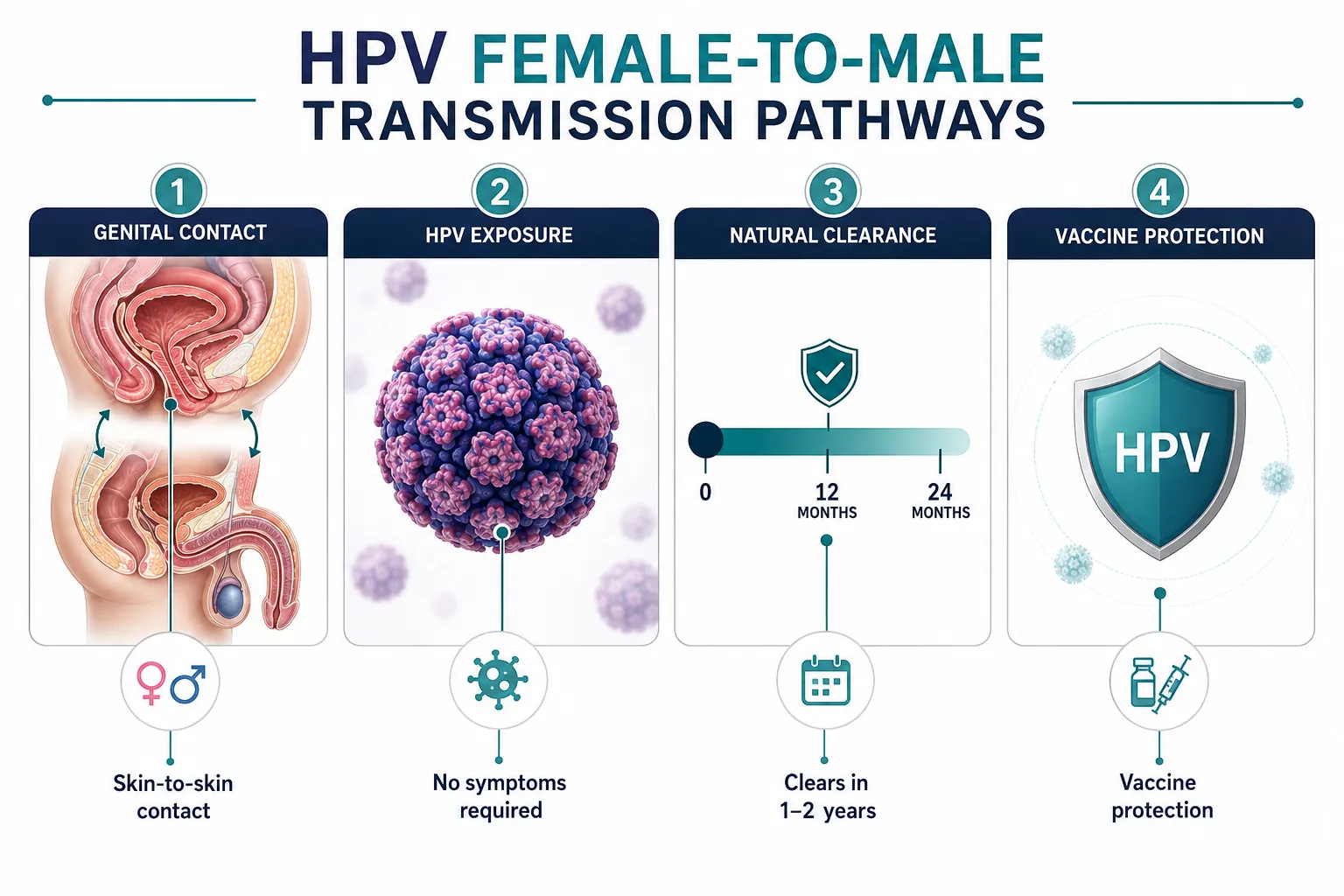
One site-specific study found that transmission from the cervix to the penis occurred at 17.4 per 100 person-months, substantially higher than the 4.9 per 100 person-months rate from penis to cervix. The penis and scrotum are the most commonly affected sites in men following sexual exposure to an infected female partner.
The reason transmission is efficient in both directions is the same: HPV spreads through skin-to-skin contact, not through bodily fluids. The virus lives in the surface cells of the genital area, and any direct contact with those cells, during sex, even without penetration, can transfer it. A condom reduces risk but doesn’t eliminate it, because it doesn’t cover all the skin involved.
For a fuller picture of how HPV spreads in general, the guide to how HPV is transmitted covers the routes and the limits of protection in more detail.
What Happens to Men Who Acquire HPV from a Female Partner?
Most of the time: nothing noticeable. The majority of HPV infections in men clear on their own within one to two years, driven by the immune system without any treatment. A 2025 study of heterosexual men found HPV present in 40.5% of penile samples, a high prevalence that reflects how commonly men acquire and carry the virus, often without ever knowing it.
What HPV does in men depends heavily on the type involved. There are more than 200 HPV genotypes, and they divide into two broad categories:
- Low-risk types (primarily HPV 6 and 11) can cause genital warts, visible, treatable, not cancerous.
- High-risk types (primarily HPV 16 and 18, plus about a dozen others) can, in some cases, lead to cancer if the infection persists rather than clearing.
The full breakdown of HPV types and what the numbers mean explains how genotyping works and which types are covered by current vaccines.
For men, persistent high-risk HPV is linked to penile cancer, anal cancer, and oropharyngeal (throat) cancer. About 4 in 10 HPV-related cancers in the United States occur in men. That’s a real risk, but it’s also worth stating plainly that most men who acquire HPV, including high-risk types, never develop cancer. The immune system clears most infections before they can cause lasting cell changes.
If you want to understand what HPV-related symptoms in men can actually look like, the HPV in men: symptoms, risks, testing, and what it means page covers this in detail.
Who Is at Higher Risk for HPV Transmission and Complications?
Not every man faces the same level of risk after exposure. Several factors affect both the likelihood of acquiring HPV from a female partner and the chance that an infection will persist rather than clear.
- Unvaccinated men have no immune protection against the types included in the 9-valent vaccine (HPV 6, 11, 16, 18, 31, 33, 45, 52, 58), making them more vulnerable to both warts and high-risk infection.
- Immunocompromised individuals, including men living with HIV and organ transplant recipients on immunosuppressive therapy, are significantly less likely to clear HPV naturally, and more likely to develop persistent infection or HPV-related disease.
- Men with multiple sexual partners or early sexual activity have more cumulative exposure events, which increases the probability of encountering an infected partner.
- Smokers have impaired local immune responses in mucosal tissue, which may reduce the body’s ability to clear HPV from the genital area.
Does HPV Transmit Even Without Symptoms?
Yes. This is one of the most important facts about HPV transmission, and it applies equally to women passing HPV to men and to any other direction of transmission.
HPV produces no symptoms in the majority of people who carry it. There’s no discharge, no sore, no rash in most cases, just the virus present in surface skin cells. A woman can have a completely normal pelvic exam, a recent normal Pap result, and still carry a transmissible HPV infection. The same is true for men.
This is why questions like “how did I get this?” or “did my partner know?” often don’t have a clean answer. The timing of HPV infection is frequently unknowable. A person can carry HPV for months or years before it’s detected, or before it causes any detectable change at all. The HPV symptoms guide explains what signs do and don’t appear, and why most people with HPV have none.
Multiple transmission events between the same two partners can also occur over time. HPV circulates within couples, one large study found that 15.5% of heterosexual couples had concordant HPV infections, meaning both partners carried the same type.
Can the HPV Vaccine Protect Men from Female-to-Male Transmission?
Yes, and this is exactly what the vaccine is designed to do. The 9-valent HPV vaccine (Gardasil 9) protects against the types responsible for most HPV-related cancers and the vast majority of genital warts. A 2024 incidence study found that new infections with vaccine-covered HPV types occurred in heterosexual men at a rate of 6.8 per 100 person-years at penile and scrotal sites, a measurable, ongoing risk that vaccination directly addresses.
The vaccine works best before exposure, but it still provides meaningful protection for men who haven’t yet encountered all the types it covers. The HPV vaccine for men, who should get it and whether it helps if you already have HPV addresses the common question of whether vaccination is still worthwhile after a diagnosis.
For men who have already acquired HPV from a partner and developed genital warts, those are treatable. The genital warts overview covers what they look like, how they’re diagnosed, and what the treatment options are.
What Should Men Do After Potential Exposure?
There’s no standard HPV test approved for routine use in men the way there is for women (where HPV testing is part of cervical screening). That means most men won’t get a formal diagnosis unless they develop visible symptoms like genital warts, or unless HPV shows up in the context of anal cancer screening in higher-risk groups.
What men can do:
- Get vaccinated if not already, up to age 26 routinely, and up to age 45 after a discussion with a doctor about individual benefit.
- Tell a doctor about any new genital lesions, genital warts are treatable, and early identification matters.
- Discuss anal Pap testing with a doctor if you are a man who has sex with men, or if you are immunocompromised, these groups have a higher risk of anal HPV-related disease.
- Understand that most infections resolve, acquiring HPV from a partner is common, and for most men, the immune system handles it without intervention.
The broader HPV treatment guide explains how the virus and its symptoms are managed across different presentations.
Frequently Asked Questions
Can a woman pass HPV to a man through oral sex?
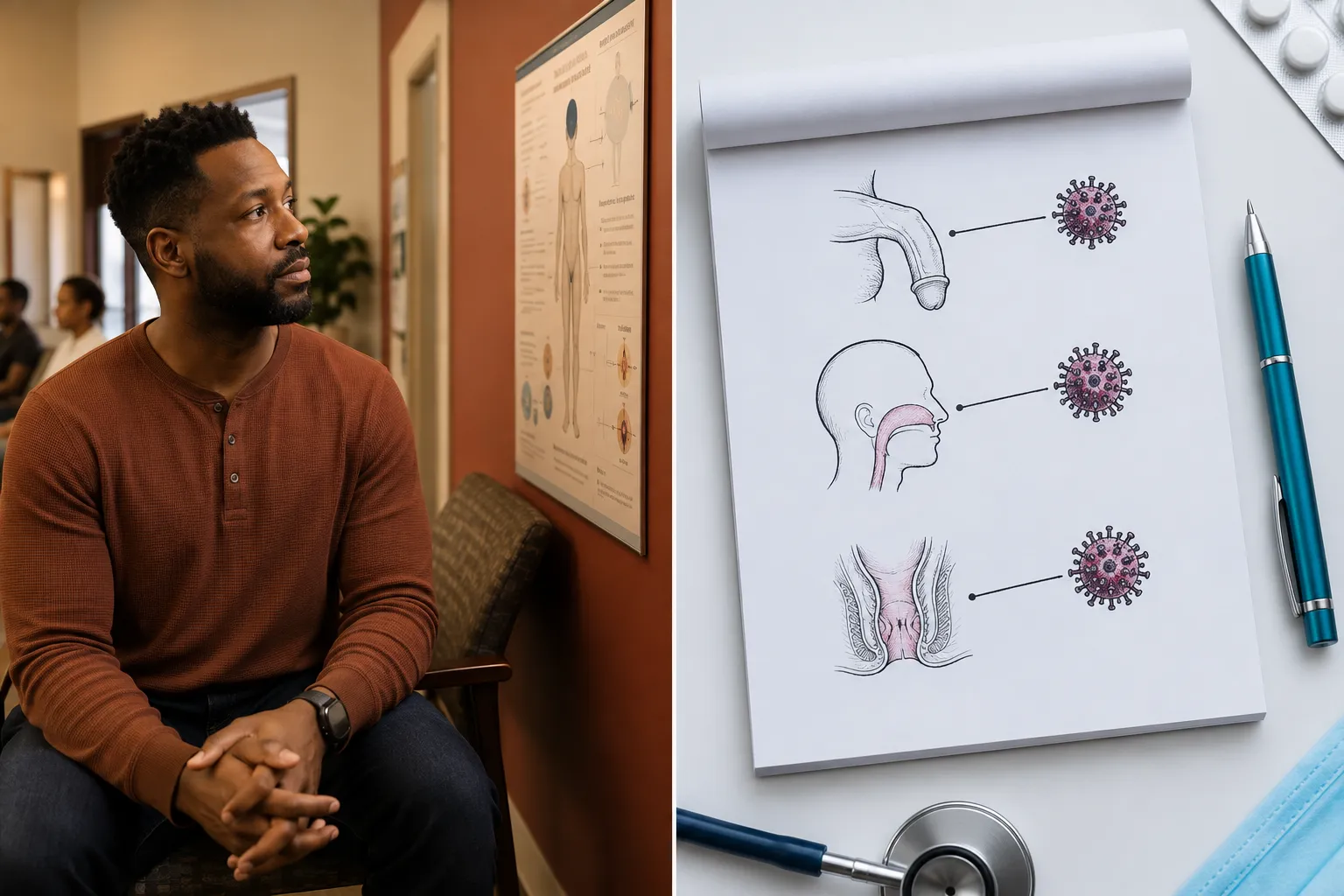
Yes, though the transmission rate via oral contact appears lower than through genital-to-genital contact. HPV 16, the type most strongly linked to oropharyngeal cancer, can be transmitted orally. Most oral HPV infections also clear on their own, but persistent oral HPV 16 is the primary driver of HPV-related throat cancer, which has increased in men over recent decades.
If my female partner has HPV, does that mean I definitely have it too?
Not necessarily, but the probability is real. Studies of heterosexual couples show that concordant HPV infection, both partners carrying the same type, is common. Whether you’ve acquired it depends on the type, the duration of sexual contact, your immune status, and whether you’re vaccinated against that type.
Can a woman pass HPV to a man using a condom?
Condoms reduce the risk of HPV transmission but don’t eliminate it. HPV spreads through skin-to-skin contact across the entire genital area, and condoms don’t cover the scrotum, perineum, or the base of the penis. Consistent condom use is still worthwhile, it reduces risk, but it’s not a guarantee.
How long after exposure would HPV show up in a man?
There’s no reliable way to answer this precisely. If genital warts develop, they typically appear within weeks to months of exposure. High-risk HPV infections often produce no symptoms at all. The virus can also remain dormant and undetectable for years, which is why pinpointing when or from whom an infection was acquired is rarely possible.
Does HPV in men always need treatment?
No. The infection itself has no treatment, only its symptoms and cell changes are treated. Most HPV infections in men clear without any intervention. If genital warts develop, those are treated directly. Men at elevated risk for anal cancer may benefit from screening and monitoring, but for most men with HPV, watchful waiting and vaccination (if not already done) are the main tools.