
Yes, every true wart is caused by human papillomavirus. That’s not a simplification; it’s the clinical definition. But the reverse isn’t true: not every HPV infection causes a wart, and not every bump someone calls a “wart” in everyday language is actually one.
That distinction matters if you’ve found a growth on your skin and are trying to figure out what it means.
Key Takeaways
- All medically defined warts, on hands, feet, face, or genitals, are caused by HPV infection.
- More than 200 HPV types exist, but only a specific subset causes warts; others cause no visible symptoms at all.
- Different HPV types produce different wart types: HPV 1 causes most plantar warts, HPV 6 and 11 cause genital warts, HPV 2 and 4 cause most common hand warts.
- Some skin growths colloquially called “warts” (skin tags, seborrheic keratoses, molluscum) are not HPV-related.
- Warts spread through direct skin contact and microabrasions, not through casual, non-skin contact.
What Does It Actually Mean That Warts Are Caused by HPV?
HPV is a family of more than 200 distinct DNA viruses. They all infect keratinocytes, the cells that make up the outer layer of your skin and mucous membranes. When a wart-causing HPV type gets into those cells through a small break in the skin, it triggers abnormal cell growth. That overgrowth is what you see as a wart.
The virus doesn’t need a deep wound to get in. A minor scrape, a hangnail, or cracked skin around a nail is enough. Once inside, the virus replicates slowly, which is why warts often appear weeks or months after the initial contact.
This is what makes warts fundamentally different from other skin growths: they are an active viral infection, not a structural skin change or a benign cyst. Treating the visible wart removes the growth, but the virus may still be present in surrounding tissue, which is why warts sometimes recur after treatment.
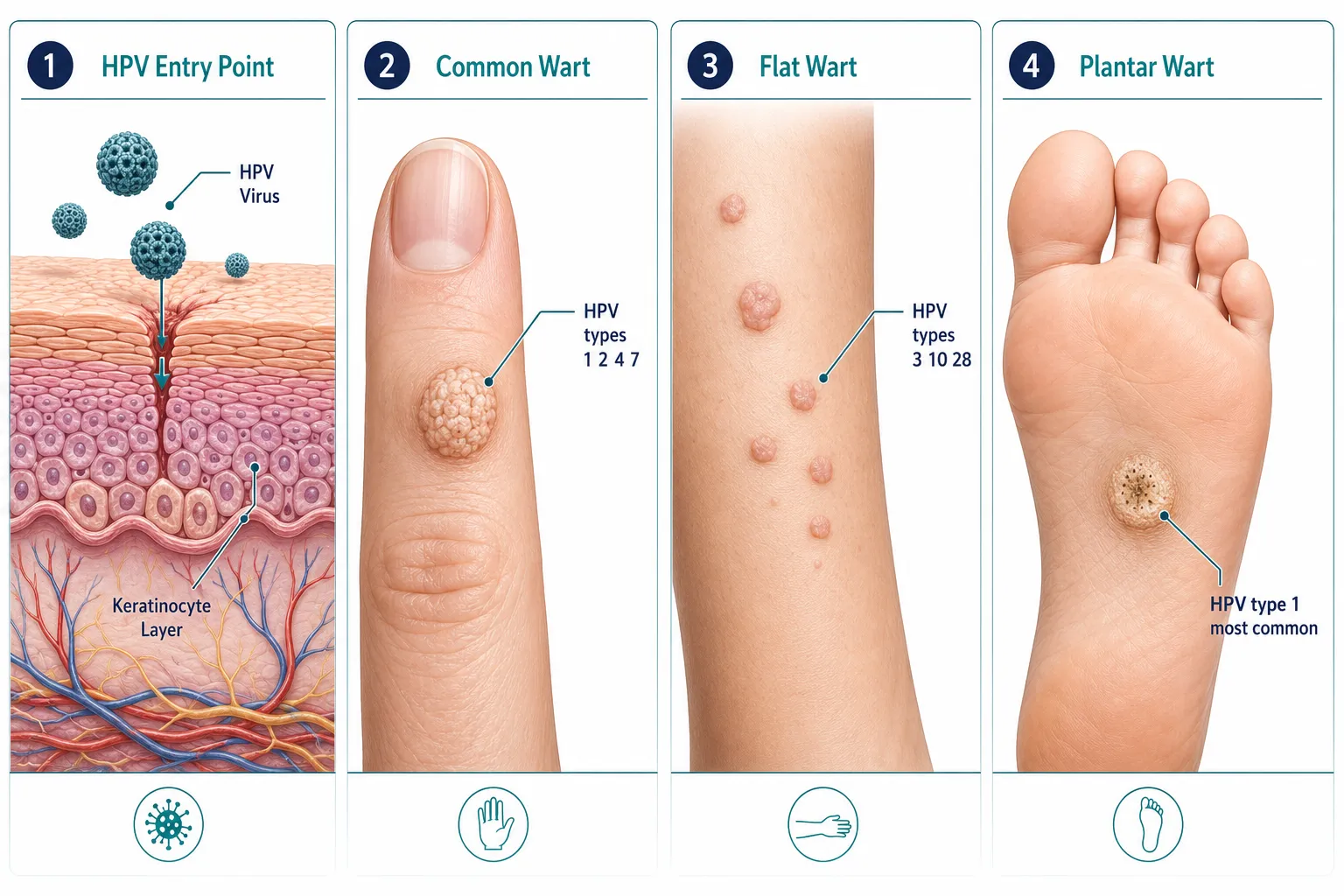
Understanding which HPV type is involved also tells you something about risk. The types that cause warts on your hands and feet, such as HPV 1, 2, 4, and 7, are entirely different from the high-risk types (16 and 18) associated with cervical and other cancers. HPV types explained covers this distinction in detail, including what the type numbers actually mean for your health.
Wart-causing HPV types are classified as low-risk. They do not cause cancer.
Which HPV Types Cause Which Warts?
The mapping between HPV genotype and wart subtype is fairly consistent across clinical literature. Here’s what the evidence shows:
| Wart Type | Common Location | Associated HPV Types |
|---|---|---|
| Common warts (verrucae vulgaris) | Hands, fingers, knees | HPV 2, 4 (also 1, 7) |
| Plantar warts | Soles of feet | HPV 1 (most common), 2, 4 |
| Flat warts (verrucae planae) | Face, legs, forearms | HPV 3, 10, 28 |
| Butcher’s warts | Hands (occupational) | HPV 7 |
| Genital warts (condylomata acuminata) | Genitals, anus, groin | HPV 6, 11 |
| Cystic warts | Palms, soles | HPV 60 |
Every entry in that table is a true wart, and every one is HPV-driven.
Genital warts deserve a specific note. HPV 6 and 11 are sexually transmitted, low-risk types, they are not the same strains that cause cancer. If you’ve been told you have genital warts, the genital warts overview on HPVGuide explains what they look like, how they’re diagnosed, and what treatment involves.
Not All HPV Causes Warts, Here’s What That Means
More than 200 HPV types exist. Only a fraction of them infect the skin in a way that produces visible warts.
Many HPV types infect mucosal tissue, the lining of the cervix, throat, anus, or vagina, without ever producing a wart. High-risk types like HPV 16 and 18 fall into this category. They can cause cell changes that, over years, may progress to cancer. But they don’t produce warts. You can carry them and have no visible sign at all.
This is why the question “are all warts caused by HPV?” has a different answer than “does all HPV cause warts?” The first answer is yes. The second is no.
It’s also why a normal skin exam doesn’t rule out HPV infection. The HPV symptoms guide covers this in more detail, most HPV infections, including high-risk ones, produce no symptoms that you’d notice.
What About Growths That Aren’t Actually Warts?
Some skin lesions get called “warts” colloquially but have nothing to do with HPV. Knowing the difference matters, because non-HPV growths don’t carry the same transmission risk and don’t respond to wart treatments.
Common HPV-negative growths sometimes mistaken for warts:
- Seborrheic keratoses, waxy, stuck-on-looking brown or tan growths, common in older adults; benign and not viral
- Skin tags (acrochordons), soft, flesh-colored flaps of skin, often in skin folds; not caused by HPV
- Molluscum contagiosum, small, dome-shaped bumps caused by a poxvirus, not HPV; common in children and immunocompromised adults
- Corns and calluses, thickened skin from pressure or friction, not a viral infection
- Dermatofibromas, firm, slightly raised nodules, usually on the legs; benign fibrous tissue, not viral
A dermatologist can distinguish these from true warts on clinical appearance. If there’s any doubt, especially with a genital lesion, a biopsy can confirm HPV involvement.
Who’s at Higher Risk for HPV Warts?
Anyone can get a wart, but some groups are more likely to develop them or have difficulty clearing them:
- Immunocompromised individuals, people living with HIV, organ transplant recipients on immunosuppressive therapy, and those on long-term corticosteroids are significantly more prone to extensive, treatment-resistant warts. In these groups, unusual HPV types (including types 5 and 8) can also produce lesions that don’t look like typical warts.
- Children and young adults, warts are most common in this age group, likely due to frequent skin trauma and developing immune responses.
- People with occupational skin exposure, butchers, meat handlers, and fish workers have elevated rates of hand warts, specifically linked to HPV 7.
- People who use communal wet areas, locker rooms, pool decks, and shared showers are environments where plantar wart transmission (HPV 1) is well-documented.
How Wart-Causing HPV Actually Spreads
HPV doesn’t travel through the air or survive long in body fluids. The types that cause skin warts spread through direct skin-to-skin contact or contact with contaminated surfaces, and they need a way in.
That entry point is usually microtrauma: a small cut, a cracked cuticle, a scraped heel. Intact skin is a reasonable barrier. Damaged skin isn’t.
Autoinoculation is also common. Picking or scratching a wart deposits virus onto adjacent skin, which is how a single wart on one finger can become several over time. Biting nails or cuticles creates exactly the kind of microabrasions that allow the virus to spread around the nail folds.
Genital warts spread differently, through sexual skin-to-skin contact, not through objects or surfaces. The how HPV spreads guide explains the transmission routes across different HPV types, including what contact does and doesn’t carry risk.
Are All Warts Caused by HPV? The Clinical Answer
The clinical answer is yes. By medical definition, a wart is an HPV-caused lesion. There is no competing viral or bacterial cause for true warts, the etiologic consensus across dermatology, infectious disease, and virology is stable on this point.
What varies is which HPV type is involved, where on the body the wart appears, and how the immune system responds. Someone with a healthy immune system will often clear a wart within one to two years without treatment. Someone who is immunocompromised may develop extensive warts that persist and resist standard treatments.
Treatment options range from salicylic acid and cryotherapy to prescription topical agents. The topical medications for genital warts guide covers prescription options specifically, including how imiquimod and podophyllotoxin work and what to expect. For a broader look at wart treatment approaches, the genital warts treatment overview walks through the full range of options.
If you have a growth you’re unsure about, particularly a genital lesion, a clinician can examine it and confirm whether it’s a wart, what type it likely is, and what treatment makes sense for your situation. Cell changes are easiest to manage before they progress; that’s what evaluation is for.
Frequently Asked Questions
Can you have HPV and never get a wart?
Yes, most people who carry HPV never develop a visible wart. Many HPV types don’t cause warts at all, and even wart-causing types may be cleared by the immune system before any growth appears. The absence of warts doesn’t mean you don’t have HPV.
Are genital warts the same as the HPV that causes cancer?
No. Genital warts are caused by HPV 6 and 11, which are classified as low-risk types. They do not cause cervical, anal, or other HPV-related cancers. The cancer-associated types, primarily HPV 16 and 18, do not produce warts. The HPV and cancer overview explains how high-risk types cause cell changes and what screening detects.
Do warts go away on their own?
Many do. In people with healthy immune function, warts often resolve without treatment within one to two years. Plantar warts and warts in immunocompromised individuals tend to be more persistent. Treatment speeds up resolution and reduces the chance of spreading the virus to other skin sites.
Can the HPV vaccine prevent warts?
The current HPV vaccines protect against HPV 6 and 11, the types responsible for approximately 90% of genital warts, as well as high-risk types 16 and 18. The vaccine does not treat existing warts or clear a current infection. It works by preventing new infection with the covered types. The HPV vaccine guide covers who should get it and what the evidence shows about effectiveness.
Is a skin tag the same as a wart?
No. Skin tags are benign fibrous growths caused by skin friction, not by HPV. They’re soft, flesh-colored, and typically appear in skin folds. True warts have a rougher, more irregular surface and are caused by active viral infection. A dermatologist can tell them apart on examination.
If a wart comes back after treatment, does that mean the treatment failed?
Not necessarily. Wart recurrence after treatment usually means the virus was still present in surrounding skin tissue, not that the treatment itself was ineffective. Complete clearance of HPV from the tissue is difficult to confirm, and the immune system plays a large role in whether the virus reactivates. Recurrent warts are common and treatable, they’re not a sign that something went wrong.
Medical Disclaimer: This article is for informational purposes only and does not constitute medical advice. See the HPVGuide medical disclaimer for full details.