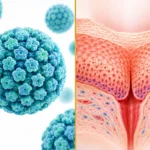
Sharing a drink does not transmit HPV. That’s the short answer, and the evidence behind it is consistent enough that clinicians state it plainly: HPV is not spread through casual contact with saliva on a cup, glass, or straw. If you’re asking because you’re worried about a recent diagnosis or a partner’s, you can set this particular concern aside.
Key Takeaways
- HPV cannot be transmitted by sharing drinks, cups, or eating utensils, no documented cases exist.
- While HPV DNA has been detected in saliva, casual saliva exposure through shared objects carries negligible risk.
- Oral HPV infection is driven by sexual behaviors, primarily oral sex and deep kissing, not by sharing food or beverages.
- The virus requires direct skin-to-skin or mucous membrane contact to establish infection; a shared cup doesn’t provide that.
- If you have concerns about oral HPV or a recent diagnosis, the plain-English guide to HPV types explains how different strains behave and what risk they actually carry.
How HPV Actually Spreads
HPV, human papillomavirus, is transmitted through direct contact with infected skin or mucous membranes. That means genital-to-genital contact, oral sex, and in some cases deep kissing with prolonged mucosal contact. It does not spread through the air, through toilet seats, or through objects that briefly touch saliva.
The virus needs a viable pathway into epithelial tissue, typically a micro-abrasion or direct mucosal exposure. A shared glass doesn’t provide that. By the time HPV-containing saliva sits on a cup rim and is contacted by another person’s lips, the biological conditions needed for transmission simply aren’t present.
There are over 200 HPV genotypes. The ones that cause most oral and oropharyngeal cancers, primarily HPV 16, are transmitted almost exclusively through sexual contact. The ones that cause common hand and foot warts (types 1, 2, and 4) spread through direct skin contact with those warts, not through saliva.
Understanding how HPV spreads and how it doesn’t is one of the most useful things you can do to put your actual risk in perspective.
Can You Get HPV from Sharing a Drink? What the Science Shows
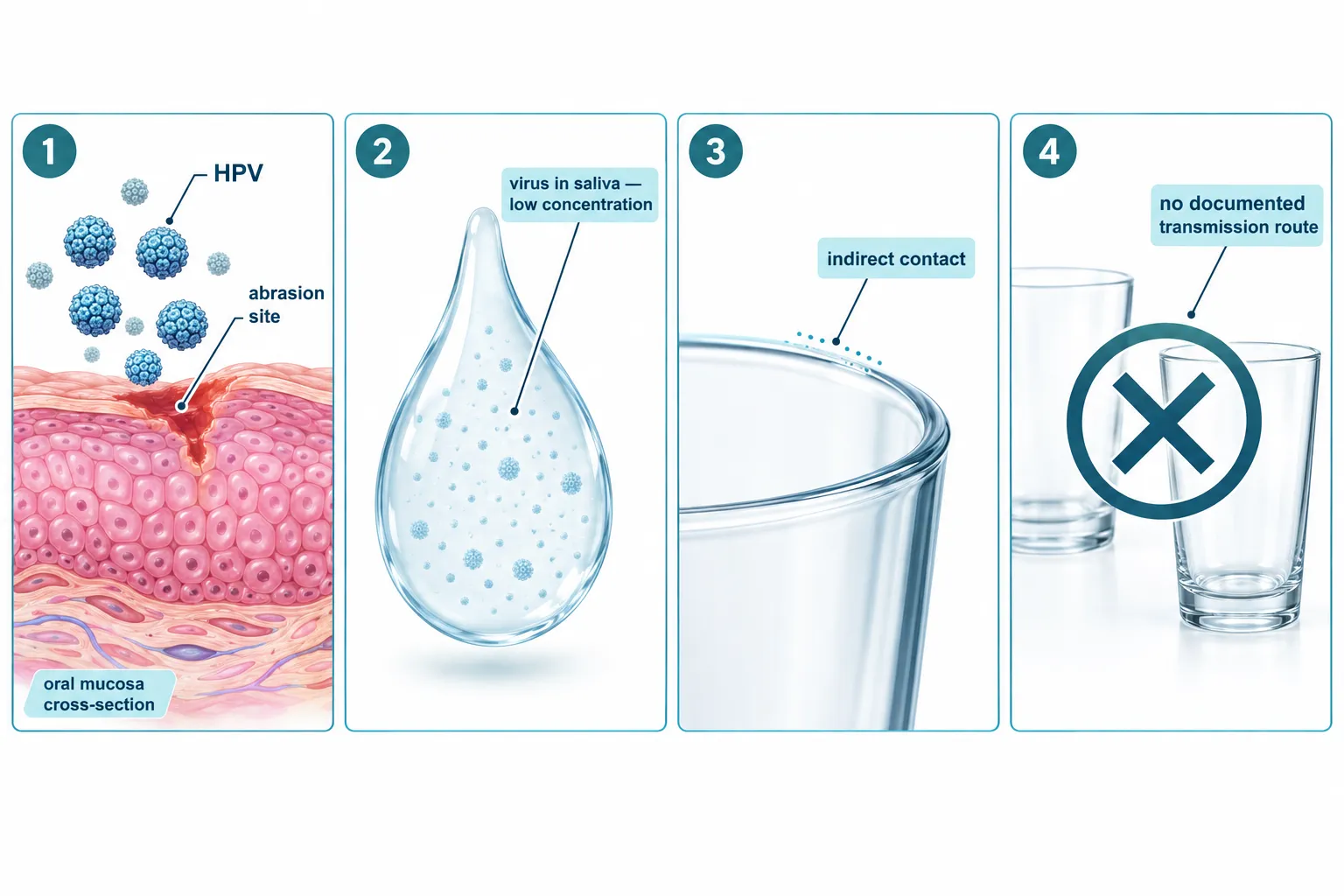
HPV DNA has been detected in saliva samples. That fact sometimes fuels anxiety, but detecting viral DNA is not the same as documenting transmission. The concentration of HPV in saliva is generally low, and saliva itself appears to be a hostile environment for the virus to survive long enough to infect a new host.
No peer-reviewed study has documented a case of HPV transmission through shared cups, glasses, straws, or eating utensils. Researchers who study household HPV transmission have looked at shared personal items, and the evidence points toward items with prolonged, high-friction mucosal contact, not shared beverages.
The expert consensus as of 2026 is straightforward: sharing a drink is not a meaningful route of HPV transmission.
A few things explain why:
- Viral load in saliva is low compared to genital secretions, where HPV transmission is well-established.
- Indirect contact via an object reduces exposure further, the virus doesn’t transfer efficiently from a surface to mucosa in the way direct skin-to-skin contact does.
- The oral environment, including enzymes in saliva and the integrity of healthy oral mucosa, creates additional barriers.
This doesn’t mean oral HPV is impossible to acquire. It means the route matters enormously. Oral sex is the primary driver of oropharyngeal HPV infection. Deep, prolonged kissing carries a low but documented risk, a separate question covered in detail on the HPV transmission through kissing page. Sharing a drink is in a different category entirely.
What Does Cause Oral HPV Infection?
Oral HPV infection, including the high-risk types linked to oropharyngeal cancer, is driven by sexual behaviors. Specifically:
- Oral sex (performing oral sex on a partner with genital HPV) is the most documented route for acquiring oral HPV 16 or 18.
- Deep kissing with a partner who has oral HPV carries a low but real risk, particularly with high numbers of lifetime partners.
- Vertical transmission (from a birthing parent to an infant during delivery) can cause a rare condition called recurrent respiratory papillomatosis, caused by HPV types 6 and 11.
Casual contact, sharing food, drinks, utensils, or touching someone’s face, has not been established as a transmission route for any of the high-risk HPV types that matter clinically.
If you’ve been told you have oral HPV or an oropharyngeal finding, the question of where it came from is often unanswerable. HPV can remain dormant for years before it’s detected. Knowing the transmission route rarely changes clinical management, what matters is what’s found and how it’s monitored.
Who Is at Higher Risk for Oral HPV Infection?
Oral HPV affects roughly 7% of adults in the U.S., but risk isn’t evenly distributed. The following groups carry higher rates of oral HPV infection:
- People with multiple oral sexual partners, the strongest documented risk factor for oral HPV 16.
- Smokers, tobacco use is associated with higher oral HPV prevalence and impaired local immune clearance.
- Immunocompromised individuals, including people living with HIV and organ transplant recipients, are less able to clear HPV infections naturally, whether oral or genital.
- Unvaccinated adults, the HPV vaccine (Gardasil 9) covers HPV 16 and 18, the types responsible for most HPV-related oropharyngeal cancers. Vaccination before exposure provides the strongest protection.
Does HPV in Saliva Mean Anything for Partners?
Finding HPV in someone’s saliva doesn’t automatically mean their partner is at risk from casual contact. The clinical concern is about sexual transmission, not shared household items.
If you or a partner has been diagnosed with oral HPV or an oropharyngeal lesion, the conversation to have is with a clinician, not about who shared whose glass. The relevant questions are about sexual history, vaccination status, and whether any screening or follow-up is indicated.
For context on what an HPV diagnosis actually means and what happens next, the full HPV overview covers the virus, its types, and its clinical course in plain language.
It’s also worth knowing that most oral HPV infections clear on their own within one to two years, just as most genital HPV infections do. Having oral HPV detected doesn’t mean you have cancer or will develop it. It means your immune system is doing what it normally does, and in most cases, it clears the infection without any intervention.
Can You Get HPV from Sharing a Drink, What About Children?
Parents sometimes worry about passing HPV to their children through shared cups or utensils. The evidence doesn’t support this as a real risk. The HPV types that cause genital warts and cervical abnormalities, types 6, 11, 16, 18, are not transmitted through casual household contact.
The question of whether a parent can transmit HPV to a child through kissing is a separate and more nuanced topic, covered on the can I give my child HPV by kissing them page. The short version: the risk from a normal parental kiss is considered negligible, and sharing a drink carries even less concern.
Oral HPV and the Bigger Picture

Oropharyngeal cancers linked to HPV, particularly cancers of the tonsils and base of the tongue, have increased over recent decades, and HPV 16 is responsible for the majority of them. This is a real trend, and it’s worth taking seriously. But the transmission pathway is sexual, not casual.
The HPV vaccine is the most effective prevention tool available. Gardasil 9 covers nine HPV types, including the two highest-risk strains for oropharyngeal cancer. The CDC recommends vaccination through age 26 for everyone, and shared clinical decision-making for adults aged 27-45. If you haven’t been vaccinated and are within the recommended age range, that conversation with your doctor is worth having.
Screening for oral HPV is not currently part of routine clinical guidelines the way cervical screening is, there’s no equivalent of a Pap smear for the throat. If you have symptoms (a persistent sore throat, a lump in the neck, difficulty swallowing that doesn’t resolve), those warrant evaluation. But a positive HPV test or a partner’s diagnosis isn’t itself a reason to panic about oropharyngeal cancer.
For more on how HPV connects to cancer risk and what the numbers actually mean, the HPV and cancer guide covers the evidence without inflating it.
Frequently Asked Questions
Can HPV survive on a cup or glass long enough to infect someone?
HPV is not well-adapted to surviving on hard surfaces. Unlike some viruses, it requires direct contact with living epithelial tissue to establish infection. The brief exposure from a shared cup rim doesn’t provide the conditions the virus needs to transmit.
If I tested positive for oral HPV, does that mean my partner gave it to me through casual contact?
Almost certainly not. Oral HPV is transmitted sexually, primarily through oral sex. If you’ve tested positive, the timing of infection is often impossible to determine, and casual contact like sharing a drink is not a plausible route.
Should I avoid sharing drinks with someone who has genital HPV?
There’s no medical reason to do so. Genital HPV types are not transmitted through saliva or shared objects. The precautions that matter for HPV are about sexual contact, not shared household items.
Is there any HPV type that could spread through saliva?
HPV types 6 and 11, the low-risk types that cause genital warts, can occasionally cause oral papillomas, and are transmitted through sexual contact involving the mouth. No HPV type has been documented to spread through casual saliva contact such as sharing a drink.
Does kissing carry more risk than sharing a drink?
Deep, prolonged kissing carries a low but documented risk for oral HPV transmission, particularly for high-risk types like HPV 16. Sharing a drink does not carry the same level of direct mucosal contact. The HPV spread by kissing page covers what the evidence actually shows on that question.
If someone has oral HPV symptoms, should they avoid sharing food or drinks?
Oral HPV typically causes no symptoms at all. If someone has visible oral warts or lesions, it’s reasonable to avoid sharing items that contact those lesions directly, but this is a general hygiene consideration, not a specific HPV transmission concern. A clinician can advise based on what’s actually present.