Roughly one in three men has a genital HPV infection at any given time. Yes, men can get HPV, and in most cases, the infection causes no symptoms and clears on its own within one to two years. That said, some types of HPV do cause real health problems in men, from genital warts to cancers of the anus, penis, and throat, and knowing the difference matters.
Key Takeaways
- About 31% of men globally carry a genital HPV infection at any given point, and 21% carry high-risk (cancer-associated) types.
- Most HPV infections in men clear without treatment; the immune system handles them silently.
- There is no routine HPV screening test for men, vaccination and risk-reduction are the main tools available.
- The 9-valent HPV vaccine (Gardasil 9) is recommended for males starting at age 9, with catch-up vaccination through age 26.
- Men who have sex with men and immunocompromised men face a substantially higher risk of persistent infection and HPV-related disease.
How Do Men Get HPV?
HPV spreads through skin-to-skin contact with an infected area, most commonly during vaginal, anal, or oral sex. You do not need to have penetrative sex to transmit it. Genital contact alone is enough.
The virus is so common that the CDC estimates most sexually active people will have HPV at some point in their lives. For men, acquisition happens at penile, scrotal, anal, and oral sites. Among unvaccinated heterosexual men, new infections at penile and scrotal sites occur at roughly 6.8 per 100 person-years. Among unvaccinated men who have sex with men, anal HPV acquisition runs even higher, around 16.8 per 100 person-years.
Condoms reduce transmission risk but don’t eliminate it, because HPV can infect areas not covered by a condom.
For a full breakdown of how the virus spreads, and the routes that are often misunderstood, the guide to how HPV spreads covers this in detail.
What HPV Does (and Doesn’t Do) in Men
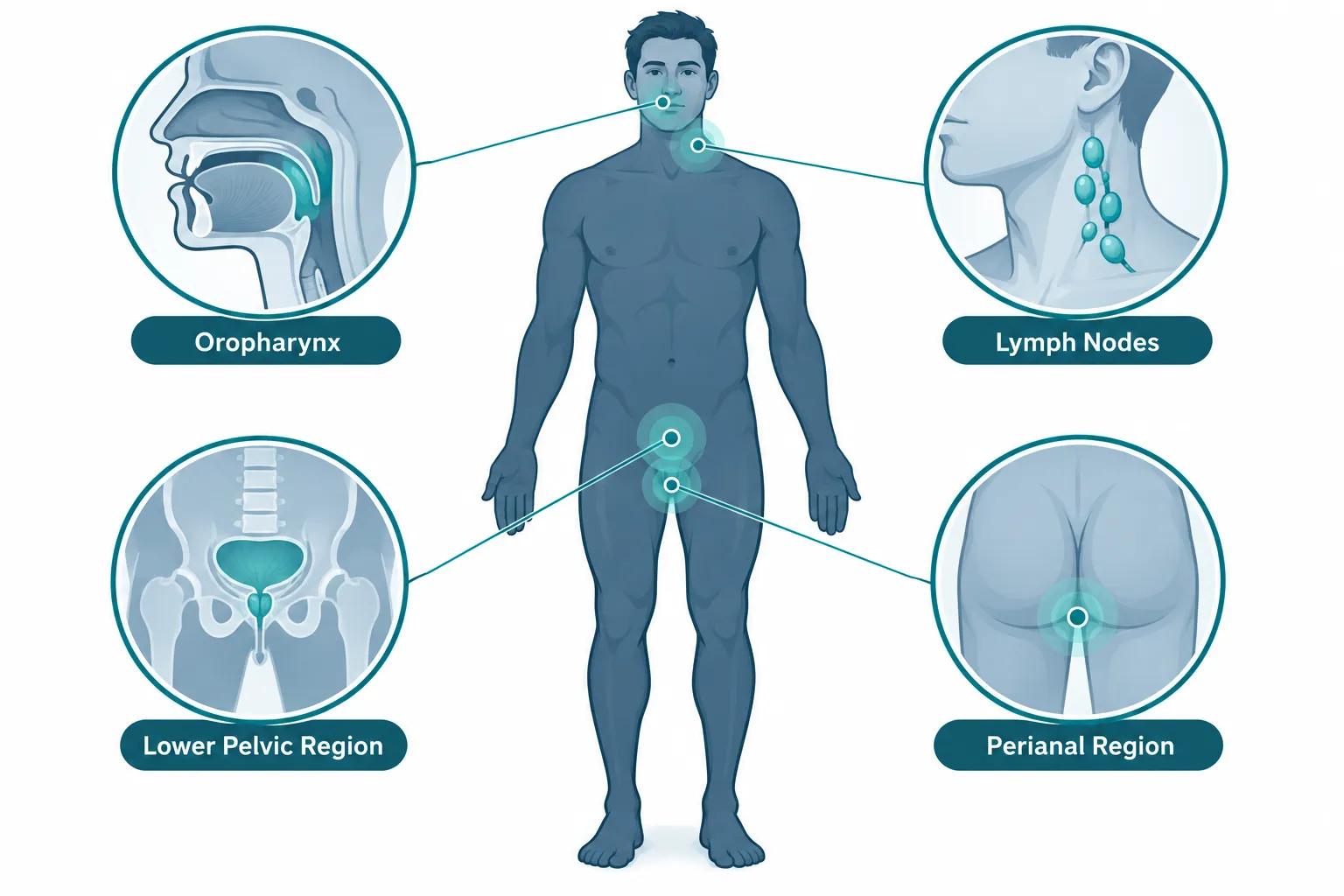
Having HPV doesn’t mean you have cancer, or that you will get it. The vast majority of infections, including high-risk types, are cleared by the immune system without any intervention.
There are more than 200 HPV genotypes. They divide into two broad categories:
- Low-risk types (most notably HPV 6 and 11) cause genital warts. These are not cancer precursors, but they are contagious and can recur.
- High-risk types (most notably HPV 16 and 18) are associated with cancers of the anus, penis, and oropharynx (throat and tonsils). Persistent infection with these types, not a single exposure, is what drives cancer risk.
Most men with high-risk HPV will never develop cancer. Persistent infection in the presence of other risk factors (smoking, immunosuppression, high viral load) is what shifts the odds.
The HPV types explained guide breaks down what the different type numbers actually mean for your health.
What Symptoms Look Like
Genital warts are the most visible sign of HPV in men, soft, flesh-colored growths on the penis, scrotum, or around the anus. They’re caused by low-risk HPV and are treatable, though not always curable in the sense that the virus can remain dormant.
Most HPV infections, including high-risk ones, produce no symptoms at all. A man can carry and transmit HPV without knowing it.
Throat HPV is increasingly recognized as a concern. A 2024 multinational study found that oral high-risk HPV acquisition occurs at 2.4 per 1,000 person-months and does not decline with age, meaning older men are not protected simply because they’ve been sexually active for years.
Who’s at Higher Risk for HPV in Men?
Not every man faces the same level of risk. These groups carry a meaningfully higher burden:
- Unvaccinated men, particularly those in their late teens through mid-20s, who are actively acquiring new infections at the highest rates.
- Men who have sex with men, who face substantially higher anal HPV incidence and a greater risk of anal cancer, a cancer with no routine screening program for most men.
- Immunocompromised men, including those living with HIV and organ transplant recipients, whose immune systems are less able to clear persistent infection, making progression to dysplasia or cancer more likely.
- Men with multiple sexual partners or early sexual debut, where cumulative exposure increases the probability of encountering high-risk genotypes.
Can Men Get Tested for HPV?
There is no FDA-approved HPV test for asymptomatic men. This is a real gap in HPV management. Unlike women, who have Pap smears and HPV co-testing to catch cervical cell changes early, men have no equivalent routine screening.
Testing in men typically happens in two situations: when genital warts are visible, or when a sexual partner has received an abnormal cervical screening result. In both cases, the clinical response focuses on treating visible disease or monitoring symptoms, not on detecting the virus itself.
The exception is anal HPV screening, which some clinics offer to men who have sex with men and HIV-positive men through anal Pap smears and high-resolution anoscopy. If you’re in one of these groups, the anal HPV symptoms, screening, and prevention guide explains what that process involves.
For men with visible genital warts, the genital warts overview covers what they look like, how they’re treated, and what to expect.
Does HPV Affect Men’s Health Beyond Cancer?
The cancer risk gets most of the attention, but there’s emerging evidence that HPV may affect male fertility. Preliminary research from 2024 found that high-risk HPV infections in the urogenital tract are associated with higher rates of sperm cell death, though standard sperm quality parameters were not dramatically altered. These findings are early-stage, they don’t change current clinical guidance, but they suggest HPV’s effects on men go beyond the sites where cancer develops.
HPV-related oropharyngeal cancer is rising in men specifically. A 2026 review characterized high-risk oral HPV in men as a public health concern, noting that men carry a disproportionate burden of throat cancers linked to HPV 16. The risk isn’t confined to younger men, it persists across adult ages.
The HPV Vaccine for Men: What the Evidence Shows

The 9-valent HPV vaccine (Gardasil 9) covers seven high-risk types, including HPV 16 and 18, plus the two low-risk types (6 and 11) that cause most genital warts. Vaccination is recommended for males starting at age 9, with routine vaccination at ages 11-12 and catch-up vaccination through age 26.
The schedule works like this:
- Ages 9-14 at first dose: 2 doses, given 6-12 months apart.
- Ages 15-26 at first dose, or immunocompromised: 3 doses at 0, 1-2, and 6 months.
For adults aged 27-45, routine vaccination isn’t recommended, but a clinician can discuss it based on individual circumstances. Many sexually active men in this range have already been exposed to some HPV types, but vaccination may still offer protection against types they haven’t encountered.
The World Health Organization now supports simplified dosing for boys and young men, including a single-dose regimen for boys aged 9-20, to expand coverage in settings where completing a multi-dose series is difficult.
The vaccine’s safety record is well-established. The CDC’s surveillance data, updated in 2025, confirms that Gardasil 9 is safe and highly effective at preventing the HPV infections most commonly linked to cancer.
For a detailed look at how the vaccine applies specifically to men, including what it does if you already have HPV, the HPV vaccine for men guide covers the evidence directly.
Frequently Asked Questions
Can a woman give a man HPV?
Yes. HPV transmission goes in both directions. A woman with HPV can pass it to a male partner through genital contact, oral sex, or anal sex. The article on whether a woman can spread HPV to a man addresses this directly, including what’s known about transmission rates.
If I have no symptoms, do I still have HPV?
Possibly. Most HPV infections in men produce no symptoms at all, no warts, no pain, no visible changes. The immune system clears the majority of these silently. The absence of symptoms doesn’t confirm the absence of infection, which is one reason vaccination before exposure is so much more effective than relying on symptom detection.
Can genital warts in men go away without treatment?
Sometimes. Low-risk HPV types that cause genital warts can clear on their own, but this varies considerably. Some warts persist for months or years without treatment. Treatment options, topical medications, cryotherapy, and others, remove visible warts but don’t eliminate the underlying virus. The genital warts page on whether they go away on their own explains what the evidence shows.
Does HPV in men always lead to cancer?
No. The overwhelming majority of HPV infections, including those caused by high-risk types like HPV 16 and 18, clear without causing cancer. Persistent infection, particularly in men who are immunocompromised or who smoke, raises the risk, but persistent infection is not the same as a cancer diagnosis. Cell changes are easiest to address before they progress, which is what monitoring is for.
Is there anything men can do to treat HPV itself?
There is no antiviral treatment that clears the HPV virus directly. Treatment focuses on managing what the virus causes, removing warts, monitoring for cell changes at high-risk sites. Some men explore immune-support supplements; the AHCC for HPV evidence review covers what the current research actually shows about one of the more studied options, without overstating the evidence.
What to Do Next
If you’ve recently learned you have HPV, or a partner has been diagnosed, the most useful next step is a straightforward conversation with your doctor about your specific situation, your vaccination status, any symptoms, and whether anal screening is appropriate given your risk profile.
If you haven’t been vaccinated and are under 26, vaccination is the single most effective step available. If you’re between 27 and 45, it’s worth discussing with a clinician whether you’d benefit.
Visible genital warts should be evaluated and treated, not because they’re dangerous, but because they’re contagious and can worsen without treatment. For everything else HPV-related in men, the evidence points clearly toward vaccination, not waiting for symptoms to appear.