
Every wart, whether it appears on your finger, the sole of your foot, or your genitals, is caused by human papillomavirus. That answer is clear and consistent across dermatology and virology: warts are an HPV infection of the skin or mucous membranes, full stop. But the reverse is not true. Not all HPV infections cause warts, and some of the most clinically significant HPV types never produce a visible lesion at all.
Understanding that distinction matters, especially if you’ve just found a wart and are wondering what it means about your health.
Key Takeaways
- All warts, common, plantar, flat, and genital, are caused by HPV infection of the skin or mucosa.
- Different HPV types cause different wart types; HPV 1 is the main cause of plantar warts, while HPV 6 and 11 cause most genital warts.
- Many HPV infections produce no warts whatsoever, the virus can be present, active, and transmissible without any visible sign.
- The HPV types that cause warts are almost entirely low-risk; they do not cause cancer.
- High-risk HPV types (16, 18, and others) are the ones linked to cervical and other cancers, and they typically cause no warts.
What Causes a Wart? The HPV Connection Explained
A wart forms when HPV infects keratinocytes, the cells that make up the outer layers of your skin. The virus triggers those cells to multiply faster than normal, producing the raised or thickened growth you can see and feel. This process happens across all wart types, whether the growth is on your hand, your foot, or your genitals.
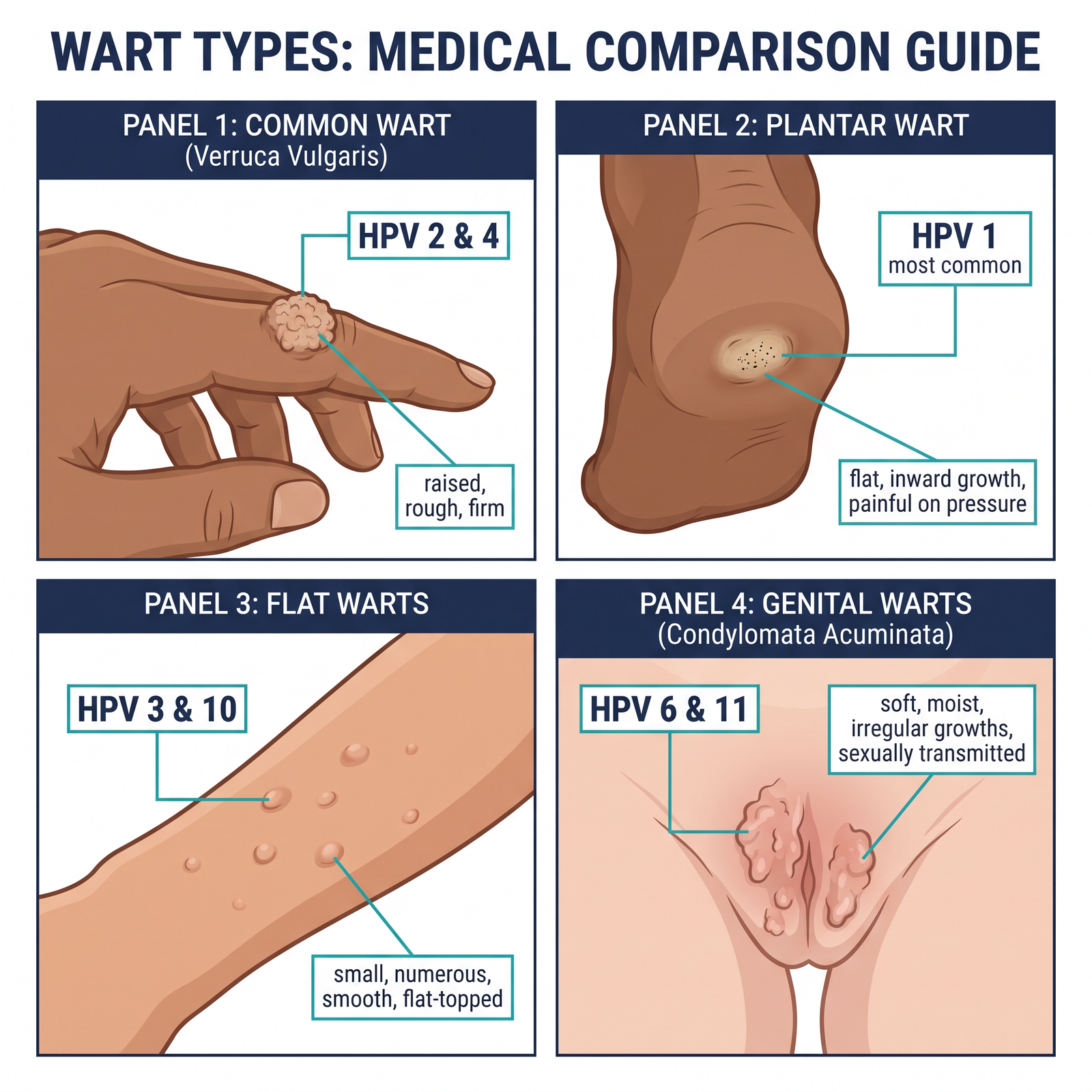
Different HPV genotypes tend to infect different body sites and produce recognizably different lesions:
| Wart Type | Common Name | Primary HPV Types |
|---|---|---|
| Verruca vulgaris | Common wart | HPV 2, 4 (also 1, 3, 27, 29, 57) |
| Verruca plantaris | Plantar wart | HPV 1 (also 2, 60, 63) |
| Verruca plana | Flat wart | HPV 3, 10, 28, 29 |
| Condyloma acuminata | Genital wart | HPV 6, 11 |
The genotype determines more than just location, it influences how the wart looks, how deeply it grows, and how readily it responds to treatment. Plantar warts caused by HPV 1, for example, tend to grow inward under pressure and can be more painful than the raised common warts associated with HPV 2.
What all of these types share is their risk profile: they are classified as low-risk HPV types. They cause benign growths. They are not associated with cancer.
Are All Warts HPV? Yes, But Not All HPV Causes Warts
This is the part that trips most people up. The question “are all warts HPV?” has a clean answer: yes. But the follow-up, does having HPV mean you’ll get warts?, does not.
HPV is a family of more than 200 related viruses. Roughly 40 of those infect the genital tract specifically. Some cause visible warts. Many cause nothing visible at all. And the ones most associated with serious disease, HPV 16 and HPV 18, which together account for the majority of cervical cancers, do not produce warts.
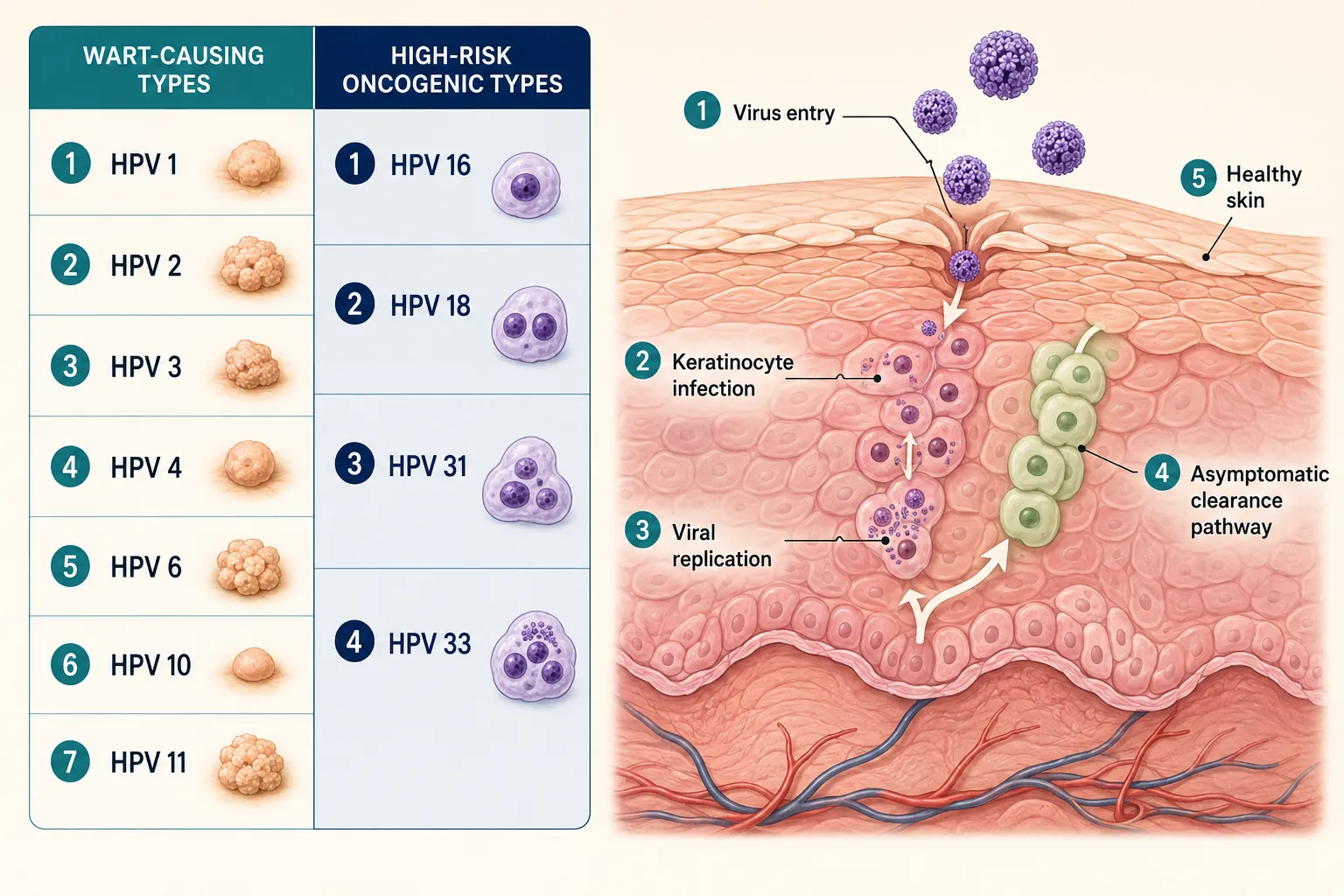
This means two things worth holding onto:
- Finding a wart does not mean you have a cancer-associated HPV type. The low-risk types that cause warts and the high-risk types that drive cancer progression are largely separate groups.
- Not having warts does not mean you don’t have HPV. Most people with HPV never develop any visible sign of infection.
If you’ve had an abnormal Pap result and want to understand how HPV testing works and what your results actually indicate, the HPV testing guide on HPVGuide.org covers how those results are read and what follow-up looks like.
Common Warts vs. Genital Warts: Are They the Same Infection?
They’re both HPV, but they’re caused by different genotypes and transmitted differently.
Common warts on your hands or feet, verruca vulgaris and verruca plantaris, spread through direct skin contact or contact with contaminated surfaces. You can pick up HPV 1 or HPV 2 by walking barefoot in a locker room or by touching a wart on someone else’s skin. These are not sexually transmitted infections.
Genital warts are a different matter. They’re caused almost exclusively by HPV 6 and HPV 11, and they spread through sexual skin-to-skin contact. They’re classified as a sexually transmitted infection. The overview of genital warts on HPVGuide.org explains what they look like and how they differ from other genital skin changes.
You cannot give yourself genital warts by touching a common wart on your hand. The genotypes don’t cross over that way in practice. And having common warts as a child, which is extremely common, does not mean you have a sexually transmitted HPV infection.
Who’s at Higher Risk for Wart-Causing HPV Infections?
Most people will have at least one wart at some point in their lives, but some groups are more likely to develop persistent or extensive warts:
- Immunocompromised individuals, people living with HIV, organ transplant recipients on immunosuppressive therapy, or anyone with a weakened immune response are significantly more likely to develop multiple or treatment-resistant warts. The immune system normally keeps HPV in check; when that’s compromised, the virus has more room to persist.
- Children and young adults, common warts are most prevalent in school-age children and teenagers, likely due to frequent skin contact and developing immunity.
- People with frequent skin trauma or wet-work exposure, butchers, fish handlers, and others who work with their hands in wet conditions have higher rates of occupational warts, particularly verruca vulgaris.
- Unvaccinated individuals, the HPV vaccine covers HPV 6 and 11, the two types responsible for the majority of genital warts. Vaccination substantially reduces genital wart risk; how the HPV vaccine works and who should get it is covered in detail on HPVGuide.org.
What Happens If You Have Genital Warts?
Genital warts are common and treatable. Finding them is not a sign of anything more serious, they’re caused by low-risk HPV types that don’t progress to cancer. That said, they don’t always go away on their own quickly, and treatment options vary depending on the size, location, and number of lesions.
Prescription topical treatments are the most common first approach. Options like imiquimod and podophyllotoxin work by either triggering an immune response or directly disrupting wart cell growth. The guide to topical medications for genital warts explains how each works and what to expect during treatment.
For warts that don’t respond to topicals, in-office procedures, cryotherapy, laser treatment, or surgical removal, are available. A full breakdown of those options is in the genital warts treatment guide.
Recurrence is possible even after successful treatment because the virus itself may still be present in surrounding tissue. Recurrence doesn’t mean treatment failed, it means the immune system hasn’t fully cleared the infection yet. This is common and manageable.
Does Having Warts Mean You’ll Spread HPV to a Partner?
HPV is most transmissible when a wart is present, but the virus can also spread from skin that looks completely normal. This is why HPV is so widespread, most transmission happens without either person knowing an infection is active.
For genital warts specifically, condoms reduce transmission risk but don’t eliminate it, because HPV spreads through skin contact in areas a condom doesn’t cover. The page on how HPV spreads covers transmission routes in detail, including what actually reduces risk and what doesn’t.
It’s worth knowing that the timing of any HPV infection is often unknowable. The incubation period between infection and visible wart development can range from weeks to months, and some people carry HPV for years before any sign appears. This makes it genuinely impossible to trace exactly when or from whom an infection was acquired.
Frequently Asked Questions
Can a wart appear without HPV being involved?
No. Every wart, regardless of where it appears on the body, is caused by an HPV infection. There is no wart-like lesion that forms through a non-HPV mechanism. If a growth looks like a wart but isn’t responding as expected, a dermatologist can confirm the diagnosis, because other skin conditions (molluscum contagiosum, seborrheic keratoses, skin tags) can sometimes be mistaken for warts.
If I have a common wart on my hand, do I need an HPV test?
No standard HPV test is used for common skin warts. The HPV tests used in clinical settings, co-testing with a Pap smear, for example, are designed to detect high-risk genital HPV types, not the types that cause hand or foot warts. A dermatologist diagnoses common warts visually; no lab test is typically needed.
Can the HPV vaccine prevent common warts on hands or feet?
The current HPV vaccines (Gardasil 9) target nine HPV types, including HPV 6 and 11 (genital warts) and the high-risk types linked to cancer. They do not specifically target HPV 1, 2, or 3, the types most commonly responsible for hand and plantar warts. So the vaccine significantly reduces genital wart risk but doesn’t offer broad protection against common skin warts.
Do genital warts always come back after treatment?
Not always, but recurrence is common, particularly in the first three to six months after treatment. Recurrence rates vary depending on the treatment used, the extent of the original infection, and immune status. People who are immunocompromised tend to have higher recurrence rates. Repeated treatment is standard and effective; recurrence doesn’t mean the initial treatment was wrong.
Is it possible to have HPV 16 or 18 and also develop warts?
It’s possible to have multiple HPV genotypes simultaneously, including both a wart-causing type and a high-risk type. However, HPV 16 and 18 themselves do not cause warts. If you have genital warts, they’re caused by HPV 6 or 11, not by the high-risk types. A separate HPV test or Pap smear would be needed to assess whether a high-risk type is also present.
What to Do Next
If you’ve found a wart and are trying to understand what it means, the straightforward answer is this: it’s an HPV infection of the skin, caused by a low-risk viral type, and it’s one of the most common skin conditions in the world. It does not indicate cancer risk, and it does not tell you anything about whether you have a high-risk HPV type.
For genital warts specifically, a clinician can confirm the diagnosis and discuss treatment. Cell changes from high-risk HPV are caught through cervical screening, a Pap smear or co-test, not through wart assessment. If you’re due for screening or have questions about an abnormal result, what to expect after an abnormal Pap smear is a useful next read.
Common warts on hands or feet can be treated by a dermatologist or, in many cases, with over-the-counter salicylic acid preparations. They often resolve on their own, particularly in children, as the immune system mounts a response to the virus.
The most important thing to know: a wart is a manageable skin infection. The HPV types that cause warts are not the ones that cause cancer. Those are different viruses, tracked through different tests, and managed through different clinical pathways.