Getting an HPV-positive result and then wondering whether the vaccine still makes sense is one of the most common questions people have, and the answer is more useful than a simple yes or no. The HPV vaccine will not clear an infection you already have. What it can do is protect you against the other high-risk HPV types you haven’t encountered yet, and that protection is real and substantial.
Key Takeaways
- Current HPV vaccines are prophylactic, meaning they prevent new infections, they do not treat or clear an existing one.
- Being infected with one HPV type does not protect you against the other eight types covered by the nonavalent (9-valent) vaccine, such as Gardasil 9.
- CDC and NCI guidelines recommend vaccination for HPV-positive people who are still within the recommended age range (through 26, and sometimes through 45 with a doctor’s input).
- Clinical trial data show roughly 90% efficacy against high-grade cervical cell changes caused by HPV types a woman had not yet acquired at the time of vaccination.
- After treatment for abnormal cervical cells, vaccination may help reduce the chance of those cells returning, an area of active clinical interest.
What “Prophylactic” Actually Means for You
The word prophylactic means preventive, not curative. Every approved HPV vaccine, including the nonavalent Gardasil 9, was designed and tested to stop new HPV infections from taking hold. None of them were built to eliminate a virus that has already integrated into your cells.
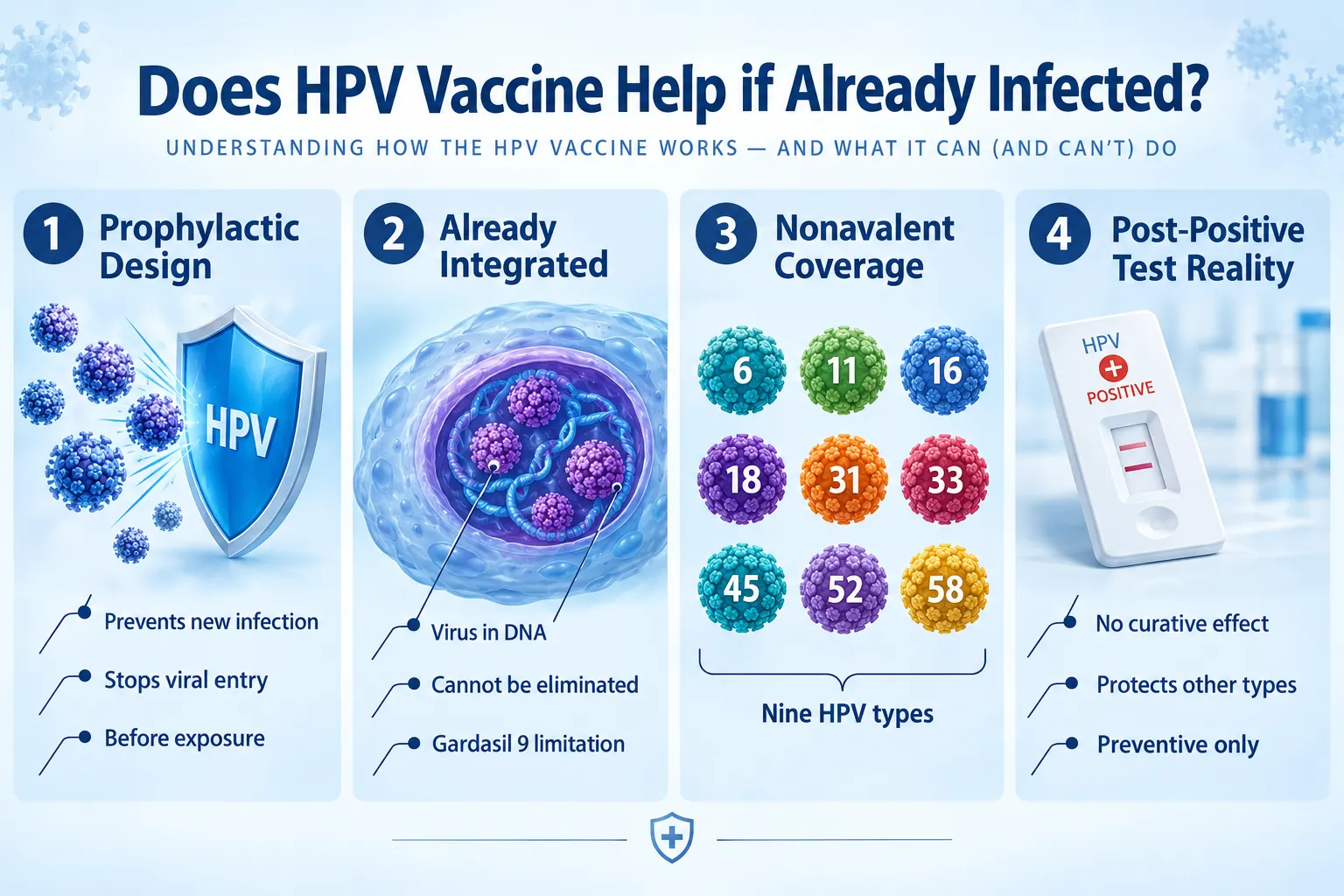
If you test positive for HPV 16, for example, the vaccine will not accelerate how fast your immune system clears that infection. Studies in women who were already HPV DNA-positive at the time of vaccination confirmed this directly: the vaccine did not change the course of the infection already present. That is a consistent finding across multiple clinical reviews, and it is the basis for the official language that the vaccine has no therapeutic effect on existing infection.
That said, “no therapeutic effect” is not the same as “no benefit.” The distinction matters, and it is the reason guidelines still recommend vaccination for people who have already tested positive.
Does HPV Vaccine Help if Already Infected, Against Other Types?
Yes, and this is the core of why vaccination still makes clinical sense after a positive test.
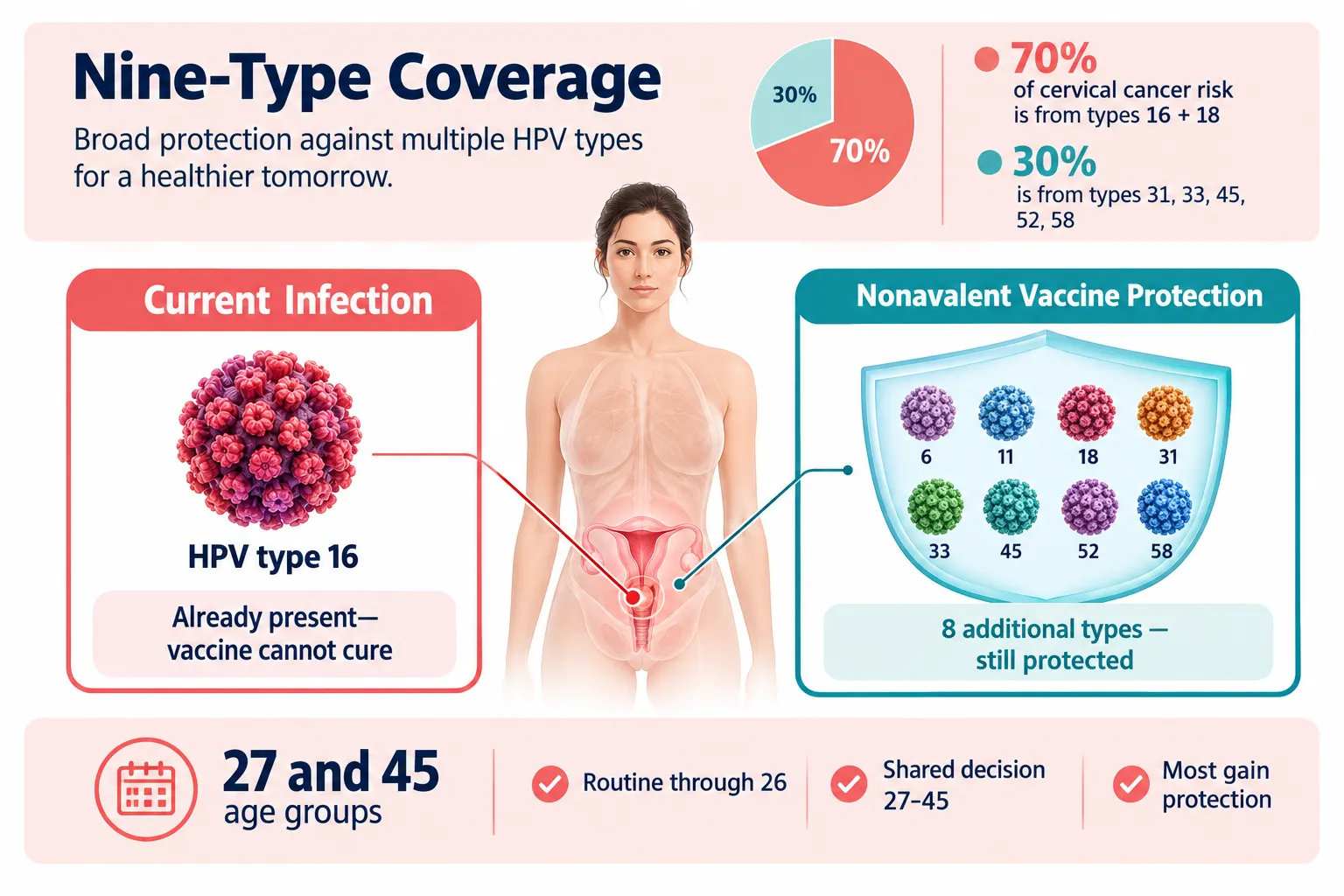
The nonavalent vaccine covers nine HPV types: 6, 11, 16, 18, 31, 33, 45, 52, and 58. Types 16 and 18 together account for roughly 70% of cervical cancers. Types 31, 33, 45, 52, and 58 account for an additional 15-20%. Types 6 and 11 cause approximately 90% of genital warts.
If you test positive for HPV 16, that tells you about one type. It says nothing about types 18, 31, 33, or the others. Most sexually active people have not been exposed to all nine vaccine-relevant types. Vaccination after a positive test protects you against the types you have not yet acquired, and that protection is substantial.
A phase 3 trial of the bivalent vaccine found approximately 90% efficacy against CIN2+ lesions (high-grade cervical precancer) caused by HPV types the women had not yet been exposed to at study entry, even though those women were already infected with other HPV types. That is not a marginal benefit. It is the same level of protection the vaccine offers someone who has never been exposed at all, applied specifically to the types they haven’t yet encountered.
For a plain-English explanation of how HPV spreads and which exposures actually matter, the how HPV spreads and how it doesn’t guide covers that in detail.
Who Should Still Get Vaccinated After a Positive HPV Test?
Ages 9 Through 26
CDC, NCI, and ACOG all recommend routine HPV vaccination through age 26, regardless of prior HPV exposure, sexual history, or a current positive test result. The rationale is straightforward: most people in this age group have not been exposed to all nine vaccine types, so the expected benefit remains high.
You do not need to test negative for HPV before getting vaccinated. You do not need to wait for an infection to clear. A positive HPV test, abnormal Pap result, or history of genital warts does not change the recommendation for this age group. The vaccine is given as scheduled, with the understanding that it will protect against types not yet acquired.
Ages 27 Through 45
For this age group, the recommendation shifts to shared decision-making between you and your doctor. The CDC describes vaccination here as a clinical decision rather than routine, because adults in this range are statistically more likely to have already been exposed to multiple HPV types, which reduces the incremental benefit.
That does not mean vaccination is pointless after 27. It means the expected benefit varies more from person to person. Someone with limited prior sexual exposure may gain meaningful protection. Someone with extensive prior exposure and a long-term monogamous relationship may gain less. Your doctor can help weigh that based on your specific history.
The HPV vaccine: how it works, who should get it, and whether it’s safe covers the full schedule and age-group guidance in more depth.
Does HPV Vaccine Help if Already Infected, After Abnormal Cell Treatment?
This is an area where the evidence is still developing, but it is worth knowing about.
After excision procedures, such as LEEP or cone biopsy, to remove high-grade cervical cell changes (HSIL), there is a real risk of recurrence. Emerging data suggest that vaccination after treatment may reduce that recurrence risk. ACOG has noted that vaccination can be “an important part of treatment” for cell changes caused by HPV, and that after abnormal cells are removed, the vaccine “may help prevent abnormal cells from coming back.”
This is not yet universally codified as standard-of-care, and it does not mean the vaccine is treating the underlying infection. The mechanism is likely the same as primary prevention: protecting against reinfection or infection with additional high-risk types that could drive new cell changes.
If you have had a colposcopy or treatment for abnormal cells and have not yet been vaccinated, this is worth raising directly with your gynecologist. The colposcopy and HPV: a step-by-step look page explains what that procedure involves and what follow-up typically looks like.
Who’s at Higher Risk for Complications From HPV Already Acquired?
Not everyone with HPV faces the same risk of progression. These groups warrant closer monitoring and have the most to gain from vaccination against additional types:
- Immunocompromised individuals, people living with HIV, organ transplant recipients, or anyone on long-term immunosuppressive therapy clear HPV more slowly and have significantly higher rates of high-grade dysplasia and HPV-related cancers.
- People with a history of abnormal Pap or HPV test results, prior LSIL, HSIL, or ASC-US findings indicate that high-risk types are already active; protecting against additional oncogenic types is directly relevant.
- Unvaccinated adults with multiple prior partners, higher cumulative exposure increases the likelihood of carrying multiple HPV types, but also increases the chance that some vaccine-covered types have not yet been acquired.
- Smokers, smoking impairs local cervical immunity and is independently associated with slower HPV clearance and higher risk of cervical dysplasia progression.
What the Vaccine Cannot Do
Being clear about this matters as much as the benefits.
The HPV vaccine will not make an existing infection go away faster. It will not reverse cervical cell changes already caused by HPV. It will not prevent cancer from an infection you already have, that is what regular screening (Pap tests, HPV co-testing) and follow-up are for.
If you have been diagnosed with HPV and are waiting to see whether it clears, the vaccine is not a substitute for your scheduled follow-up appointments. Cell changes are easiest to manage before they progress, that is the entire point of cervical screening. The HPV in women: symptoms, screening, cervical risk, and what it means page explains what that monitoring process looks like in practice.
For people who have been diagnosed with genital warts specifically, the vaccine does not treat existing warts, but it does protect against the other HPV types not yet acquired. The are genital warts curable? page covers treatment options for the warts themselves.
The Practical Answer: Should You Get Vaccinated if You Already Have HPV?
If you are under 26 and have not been vaccinated, yes, the evidence supports getting vaccinated even with a current HPV infection. The benefit is real, the safety profile is well-established, and guidelines from CDC, NCI, and ACOG are consistent on this point.
If you are between 27 and 45, the answer depends on your history and is worth a direct conversation with your doctor. The expected benefit is smaller on average but not zero, and your specific situation, immune status, sexual history, prior exposures, shapes the calculation.
In either case, vaccination is not a replacement for screening. It works alongside Pap tests and HPV co-testing, not instead of them. If you are already HPV-positive, continuing your scheduled screening is the most important thing you can do to catch any cell changes early.
Frequently Asked Questions
Can the HPV vaccine cure an existing HPV infection?
No. The vaccine has no therapeutic effect on an infection already present. It will not accelerate viral clearance or reverse cell changes already caused by HPV. Its benefit after a positive test is protection against the other HPV types you have not yet acquired.
Do I need to tell my doctor I have HPV before getting vaccinated?
Yes, disclose your full history, but a positive HPV test does not disqualify you from vaccination. Your doctor will use that information to counsel you on expected benefit, especially if you are between 27 and 45 where the recommendation involves shared decision-making.
If I already have HPV 16, does the vaccine protect me against HPV 18?
Yes. Infection with one HPV type does not confer immunity to others. If you have HPV 16 and have not been exposed to HPV 18, the vaccine can still protect against HPV 18 and the other seven types covered by the nonavalent vaccine.
Does the vaccine help after LEEP or cone biopsy for abnormal cells?
Emerging evidence suggests vaccination after excision treatment may reduce the risk of recurrence, likely by protecting against reinfection or additional high-risk types. This is not yet universal standard-of-care, but it is a reasonable question to raise with your gynecologist after treatment.
Is there any point in getting vaccinated if I’ve had multiple HPV infections?
Possibly, yes. Unless you have been exposed to all nine types covered by the vaccine, which is difficult to confirm without extensive testing, there may still be types you have not acquired. The benefit decreases with increasing prior exposure, which is why the 27-45 age group involves a clinical conversation rather than a blanket recommendation.
Does natural HPV infection give me the same protection as the vaccine against other types?
No. Natural immunity after infection with one HPV type does not reliably protect against other genotypes and does not provide the same level of protection against reinfection with the same type that vaccination does. This is one reason expert groups continue to recommend vaccination even for people who have already had HPV.