Condoms reduce the risk of HPV transmission, but they don’t eliminate it. That’s the honest answer to the question “does condom protect from HPV?” and understanding why matters more than the yes-or-no.
HPV spreads primarily through skin-to-skin genital contact, not just penetrative sex. A condom covers some of that skin. It doesn’t cover all of it. That gap is why protection is real but partial, and why combining condoms with vaccination gives you a meaningfully stronger defense.
Key Takeaways
- Consistent condom use lowers the risk of new HPV infection by roughly 50-70%, depending on the study population and how consistently condoms are used.
- HPV transmits through skin-to-skin contact, including areas a condom doesn’t cover, inner thighs, the base of the penis, the vulva, and the perineum.
- No condom, used perfectly, blocks HPV the way it blocks fluid-borne infections like HIV or gonorrhea.
- The HPV vaccine is more effective at preventing HPV than condoms alone, and the two work better together.
- Consistent use matters far more than occasional use, the protection gap between “always” and “sometimes” is significant.
How Does Condom Use Reduce HPV Risk?
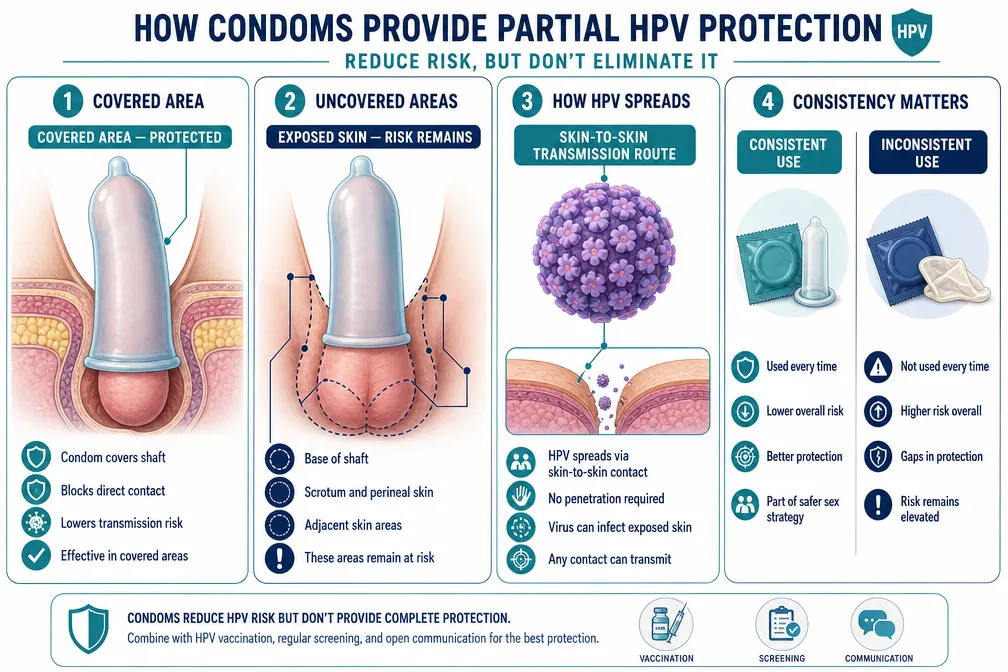
The mechanism is straightforward. HPV lives in the surface cells of skin and mucous membranes. When an infected area makes direct contact with an uninfected area, transmission can happen. A condom physically blocks that contact, but only for the skin it covers.
Studies in women show that consistent condom use is associated with approximately 70% lower risk of acquiring a new HPV infection compared to no condom use. Data in men show a roughly 50% risk reduction among those at higher risk. These are meaningful numbers. They also mean that a significant proportion of transmission still occurs even with correct, consistent use.
The reason comes down to anatomy. Genital HPV, including high-risk types like HPV 16 and 18, and low-risk types like HPV 6 and 11, can be present on skin that a standard condom never touches: the base of the shaft, the scrotum, the labia, the perineum, and the upper inner thighs. Any of those surfaces coming into contact during sex creates a transmission opportunity that no condom addresses.
Female condoms (femidoms) cover a larger surface area of the vulva and vaginal opening, which may offer somewhat broader protection, though the evidence base for femidoms specifically is thinner than for male condoms.
The practical implication: using a condom consistently and correctly is worth doing. The protection is real. It just isn’t complete, and treating it as complete is where the risk misunderstanding comes from.
For a detailed breakdown of how different HPV types behave differently, the HPV types guide covering low-risk and high-risk strains explains what the numbers actually mean.
Who’s at Higher Risk for HPV Transmission Despite Condom Use?
Some people face a higher baseline risk of HPV acquisition even with condom use, because their immune response or exposure pattern affects how the virus behaves.
- Immunocompromised individuals, people living with HIV, organ transplant recipients, or anyone on long-term immunosuppressive therapy, are less able to clear HPV naturally, making initial infection more consequential.
- Unvaccinated adults, particularly those who haven’t received the Gardasil 9 vaccine, have no immune protection against the nine HPV types the vaccine covers, including the two types responsible for roughly 70% of cervical cancers.
- People with multiple recent sexual partners, higher exposure frequency increases the probability that any given contact involves an HPV-positive partner, compounding the partial-protection limitation of condoms.
- Smokers, smoking impairs local immune function in cervical tissue, which may make it harder for the body to clear HPV after exposure.
Does Condom Protect from HPV the Same Way It Protects Against Other STIs?
No, and this distinction is worth being clear about.
For fluid-borne infections like HIV, gonorrhea, and chlamydia, a condom used correctly is highly effective because it physically blocks the transmission route entirely. HPV doesn’t work that way. It transmits through epithelial skin contact, not through semen or vaginal fluid specifically. The condom blocks fluid; it doesn’t encase all potentially infected skin.
This is why older epidemiological data consistently shows reduced HPV positivity and fewer high-risk strains detected in consistent condom users, not zero HPV, but measurably less. The evidence is real. The protection is partial.
It’s also worth noting that protection appears stronger in certain contexts. Studies suggest condoms are more effective at reducing HPV acquisition in non-monogamous relationships with higher exposure frequency than in long-term monogamous couples where HPV may already be present in both partners. If both partners already carry the same HPV genotype, condom use doesn’t change that existing status.
If you’re wondering about other transmission routes beyond penetrative sex, the guide to whether you can get HPV from oral sex covers what the evidence shows for that specific route.
The Vaccination Difference: Why Condoms Alone Aren’t Enough

The HPV vaccine is more effective at preventing HPV infection than condoms alone. That’s not a criticism of condoms, it’s a statement about how differently the two tools work.
Gardasil 9 protects against nine HPV genotypes, including HPV 16 and 18 (the two types responsible for the majority of HPV-related cancers) and HPV 6 and 11 (the two types that cause most genital warts). When given before first exposure, the vaccine is close to 100% effective against those specific types. It doesn’t protect against types you’ve already been exposed to, and it doesn’t cover every HPV genotype, there are over 200 known types, but it targets the ones that cause the most serious outcomes.
Condoms and vaccination address different parts of the problem. Vaccination prevents infection from specific high-risk types. Condoms reduce the probability of transmission during any given sexual encounter. Used together, what some clinicians call a dual-protection approach, the combined effect is substantially stronger than either alone.
The overview of HPV and cancer covering which cancers are linked and how prevention works explains why targeting HPV 16 and 18 specifically has such a large impact on cancer risk.
For people who are already sexually active and may have been exposed to some HPV types, vaccination still provides protection against the types not yet encountered. A clinician can help assess whether vaccination is still beneficial based on age and history.
What Consistent Use Actually Means
The 50-70% risk reduction figures come from studies where participants reported using condoms consistently, meaning every time, from start to finish, for every sexual encounter. That’s a higher bar than most people maintain in practice.
“Sometimes” use offers some protection. The gap between sometimes and always is significant in the data. Condoms used only for part of an encounter, or only for some encounters, provide less protection than the headline figures suggest.
A few practical points the evidence supports:
- Use a condom from the beginning of sexual contact, not just before ejaculation, HPV can transmit before any fluid exchange occurs.
- Water-based or silicone-based lubricant reduces condom breakage, which matters for consistent protection.
- Condoms don’t cover all genital skin, this is a structural limitation, not a user error.
If you’ve recently been diagnosed or are trying to understand your current HPV status, the HPV testing guide covering how results are read and what they mean is a useful next step.
Anal HPV and Condom Protection
Anal HPV follows the same partial-protection principle. Condoms reduce but don’t eliminate transmission risk during anal sex, because the perianal skin and surrounding tissue aren’t fully covered. HPV 16 is the type most associated with anal cancer, and it can be present on perianal skin outside the area a condom covers.
Consistent condom use during anal sex is still recommended, the risk reduction is real. For people at higher risk, including men who have sex with men and immunocompromised individuals, regular anal HPV screening is the more important protective tool. The anal HPV guide covering symptoms, screening, and prevention covers how that screening works and who it’s recommended for.
Genital Warts: Does Condom Use Help?
Genital warts are caused by low-risk HPV types 6 and 11. They’re common, treatable, and not associated with cancer, but they are transmissible, and condoms provide only partial protection against them for the same skin-coverage reasons.
If you’ve been diagnosed with genital warts, the more reassuring fact is that they’re manageable. Several treatment options exist. The overview of genital warts covering what they are and what to do explains the options without alarm.
Frequently Asked Questions
Can you get HPV even if you always use condoms correctly?
Yes. Consistent and correct condom use substantially reduces the risk, by roughly 50-70% depending on the population studied, but doesn’t eliminate it. HPV transmits through skin-to-skin contact in areas condoms don’t cover, including the base of the penis, scrotum, vulva, and perineum. This is a structural limitation of how condoms work, not a failure of the product.
Does the type of HPV affect how well condoms protect?
The partial-protection principle applies to both high-risk types (like HPV 16 and 18) and low-risk types (like HPV 6 and 11). There’s no evidence that condoms are more or less effective against specific genotypes, the coverage limitation is anatomical, not type-specific.
If my partner and I both have HPV, should we still use condoms?
It depends on your specific situation, and it’s worth discussing with a clinician. If you both carry the same genotype, condom use won’t change that existing status. If there’s uncertainty about which types each partner carries, or if one partner has a high-risk type and the other doesn’t, reducing ongoing exposure may still be relevant. A clinician can help assess this based on your test results.
Does using a female condom offer better HPV protection than a male condom?
Female condoms cover a larger portion of the vulva and vaginal opening, which theoretically addresses some of the skin-coverage gap. The evidence base is smaller than for male condoms, so it’s harder to quantify the difference precisely. Either type provides meaningful partial protection; neither provides complete protection.
Is there any point using condoms if I’ve already been vaccinated?
Yes. The HPV vaccine protects against nine specific genotypes. There are over 200 known HPV types, and while the vaccine targets the most clinically significant ones, condoms reduce exposure to all types, including those not covered by the vaccine. Vaccination and condom use address different parts of the risk picture.
What This Means for You in 2026
Condoms are a meaningful part of HPV prevention, not a complete solution on their own. The evidence is consistent: consistent use reduces transmission risk substantially, and that reduction is real and worth acting on. The limitation is anatomical, not a reason to abandon condom use.
The strongest protection comes from combining consistent condom use with HPV vaccination. If you haven’t been vaccinated and are under 45, talk to a clinician about whether the vaccine is still appropriate for you, cell changes from HPV are easiest to address before they progress, and prevention is always the better starting point than treatment. If you’re already sexually active and uncertain about your HPV status, understanding what HPV testing involves and what your results mean is the most direct next step.