Cryotherapy is one of the most widely used procedures for treating HPV-related genital warts and cervical cell changes. It works by freezing abnormal tissue with liquid nitrogen, destroying the cells that carry the virus. This article gives you a clear overview of what the procedure involves, what to expect during recovery, who it’s most appropriate for, and where it fits among other treatment options.
Key Takeaways
- Cryotherapy destroys HPV-affected tissue by freezing it, but it does not eliminate the HPV virus itself from your body
- It is effective for both external genital warts (caused by HPV types 6 and 11) and cervical precancerous changes (CIN)
- Most people need one to three sessions; recurrence is possible because the virus can persist
- The procedure is generally safe and well-tolerated, though it is not recommended during pregnancy
- It remains a first-line option in many clinical settings, including low-resource environments, because it requires minimal equipment
How Cryotherapy Works Against HPV-Related Tissue
Cryotherapy does not treat the HPV virus directly. What it does is destroy the abnormal tissue the virus has produced, warts on the skin surface, or dysplastic cells on the cervix.
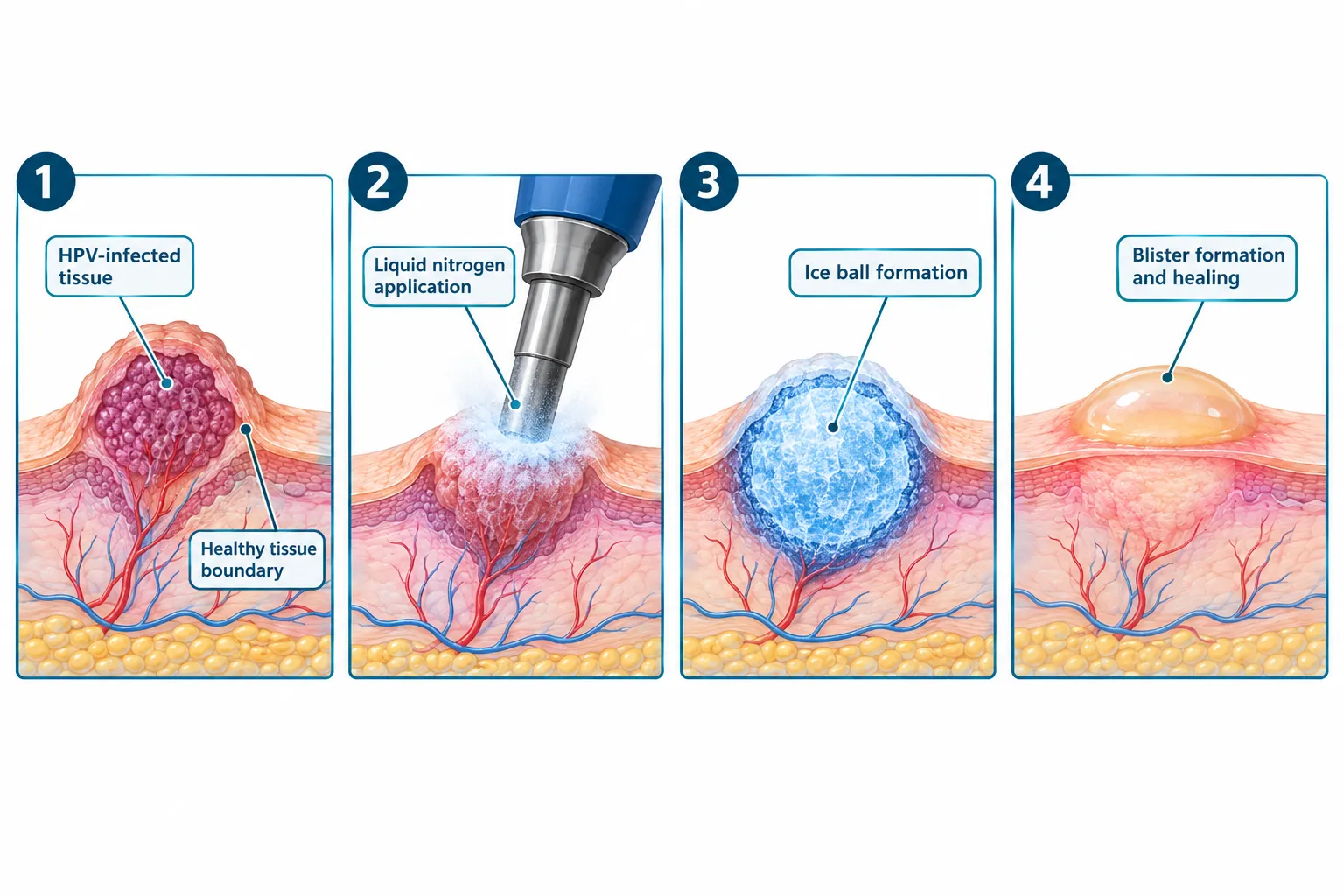
The mechanism is straightforward. Liquid nitrogen, which reaches temperatures as low as -196°C, is applied to the target tissue using a probe or spray. This causes rapid ice crystal formation inside the cells, rupturing cell membranes and triggering cell death. The body then sheds the dead tissue over the following one to two weeks.
For genital warts caused by low-risk HPV types 6 and 11, the freeze targets the visible wart tissue. For cervical precancer (classified as CIN 1, CIN 2, or CIN 3), the freeze is applied to the transformation zone, the area of the cervix where cell changes are most likely to develop.
One treatment cycle typically involves a freeze-thaw-freeze sequence lasting two to three minutes. The depth of the freeze matters: too shallow and abnormal cells survive; too deep and healthy tissue is damaged unnecessarily.
What Cryotherapy Treats: Genital Warts vs. Cervical Changes
The procedure is used in two distinct clinical situations, and the approach differs between them.
External Genital Warts
Genital warts caused by HPV types 6 and 11 are the most common indication. Cryotherapy is a standard first-line option for external anogenital warts, meaning warts on the vulva, penis, perianal skin, or perineum. It works best on warts that are small, flat, or few in number. Large, extensive, or keratinized warts may respond less predictably.
Clearance rates after a full course of treatment (typically one to three sessions spaced one to two weeks apart) range from roughly 60% to 90%, depending on wart size, location, and immune status. Recurrence within three months occurs in a significant proportion of cases, estimates vary, but rates between 20% and 40% are commonly cited in clinical literature. This is not a treatment failure; it reflects the fact that HPV can persist in surrounding tissue even after visible warts are gone. The HPV treatment overview at HPVGuide.org covers the full range of management options, including alternatives to cryotherapy.
If you’ve been wondering whether genital warts can resolve without any treatment at all, the answer is sometimes yes, the evidence on whether genital warts go away on their own explains what drives spontaneous clearance and how long it typically takes.
Cervical Precancer (CIN)
For CIN 1, CIN 2, and selected CIN 3 lesions, cryotherapy is an accepted ablative treatment, meaning it destroys abnormal tissue rather than removing it surgically. It is most appropriate when the entire transformation zone is visible, the lesion fits within the cryotherapy probe tip, and there is no suspicion of invasive cancer.
Current guidance favors cryotherapy for CIN 2 lesions in settings where LEEP (loop electrosurgical excision procedure) is unavailable, and it remains a core tool in low-resource settings globally. For CIN 3 or lesions extending into the cervical canal, excisional procedures like LEEP are generally preferred because they also provide a specimen for pathological review.
An abnormal Pap smear result is often the first sign that cervical cell changes need further evaluation, colposcopy confirms the grade before any ablative treatment is considered.
Who’s at Higher Risk for Recurrence or Complications After Cryotherapy?
Cryotherapy is safe for most people, but certain groups face a higher likelihood of recurrence or reduced treatment response:
- Immunocompromised individuals, people living with HIV, organ transplant recipients, or anyone on long-term immunosuppressive therapy clear HPV-related lesions more slowly and have higher recurrence rates after cryotherapy
- People with extensive or multi-site warts, larger wart burden, or warts at multiple anatomical sites, predicts a lower single-session clearance rate and a greater need for repeat treatment
- Smokers, smoking impairs local immune surveillance and is associated with slower resolution of both warts and cervical dysplasia
- People with a history of abnormal Pap results, prior LSIL or HSIL findings suggest a more persistent HPV infection, which increases the chance that cell changes will recur after ablative treatment
What the Procedure Feels Like and What Happens Afterward
Most people describe cryotherapy as a cold, burning, or cramping sensation during the procedure. For external warts, topical anesthetic can reduce discomfort. For cervical cryotherapy, a mild to moderate cramping sensation is common during the freeze; some clinicians offer ibuprofen beforehand.
After treatment, expect:
- A blister or swollen area at the treatment site within 24 hours (external warts)
- A watery or slightly blood-tinged discharge lasting one to three weeks after cervical cryotherapy, this is normal and represents the shedding of treated tissue
- Mild soreness or sensitivity at the site for a few days
A phenomenon described in recent clinical observations is the “doughnut wart”, a ring-shaped recurrence that appears at the periphery of the original freeze zone. This occurs when the freeze margin was insufficient to destroy all HPV-infected cells at the wart’s edge. It is not a new infection; it is a recurrence from surviving tissue, and it responds to a repeat cryotherapy session with an adjusted freeze margin.
Cryotherapy is not recommended during pregnancy. The procedure can be deferred safely in most cases, as many warts regress postpartum and cervical CIN is monitored rather than treated during pregnancy.
Post-Procedure Care
- Avoid sexual contact for at least one week after external wart treatment, or until the treatment site has healed
- After cervical cryotherapy, avoid intercourse, tampons, and swimming for at least three to four weeks
- Shower normally; avoid soaking the treated area in baths or pools during the healing window
- Report any signs of infection, increasing pain, fever, or purulent discharge, to your provider
Cryotherapy vs. Other HPV Wart Treatments

Cryotherapy is one of several options for managing genital warts and cervical dysplasia. Understanding where it fits helps you have a more informed conversation with your doctor.
| Treatment | Best for | Requires clinic visit? | Notes |
|---|---|---|---|
| Cryotherapy | Small-moderate warts; CIN in low-resource settings | Yes | Fast, no anesthesia needed |
| LEEP | CIN 2-3; larger cervical lesions | Yes | Provides tissue for biopsy |
| Podophyllotoxin (patient-applied) | Small, accessible external warts | No | Not for cervical or vaginal use |
| Imiquimod (patient-applied) | External warts; immune modulation | No | Slower; not for internal use |
| Trichloroacetic acid (TCA) | Small warts; pregnancy-safe option | Yes | Useful when other options limited |
No single treatment is universally superior. Cryotherapy’s advantages are speed, no requirement for local anesthesia in most cases, and availability in settings without surgical equipment. Its limitation is that it cannot treat lesions inside the vaginal canal or cervical os without specialized equipment, and it does not provide a tissue specimen.
For people asking whether genital warts can be permanently resolved, the evidence on whether genital warts are curable addresses what “cure” realistically means when an underlying viral infection may persist.
Follow-Up After Cryotherapy
Follow-up depends on what was treated.
After external genital wart treatment, a clinical review at three months is standard to assess clearance and check for recurrence. If warts have fully resolved, no further scheduled follow-up is required, though you should return if new lesions appear.
After cervical cryotherapy for CIN, most guidelines recommend a co-test (HPV test plus cytology) or HPV test alone at six months and again at twelve months. If both results are normal, you return to routine screening intervals. If HPV persists or cytology shows residual abnormality, colposcopy is repeated to assess whether further treatment is needed.
Persistent high-risk HPV after treatment, particularly types 16 and 18, warrants closer monitoring. The virus remaining detectable does not automatically mean treatment failed; it means the immune system hasn’t yet cleared the infection, and continued surveillance is the appropriate response.
Frequently Asked Questions
Does cryotherapy cure HPV, or just the warts?
Cryotherapy removes the visible warts or abnormal cells, but it does not eliminate HPV from your body. The virus can remain in surrounding tissue even after successful treatment. Many people’s immune systems clear the virus over time, typically within one to two years, but this happens independently of the procedure.
How many cryotherapy sessions will you need?
This varies. A single session clears warts in some people; others need two or three sessions spaced one to two weeks apart. Larger warts, warts in difficult locations, or immunocompromised status all increase the likelihood of needing repeat treatment.
Can you have sex after cryotherapy?
After external wart treatment, most clinicians recommend waiting until the treated area has healed, usually about one week. After cervical cryotherapy, the standard advice is to avoid intercourse for three to four weeks. The guidance on sex with HPV covers the broader question of transmission risk and how to talk to a partner.
Is cryotherapy safe if you’re pregnant?
It is generally avoided during pregnancy. Many warts regress after delivery, and cervical cell changes are monitored rather than treated until after the birth. TCA is one of the few options considered when treatment of external warts during pregnancy is genuinely necessary. Discuss timing with your provider.
What if warts come back after cryotherapy?
Recurrence is common and does not mean the treatment was done incorrectly. It means HPV persisted in tissue adjacent to the treated area. A repeat session, often with a slightly wider freeze margin, is the standard next step. Persistent recurrence despite multiple sessions may prompt a switch to a different treatment modality, such as imiquimod or podophyllotoxin.
Does getting the HPV vaccine after cryotherapy help?
The vaccine does not treat an existing infection, but it can protect against HPV types you haven’t yet been exposed to. If you haven’t completed the vaccine series, it’s worth discussing with your provider, the HPV vaccine guide covers who benefits and at what age.
What to Do Next
Cryotherapy for HPV-related warts and cervical changes is a well-established, accessible procedure. It works. It also has limits, it doesn’t eliminate the virus, and recurrence is a real possibility, especially in the first three months after treatment.
The most useful thing you can do after cryotherapy is follow the recommended follow-up schedule. Cell changes are easiest to manage before they progress, that’s exactly what post-treatment monitoring is designed to catch. If you’ve had an abnormal Pap result and are waiting to understand what happens next, the guide to abnormal Pap smear follow-up walks through what each step involves.
Talk to your doctor about which treatment approach fits your specific situation, wart type, location, immune status, and whether you’re considering pregnancy all factor into the decision.