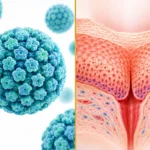
Kissing your child is not a known route for spreading HPV. The risk from a parent’s everyday kiss, on the cheek, the forehead, the top of the head, is considered negligible by pediatric and infectious disease experts. That said, the question deserves a real answer, not just a dismissal, because the biology behind it matters.
Key Takeaways
- Casual kissing between a parent and child is not a documented transmission route for HPV.
- Saliva can carry HPV DNA, but carrying viral DNA is not the same as transmitting an active infection.
- The primary route of HPV to a child is birth, through direct contact with an infected birth canal.
- Non-sexual HPV transmission within households does occur, but it is uncommon and poorly quantified.
- HPV vaccination, not avoiding affection, is the evidence-based strategy for protecting your child.
How HPV Actually Spreads, and Where Kissing Fits In
HPV is a skin-to-skin virus. It spreads most efficiently through direct mucosal or epithelial contact, which is why genital-to-genital and oral-to-genital contact are the primary transmission routes in adults. The full picture of how HPV transmits is more nuanced than most people realize.
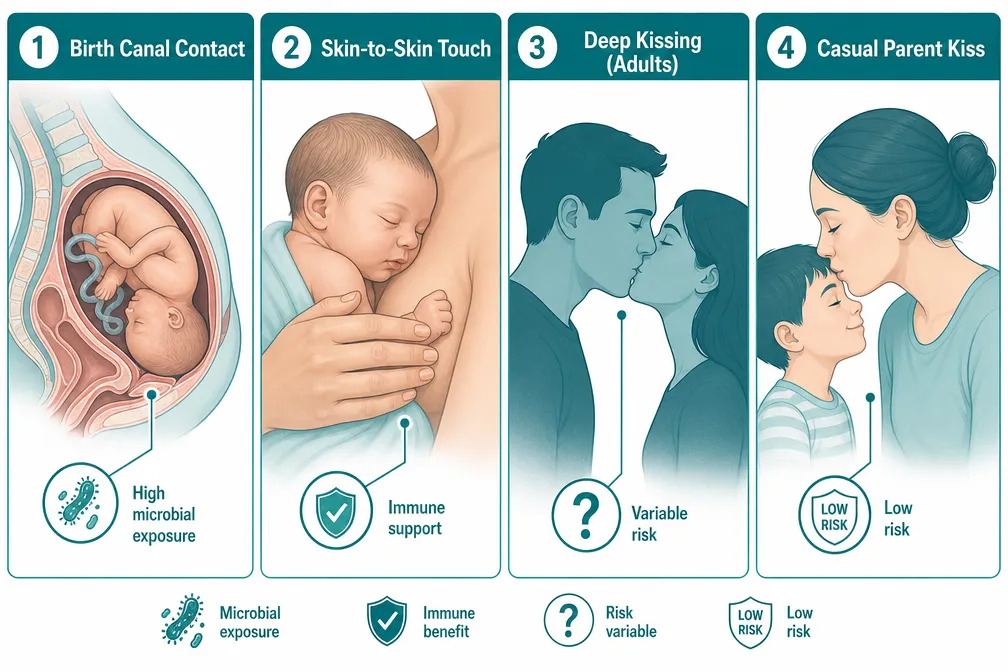
Saliva does contain HPV DNA in some people with oral HPV infections. But detecting viral DNA in saliva is not the same as proving that saliva transmits the virus. The virus needs to reach susceptible mucosal tissue and establish infection, and the evidence that a normal parent-to-child kiss achieves that is essentially absent.
The routes that are documented in children are:
- Perinatal transmission: Direct contact with HPV-infected tissue during vaginal delivery. This is the main established route for children acquiring HPV types 6 and 11, which can cause recurrent respiratory papillomatosis (RRP), a rare condition affecting the airway.
- Early skin-to-skin contact: Non-sexual household transmission has been observed in studies, but the exact mechanism, whether it’s touch, shared surfaces, or something else, is not fully established.
- Autoinoculation: A child with a common wart on their hand could theoretically spread it to another site on their own body.
A parent kissing their child does not fit neatly into any of these documented pathways.
Can You Pass HPV to Your Child by Kissing? What the Evidence Actually Shows
The direct question, can you pass HPV to your child by kissing, has been studied, and the answer is: not through ordinary kissing, and the evidence for any kissing-based transmission to children is weak.
Here is what is known. Deep, open-mouth kissing between adult partners may carry some HPV transmission risk, particularly for oral HPV types. The relationship between kissing and HPV spread in adults is an active area of research, and the risk magnitude is still being quantified. But adult-to-adult deep kissing is a very different exposure than a parent kissing a child on the cheek or forehead.
For children specifically, authoritative pediatric sources do not list postnatal kissing as a meaningful transmission route. The concern that parents sometimes raise, “I have HPV, could I give it to my child by kissing them?”, is understandable, but the biology does not support it as a practical risk.
A few things explain why:
- Most oral HPV infections in adults are subclinical and do not produce the kind of high viral shedding that would make casual contact infectious.
- A brief kiss does not involve the sustained mucosal contact that efficient HPV transmission requires.
- Children’s immune systems respond to HPV exposures, and most exposures, even documented ones, do not result in persistent infection.
The broader question of whether HPV can be passed by kissing is worth understanding in context, but for parent-to-child kissing specifically, the risk is not something that warrants changing how you interact with your child.
Who Is at Higher Risk for HPV Transmission to Children?
Most parent-to-child HPV exposure carries very low risk. A few specific situations do raise the probability:
- Newborns delivered vaginally to a parent with active genital HPV lesions: This is the highest-risk scenario for a child acquiring HPV types 6 or 11, which cause RRP.
- Immunocompromised children: Children on immunosuppressive therapy or with conditions affecting immune function may be less able to clear an HPV exposure before it establishes infection.
- Households where a parent has active oral HPV lesions (oral warts or papillomas): Visible lesions indicate higher viral load, which theoretically increases any contact-based risk, though documented transmission in this scenario is still rare.
- Unvaccinated children approaching adolescence: Not a transmission-risk factor per se, but unvaccinated children have no immune protection against the HPV types covered by the vaccine, making any future exposure more likely to result in persistent infection.
What About Oral HPV in Parents, Does That Change the Risk?
If you have been told you have oral HPV, or if you have had an HPV-related throat or mouth diagnosis, it is reasonable to ask whether that changes anything for your child.
The honest answer: it raises the theoretical concern slightly, but it does not translate into a clear, quantified risk from kissing. Oral HPV, including high-risk types like HPV 16, which is linked to oropharyngeal cancer, is common in adults. Most people with oral HPV have no visible lesions and shed virus at low levels, if at all. The connection between HPV types and cancer risk is real in adults, but that risk pathway is not relevant to a child receiving a kiss on the forehead.
If you have active oral warts or papillomas, that is worth mentioning to your child’s pediatrician, not because kissing is proven dangerous, but because a clinician can give you specific guidance based on your actual situation.
How to Actually Protect Your Child from HPV
The evidence-based answer to protecting your child from HPV is vaccination, not avoiding affection.
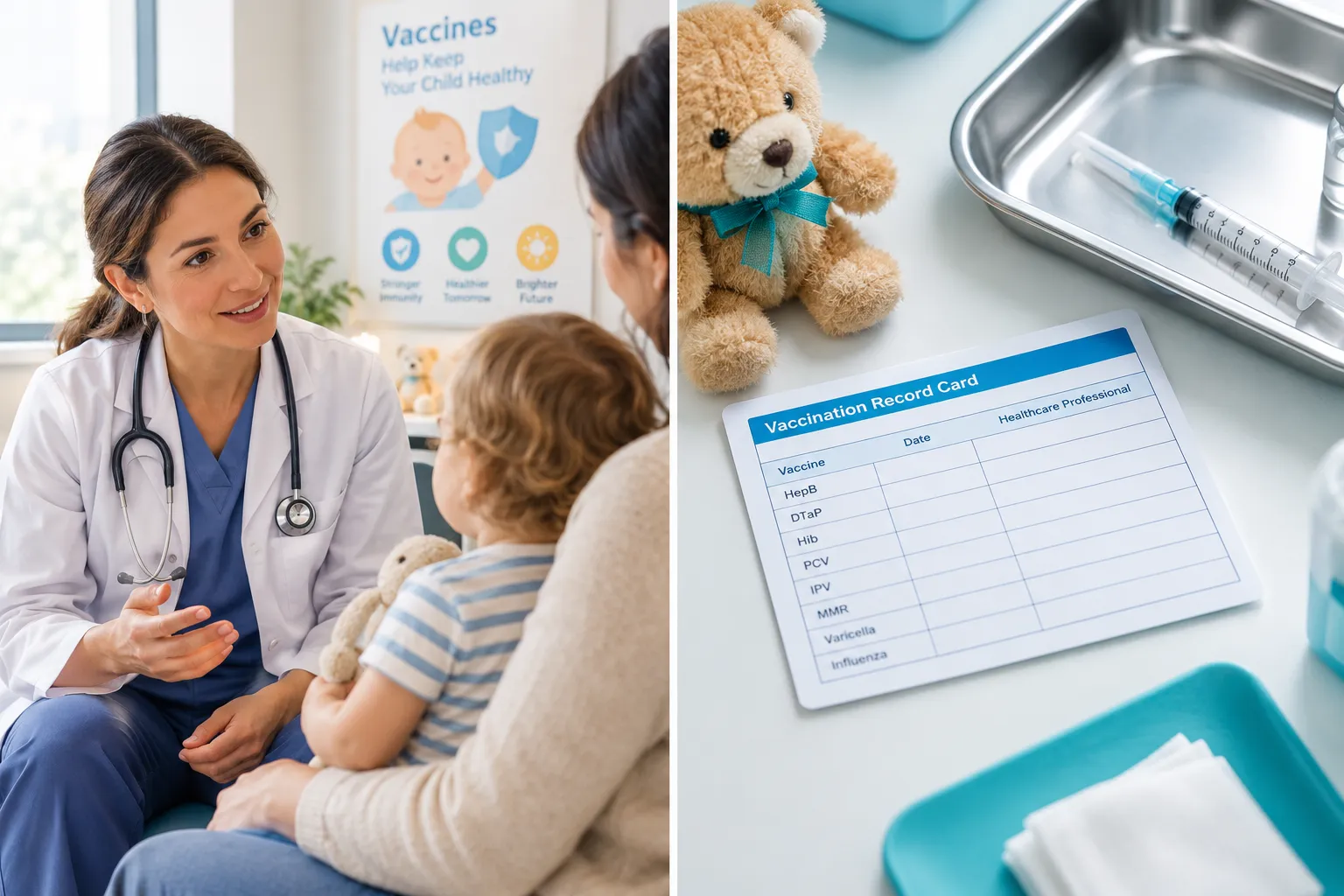
The HPV vaccine is recommended in the United States starting at age 11 or 12, with a two-dose schedule if started before age 15. It protects against HPV types 6, 11, 16, 18, and several other high-risk strains. The HPV vaccine guide covers how it works, who should get it, and the safety data behind it.
Vaccination before any HPV exposure produces the strongest immune response. That is the reason for the adolescent schedule, not because HPV is a risk in childhood, but because building immunity before sexual activity begins is the most effective window.
There is no recommendation, from any major health authority, to restrict normal parental affection as an HPV prevention measure. The CDC, WHO, and AAP guidance on HPV in children focuses on vaccination, routine screening for parents, and monitoring newborns born to parents with active genital HPV, not on kissing.
Frequently Asked Questions
Can a parent with genital HPV pass it to a child through everyday contact?
Genital HPV types are transmitted through genital skin-to-skin contact. Everyday contact, hugging, kissing, sharing a towel, is not a documented route for genital HPV transmission to children. The main risk to a child from a parent with genital HPV is during vaginal delivery, not postnatal contact.
My child has warts on their hands, did they get HPV from me?
Common hand warts are caused by HPV types 1, 2, and 4, which are distinct from the genital and oral HPV types that adults typically carry. Children pick up these strains from surfaces, shared objects, and minor skin abrasions. Understanding which warts are caused by HPV helps clarify that hand warts in children are almost never connected to a parent’s HPV status.
Should I tell my child’s doctor that I have HPV?
It is worth mentioning if you have active oral lesions, a current genital HPV diagnosis during or just before pregnancy, or if your child’s pediatrician asks about family health history. In most cases, a parent’s HPV status does not require any change in the child’s routine care, but your child’s doctor can give you specific guidance.
Does HPV testing exist for children?
There is no routine HPV screening for children. HPV testing in adults is used in the context of cervical cancer screening (Pap tests combined with HPV co-testing) or to evaluate abnormal results. If a child develops symptoms that raise concern, such as warts in the throat or airway, a clinician will investigate, but this is rare. HPV symptoms in children are uncommon and usually present as visible warts rather than internal lesions.
If I was vaccinated against HPV, can I still pass it to my child?
The HPV vaccine does not treat existing infections, it prevents new ones. If you acquired an HPV infection before vaccination, the vaccine does not eliminate that infection. However, the overall risk of passing HPV to a child through kissing remains low regardless of vaccination status, for the reasons outlined above.
What to Do Next
If you have HPV and are worried about your child, the most useful next step is a conversation with your child’s pediatrician, not a change in how you show affection. Bring up your diagnosis, ask whether your child’s vaccination schedule is on track, and ask specifically about any symptoms you have noticed. That conversation will be more productive than any precautions around kissing.
If your child is approaching age 11 or 12 and has not started the HPV vaccine series, that is the most concrete protective action available. The vaccine works best before exposure, and for most children, that window is still open.