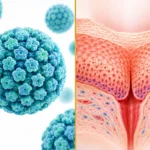
No, you cannot catch HPV from sharing a drink. The question “can you catch HPV from sharing a drink?” comes up often, and the answer is clear: HPV does not spread through shared cups, bottles, or utensils. The virus requires direct skin-to-skin or mucous membrane contact to transmit, and a shared glass simply does not provide that pathway.
Key Takeaways
- HPV is not transmitted through shared drinks, cups, bottles, or eating utensils.
- Saliva can contain HPV DNA, but detecting viral DNA in saliva is not the same as casual contact being a transmission route.
- Oral HPV is linked to sexual contact, specifically oral-genital and deep oral contact, not casual saliva sharing.
- HPV survives poorly outside the human body, which limits any theoretical risk from contaminated surfaces or drinkware.
- If you have concerns about how HPV spreads, the most useful next step is understanding the actual transmission routes.
How HPV Actually Spreads
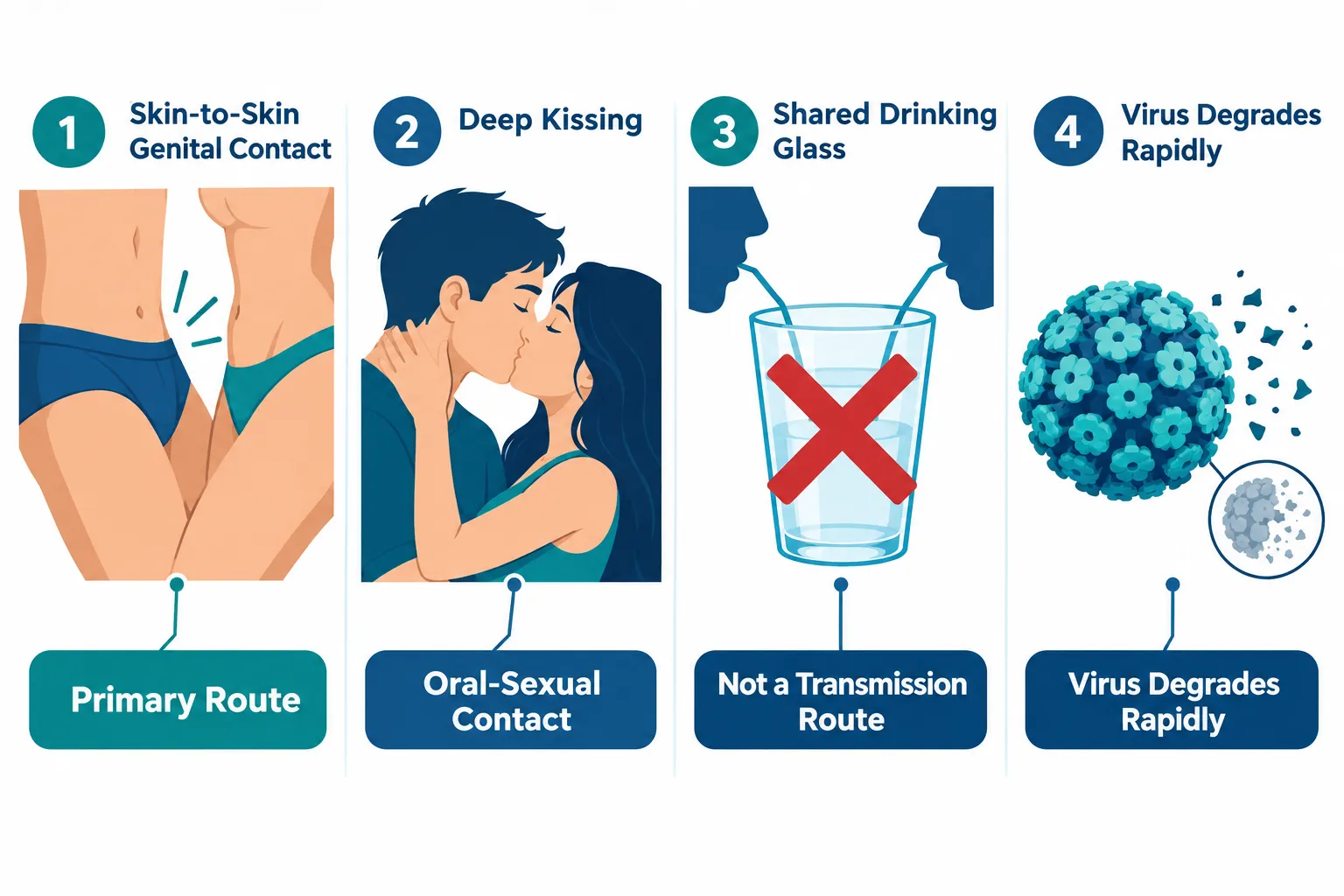
HPV, human papillomavirus, is a skin-level virus. It transmits through direct contact with infected skin or mucous membranes, most commonly during sexual activity. That includes genital-to-genital contact, anal sex, oral sex, and in some cases deep kissing when one partner carries an oral HPV infection.
The full breakdown of how HPV spreads and how it doesn’t covers this in detail, but the core point is this: HPV needs a living host cell to replicate. It does not survive on hard surfaces, glass, plastic, metal, long enough to infect someone through incidental contact.
There are over 200 HPV genotypes. The ones most relevant to sexual transmission are high-risk types like HPV 16 and 18, which are associated with cervical and other cancers, and low-risk types like HPV 6 and 11, which cause genital warts. None of these types have a documented transmission route through shared drinkware.
Can You Catch HPV from Sharing a Drink? What Saliva Research Actually Shows
Saliva can test positive for HPV DNA. That fact sounds alarming, but it needs context.
Finding HPV DNA in saliva means the virus, or fragments of it, is detectable in the mouth. It does not mean that saliva sitting on the rim of a glass is capable of infecting the next person who drinks from it. For transmission to occur, the virus needs to reach susceptible mucosal tissue in sufficient quantity, and it needs to survive long enough to do so.
HPV survives poorly outside the body. Once outside a living cell, the viral load degrades quickly on hard surfaces. A shared drink does not replicate the conditions needed for transmission, there is no sustained mucous membrane contact, no friction, and no viable quantity of virus reaching new tissue in the way sexual contact provides.
Oral HPV infections, most commonly HPV 16, which is linked to oropharyngeal cancers, are associated with oral-sexual behaviors, not with sharing cups or food. The relationship between saliva and HPV transfer is more nuanced than a simple yes or no, and that page explains what the research does and does not show.
As of 2026, no documented cases of HPV transmission have been traced to shared drinkware or utensils. That absence of evidence, combined with what is known about how the virus behaves outside the body, puts the risk in the negligible category, not “low but possible,” but genuinely not a recognized transmission route.
Deep Kissing vs. Sharing a Cup: Why the Distinction Matters
These two things are not the same risk, and conflating them causes unnecessary anxiety.
Deep kissing, prolonged, open-mouth contact, involves direct and sustained mucous membrane contact. Some research suggests this may be a route for oral HPV transmission, particularly for high-risk types like HPV 16. The question of whether HPV can be passed through kissing addresses this specifically.
Sharing a drink is categorically different. The contact is indirect. Any viral material on a glass rim is exposed to air, diluted by liquid, and not delivered to mucosal tissue through the kind of sustained contact that enables transmission. These are not two points on the same risk spectrum, they are different mechanisms entirely.

Who Is at Higher Risk for Oral HPV?
Oral HPV is not evenly distributed. These groups carry a meaningfully higher prevalence:
- People with multiple oral-sexual partners, the number of lifetime oral sex partners is the strongest predictor of oral HPV infection.
- Smokers, tobacco use is associated with higher oral HPV prevalence and reduced immune clearance.
- Immunocompromised individuals, people living with HIV, organ transplant recipients, or others on immunosuppressive therapy are less able to clear HPV infections, including oral ones.
- Unvaccinated adults, HPV 16, the type most associated with oropharyngeal cancer, is preventable with the HPV vaccine. Unvaccinated people over 26 who have not been exposed carry a different risk profile than vaccinated individuals.
What About Other Casual Contact, Utensils, Lip Balm, Straws?
The same logic applies. Sharing a straw, a fork, or lip balm does not constitute a recognized HPV transmission route. These involve brief, indirect contact with surfaces that do not sustain the virus.
HPV is not in the same category as cold sores (herpes simplex virus) or mono (Epstein-Barr virus), both of which spread more readily through saliva. Understanding what HPV actually is and how it behaves helps clarify why casual contact does not carry the same risk it does for other viruses.
If you have been diagnosed with oral HPV and are trying to understand how you acquired it, the timing of HPV infection is often unknowable. The virus can remain dormant for months or years before detection. That makes tracing a specific exposure, or ruling out a specific one, medically unreliable.
HPV Symptoms and When to Talk to a Doctor
Most HPV infections, including oral ones, produce no symptoms at all. The virus often clears on its own within one to two years. The full picture of HPV symptoms in men and women explains what signs, if any, to look for.
Oral HPV that persists, particularly HPV 16, is associated with oropharyngeal cancers, which affect the back of the throat, the base of the tongue, and the tonsils. This is a real risk, but it applies to persistent high-risk infection, not to a single exposure or a positive test result. Cell changes are easiest to address before they progress, that is what monitoring is for.
If you have a confirmed oral HPV diagnosis and want to understand your options, the overview of HPV treatment approaches covers what management currently looks like.
Frequently Asked Questions
Can HPV live on surfaces long enough to infect someone?
HPV survives very poorly outside the human body. On hard surfaces like glass or plastic, the virus degrades quickly and does not retain the ability to infect mucosal tissue. This is one of the key reasons casual contact with objects is not a recognized transmission route.
If my partner has oral HPV, should I avoid kissing them?
Deep, prolonged kissing carries a different, and higher, theoretical risk than sharing a drink, because it involves direct mucous membrane contact. That said, oral HPV is common, often clears on its own, and the absolute risk from any single exposure is low. This is worth discussing with a healthcare provider if you have specific concerns, particularly if either partner is immunocompromised.
Can you get HPV in your mouth from oral sex?
Yes. Oral sex is the primary route for oral HPV transmission. HPV 16 in particular is associated with oropharyngeal cancers, and its prevalence is linked to the number of oral sex partners rather than to casual contact like shared cups or utensils.
Does the HPV vaccine protect against oral HPV?
The Gardasil 9 vaccine covers HPV 16 and 18, among other types. It is most effective when given before exposure, ideally in adolescence, but it can still provide protection for adults who have not yet been infected with the covered types. Vaccination is the most reliable preventive measure against high-risk HPV, including oral strains.
I tested positive for HPV. Does that mean I got it from a recent partner?
Not necessarily. HPV can remain dormant for months or years before it is detected. A positive result does not identify when or from whom you acquired the virus. This is a point worth understanding clearly, the question of whether HPV can reactivate without new sexual contact explains the dormancy issue in more depth.