Yes, a woman can spread HPV to a man, and she can do so without knowing she carries the virus. HPV transmits through skin-to-skin genital contact, not through bodily fluids, which means penetrative sex is not required for transmission to occur. Most people with HPV have no symptoms and no idea they’re infected, making silent transmission the norm rather than the exception.
Key Takeaways
- Female-to-male HPV transmission is well-documented and occurs through genital skin contact, vaginal sex, anal sex, and oral sex.
- Research shows women transmit HPV to men at a higher rate than men transmit to women, roughly 37 per 1,000 person-months versus 20 per 1,000 person-months in the other direction.
- Most men who acquire HPV clear the infection on their own within one to two years.
- HPV can cause genital warts and, less commonly, cancers of the penis, anus, and head and neck in men.
- Vaccination, condoms, and reducing the number of sexual partners all lower, but do not eliminate, transmission risk.
How Can a Woman Spread HPV to a Man?
HPV is a skin-to-skin virus. It lives in the surface cells of genital tissue, the vulva, vagina, cervix, perineum, and passes to a partner through direct contact with those areas. No exchange of semen or vaginal fluid is needed.
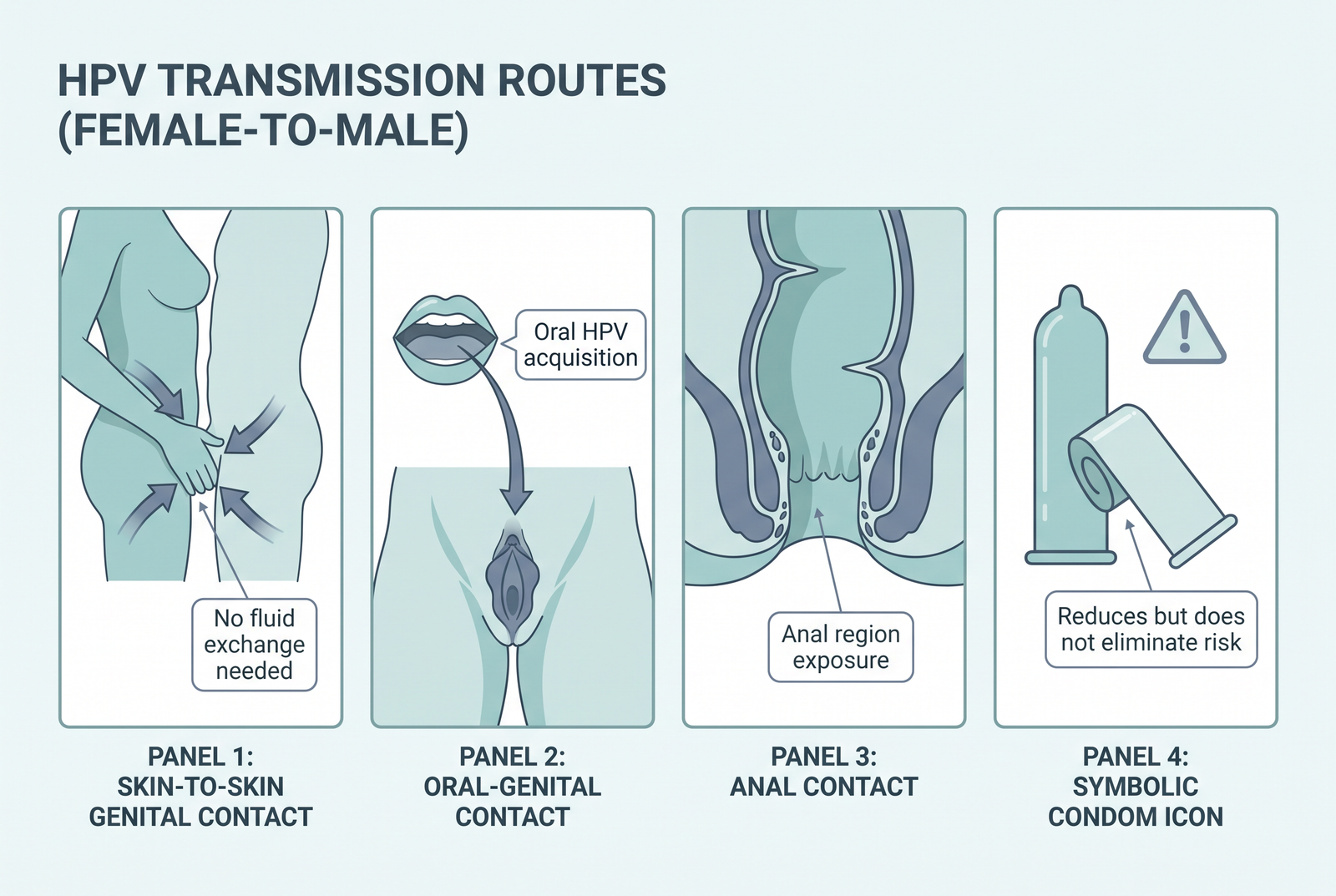
The documented routes by which a woman can spread HPV to a man include:
- Vaginal intercourse, the most common route; the penis comes into direct contact with infected cervical and vaginal tissue.
- Anal sex, HPV can infect the anus and surrounding skin of either partner.
- Oral sex, performing oral sex on a woman with genital HPV is a recognized route of oral HPV acquisition in men; data from multinational studies report an incidence of oral oncogenic HPV in men of around 2.4 per 1,000 person-months, with risk rising among men who have more female sexual partners and who perform oral sex frequently.
- Genital-to-genital contact without penetration, friction involving the vulva, labia, or perineal area is sufficient; the virus does not require a mucosal surface breach to transfer.
- Shared sex toys, if genital tissue contacts a surface carrying HPV, transmission is possible.
For a broader look at how HPV moves between people, the guide to how HPV spreads and how it doesn’t covers the full picture, including non-sexual routes that are far less common.
Why Transmission Happens Without Symptoms
A woman with HPV usually has no visible signs. No warts, no discharge, no discomfort. The virus can be present on genital skin even when a Pap smear is normal and even between active outbreaks in those who do develop warts. That’s not unusual, it’s how HPV behaves in most people. The full overview of HPV in women explains why so many infections go undetected and what screening actually looks for.
How Efficient Is Female-to-Male Transmission?
More efficient than most people expect. A systematic review of HPV natural history found a pooled female-to-male transmission rate of approximately 37 per 1,000 person-months, compared to roughly 20 per 1,000 person-months for male-to-female transmission. The rate ratio, about 1.72, means women transmit HPV to men nearly twice as efficiently as men transmit to women.
A separate modeling analysis estimated women-to-men transmission at 5.6 per 100 person-months versus 3.5 per 100 person-months in the reverse direction. Couple-based studies of genital HPV concordance have found female anogenital-to-male anogenital transmission rates around 21 per 100 person-months.
The biological reason is straightforward: the surface area of female external genital tissue is larger, and the virus sheds from multiple sites simultaneously, cervix, vaginal walls, vulva, perineum, creating more opportunities for contact.
This doesn’t mean every sexual encounter leads to transmission. It means the cumulative probability rises with repeated exposure, and that a man in a long-term relationship with a woman who carries HPV has a meaningful chance of acquiring it over time.
What Happens to a Man Who Acquires HPV?
Most men who acquire HPV from a female partner, or from any partner, clear the infection on their own. The immune system resolves most genital HPV infections within one to two years without treatment or lasting effects.
When HPV does cause problems in men, the outcomes fall into two categories:
Low-risk HPV types (mainly types 6 and 11): These cause genital warts, soft, flesh-colored growths on the penis, scrotum, anus, or surrounding skin. They’re not dangerous, but they are treatable. The overview of genital warts covers what they look like and what to do if they appear.
High-risk HPV types (mainly types 16 and 18): These can, in a small proportion of cases, lead to cancers of the penis, anus, and the oropharynx (throat and base of tongue). Oropharyngeal cancer driven by HPV 16 has been rising in men for decades. The HPV and cancer overview explains which cancers are linked and how that risk is monitored.
Men don’t have a routine HPV screening test equivalent to the Pap smear, which means HPV-related disease in men often goes undetected until symptoms appear. That’s a gap in care worth knowing about, not a reason to panic, but a reason to discuss any unusual symptoms with a clinician.
For a complete picture of how HPV presents and progresses in male patients, the HPV in men guide covers symptoms, risks, and testing in detail.
Who’s at Higher Risk for Acquiring HPV From a Female Partner?

Not every man faces the same level of risk. Several factors increase the likelihood of acquiring HPV from a female partner:
- Unvaccinated men, particularly those who missed adolescent vaccination and haven’t received catch-up doses; the vaccine covers the highest-risk types.
- Men with multiple sexual partners, cumulative exposure across multiple partners significantly raises the probability of encountering HPV.
- Immunocompromised individuals, men living with HIV, those on immunosuppressive therapy after organ transplantation, or anyone with a weakened immune system are less able to clear HPV after acquisition and face higher risk of persistent infection and related disease.
- Men who have sex with both men and women, research on penile high-risk HPV identifies this group as having higher exposure through both genital-genital and oral-genital contact.
Can a Woman Spread HPV to a Man Even If She’s Been Treated?
Treatment for HPV-related conditions, genital warts, cervical dysplasia, abnormal Pap results, does not eliminate the virus from the body. Treatment removes visible warts or abnormal cells; it does not eradicate HPV itself. A woman who has been treated for genital warts caused by HPV types 6 or 11 may still carry the virus in surrounding tissue and can still transmit it.
This is not a reason to avoid intimacy after treatment. It is a reason to have an honest conversation with a partner and to discuss vaccination and barrier methods with a clinician.
Does Using a Condom Prevent Female-to-Male HPV Transmission?
Condoms reduce the risk. They do not eliminate it. Because HPV spreads through skin contact, not fluid, any genital skin not covered by a condom remains a potential transmission surface. Consistent condom use has a measurable protective effect in studies, and it also reduces the risk of other sexually transmitted infections. But a condom covering the penile shaft does not protect against contact with the vulva, perineum, or base of the scrotum.
How to Reduce the Risk of Female-to-Male HPV Transmission
Three strategies have real evidence behind them:
- HPV vaccination, the most effective single intervention. The 9-valent vaccine (Gardasil 9) covers types 6, 11, 16, 18, 31, 33, 45, 52, and 58. Catch-up vaccination is available for men through age 26, and shared clinical decision-making allows vaccination up to age 45 for those at higher risk. The HPV vaccine for men explains who should get it and whether it helps if HPV is already present.
- Consistent condom use, reduces but does not eliminate transmission risk; worth using alongside vaccination, not instead of it.
- Reducing the number of concurrent sexual partners, lowers cumulative exposure across the population; this is a statistical reality, not a moral judgment.
Frequently Asked Questions
If my female partner has HPV, does that mean I already have it?
Not necessarily, but the probability increases with the duration and frequency of sexual contact. Many couples are concordant, both carry the same HPV type, but that’s not universal. There’s no routine HPV test for men, so the honest answer is that you likely won’t know unless symptoms develop or you’re tested as part of a specific clinical evaluation.
Can a woman transmit HPV to a man through oral sex?
Yes. Performing oral sex on a woman with genital HPV is a documented route by which men acquire oral HPV, including high-risk types linked to oropharyngeal cancer. The risk per encounter is lower than genital-to-genital contact, but it is real and rises with frequency and number of partners.
How long after exposure would symptoms appear in a man?
Genital warts, if they develop, typically appear within weeks to a few months of exposure, though the range is wide and some people don’t develop visible warts at all. High-risk HPV infections that progress to cancer take years to decades. Most men never develop any symptoms from HPV and clear the infection without knowing they had it.
Is it possible to know which partner introduced HPV into a relationship?
Usually not. HPV can remain dormant for months or years before any detectable sign appears, and there’s no test that timestamps an infection. It’s genuinely impossible in most cases to determine when or from whom a specific infection was acquired. This is a medical fact, not an evasion.
Should a man get tested for HPV if his partner has it?
Routine HPV testing for men isn’t currently recommended or widely available in the way Pap smears are for women. If symptoms like warts appear, a clinician can diagnose those visually. For men at higher risk, particularly those who are immunocompromised or who have sex with men, anal Pap testing may be discussed. The most actionable step for most men is vaccination if not already done.
What to Do Next
If your partner has been diagnosed with HPV, the most useful thing you can do right now is check your vaccination status. If you haven’t been vaccinated, or completed the series, talk to a clinician about catch-up dosing. That’s the single most effective step available.
If you have visible symptoms like unusual growths or skin changes in the genital area, get them evaluated. Most turn out to be benign, but the only way to know is to have a clinician look.
And if you’re trying to understand what an HPV diagnosis actually means, for your partner, for you, or for a relationship, the plain-English guide to what HPV is is a reasonable place to start. Cell changes are easiest to manage before they progress. That’s what knowing your status is for.