Condoms reduce your risk of getting HPV, but they don’t eliminate it. That’s the honest answer, and it matters because HPV is the most common sexually transmitted infection in the world, and understanding what condoms actually do (and don’t do) changes how you protect yourself.
The question of whether using a condom prevents HPV comes up constantly, especially after a new diagnosis or a conversation with a partner. The short version: consistent condom use cuts HPV transmission risk significantly, roughly 70% in some studies among women who always used them, but HPV can still spread through skin-to-skin contact in areas a condom doesn’t cover.
Key Takeaways
- Condoms reduce HPV transmission risk substantially but do not provide complete protection because HPV spreads through skin contact, not just fluid exchange.
- Studies show consistent condom use lowers HPV acquisition by approximately 70% in women and about 50% in men who use them every time.
- The skin-coverage gap, areas of genital skin left exposed, is the main reason condoms cannot fully block HPV.
- Combining condoms with HPV vaccination offers the strongest protection currently available.
- Regular screening (Pap tests, HPV tests) remains essential because even protected sex carries some residual risk.
How Does HPV Actually Spread?
HPV is not transmitted through blood or bodily fluids the way HIV or hepatitis B is. It spreads through direct skin-to-skin contact, specifically contact with infected genital, anal, or oral skin. That distinction is what makes HPV harder to block with a condom than many other STIs.
More than 200 HPV genotypes exist. The ones most relevant to sexual health fall into two categories: high-risk types like HPV 16 and 18, which are linked to cervical, anal, and oropharyngeal cancers, and low-risk types like HPV 6 and 11, which cause most cases of genital warts. Both categories spread the same way, skin contact, which means the same coverage limitation applies to both.
You can read more about transmission routes in the HPV transmission guide covering how it spreads and how it doesn’t.
Does Using a Condom Prevent HPV, What the Evidence Actually Shows
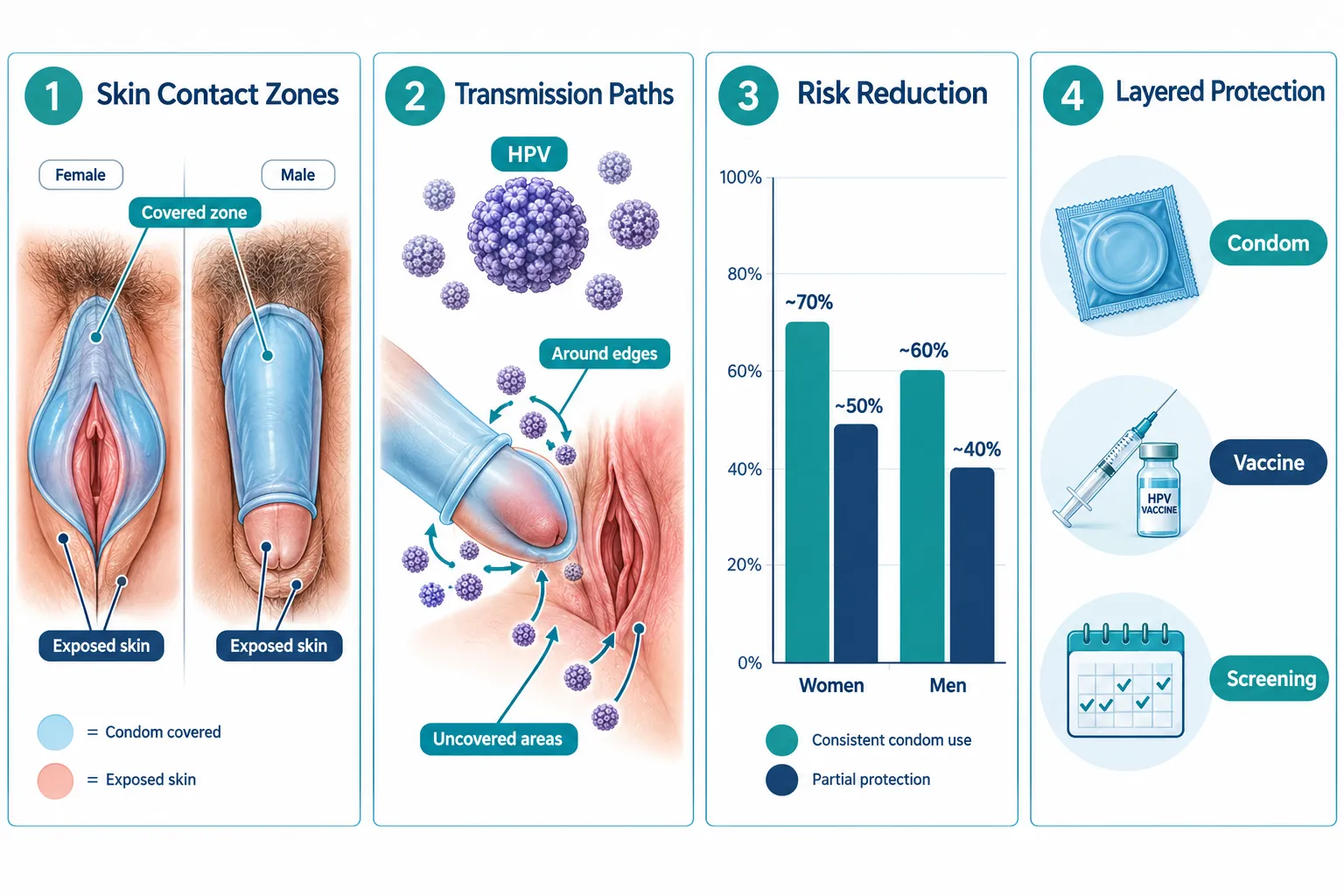
The evidence is consistent and worth knowing precisely. Among women who reported using condoms every single time, studies found approximately a 70% reduction in new HPV infections compared to women who never used them. Among men at higher risk, consistent use was associated with roughly a 50% lower chance of HPV acquisition.
Those numbers are meaningful. A 70% reduction is not trivial protection, it’s the difference between high exposure and substantially lower exposure over time. But “substantially lower” is not the same as “protected.”
Condom use also appears to shorten the duration of HPV infections and reduce the likelihood that an infection persists long enough to cause cell changes. That’s a secondary benefit that often goes unmentioned: even when transmission does occur, consistent condom use may make the infection less likely to linger.
The CDC’s current guidance, reinforced through 2026 updates, frames condoms as providing “partial protection” against HPV, effective for many STIs, but not a complete barrier for HPV specifically.
Why Condoms Can’t Fully Block HPV: The Skin-Coverage Gap
This is the core issue. A condom covers the shaft of the penis and, depending on fit and placement, part of the surrounding skin. It does not cover the scrotum, the base of the penis, the inner thighs, the perineum, or the vulva. HPV can live on any of those surfaces.
During sexual contact, those uncovered areas can touch infected skin on a partner, and that contact alone is enough for transmission. No amount of correct condom use changes the anatomy of what remains exposed.
This is not a reason to skip condoms. It’s a reason to understand that condoms are one layer of protection, not the whole strategy.
The same logic applies to how condoms protect against HPV more broadly, the protection is real, it’s just incomplete by the nature of how HPV spreads.
Who Is at Higher Risk for HPV Transmission Despite Condom Use?
Some groups face a higher baseline risk, which means the residual risk after condom use is also higher for them:
- People who are immunocompromised, including those living with HIV or who have had an organ transplant, are less able to clear HPV naturally, so any exposure carries more weight.
- Unvaccinated individuals, the HPV vaccine covers the highest-risk genotypes (16, 18, 6, 11 among others); without it, condoms are the only barrier, and a partial one.
- People with a history of abnormal Pap results, prior dysplasia suggests past high-risk HPV exposure, and ongoing unprotected or partially protected contact raises re-exposure risk.
- Those with multiple concurrent partners, more partners increases the probability of encountering an HPV type not previously cleared.
Does Using a Condom Prevent HPV-Related Diseases Like Warts and Cancer?
Condoms lower the risk of HPV-related outcomes, not just the infection itself. Studies associate consistent condom use with lower rates of HPV-related cervical changes and cervical cancer. For genital warts, caused by low-risk HPV types 6 and 11, condoms reduce transmission, though again, not completely, because warts can appear on skin outside the condom’s coverage area.
The important distinction here: reducing transmission risk is not the same as eliminating disease risk. If HPV does transmit despite condom use, the infection can still progress to dysplasia or warts depending on the type, your immune response, and whether it’s caught through screening.
That’s why the link between HPV and cancer is best managed through a combination of prevention and monitoring, not prevention alone.
The Strongest Protection Combines Condoms, Vaccination, and Screening
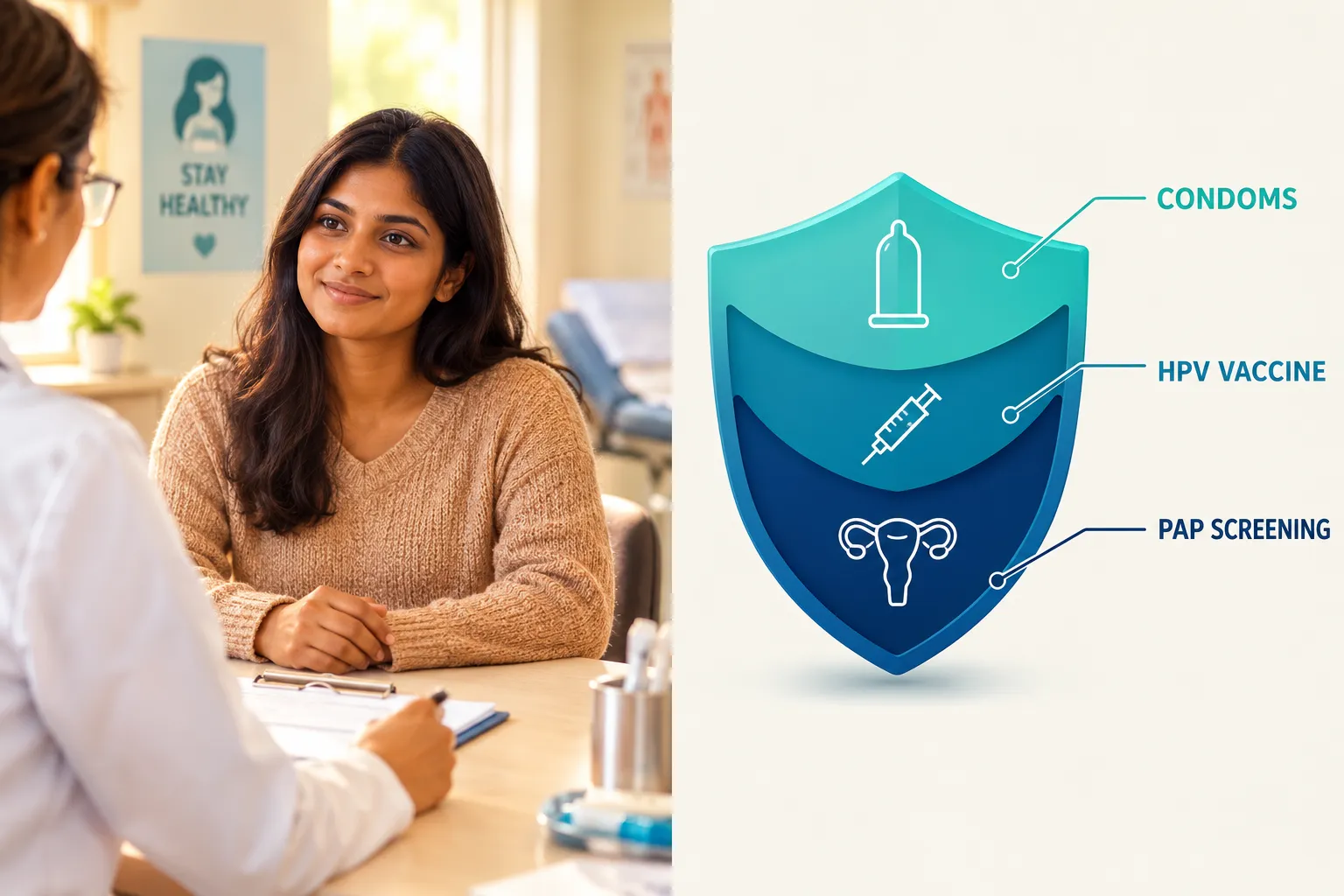
No single tool covers everything. The current public health consensus, as of 2026, is that the best protection against HPV and its consequences comes from layering three strategies:
HPV vaccination targets the genotypes responsible for most HPV-related cancers and warts. The vaccine doesn’t treat existing infections, but it prevents new ones from the types it covers. The HPV vaccine’s role in preventing HPV infection is well-established and distinct from what condoms do.
Consistent condom use reduces transmission risk for all sexual contact, including types not covered by the vaccine.
Regular screening, Pap tests and HPV co-tests, catches cell changes early, when they’re easiest to manage. Cell changes are most treatable before they progress, which is exactly what screening is designed to detect.
If you’re wondering whether the vaccine still helps after a previous exposure, the evidence on HPV vaccination after infection explains what it can and can’t do in that situation.
Does HPV Go Away Even If You Get It Despite Using Condoms?
Most HPV infections clear on their own. The immune system resolves the majority of infections, including high-risk types, within one to two years without treatment. This is true whether you used a condom or not.
Persistence is what creates risk. When high-risk HPV types like 16 or 18 don’t clear, they can cause gradual cell changes over years. That’s why ongoing screening matters even for people who use condoms consistently and are vaccinated.
The full picture of whether HPV goes away on its own covers what clearance looks like and when monitoring becomes more important.
Practical Steps Based on the Evidence
Condoms are worth using, consistently and correctly. The risk reduction they provide is real, and using them every time matters because the benefit is cumulative. Inconsistent use drops the protection substantially.
If you’re not vaccinated and are under 45, talk to your doctor about whether the HPV vaccine is appropriate for you. If you are vaccinated, continue using condoms, the vaccine covers the most dangerous types, not all of them.
Screening schedules vary by age and history, but Pap tests and HPV co-tests remain the most reliable way to catch any changes early. If you’re unsure about your screening status, that’s the most concrete next step you can take.
Frequently Asked Questions
Do condoms protect against all types of HPV?
No. Condoms reduce transmission risk across HPV types, but no specific genotype is fully blocked. The coverage limitation, exposed genital skin, applies regardless of whether the HPV type is high-risk or low-risk.
Does using a condom prevent HPV if my partner already has it?
It lowers your risk meaningfully, but it doesn’t eliminate it. If a partner has an active HPV infection, skin-to-skin contact outside the condom’s coverage area can still transmit the virus. Vaccination adds a layer of protection that condoms alone can’t provide.
Can HPV spread through oral sex even with a condom or dental dam?
Yes. Oral HPV transmission is possible, and barriers like condoms or dental dams reduce but don’t eliminate that risk. Oropharyngeal HPV, linked to throat cancers, is increasingly recognized as a concern, particularly for HPV 16.
Is HPV only a concern for women?
No. HPV affects men too, causing genital warts and raising the risk of anal, penile, and oropharyngeal cancers. The ways HPV affects men are distinct in some ways but the transmission and prevention logic is the same.
If I always use condoms, do I still need HPV screening?
Yes. Consistent condom use reduces risk but doesn’t eliminate it. Pap tests and HPV co-tests catch changes that can develop even with careful prevention practices. Screening is not redundant, it’s a separate layer of protection.