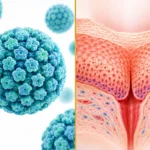
Condoms reduce the risk of HPV transmission, but they do not eliminate it. HPV spreads through skin-to-skin genital contact, and a condom cannot cover every area of skin that may carry the virus, which means protection is real but partial.
That distinction matters. Knowing exactly what condoms do and don’t do lets you make genuinely informed decisions about your sexual health, rather than either dismissing condoms as useless or assuming they make HPV transmission impossible.
Key Takeaways
- Consistent, correct condom use lowers HPV transmission risk by roughly 70% in women and around 50% in men, based on cohort research.
- Condoms cannot cover the vulva, scrotum, or perianal skin, all areas where HPV can live and spread.
- HPV types 6 and 11 cause genital warts; types 16 and 18 drive the majority of HPV-related cancers. Condoms reduce risk for both groups, but not to zero.
- The HPV vaccine provides far stronger protection than condoms alone, and the two strategies work best together.
- Starting a condom before any genital contact, not just before penetration, gives the most protection.
How Do Condoms Protect Against HPV?
HPV is not transmitted through bodily fluids the way HIV or gonorrhea are. It spreads through direct contact between skin or mucous membranes, and that contact can happen before penetration even begins.
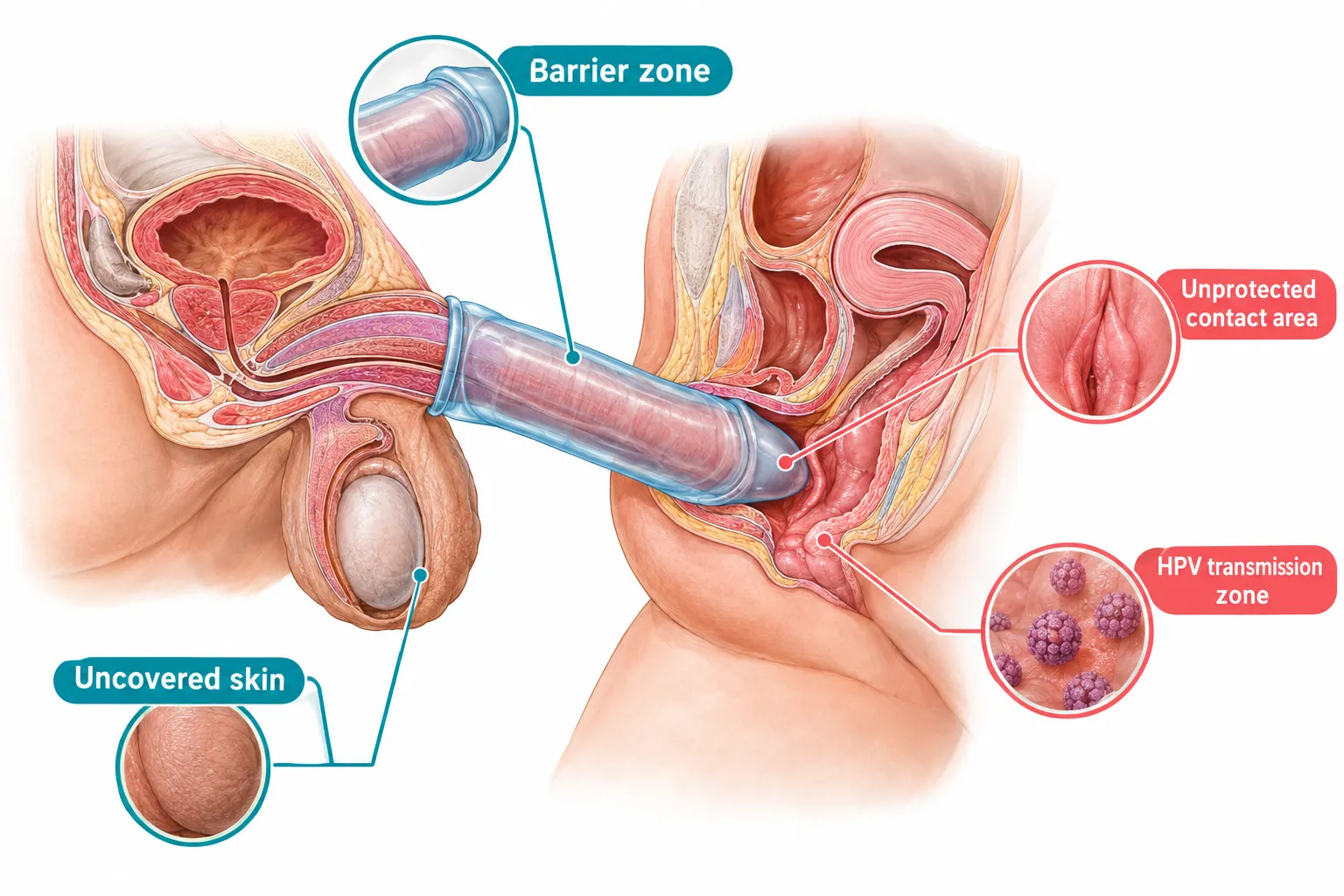
A latex condom works as a physical barrier over the penile shaft. Where that barrier sits, it blocks the virus from moving between skin surfaces. Research on newly sexually active women found that when partners used condoms consistently, meaning during every single act of intercourse, those women were about 70% less likely to acquire a new HPV infection compared with partners who used condoms only about 5% of the time.
Studies in men show a similar pattern. Men who always used condoms had roughly half the rate of new HPV infections over 12 months compared with men who never used them. There is also evidence that consistent condom use is associated with faster clearance of existing HPV infections and higher rates of regression of cervical cell changes, which matters if you or a partner already has HPV.
The key word throughout all of this is “consistent.” Condoms used some of the time offer much weaker protection than condoms used every time, from start to finish.
Why Condoms Don’t Fully Protect Against HPV
The virus can live on any genital skin, the scrotum, the vulva, the perianal area, the inner thighs in some cases. A standard male condom covers the penile shaft but leaves those surrounding areas exposed. Female (internal) condoms cover more of the vulva, which may offer somewhat broader coverage, though they have been studied less rigorously for HPV specifically.
HPV can also be present on skin before the condom goes on. If there is any unprotected skin-to-skin contact during foreplay or before the condom is applied, transmission can occur in that window. This is not a reason to avoid condoms, it is a reason to use them from the very start of any genital contact.
The CDC, the American Cancer Society, and national health programs around the world all carry the same message: condoms lower the risk of HPV infection and HPV-associated conditions like genital warts and cervical dysplasia, but because HPV infects areas the condom does not cover, protection is partial rather than complete.
Who’s at Higher Risk for HPV Transmission Despite Condom Use?
Some people face a meaningfully higher chance of acquiring HPV even with consistent condom use:
- Unvaccinated people, the HPV vaccine (Gardasil 9) covers nine HPV types, including the high-risk types 16 and 18. Without vaccination, condoms are the only barrier strategy, and their partial coverage gap is more consequential.
- Immunocompromised individuals, people living with HIV, organ transplant recipients, or anyone on long-term immunosuppressive therapy are less able to clear HPV naturally, so any transmission event carries more weight.
- People with multiple recent partners, higher cumulative exposure increases the probability that at least some contacts involve uncovered skin transmission, even with consistent condom use.
- People with a history of abnormal Pap results, prior cell changes can indicate ongoing or recurrent high-risk HPV activity; additional protective strategies matter more in this group.
Do Condoms Protect Against HPV During Oral and Anal Sex?
For anal sex, condoms cover the penetrating partner’s shaft but leave perianal skin exposed. The receptive partner’s anal tissue is covered during penetration, which does reduce transmission risk. Consistent use still matters, the same coverage-gap principle applies. If you want to understand anal HPV testing in more detail, the anal HPV test guide explains what to expect from the process.
For oral sex, standard condoms and dental dams can reduce skin-to-skin contact with genital or anal tissue, but they are rarely used consistently in practice. HPV types 16 and 18 are associated with oropharyngeal cancers, and oral transmission is a real route, though condoms are not commonly discussed as the primary prevention tool for oral HPV.
The broader picture of how HPV spreads, including which acts carry the most risk, is worth understanding alongside the condom question.
Condoms vs. the HPV Vaccine: Which Offers More Protection?
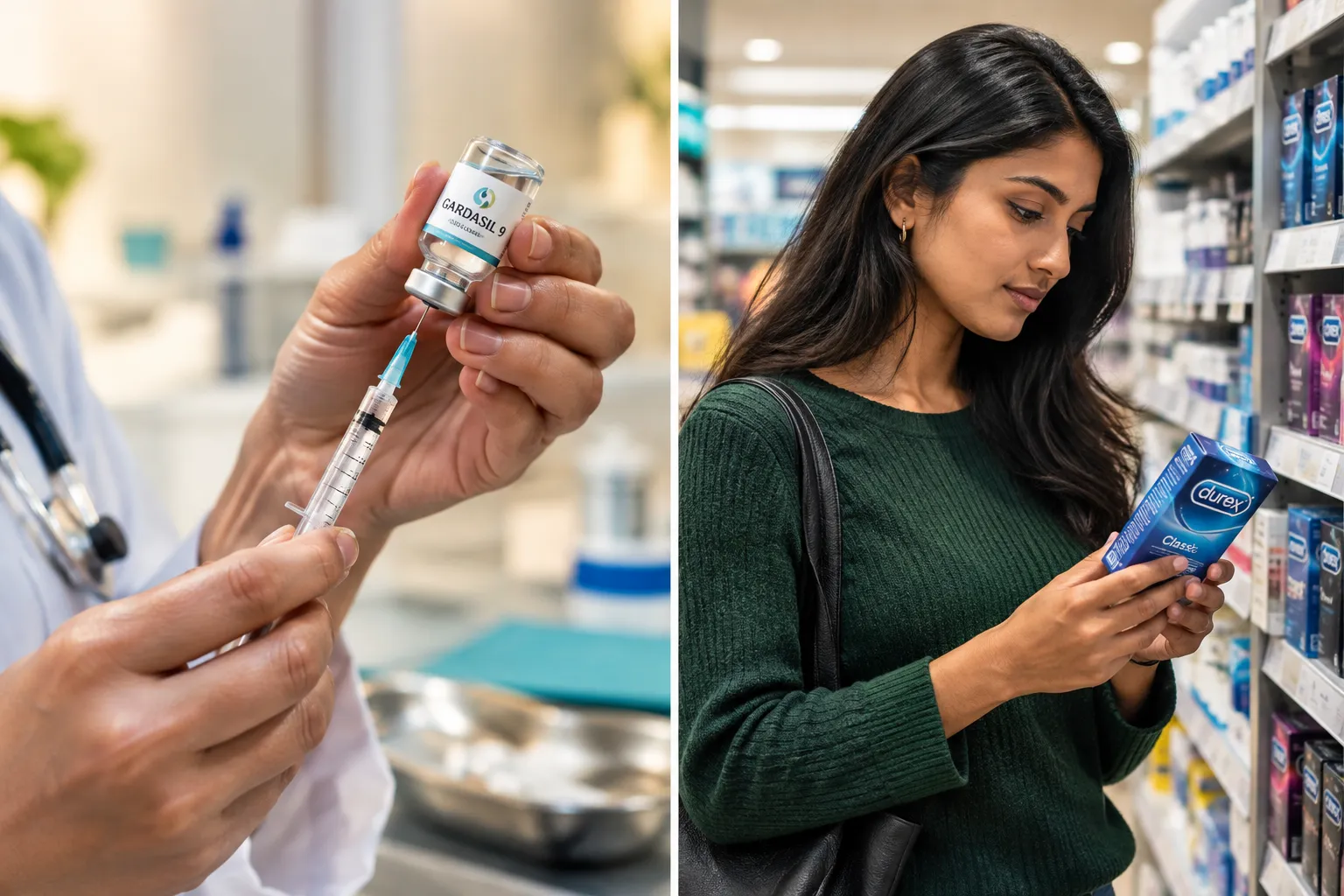
The HPV vaccine is significantly more effective than condoms at preventing infection from the HPV types it covers. Gardasil 9 targets nine types, including the two highest-risk types (16 and 18) responsible for the majority of HPV-related cancers, and the two types (6 and 11) that cause most genital warts. Vaccine efficacy against those types in people not previously exposed approaches 97-99%.
Condoms, used consistently, reduce transmission risk by roughly 50-70% depending on the study population. That is meaningful protection. It is not the same as near-complete prevention.
The evidence-based answer is that condoms and the HPV vaccine address different parts of the risk. The vaccine prevents infection from specific high-risk types. Condoms reduce transmission across all types, including the 100-plus types Gardasil 9 does not cover, by limiting skin contact. Using both together offers substantially more protection than either alone.
The HPV vaccine guide covers who should get it, the recommended schedule, and what the safety data shows.
If You or Your Partner Already Has HPV
Having HPV does not mean condoms become pointless. They still serve two purposes: reducing the chance of transmitting your current strain to a partner, and reducing your partner’s chance of acquiring a different HPV strain they don’t already carry. HPV has more than 200 types; having one type does not protect against others.
If you have been diagnosed and are thinking through what sexual activity looks like now, the guide to having sex with HPV covers that conversation in practical terms.
For people whose HPV has led to an abnormal Pap result, the abnormal Pap smear guide explains what the different result categories mean and what follow-up typically looks like.
Condom use has also been associated with faster regression of cervical intraepithelial neoplasia (CIN) in women with existing HPV infections, which suggests that even after infection, reducing ongoing viral exposure may support the immune system’s ability to clear the virus.
Practical Steps to Maximize Condom Protection Against HPV
Getting the most out of condoms for HPV risk reduction comes down to a few specific habits:
- Use a condom before any genital skin contact begins, not just before penetration.
- Use latex or polyurethane condoms; natural membrane condoms (lambskin) have pores large enough for viruses to pass through.
- Use the correct size and apply correctly, a condom that slips or breaks provides no barrier.
- Consider internal (female) condoms as an option, since they cover more of the vulvar area.
- Combine condom use with HPV vaccination if you are eligible and not yet vaccinated.
If you have a new partner and are thinking through transmission risk more broadly, including whether HPV can spread through non-penetrative contact, the HPV transmission overview covers the full picture.
Frequently Asked Questions
Can you get HPV even if you always use condoms?
Yes. Consistent condom use significantly lowers the risk, but HPV can be transmitted through skin-to-skin contact in areas the condom does not cover, including the scrotum, vulva, and perianal skin. Transmission is less likely with consistent correct use, but it is not impossible.
Does using a condom help if my partner already has HPV?
It does. Condoms reduce the chance of transmission to you, and they also reduce the chance of you acquiring a different HPV type your partner may carry. Having one HPV type does not protect against others, so barrier protection still has value.
Are female (internal) condoms better than male condoms for HPV protection?
Internal condoms cover more of the vulvar area, which is relevant because that skin can carry HPV. They have not been studied as thoroughly as male condoms for HPV specifically, so a direct comparison is difficult. They are a reasonable option, particularly for people who want broader coverage of external genital tissue.
Does HPV transmission risk change in a long-term monogamous relationship?
If both partners have already been exposed to the same HPV type, condoms won’t prevent what has already been transmitted. But HPV can remain dormant and reactivate, and whether HPV can come back without new sexual activity is a separate question worth understanding. In a monogamous relationship, condoms may matter less for HPV specifically, but that depends on each person’s HPV history and immune status.
Should I get the HPV vaccine if I’m already sexually active?
Yes, in most cases. The vaccine protects against types you haven’t yet been exposed to, and most sexually active people have not been infected with all nine types Gardasil 9 covers. Talk to your doctor about eligibility, vaccination is approved through age 45 in many countries, though it is most effective before any exposure.
Can a man give a woman HPV even with a condom?
Yes, though the risk is lower with consistent correct use. HPV can be present on scrotal skin or the base of the penis, areas not covered by the condom. The guide on whether a man can give a woman HPV covers the transmission dynamics in more detail.
The Practical Answer
Condoms are a meaningful part of HPV risk reduction, not a complete solution, but not ineffective either. The 70% reduction in women and roughly 50% reduction in men seen in research represent real, clinically significant protection. That protection depends on using condoms correctly and consistently, starting before any genital contact.
The most effective approach combines condoms with HPV vaccination. If you are not yet vaccinated and are within the eligible age range, that conversation with your doctor is worth having. Cell changes and HPV-related conditions are easiest to manage when they are caught early, that is what regular screening is for, and it remains important regardless of condom use or vaccination status.