
Testing positive for HPV doesn’t mean you have cancer, or that you will get it. An HPV-positive result means the virus was detected in your cells, and for most people, the immune system clears it without any treatment at all.
That said, understanding exactly what “HPV positive” means, and what it doesn’t mean, matters. The research is clear on the risk levels, the timelines, and what monitoring actually does. Here’s what the evidence shows.
Key Takeaways
- An HPV-positive result is a detection of the virus, not a diagnosis of disease or cancer.
- Most HPV infections, including high-risk types, clear on their own within one to two years.
- High-risk types, especially HPV 16 and 18, are linked to cervical and other cancers, but only when infection persists and goes unmonitored.
- Screening pathways exist precisely to catch cell changes early, when they are easiest to manage.
- Vaccination with Gardasil 9 has dramatically reduced HPV positivity rates in vaccinated populations, with long-term data now confirming durable protection.
What “HPV Positive” Actually Means
HPV positive means a test found human papillomavirus DNA or mRNA in a sample taken from your cervix, throat, or another site. It’s a detection result, not a clinical diagnosis of illness.
Clinically, an HPV-positive result is best understood as evidence of an active infection, the virus is present in your cells at the time of testing. It does not tell you how long it has been there, how you acquired it, or whether it will persist. Timing of HPV infection is often impossible to trace, even in long-term relationships.
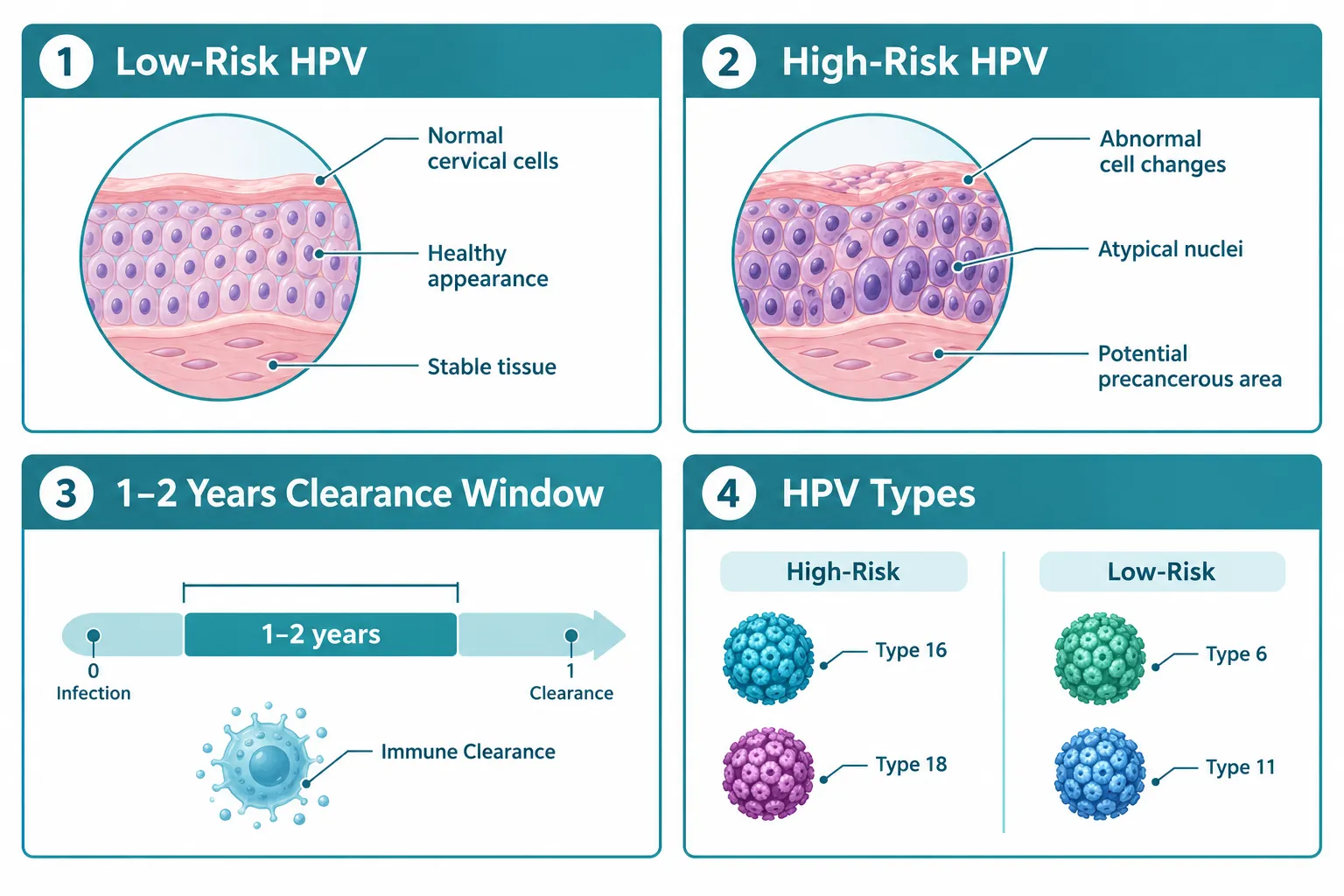
There are more than 200 HPV genotypes. Roughly 14 are classified as high-risk, meaning they have the potential to cause cell changes that, if left unmonitored over years, can progress toward cancer. HPV 16 and 18 together account for approximately 70% of cervical cancer cases globally. The remaining types are low-risk and are associated with genital warts rather than cancer. You can read more about the full range of genotypes in this plain-English breakdown of HPV types.
A positive result for a low-risk type is clinically different from a positive result for HPV 16 or 18. Your result should specify which type or category was detected, if it doesn’t, ask your provider.
HPV Positive vs. Having a Disease: The Research Is Clear
Having HPV is not the same as having a disease. Most HPV infections produce no symptoms, no cell changes, and no lasting harm.
Research consistently shows that roughly 80-90% of HPV infections clear on their own within one to two years, driven by a normal immune response. This applies to both low-risk and high-risk types. The immune system recognizes and suppresses the virus without any intervention.
The risk of cancer arises specifically from persistent high-risk infection, meaning the same high-risk HPV type remains detectable over multiple years and causes progressive cell changes. Even then, the progression from initial infection to invasive cervical cancer typically takes 10 to 15 years. That window is exactly what cervical screening is designed to use.
For a broader picture of what HPV means for women specifically, including how it interacts with the cervix over time, the HPV in women guide covers the full clinical picture.
How HPV-Positive Results Are Managed in Screening
An HPV-positive result triggers a specific clinical pathway, it doesn’t leave you without a next step.
In most current screening protocols, a positive high-risk HPV test is followed by either a co-test (Pap smear reviewed alongside the HPV result) or a reflex cytology test to look for actual cell changes. If the Pap result shows abnormal cells, classified as ASC-US, LSIL, or HSIL, the next step is typically a colposcopy, where a clinician examines the cervix more closely and may take a biopsy.
If the HPV test is positive but cytology is normal, most guidelines recommend a repeat test in 12 months rather than immediate colposcopy. Cell changes are easiest to treat before they progress, that’s what the interval is for.
The Aptima HPV test guide explains how one of the most widely used high-risk HPV tests reads results and what the different result types mean. If you’ve had an abnormal Pap alongside your HPV result, the abnormal Pap smear guide walks through exactly what happens at each stage.

Who’s at Higher Risk for Persistent HPV Infection?
Most HPV infections clear. But certain groups are more likely to develop persistent infection, which is the factor that raises cancer risk.
- Immunocompromised individuals, including people living with HIV and organ transplant recipients, have a significantly reduced ability to suppress HPV, making persistence and progression more likely.
- Smokers, tobacco use impairs local immune function in cervical tissue, increasing the likelihood that high-risk HPV will persist.
- People with a history of abnormal Pap results, prior dysplasia indicates the cervix has already responded to HPV-related cell stress, which warrants closer follow-up.
- Unvaccinated people, those who have not received Gardasil 9 remain susceptible to HPV 16, 18, and the other high-risk types the vaccine covers.
What the Research Shows About Vaccination and Future HPV Positivity
Vaccination has fundamentally changed what an HPV-positive result will mean for younger generations.
Long-term data on Gardasil 9, which targets HPV types 6, 11, 16, 18, 31, 33, 45, 52, and 58, now confirms durable protection extending beyond ten years in vaccinated cohorts. Countries with high adolescent vaccination coverage have documented sharp declines in high-risk HPV prevalence, abnormal Pap rates, and cervical cancer incidence among vaccinated age groups.
A landmark study published in 2022 in the New England Journal of Medicine found that women vaccinated against HPV in adolescence had near-zero rates of cervical cancer by their late 20s and early 30s, a finding that has since shaped WHO elimination targets. By 2026, several European countries are on track to meet or approach the WHO’s 90% vaccination coverage threshold, which is projected to reduce cervical cancer to a rare disease within a generation.
This matters for how you interpret a positive result today. If you were vaccinated with Gardasil 9, a positive HPV result is more likely to involve a type not covered by the vaccine, context your provider can help clarify.
For men, HPV-positive results carry their own specific risks and screening considerations, covered in detail in the HPV in men guide.
Does HPV Positive Mean You’ll Always Test Positive?
No. Most people who test HPV positive will test negative at a future screening.
When the immune system clears an infection, subsequent tests typically return negative. This doesn’t mean the virus is completely eliminated from every cell, it means the viral load has dropped below detectable levels and the infection is no longer clinically active. Reactivation is possible but uncommon in people with healthy immune function.
This is why a single positive result, without persistent positivity on follow-up testing, is not treated as a chronic condition. It’s treated as a finding that warrants monitoring for a defined period.
Frequently Asked Questions
Can you have HPV positive results without ever having symptoms?
Yes, and this is the norm, not the exception. Most HPV infections produce no visible symptoms. High-risk types in particular rarely cause noticeable signs. The infection is detected only through testing, which is why routine cervical screening exists.
If my partner tests HPV positive, does that mean someone was unfaithful?
Not necessarily, and there’s no way to determine this from a test result. HPV can remain dormant for years before being detected, and most people have no idea when or from whom they acquired it. The timing of a positive result cannot be used to infer recent transmission.
Is an HPV-positive result the same as an abnormal Pap smear?
No. These are two different tests measuring different things. An HPV test detects the presence of the virus. A Pap smear looks at the appearance of cervical cells. You can have a positive HPV result with completely normal cell appearance, which is common and typically managed with a follow-up test rather than immediate intervention. The abnormal Pap smear overview explains how the two results are read together.
Are there supplements that help clear HPV?
Some research has examined AHCC, a mushroom-derived compound, for its potential role in supporting immune clearance of HPV. The evidence is preliminary, and it’s not a replacement for screening or medical follow-up. The AHCC and cervical cancer overview covers what the current research actually shows.
Does a high-risk HPV positive result mean I need a colposcopy immediately?
Not automatically. Most guidelines recommend colposcopy only when a high-risk positive result is accompanied by abnormal cytology (such as LSIL or HSIL), or when high-risk HPV persists across two consecutive screenings. A single positive result with normal cells typically means a repeat test in 12 months.
What to Do With This Information
Define HPV positive correctly and you’ve already removed the most damaging assumption, that a positive result means cancer is present or inevitable. It doesn’t. It means the virus was detected, and that a defined clinical pathway now applies to you.
The next step is specific to your result: which type was detected, what your cytology showed, and what your provider recommends for follow-up. That information, not the positive result alone, determines what happens next.
If you haven’t been vaccinated and are within the eligible age range, ask your provider whether Gardasil 9 is still appropriate for you. Vaccination after a positive result for one type still provides protection against the other types covered by the vaccine.
Screening works because it catches changes early. Staying in that system is the most evidence-based thing you can do.