An ASCUS Pap result does not mean you have cancer. It means the lab found a small number of cervical cells that look slightly unusual, not clearly abnormal, not clearly normal, and that a follow-up step is needed to understand why. Understanding the ASCUS Pap result and how it works takes the guesswork out of what comes next.
Key Takeaways
- ASC-US stands for “atypical squamous cells of undetermined significance”, the mildest category of abnormal Pap result.
- Most ASC-US results are caused by transient HPV infections or minor irritation, not precancer.
- High-risk HPV testing (co-testing) is the standard next step and determines whether colposcopy is needed.
- People with ASC-US and a negative HPV test can usually return to routine screening on a normal schedule.
- Cell changes are easiest to manage before they progress, that is exactly what this screening process is designed to catch.
What ASC-US Actually Means
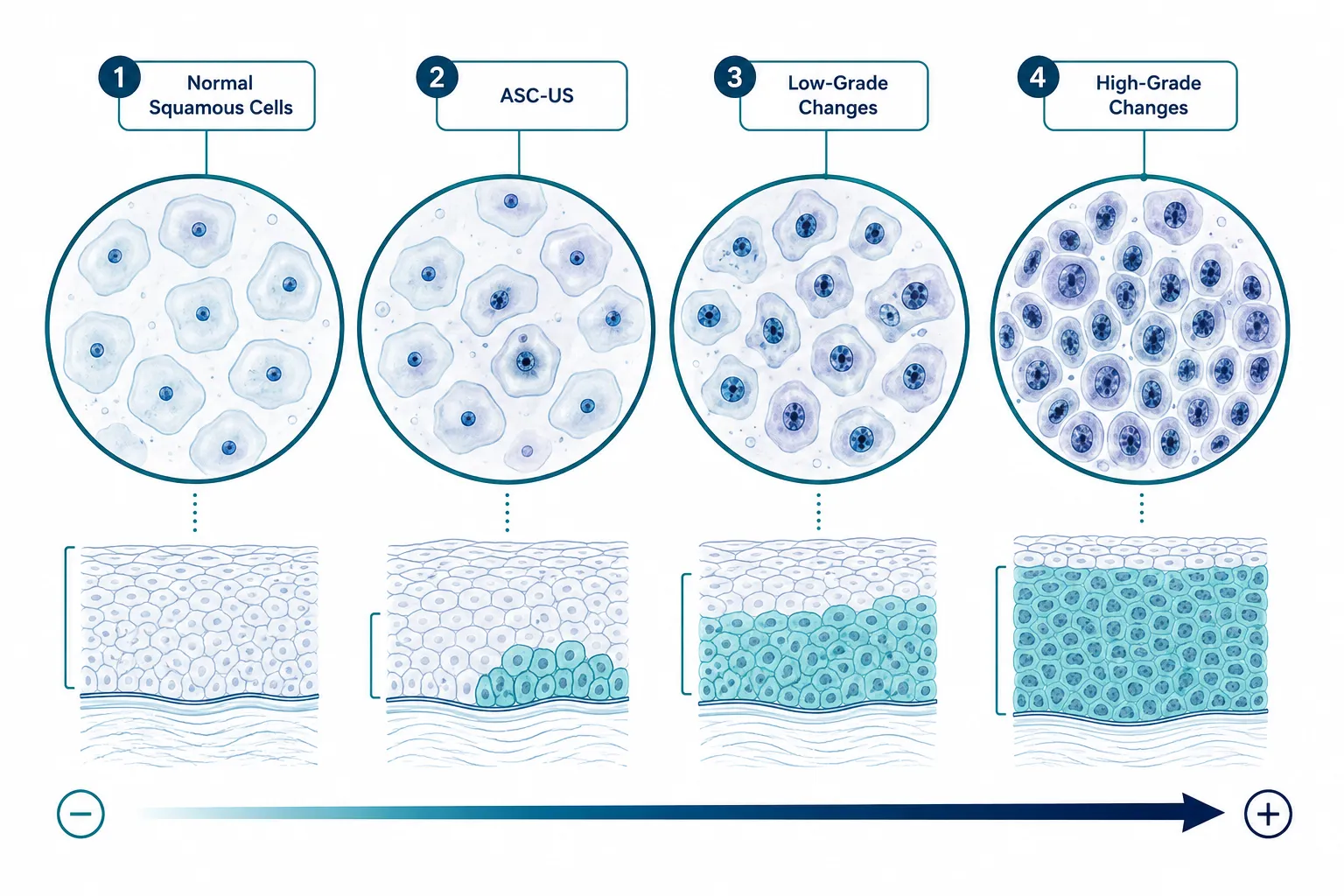
“Atypical squamous cells of undetermined significance” is the formal name for the mildest category on the cervical cytology reporting scale. The squamous cells lining your cervix looked slightly different under the microscope, enlarged nucleus, irregular edges, but not different enough to classify as a low-grade lesion (LSIL) or high-grade lesion (HSIL).
Think of ASC-US as the lab’s way of saying: something is worth a second look, but we cannot say what it is yet.
ASC-US is the most common abnormal Pap result. Roughly 3 to 5 percent of all Pap smears in the United States come back as ASC-US each year. The majority of those cases are linked to a transient HPV infection that the immune system will clear on its own, or to non-HPV causes like inflammation, hormonal changes, or recent intercourse.
That said, a small percentage of ASC-US results do reflect underlying cell changes that need monitoring. The HPV co-test is what separates the two groups.
How the Lab Generates an ASCUS Pap Result
During a Pap smear, a clinician collects cells from the transformation zone, the area where the cervix’s squamous cells meet the glandular cells of the cervical canal. This is where most HPV-related cell changes begin.
Those cells are transferred to a liquid-based vial (the standard method since the late 1990s) and sent to a cytology lab. A cytotechnologist or pathologist examines the cells under a microscope, looking at nuclear size, shape, and chromatin pattern.
When cells show mild nuclear enlargement or slight irregularity, but not enough to meet the threshold for LSIL, the result is reported as ASC-US. The Bethesda System, the classification framework used across the US and most of the world, places ASC-US at the lowest end of the abnormal spectrum, below ASC-H (atypical cells, cannot exclude high-grade), LSIL, and HSIL.
The liquid-based sample also allows reflex HPV testing from the same vial, no second collection needed.
What Causes an ASC-US Result
Several things can produce mildly atypical cervical cells:
- High-risk HPV infection (types 16, 18, 31, 33, 45, and others), the most clinically significant cause
- Low-risk HPV infection (types 6 and 11), associated with genital warts, not precancer; see the genital warts overview for context
- Cervical inflammation or infection (bacterial vaginosis, trichomoniasis)
- Hormonal changes, including those related to pregnancy, menopause, or hormonal contraception
- Mechanical irritation from recent intercourse or a gynecological procedure
Because the cause cannot be determined from cytology alone, the HPV co-test is what drives the next clinical decision. The HPV testing guide covers how HPV results are read and what the different result types mean.
Who Is at Higher Risk for an Abnormal Follow-Up After ASC-US
Most people with ASC-US will not have significant cell changes. But certain groups face a higher likelihood that an ASC-US result reflects something that needs closer follow-up:
- People with high-risk HPV genotypes 16 or 18, these two types together account for roughly 70 percent of cervical cancers, and their presence with ASC-US warrants prompt colposcopy rather than watchful waiting.
- Immunocompromised individuals, including those living with HIV or on immunosuppressive therapy after organ transplant, are less able to clear HPV naturally, raising the risk that cell changes will persist or progress.
- Smokers, smoking impairs local immune surveillance in cervical tissue and is consistently associated with higher rates of persistent HPV and dysplasia.
- People with a prior history of abnormal Pap results, a second ASC-US or higher-grade result carries more clinical weight than a first-time finding.
How an ASCUS Pap Result Is Managed: The Current Guidelines
The American Society for Colposcopy and Cervical Pathology (ASCCP) risk-based management guidelines, updated and refined through 2025, determine next steps based on a combination of the current result and your prior screening history.
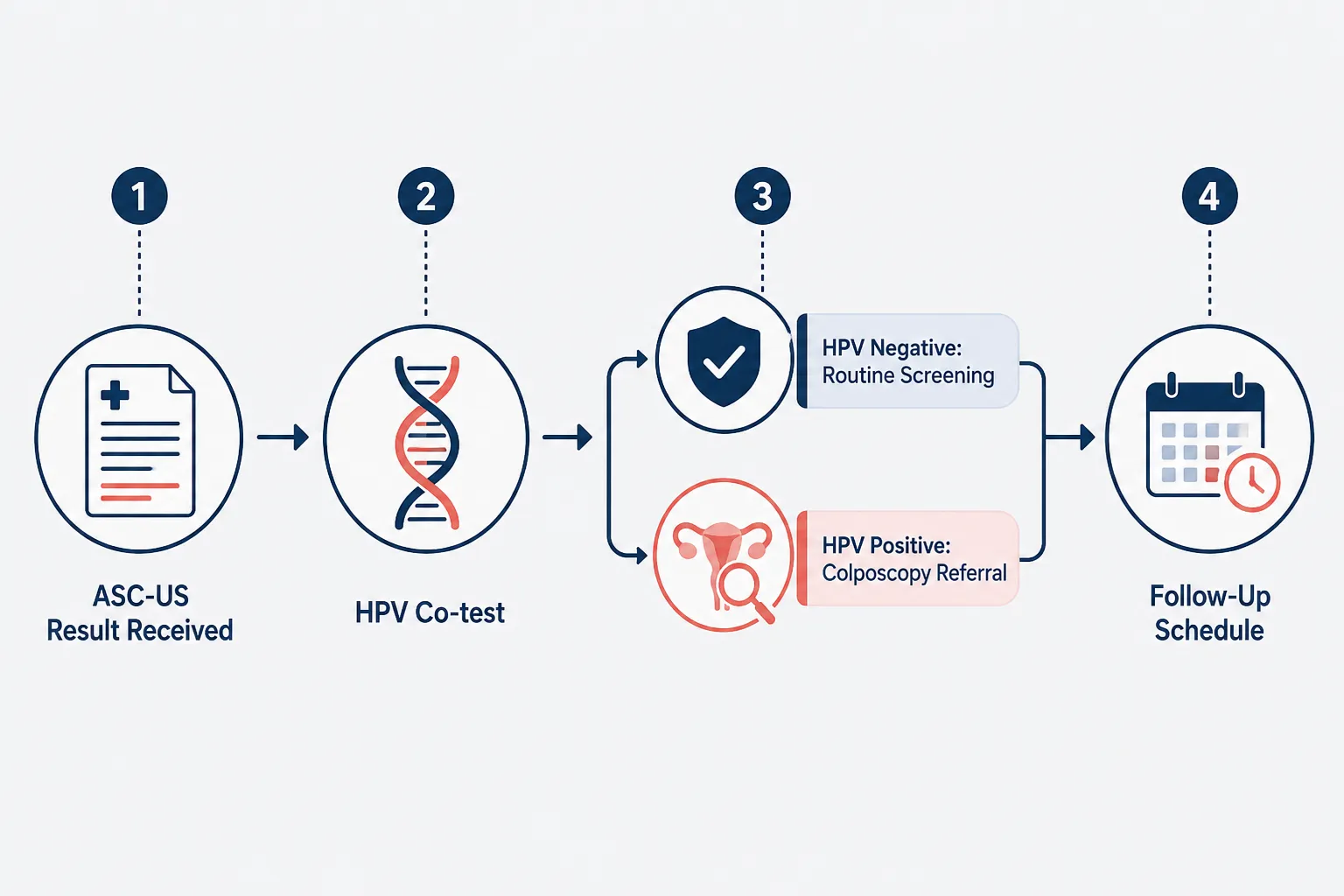
For most people with a first-time ASC-US result, the pathway looks like this:
If HPV co-test is negative: The risk of underlying CIN 2+ (cervical intraepithelial neoplasia grade 2 or higher) is very low, below 1 percent in most studies. Return to routine screening in three years is appropriate.
If HPV co-test is positive for types 16 or 18: Colposcopy is recommended promptly, regardless of the cytology grade. These genotypes carry the highest cancer risk among high-risk types.
If HPV co-test is positive for other high-risk types (not 16/18): Colposcopy is typically recommended, though some guidelines allow a one-year repeat co-test depending on prior history and clinical context.
If no HPV test was performed: A repeat Pap in 12 months or a reflex HPV test from the same liquid-based sample is the alternative pathway.
The abnormal Pap smear guide on what to expect walks through what happens at a colposcopy appointment and what results from that procedure mean.
Does ASC-US Mean You Have HPV?
Not necessarily. HPV is the most common cause of ASC-US, but it is not the only one. Roughly 40 to 60 percent of ASC-US results are HPV-positive when reflex testing is done, which also means 40 to 60 percent are not.
If you do test positive for a high-risk HPV type, that is not a diagnosis of cancer or precancer. It means a virus that can, in some cases over many years, contribute to cell changes is currently detectable. Most high-risk HPV infections clear without treatment within one to two years. The full explanation of what HPV is and how it works covers this in more detail.
Understanding how HPV spreads can also help answer questions that often come up alongside an ASC-US result, particularly around timing, since it is often impossible to know when an infection was acquired.
What Happens at Colposcopy
Colposcopy is not a treatment, it is a closer look. A clinician uses a magnifying instrument to examine the cervix under bright light, often applying a dilute acetic acid solution that makes abnormal cells appear white (acetowhitening). If an area looks suspicious, a small biopsy is taken.
Biopsy results determine whether any treatment is needed. Most people referred for colposcopy after ASC-US are found to have either no significant lesion or CIN 1, a low-grade change that frequently resolves on its own. CIN 2 or CIN 3 findings are less common after ASC-US but do occur, particularly in people with HPV 16 or 18.
The guide to what happens next after an abnormal Pap smear covers biopsy results and treatment options in detail.
Self-Collected HPV Samples and ASC-US in 2026
As of 2026, ACOG has updated its guidance to recognize self-collected vaginal HPV samples as an acceptable alternative to clinician-collected samples in certain screening contexts. This matters for ASC-US because the HPV co-test, not the cytology result alone, is the primary driver of management decisions.
Self-collection does not change what ASC-US means or how it is managed. It does expand access to the HPV testing that determines next steps, particularly for people who face barriers to clinic-based screening.
Frequently Asked Questions
Can an ASCUS Pap result go away on its own?
ASC-US is a cytology finding, not a condition itself, it reflects the state of cells at the time of the test. If the underlying cause (such as a transient HPV infection or mild inflammation) resolves, a follow-up Pap will typically return to normal. This is common, particularly in people under 30 whose immune systems clear HPV efficiently.
Should I be worried if I get an ASCUS result while pregnant?
ASC-US during pregnancy is managed conservatively. Colposcopy may be performed to rule out high-grade changes, but treatment is almost always deferred until after delivery. Pregnancy itself can cause minor cell changes that resolve postpartum. Tell your clinician you are pregnant so the management plan accounts for that.
Does an ASCUS result affect my chances of getting cervical cancer?
A single ASC-US result with a negative HPV co-test carries a very low risk of progression to cervical cancer, below 1 percent over the following three to five years in most data. The risk is higher with HPV 16 or 18 positivity, which is why those results trigger prompt colposcopy. The HPV and cancer overview explains the full progression pathway from infection to cancer and how long it typically takes.
How is ASC-US different from LSIL or HSIL?
ASC-US, LSIL, and HSIL are all categories on the Bethesda cytology scale, ranked by the degree of cell change. LSIL (low-grade squamous intraepithelial lesion) shows clearer evidence of HPV effect on cells. HSIL (high-grade squamous intraepithelial lesion) shows more significant changes that carry a higher risk of underlying CIN 2 or CIN 3. ASC-US sits below LSIL, it is the most ambiguous and generally lowest-risk category.
What if my ASCUS result keeps coming back?
Persistent ASC-US over two or more consecutive screenings, especially with a positive HPV co-test, warrants colposcopy even if no single result would have triggered it on its own. Persistent findings carry more clinical weight than a one-time result, and the cumulative risk picture changes the management threshold.
What to Do After an ASCUS Result
An ASC-US result is a prompt to take the next step, not a reason to panic, and not something to ignore. The HPV co-test result is the most important piece of information that follows. If your clinician has not already ordered one, ask about reflex HPV testing from your existing sample.
Cell changes at the ASC-US level are early and manageable. The entire point of cervical screening is to catch changes before they progress, and at this stage, the system is working exactly as intended. Attend your follow-up appointment, get the HPV co-test result, and let that guide the next decision with your clinician.