
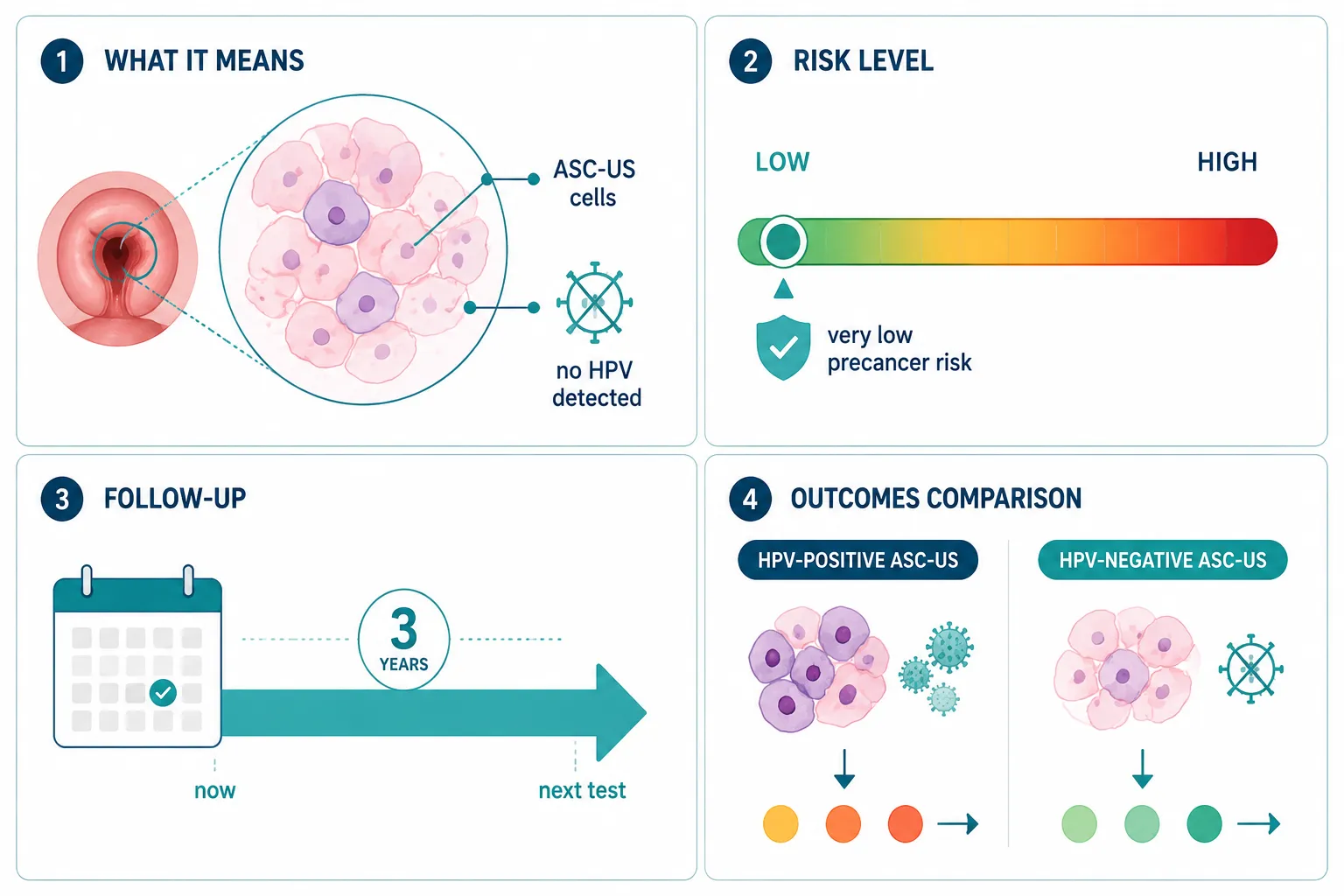
An ASC-US result with a negative HPV test is one of the lowest-risk combinations possible on a cervical screening report. It does not mean you have cancer, and it does not mean you need urgent intervention. What it means, practically, is that your cells showed a mild, ambiguous change, but the virus most responsible for turning those changes into something serious was not found.
Understanding the full picture of ASCUS HPV Negative: What It Means for You helps you walk into your next appointment knowing exactly what your clinician is watching for and why.
Key Takeaways
- ASC-US stands for “atypical squamous cells of undetermined significance”, the mildest category of abnormal Pap result.
- When HPV testing is negative alongside an ASC-US result, the risk of having cervical precancer (CIN 2 or worse) is very low, under 1% in most studies.
- Immediate colposcopy is generally not recommended for this result combination.
- Most guidelines support returning to routine screening in three years, though your clinician may adjust this based on your age and history.
- Non-HPV factors, including hormonal changes around menopause and minor inflammation, commonly cause ASC-US findings.
What ASC-US Actually Means
“Atypical” is the word that sends people searching at midnight. It sounds alarming. It isn’t.
ASC-US is the most common abnormal Pap result, and it sits at the very bottom of the abnormal spectrum, below LSIL (low-grade squamous intraepithelial lesion) and well below HSIL (high-grade squamous intraepithelial lesion). The pathologist who read your smear saw cells that looked slightly off but not clearly abnormal enough to classify as a definite precancerous change. That ambiguity is built into the name: “undetermined significance.”
Cervical cells change for many reasons that have nothing to do with HPV. Hormonal shifts during perimenopause, mild yeast or bacterial infections, recent sexual activity, and even the mechanics of sample collection can all produce cells that look mildly atypical under a microscope. The Pap test is sensitive by design, it flags things that are probably nothing so that the rare serious finding isn’t missed.
That sensitivity is why ASC-US is so common. Roughly 5-10% of Pap results in the United States come back as ASC-US. Most of those cases resolve without any treatment at all.
Why the HPV Result Changes Everything
The HPV test is the deciding factor in how an ASC-US result is managed. That’s because virtually all cervical precancer and cervical cancer is caused by persistent infection with high-risk HPV genotypes, primarily types 16 and 18, which together account for roughly 70% of cervical cancers, along with types 31, 33, 45, and several others.
When HPV testing comes back negative alongside an ASC-US Pap, it tells your clinician two things at once: the mild cell changes present are unlikely to be HPV-driven, and the biological engine that converts mild abnormalities into precancer is not currently detectable.
The risk of having CIN 2 or worse (the threshold at which treatment is typically considered) in someone with ASC-US and a negative HPV test is estimated at less than 1%. That is lower than the background risk in someone with a completely normal Pap. The HPV test, in this context, is more informative than the Pap result itself.
This is why the HPV testing guide at HPVGuide.org explains that co-testing, running both a Pap and an HPV test together, gives clinicians a much clearer picture than either test alone.
What Current Guidelines Recommend
The 2019 ASCCP risk-based management guidelines shifted the framework for cervical screening away from result categories and toward individualized risk estimates. For someone with ASC-US and a negative HPV test, that risk estimate places them in a group where the evidence consistently supports returning to routine screening rather than escalating to colposcopy.
Most guidelines recommend a follow-up interval of three years for this result combination, the same interval used for a completely normal co-test result in many age groups. Some clinicians may recommend a 12-month repeat if there are additional factors in your history, such as a prior abnormal result, immunosuppression, or incomplete prior screening records. That’s a clinical judgment call, not a sign that something is wrong.
What is generally not recommended: immediate colposcopy. The evidence does not support sending someone with ASC-US HPV-negative directly to colposcopy, because the probability of finding a significant lesion is too low to justify the procedure’s cost, discomfort, and potential for overtreatment.
If you want a fuller picture of what happens after an abnormal Pap result more broadly, the guide to what happens next after an abnormal Pap smear walks through the decision tree in detail.
Who’s at Higher Risk for Cervical Cell Changes
Even with a low-risk result, certain groups benefit from closer attention at follow-up:
- People who are immunocompromised, including those living with HIV or on immunosuppressive therapy after an organ transplant, clear HPV less efficiently, and cell changes can progress more quickly.
- Smokers, tobacco use is independently associated with a higher risk of cervical dysplasia, even when HPV type is accounted for.
- People with a history of prior abnormal Pap results, a current ASC-US HPV-negative result sits in a different context if there have been LSIL or HSIL findings in the past.
- People in perimenopause or postmenopause, declining estrogen causes atrophic changes in cervical and vaginal cells that can mimic dysplasia on a Pap smear, making ASC-US results more common and sometimes harder to interpret.
Non-HPV Causes of ASC-US and Special Considerations
This is worth understanding clearly: ASC-US does not automatically mean HPV was involved at all.
Atrophic vaginitis, the thinning and drying of vaginal tissue that often accompanies the hormonal shifts of perimenopause and postmenopause, is one of the most common non-HPV causes of ASC-US. In these cases, a short course of topical estrogen followed by a repeat Pap can resolve the finding entirely. If you are perimenopausal or postmenopausal and your clinician mentions atrophy as a possible explanation, that’s a specific, treatable cause, not a vague reassurance.
Other non-HPV causes include:
- Bacterial vaginosis or yeast infections at the time of sampling
- Trichomonas infection
- Recent cervical or vaginal procedures
- Reactive changes from an IUD
The HPV in Women overview covers how HPV interacts with cervical health across different life stages, including how screening recommendations shift with age.
What to Expect at Your Follow-Up Appointment

Your follow-up visit is not a high-stakes appointment. For most people with ASC-US HPV-negative, it’s a repeat co-test, Pap plus HPV, at the interval your clinician recommends, most commonly in three years.
At that visit, the most likely outcome is a normal result. If the repeat co-test is normal, you return to the standard screening schedule. If ASC-US appears again but HPV remains negative, most guidelines still support continued routine surveillance rather than escalation. If HPV becomes detectable at follow-up, your clinician will reassess your risk level and adjust the management plan accordingly.
Cell changes are easiest to monitor and treat before they progress, that’s the entire purpose of cervical screening. The system is working when it catches something mild and watches it closely.
For context on how HPV types are classified and which ones are considered high-risk, the guide to HPV types explains the difference between low-risk and high-risk genotypes and what the numbers mean.
ASCUS HPV Negative: What It Means for You Going Forward
The practical answer is: very little changes right now. You don’t need treatment. You don’t need colposcopy. You need a follow-up test at the right interval, and you need to keep that appointment.
Some people ask whether supplements or lifestyle changes can reduce the chance of HPV appearing at a future test. The evidence on interventions like AHCC, a mushroom extract studied in the context of HPV clearance, is preliminary. The evidence review for AHCC and HPV covers what the research currently shows and where the gaps are, without overstating the findings.
What the evidence does support: not smoking, maintaining immune health, and keeping up with scheduled screening. Those are the factors with the strongest track record.
Frequently Asked Questions
Does ASC-US HPV negative mean I definitely don’t have HPV?
A negative HPV test means no high-risk HPV genotypes were detected at the time of testing. It doesn’t rule out low-risk types, and it doesn’t mean you’ve never had HPV. HPV can be present at levels below the test’s detection threshold, or a past infection may have already cleared. The clinical significance of an undetectable result is the same: your current risk of precancer is very low.
Can ASC-US HPV negative turn into something more serious?
It can, but the probability is low. If a high-risk HPV type is acquired or becomes detectable at a future test, the clinical picture would change and your follow-up plan would be updated. That’s exactly what scheduled repeat testing is designed to catch, cell changes are most manageable when identified early.
Do I need to tell a partner about an ASC-US HPV-negative result?
There’s no clinical requirement to disclose an ASC-US result to a partner, and an HPV-negative result means no high-risk HPV was found. If you have questions about HPV transmission and what a result means for a partner’s health, the HPV in Men guide covers screening and risk considerations for male partners.
What if my doctor recommends colposcopy despite an HPV-negative result?
Some clinicians take a more cautious approach, particularly if there are additional risk factors in your history, prior abnormal results, immunosuppression, or incomplete screening records. If you’re unsure why colposcopy is being recommended, asking your clinician to walk through the specific risk factors driving that decision is entirely reasonable.
Will this result affect my next Pap schedule permanently?
No. A single ASC-US HPV-negative result doesn’t permanently alter your screening schedule. If your follow-up test is normal, you return to the standard interval for your age group. Screening history is cumulative, one low-risk result doesn’t define your long-term plan.