HPV does affect men, and far more often than most people realize. Roughly 31% of men worldwide carry an active HPV infection at any given time, and over 80% of sexually active people of any gender will acquire HPV at some point in their lives. Most infections clear without treatment and without symptoms. But some don’t, and for men the consequences can include genital warts, penile cancer, anal cancer, and a rising tide of throat cancers that now outnumber HPV-related cervical cancers in several countries.
Key Takeaways
- HPV is extremely common in men, global prevalence sits around 31%, and most infections produce no symptoms at all.
- High-risk HPV types (particularly types 16 and 18) can cause cancers of the throat, penis, and anus in men.
- Men have nearly three times the rate of oral HPV infection compared to women, making oropharyngeal cancer the fastest-growing HPV-related cancer in men.
- About 90% of HPV infections clear on their own within two years; persistent infection is what raises cancer risk.
- The HPV vaccine is recommended for all males through age 26, with shared decision-making up to age 45, and has been shown to reduce HPV-related cancer rates by roughly 46% in vaccinated males.
How Does HPV Spread in Men?
HPV spreads through direct skin-to-skin contact, not through blood, saliva in a shared drink, or casual touch. Genital, anal, and oral sexual contact are the primary routes. Because the virus lives in skin and mucosal cells, condoms reduce transmission risk but don’t eliminate it entirely; areas not covered by a condom can still carry and transmit the virus.
The full breakdown of how HPV spreads, and how it doesn’t covers the transmission routes in detail, including non-sexual contact scenarios that often cause confusion.
One point worth stating plainly: knowing when or from whom you acquired HPV is usually impossible. The virus can remain dormant for months or years before any sign appears, so a new diagnosis tells you nothing about the timing of exposure or the behavior of any partner.
What Are the Symptoms of HPV in Men?
Most men with HPV have no symptoms at all. The immune system clears the majority of infections silently, and no test is routinely available to confirm clearance.
When symptoms do appear, they fall into two broad categories:
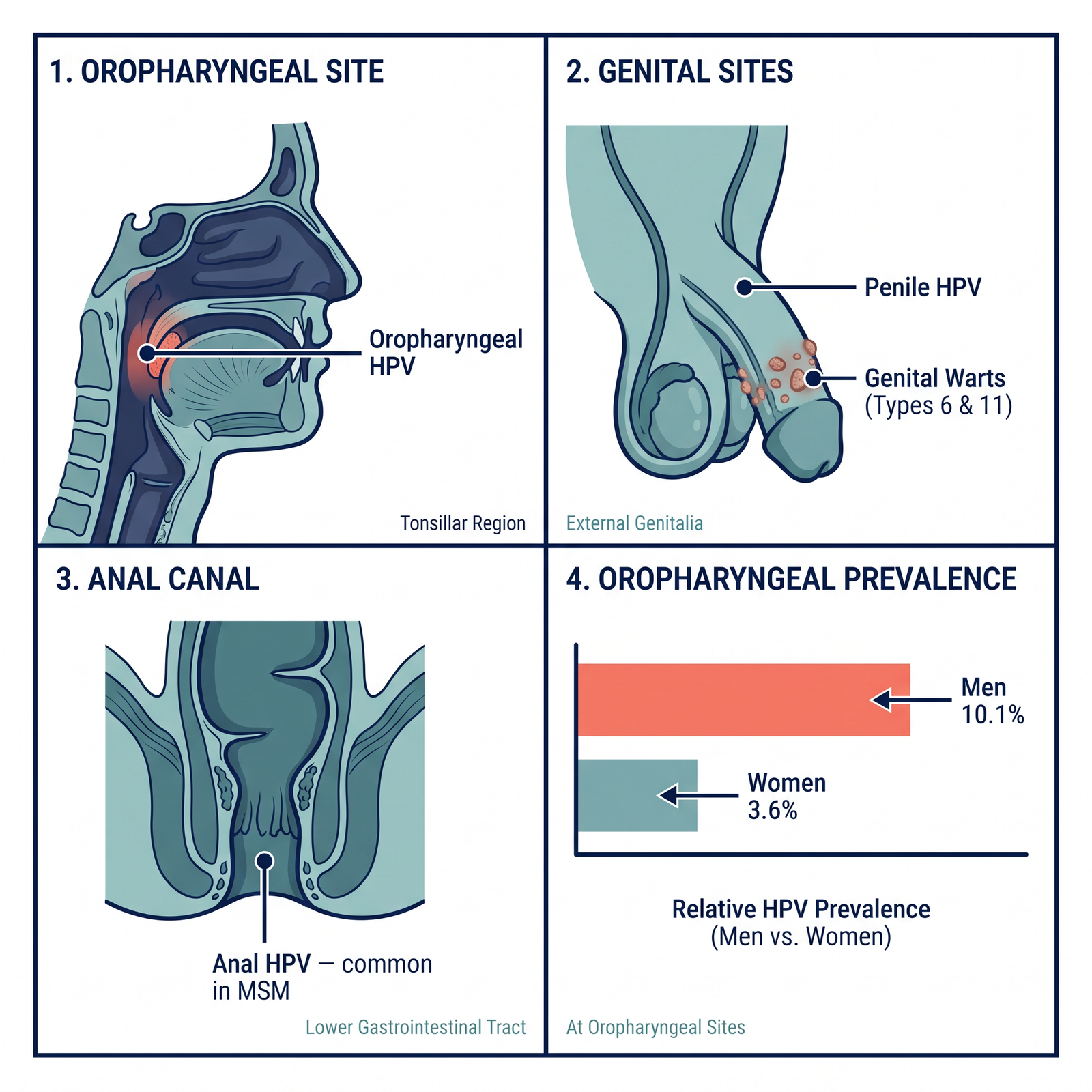
Genital warts, caused by low-risk HPV types 6 and 11, appear as soft, flesh-colored growths on the penis, scrotum, groin, thighs, or around the anus. They’re not cancerous. They are treatable, and they are common. The overview of condyloma (genital warts) explains what they look like and how they differ from other skin changes.
Cancer-related changes, caused by high-risk types, primarily HPV 16 and 18, produce no visible symptoms in their early stages. By the time symptoms appear (a persistent sore throat, difficulty swallowing, a lump in the neck, or a lesion on the penis), the disease is already established. That’s the core reason why understanding HPV risk matters even when you feel completely well.
Who’s at Higher Risk for HPV-Related Disease in Men?
Certain groups face a meaningfully higher chance of persistent infection or HPV-related cancer:
- Men who have sex with men (MSM): Anal HPV infection and anal cancer rates are substantially higher in this group. The anal HPV test guide explains how anal screening works and who it’s recommended for.
- Men living with HIV or other immunosuppressing conditions: A CD4+ cell count below 200 cells/mm³ is strongly associated with HPV persistence and faster disease progression.
- Smokers: Current smoking is independently linked to HPV persistence and increased cancer risk.
- Unvaccinated men over 30: Age combined with no prior vaccination and ongoing exposure raises the probability of persistent high-risk infection.
Does HPV Affect Men Differently Than Women?
Yes, in one specific and important way. Men have nearly three times the rate of oral HPV infection compared to women (10.1% versus 3.6% at oropharyngeal sites). This difference is a key driver of why HPV-related throat and mouth cancers now disproportionately affect men.
In the United States, approximately 13,600 HPV-related oropharyngeal cancers are diagnosed in men each year. Men are diagnosed with head and neck cancers at more than four times the rate of women. HPV type 16 is responsible for the majority of these cases.
Women, by contrast, face the well-documented risk of cervical cancer from persistent HPV, a risk that is actively managed through Pap smears, HPV co-testing, and colposcopy. Men have no equivalent routine screening program for most HPV-related cancers, which means the virus often goes undetected until a cancer is already present.
The detailed guide to HPV in men covers the full picture of symptoms, testing options, and what a diagnosis actually means in practice.
Can HPV in Men Cause Cancer?
Yes. Persistent infection with high-risk HPV types, particularly types 16 and 18, can cause:
- Oropharyngeal cancer (throat, tonsils, base of tongue)
- Penile cancer
- Anal cancer
About 90% of HPV infections clear on their own within two years. Persistent infection is the exception, not the rule. But when the immune system doesn’t clear the virus, cell changes can develop over years, eventually progressing to cancer if left unmonitored.
HPV-related oropharyngeal cancer is now the fastest-growing HPV-associated cancer in men, with a marked rise particularly among men aged 40 and older. Risk increases with the number of lifetime oral sex partners. There is currently no approved routine screening test for oropharyngeal HPV in men, which makes vaccination the most effective preventive tool available.
Questions about whether HPV can affect fertility are separate from cancer risk, the HPV and male infertility page addresses that specifically.
Can Men Get Tested for HPV?
This is where male HPV management differs most sharply from female management. There is no FDA-approved HPV test for men equivalent to the cervical HPV test used in women. Genital warts can be diagnosed by visual examination. Anal HPV testing and anal Pap smears are recommended for high-risk groups, particularly MSM and men living with HIV, but are not routine for all men.
For most men, HPV is managed by monitoring symptoms and addressing any visible warts or lesions, not by a laboratory test confirming viral presence. The guide to HPV testing explains how testing works across genders and what the results actually mean.
Does HPV Affect Men Who Are Vaccinated?
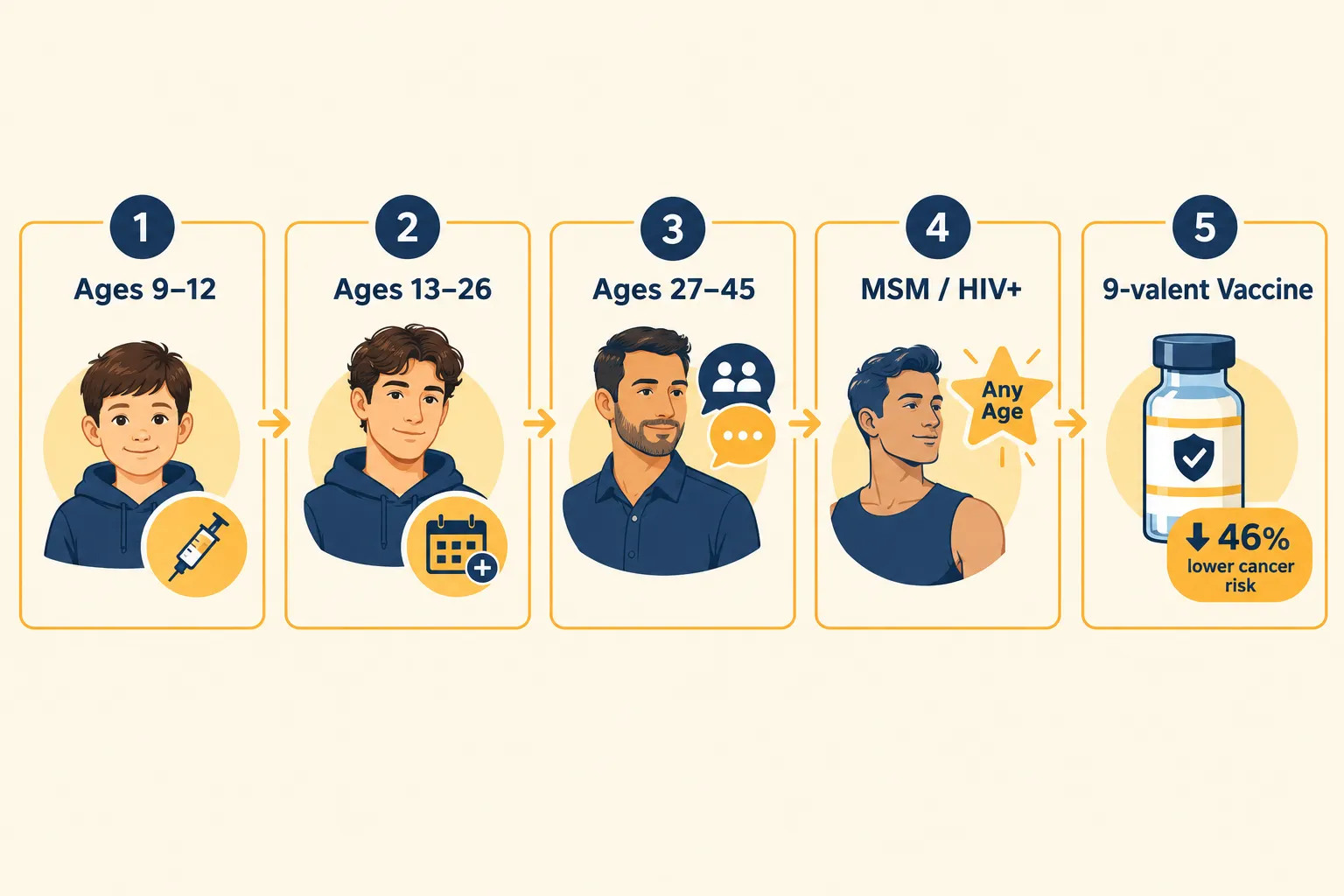
Vaccination substantially changes the picture. Males aged 9-26 who received the 9-valent HPV vaccine (Gardasil 9) had approximately 46% lower rates of HPV-related cancers compared with unvaccinated males in a large recent study. The vaccine covers HPV types 6, 11, 16, 18, 31, 33, 45, 52, and 58, the types responsible for the majority of HPV-related cancers and genital warts.
Current U.S. guidance recommends:
- Ages 9-12: Routine vaccination, 2-dose series
- Ages 13-26: Catch-up vaccination if not previously vaccinated, 2- or 3-dose series depending on age at first dose and immune status
- Ages 27-45: Shared clinical decision-making with a healthcare provider
- MSM and immunocompromised men: Catch-up vaccination recommended through age 26; some international guidelines (including Australia’s) recommend vaccination for MSM of any age given their elevated risk
The HPV vaccine is not licensed for adults over age 45. If you’re in the 27-45 window and haven’t been vaccinated, the conversation to have is with your doctor, not a decision to make based on age alone.
How Is HPV in Men Treated?
There is no antiviral treatment that clears HPV itself. Treatment targets what the virus causes.
Genital warts can be treated with topical medications (imiquimod, podophyllotoxin) or in-office procedures such as cryotherapy, laser treatment, or surgical removal. Warts often recur because the underlying virus may still be present in surrounding tissue. The cryotherapy for genital warts guide covers what to expect from that specific procedure.
HPV-related cancers are treated through standard oncology pathways, surgery, radiation, chemotherapy, or combinations, depending on the site and stage. Early detection significantly improves outcomes, which is the medical reason for staying alert to persistent symptoms like a sore throat that doesn’t resolve, a new neck lump, or any unusual lesion on the penis or around the anus.
Condom use during vaginal, anal, and oral sex lowers, but does not eliminate, transmission risk. Vaccination plus consistent safer-sex practices is the most effective combined strategy currently available.
Frequently Asked Questions
Can a man pass HPV to a woman without knowing he has it?
Yes. Most men with HPV have no symptoms and no way of knowing they’re infected. The virus is present in skin and mucosal cells and can be transmitted through sexual contact even without visible warts or any other sign. The guide on whether a man can give a woman HPV explains the transmission dynamics in detail.
How long does HPV last in men?
About 90% of infections clear within two years as the immune system suppresses the virus. Some infections persist longer, and persistence, not initial infection, is what raises cancer risk. Factors like smoking, age over 30, and immune suppression are associated with slower clearance.
Is there a routine HPV screening program for men?
Not in most countries. Unlike cervical screening for women, there is no standard population-level HPV test for men. Anal Pap smears and HPV testing are recommended for high-risk groups such as MSM and HIV-positive men, but general male screening programs don’t currently exist. Vaccination remains the primary preventive tool.
Can HPV come back after it seems to have cleared?
It can. The virus may remain at undetectable levels and reactivate, particularly if the immune system is weakened. This is sometimes called viral reactivation rather than a new infection, though distinguishing between the two isn’t always possible clinically.
Does having HPV mean a man has to tell his sexual partners?
This varies by jurisdiction and relationship context, but the medical reality is straightforward: HPV is extremely common, transmission can occur without symptoms, and partners may already have been exposed. Disclosure conversations are worth having, and a healthcare provider can help frame them accurately rather than alarmingly.
Tags: HPV in men, does HPV affect men, male HPV symptoms, HPV and throat cancer, HPV vaccination men, oropharyngeal HPV, genital warts men, anal HPV, high-risk HPV types, HPV prevention, HPV-related cancer, men who have sex with men HPV