{“cover”:”Editorial landscape format (1536×1024) hero image for a health information article about condoms and HPV prevention. Clean, clinical-yet-warm composition: a flat-lay arrangement on a soft white medical linen surface featuring an unopened condom packet in neutral packaging beside a small informational card with abstract teal and navy geometric shapes, a single green leaf suggesting health and prevention, soft natural window light casting gentle shadows, shallow depth of field, muted teal and warm white color palette, magazine-quality editorial photography, no text overlays, no labels, no price tables.”,”content”:[“Annotated four-panel educational diagram on a clean white background with teal and slate-blue palette illustrating how condoms interact with HPV transmission risk. Panel 1: cross-section illustration of skin-to-skin contact zones showing covered versus uncovered genital skin areas with short callout labels indicating ‘covered area’ and ‘exposed skin.’ Panel 2: simplified anatomical outline showing HPV viral particles on skin surface with arrow indicating direction of contact. Panel 3: side-by-side comparison of consistent versus inconsistent condom use with risk reduction indicators shown as graduated bar segments. Panel 4: small icon row showing condom, dental dam, and HPV vaccine symbols as layered prevention tools. Callout lines are thin and precise, labels 1-5 words each, inside safe margins, no full sentences, no pricing, editorial medical-guide finish, landscape 1536×1024.”,”Split-screen editorial photograph, landscape format 1536×1024, high-contrast magazine composition. Left half: a warm-lit close-up of a healthcare provider’s hands resting on a consultation desk beside a printed HPV prevention checklist and a small model of the female reproductive system, soft amber clinic lighting, shallow depth of field. Right half: a young adult of South Asian descent sitting in a bright modern waiting room, relaxed posture, holding a folded information pamphlet, natural daylight from a large window, cool blue-white tones. The two halves are divided by a thin teal line. No text overlays, no labels on the photograph itself, purely visual editorial composition.”,”cover”:””,”content”:[]}”]}
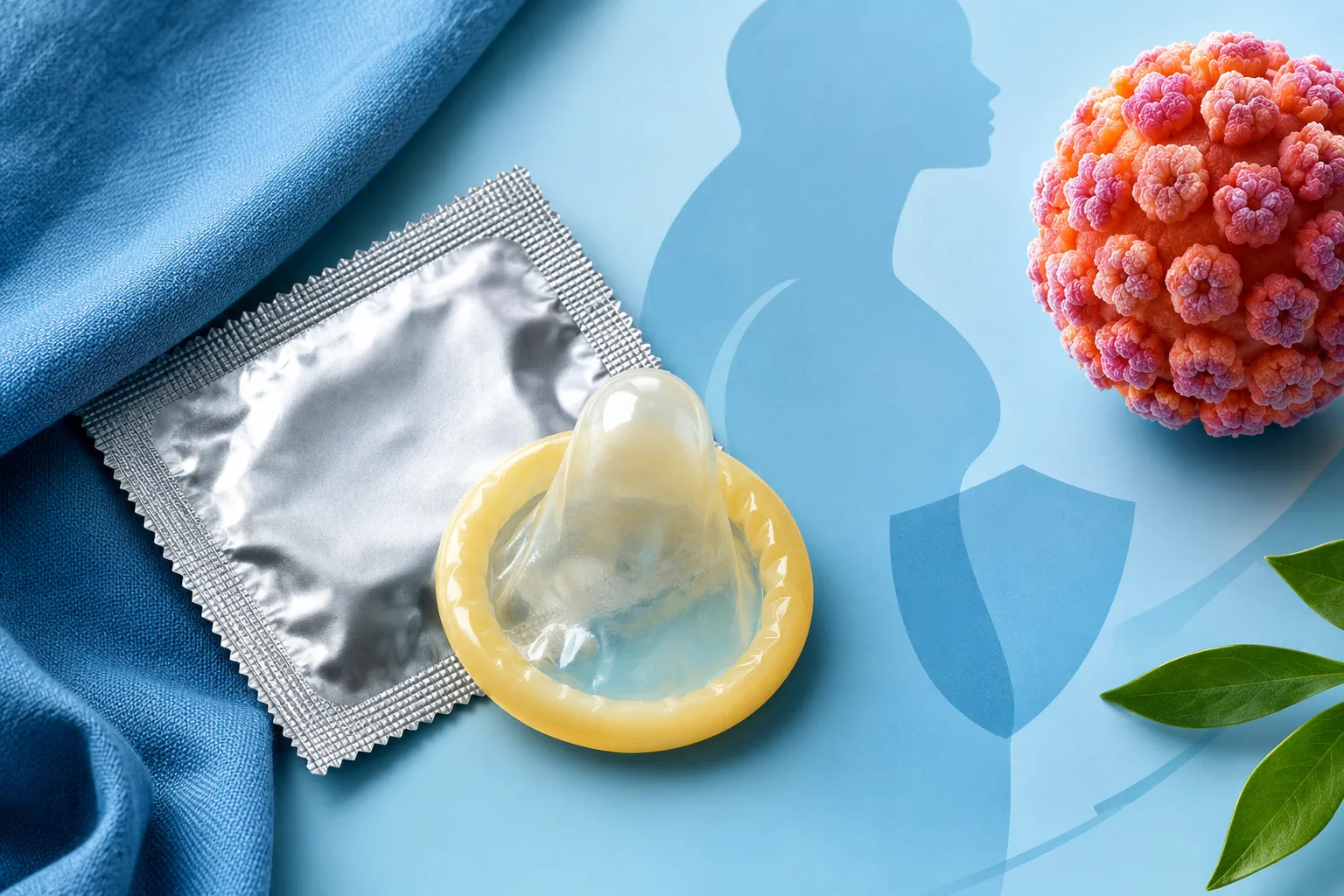
Condoms reduce the risk of HPV transmission, but they do not eliminate it. That one fact shapes almost every conversation about safer sex and HPV, and understanding why it’s true, and what to do about it, matters more than any simple reassurance.
Key Takeaways
- Condoms lower HPV transmission risk significantly but cannot fully prevent it because HPV spreads through skin-to-skin contact in areas a condom does not cover.
- Consistent, correct condom use is still strongly recommended, the risk reduction is real and meaningful.
- The HPV vaccine is the most effective prevention tool available; condoms and vaccination work better together than either does alone.
- Dental dams offer similar partial protection for oral and vulva-to-vulva contact.
- No single method, condom, vaccine, or otherwise, provides complete protection on its own.
Why Condoms Don’t Fully Prevent HPV
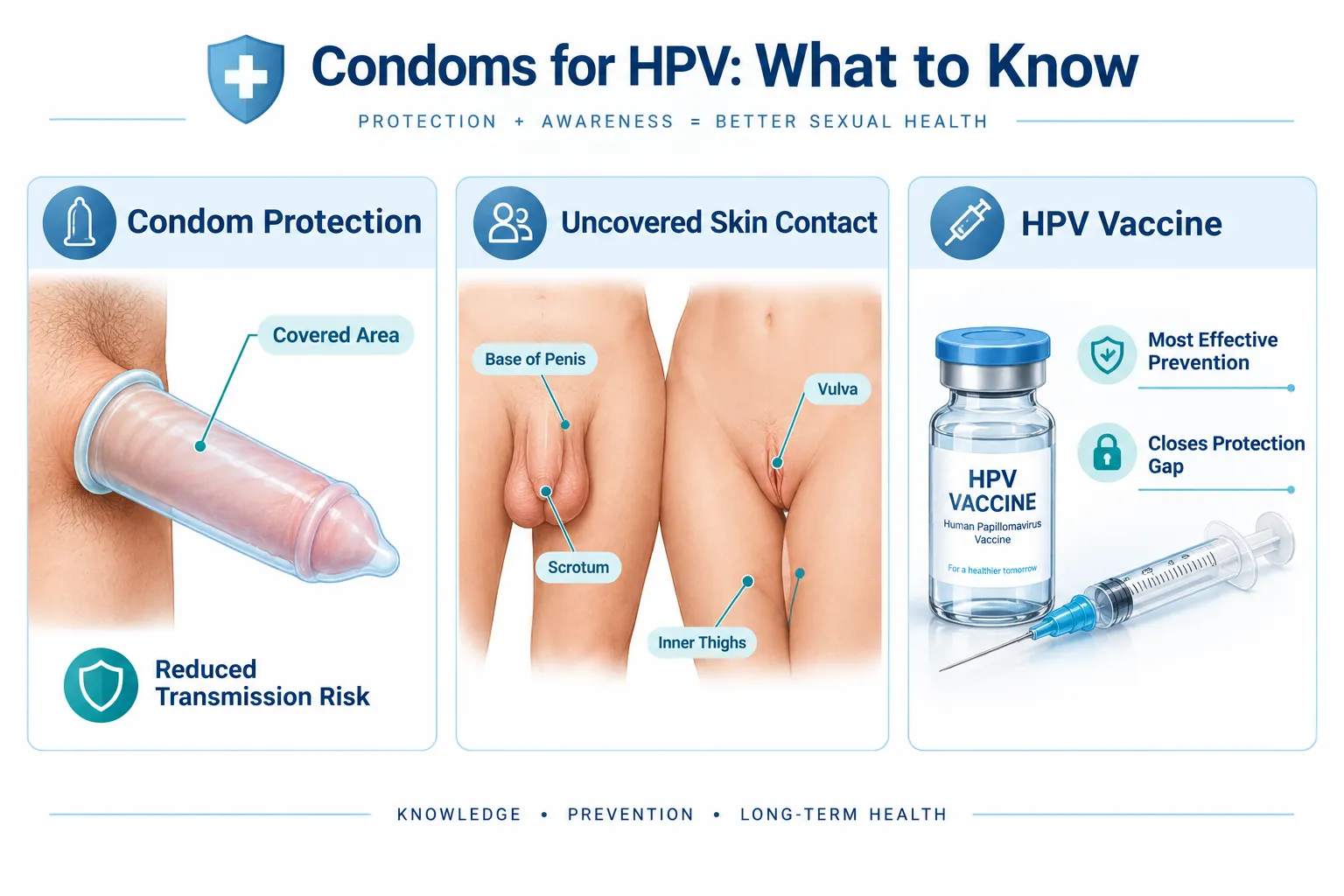
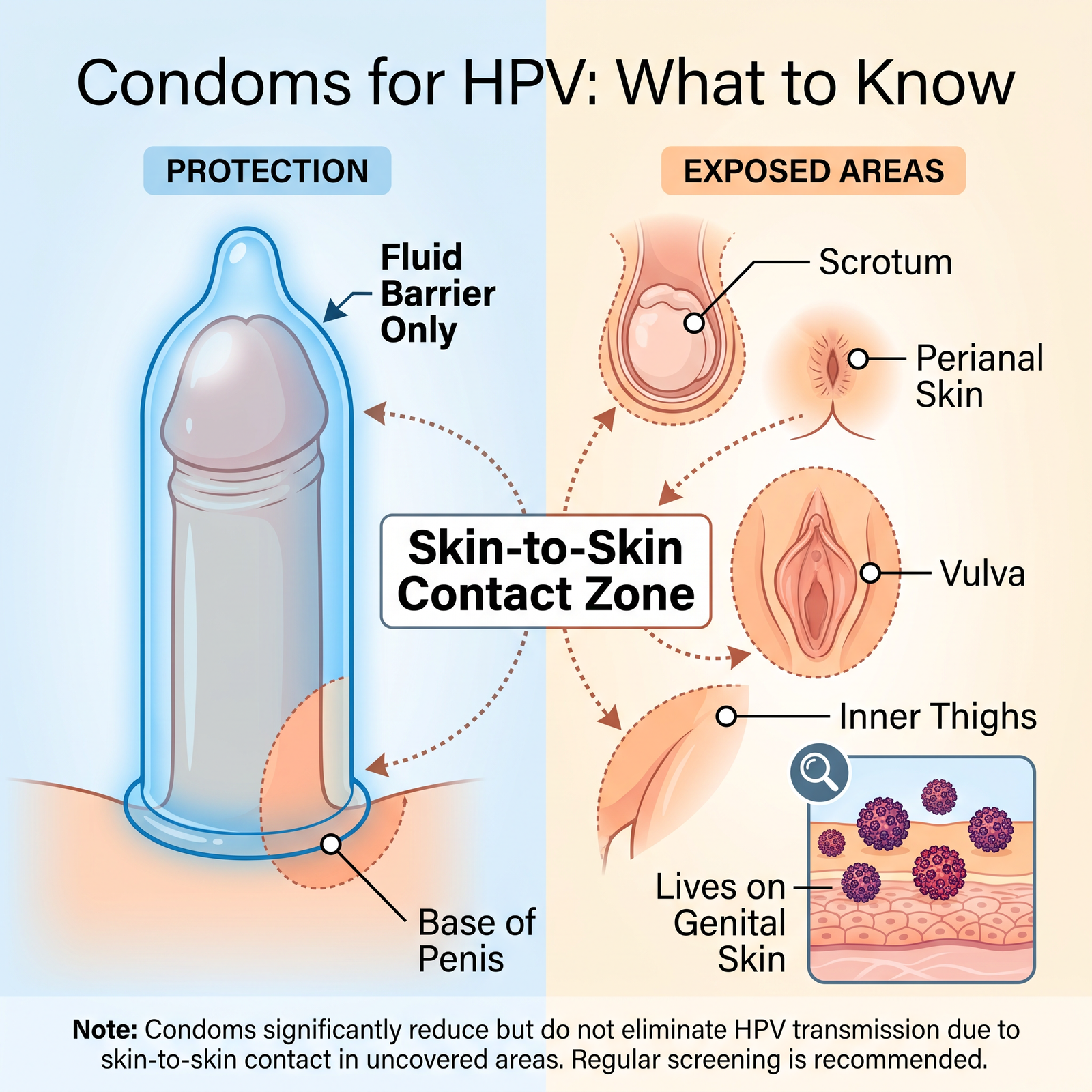
HPV is not transmitted through bodily fluids the way HIV or gonorrhea is. It spreads through direct skin-to-skin contact, and the virus can live on genital skin that a condom never touches. The base of the penis, the scrotum, the inner thighs, the vulva, and the perianal skin can all carry HPV. A condom covers the shaft of the penis and nothing else.
That’s the core limitation. It’s not a flaw in condom design; it’s a basic fact about how this virus moves between people.
A landmark study published in the New England Journal of Medicine followed college-age women over time and found that consistent condom use by male partners reduced female HPV acquisition by about 70 percent. That’s a substantial reduction, not negligible, not complete. More recent systematic reviews confirm the same range: significant risk reduction, not elimination.
For people with penises, the evidence points in the same direction. Consistent condom use lowers HPV infection rates and reduces the likelihood of developing genital warts caused by low-risk types like HPV 6 and 11. It also reduces exposure to high-risk types like HPV 16 and 18, which are responsible for the majority of HPV-related cancers.
The practical message: use condoms consistently and correctly, and pair them with vaccination. One without the other leaves a gap.
If you want a broader picture of how HPV spreads and what the different types actually do, the plain-English guide to HPV types, risks, and prevention covers that ground clearly.
Who’s at Higher Risk for HPV Transmission Despite Condom Use
Some groups face a meaningfully higher risk of HPV acquisition even with condom use, because of immune status, exposure patterns, or vaccination history.
- Unvaccinated people of any gender, the vaccine closes the gap that condoms leave open for the types it covers.
- Immunocompromised individuals, people living with HIV, organ transplant recipients, or anyone on long-term immunosuppressive therapy are less able to clear new HPV infections and more likely to develop persistent infection.
- People with multiple recent partners, higher cumulative exposure increases the probability of encountering a type not yet encountered.
- People with a history of abnormal Pap results, prior high-risk HPV exposure suggests ongoing or recurrent infection risk that barrier methods alone won’t fully address.
What Condoms for HPV Actually Protect Against
The protection condoms provide is real, even if partial. Here’s what the evidence actually supports.
Genital warts. Consistent condom use reduces transmission of HPV 6 and 11, the types that cause most genital warts. This is one of the clearer benefits, treatment for genital warts is effective, but prevention is simpler.
Cervical HPV infection. Studies show reduced rates of cervical HPV detection in women whose partners use condoms consistently. This matters because persistent high-risk HPV infection is what drives cervical cell changes, the kind that show up on a Pap smear as ASC-US or LSIL. If you’ve had an abnormal result and want to understand what comes next, the guide to abnormal Pap smear results explains the follow-up process in plain terms.
Anal HPV. Condoms used during anal sex reduce anal HPV exposure, though the same coverage limitation applies, perianal skin remains exposed. The anal HPV test guide explains how anal HPV is screened and what a positive result means.
Oral HPV. This is where the evidence is thinner and the conversation is newer. Oral HPV, including high-risk types linked to oropharyngeal cancers, can be transmitted through oral sex. Standard condoms used during oral sex on a penis provide some coverage. Dental dams used during oral sex on a vulva or anus offer similar partial protection. Neither eliminates oral HPV risk, but both reduce it.
Dental Dams and Oral HPV: The 2026 Picture
Dental dams have received growing attention in 2026 sexual health guidance, partly because oropharyngeal HPV cancers, particularly those linked to HPV 16, have been rising steadily in men over the past two decades.
A dental dam is a thin sheet of latex or polyurethane placed over the vulva or anus during oral sex. Like a condom, it creates a barrier over the area being contacted. Like a condom, it doesn’t cover every surface that might carry HPV.
The CDC and major sexual health organizations now include dental dams in their HPV prevention messaging alongside condoms. The honest framing: they reduce risk for the area they cover, and using them is better than not using them. They’re not widely used, largely because they’re less familiar and less available than condoms, but they’re a legitimate tool in the prevention toolkit.
How to Use Condoms for HPV Risk Reduction: Practical Steps
Correct and consistent use matters. A condom used incorrectly or only sometimes provides far less protection than one used properly every time.
- Use a new condom for every act of vaginal, anal, or oral sex.
- Put the condom on before any genital contact begins, not after, because HPV can be present on skin before penetration.
- Use condoms that fit correctly; breakage and slippage reduce coverage.
- Store condoms away from heat and friction (not in a wallet for months).
- Latex or polyurethane condoms both provide barrier protection; lambskin condoms do not, they have pores large enough for viruses to pass through.
Pairing consistent condom use with HPV vaccination is the most evidence-supported prevention strategy available. The vaccine covers HPV 6, 11, 16, 18, and additional high-risk types depending on which formulation is used, types that condoms alone cannot reliably block. HPV testing is the other piece of the picture: knowing your status allows for appropriate monitoring and follow-up.
For women, the HPV in women guide covers how HPV behaves differently across life stages, including during pregnancy and after menopause.
What Condoms Cannot Do
No condom prevents HPV with certainty. There is no “HPV-proof” condom, and as of 2026, none is in development that would realistically cover all exposed genital skin during sex.
Condoms also cannot treat an existing infection. If you or a partner already have HPV, condom use may reduce the chance of passing it to a new site or a new partner, but it won’t clear the virus. The immune system does that, most HPV infections, including high-risk types, clear on their own within one to two years.
What condoms do is reduce new exposures. That matters most when one partner has a known HPV infection and the other does not, or when vaccination status is unknown.
Condoms for HPV: What to Know Before Your Next Conversation With a Doctor
If you’ve been diagnosed with HPV and are wondering what to tell a partner, or if a partner’s diagnosis has prompted you to think about your own risk, condoms are part of the answer, not the whole answer.
The full prevention picture for 2026 looks like this: vaccination if you’re eligible and haven’t completed the series, consistent condom use for all penetrative and oral sex, dental dams for oral-vulvar and oral-anal contact, and regular screening appropriate to your age and risk profile. An Aptima HPV test or standard co-test can clarify whether high-risk HPV is currently detectable.
Cell changes from HPV are easiest to manage before they progress, that’s what screening is for. Condoms reduce the chance of acquiring or transmitting the virus in the first place.
Frequently Asked Questions
Can you get HPV even if you always use a condom?
Yes. Consistent condom use significantly reduces HPV risk but does not eliminate it, because HPV spreads through skin-to-skin contact in areas a condom does not cover. Studies suggest consistent use reduces female HPV acquisition by roughly 70 percent, meaningful, but not complete protection.
Do condoms protect against all HPV types?
Condoms reduce exposure to all HPV types that are transmitted through the covered area, including high-risk types like HPV 16 and 18 and low-risk types like HPV 6 and 11. They do not differentiate between types, the limitation is anatomical coverage, not the specific type.
Does my partner need to use a condom if I’ve already been diagnosed with HPV?
It depends on context. If a long-term partner has likely been exposed already, the practical impact of condom use on that specific relationship is less clear. For new partners, or when trying to avoid transmitting HPV to a site that isn’t yet infected, consistent condom use reduces ongoing exposure. Talk to your doctor about your specific situation.
Are internal (female) condoms as effective as external condoms for HPV?
Internal condoms cover more of the vaginal canal and some of the external vulvar area, which may offer slightly broader coverage than external condoms in some situations. The evidence base for internal condoms and HPV specifically is smaller, but the same principle applies: coverage reduces risk in the covered area; uncovered skin remains a transmission route.
Do condoms help if I already have HPV?
Condoms won’t clear an existing infection, that’s the immune system’s job. They can reduce the chance of transmitting HPV to a partner or to a new anatomical site, and they reduce the risk of acquiring additional HPV types you haven’t yet encountered.
Is the HPV vaccine still worth getting if I already use condoms consistently?
Yes. The vaccine and condoms address different parts of the transmission risk. Condoms reduce skin-to-skin contact; the vaccine trains the immune system to recognize and fight specific HPV types before infection takes hold. Together, they provide substantially better protection than either does alone.