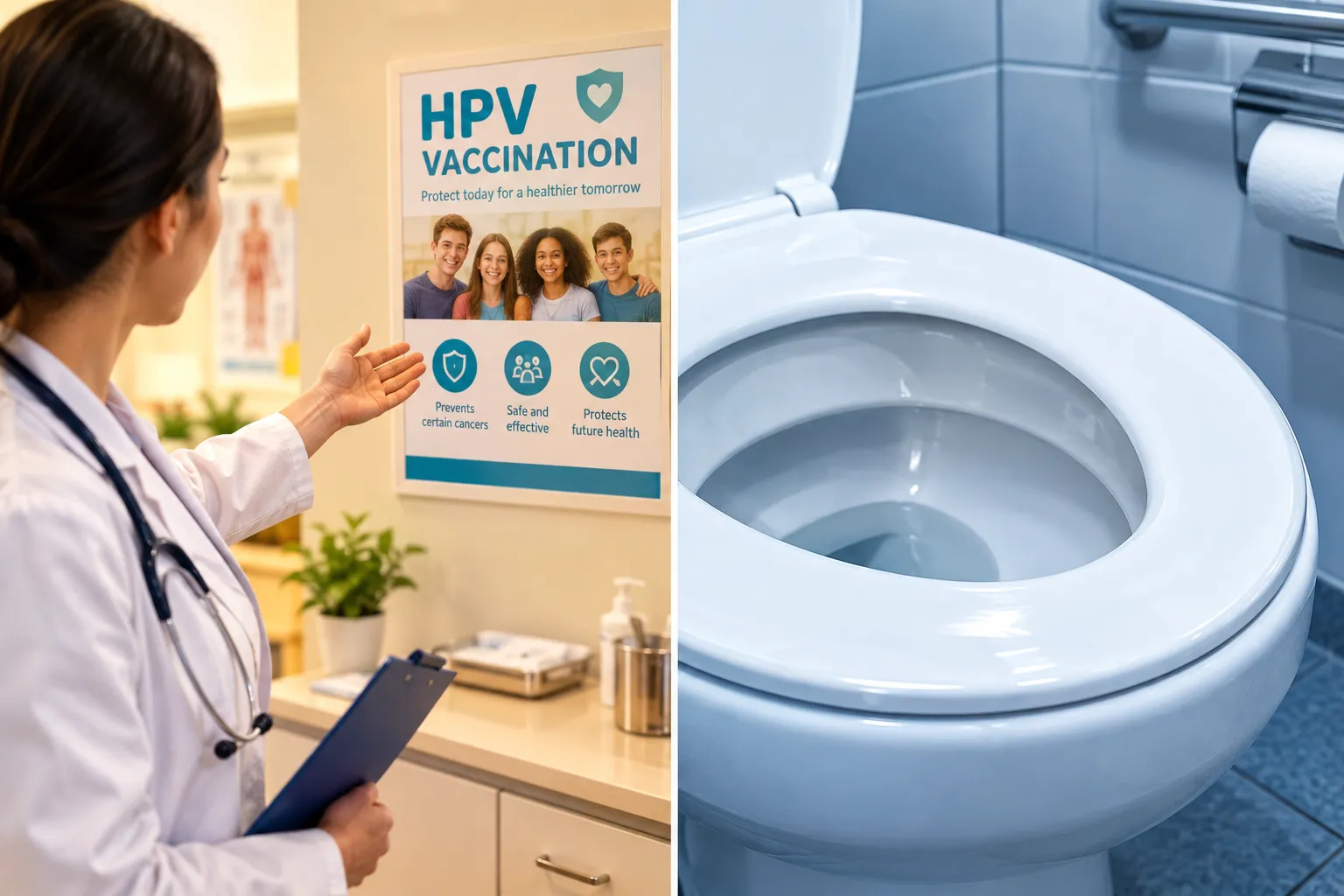
No, you cannot get HPV from a toilet seat. There are no documented cases in medical literature of genital HPV being transmitted through contact with a toilet seat, and public health agencies do not include toilet seats in HPV prevention guidance for this reason.
That said, it’s one of the most common questions people ask after learning about HPV, and asking it makes sense. Understanding why toilet-seat transmission doesn’t happen tells you something important about how HPV actually spreads, and what does, and doesn’t, put you at real risk.
Key Takeaways
- Genital HPV requires direct, skin-to-skin contact with infected genital, anal, or oral tissue to spread, toilet seats do not provide this.
- No documented case of genital HPV transmission via a toilet seat exists in modern medical literature.
- HPV can survive briefly on dry surfaces, but surviving on a surface and being able to infect through casual contact are two different things.
- The actual transmission routes for HPV are vaginal, anal, and oral sex, and close genital skin-to-skin contact.
- If you have questions about your own HPV exposure, the route almost certainly wasn’t a bathroom.
How HPV Actually Spreads
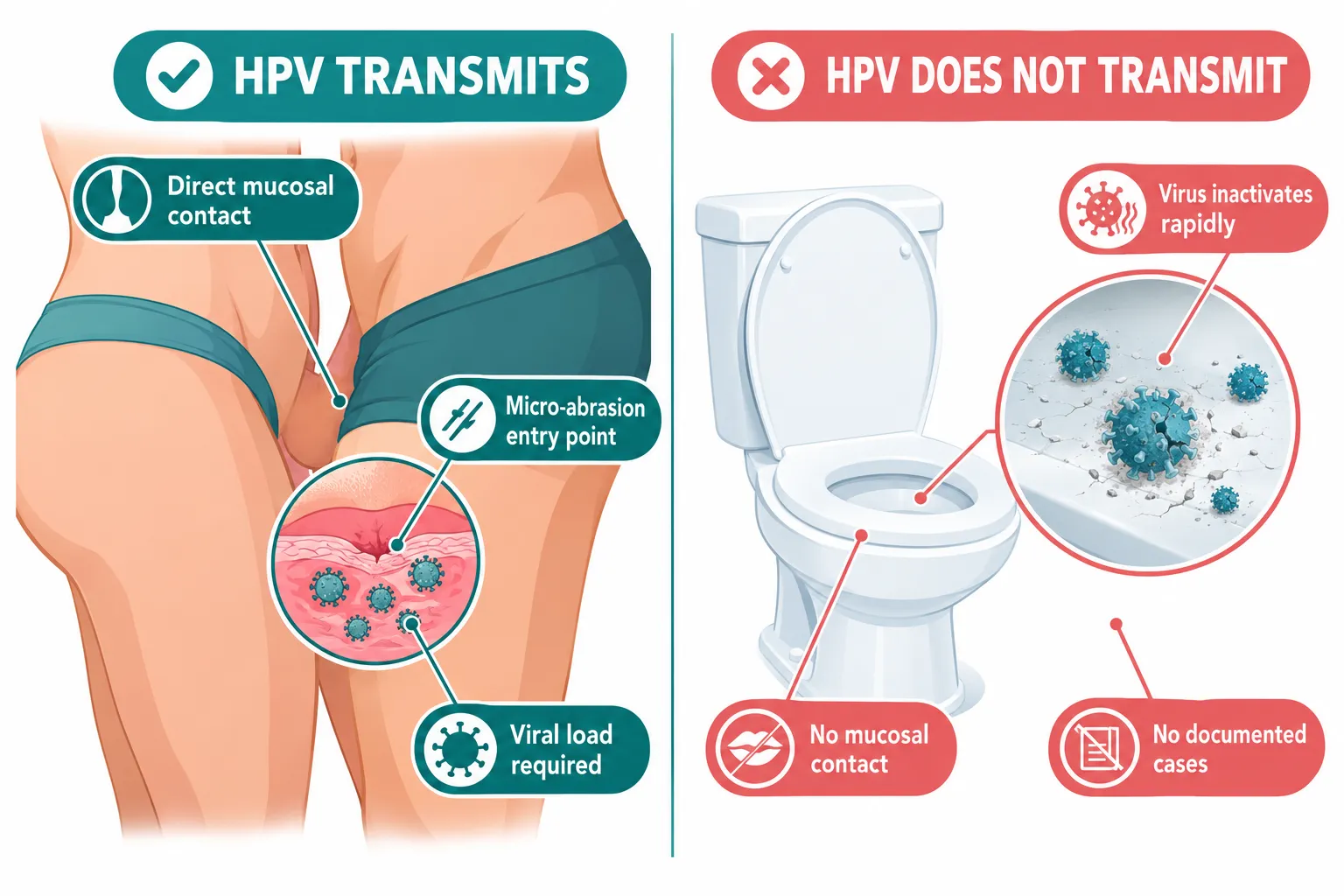
HPV, human papillomavirus, is transmitted through direct contact with infected skin or mucous membranes. Specifically, the genital HPV types (including high-risk types 16 and 18, and low-risk types 6 and 11) spread through vaginal sex, anal sex, oral sex, and close genital skin-to-skin contact even without penetration.
The virus enters the body through small breaks or micro-abrasions in the skin or through mucous membranes. It needs that direct, sustained contact with a living, warm, moist surface. A toilet seat is none of those things.
For transmission to occur, several conditions have to line up simultaneously: a high enough viral load, a viable (still-infectious) virus, and direct contact with broken skin or mucosal tissue. Sitting briefly on a dry, hard, non-mucosal surface doesn’t meet any of those conditions in a meaningful way.
HPV is one of the most common sexually transmitted infections worldwide, but the reason it’s so common is sexual contact, not shared surfaces. The full overview of how HPV spreads and how it doesn’t covers the transmission picture in more detail if you want to understand the broader context.
Can You Get HPV from a Toilet Seat, What the Evidence Shows
The short answer: no, and the evidence is consistent on this point.
HPV DNA has been detected on various surfaces in studies, including bathroom floors and equipment. The virus can remain on dry surfaces for a period, some estimates suggest up to a few days under the right conditions. But detecting viral DNA on a surface is not the same as demonstrating that the virus can infect someone through casual contact with that surface.
What matters clinically is whether transmission actually occurs. And for toilet seats, there are zero documented cases.
The American Cancer Society explicitly lists toilet seats among the surfaces and situations from which you cannot get HPV. Public health microbiologists note that while toilet-seat transmission is theoretically conceivable under a very specific set of conditions, compromised genital skin, viable virus present, prolonged direct contact, those conditions are not met during ordinary bathroom use.
For genital HPV types specifically, the virus needs to reach genital, anal, or oral mucosal tissue. Sitting on a toilet seat, even a contaminated one, doesn’t place the virus in contact with those tissues in a way that enables infection.
This is also why understanding the difference between HPV types matters: the strains responsible for genital warts and cervical cell changes are adapted for transmission through intimate sexual contact, not environmental surfaces.
Why People Worry About Toilet Seats
The concern is understandable. Bathrooms feel like shared, potentially contaminated spaces. And if you’ve just received an HPV diagnosis, or learned a partner has HPV, the mind naturally looks for an explanation that doesn’t involve sexual transmission.
Here’s the medical reality: the timing of an HPV infection is often genuinely unknowable. HPV can remain dormant for months or years before it’s detected, which means a positive test result today doesn’t tell you when or from whom you were infected. The question of whether HPV can be dormant is worth reading if you’re trying to make sense of a diagnosis that feels unexpected.
What the evidence doesn’t support is toilet-seat transmission as an explanation. The virus simply doesn’t spread that way under normal circumstances.
What Surfaces and Situations Don’t Spread HPV
To be direct about it: the following do not transmit genital HPV.
- Toilet seats
- Toilet handles or flush levers
- Doorknobs and shared surfaces
- Swimming pools or hot tubs
- Hugging or shaking hands
- Sharing food, drinks, or utensils
- Clothing or towels (in typical use)
These are all listed consistently across public health guidance because HPV requires intimate skin-to-skin contact to spread. It is not an airborne virus. It does not spread through water. It does not spread through casual physical contact.
The routes that do spread genital HPV are vaginal, anal, and oral sex, and genital skin-to-skin contact. Condoms reduce risk but don’t eliminate it entirely, because HPV can be present on skin not covered by a condom. The plain-English guide to what HPV is explains the virus’s behavior in accessible terms if you’re starting from scratch.
Who’s at Higher Risk for Genital HPV?
HPV is common, most sexually active adults will have at least one HPV infection at some point. But certain groups face a higher likelihood of infection or of an infection causing problems.
- Unvaccinated people who are sexually active have no immune protection against the HPV types covered by the vaccine, including types 16 and 18.
- Immunocompromised individuals, including people living with HIV and organ transplant recipients, are less likely to clear HPV naturally and more likely to develop persistent infections that progress to cell changes.
- People with a history of abnormal Pap results have already shown that their immune response to HPV may not be clearing the virus efficiently, which warrants closer monitoring.
- Smokers have a higher risk of persistent HPV infection and cervical dysplasia, likely because smoking impairs local immune function in cervical tissue.
Does the HPV Vaccine Protect Against Toilet-Seat Transmission?
This question slightly misframes how the vaccine works, but it’s worth addressing directly.
The HPV vaccine (Gardasil 9) protects against nine HPV genotypes, including the two highest-risk types (16 and 18) and the two types most responsible for genital warts (6 and 11). It works by training your immune system to recognize and neutralize the virus before an infection can establish itself.
Because toilet seats aren’t a real transmission route, the vaccine’s role here is moot. What the vaccine does protect against is the actual transmission route: sexual skin-to-skin contact. If you’re unvaccinated and sexually active, vaccination is worth discussing with your doctor regardless of your age, guidelines in 2026 support vaccination up to age 45 in some cases. The HPV vaccine category pages cover eligibility and timing in detail.
Frequently Asked Questions
Can HPV survive on a toilet seat long enough to infect someone?
HPV can survive on dry surfaces for a short period, some research suggests the virus may remain detectable for up to a few days. But surviving on a surface and being able to cause an infection through casual contact are different things. Genital HPV needs direct contact with mucosal tissue or broken skin to infect, and sitting on a toilet seat doesn’t provide that contact pathway. No transmission has ever been documented this way.
If HPV is so common, why isn’t it spreading through surfaces?
HPV is common precisely because sexual contact is so common, not because the virus spreads easily through the environment. The virus is adapted for transmission through intimate skin-to-skin contact, which means it’s highly efficient at spreading sexually but poorly suited to surviving and infecting through dry, hard surfaces. That’s a feature of its biology, not a coincidence.
Can other STIs spread from toilet seats?
The same general principle applies. Most sexually transmitted infections, including chlamydia, gonorrhea, and herpes, are fragile outside the body and die within seconds to minutes on dry surfaces. The conditions required for toilet-seat transmission (viable pathogen, direct mucosal contact, sufficient exposure time) are not met during ordinary bathroom use. This is consistent with why STI prevention guidance focuses on sexual contact, not bathroom hygiene.
I was just diagnosed with HPV. Could I have gotten it from a bathroom?
Almost certainly not. Genital HPV is transmitted through sexual contact. If you’ve received a positive HPV test, whether through a cervical screening result like an abnormal Pap smear or another route, the infection came from skin-to-skin sexual contact. HPV can stay dormant for a long time, so the infection may be older than you’d expect. The timing is often impossible to pinpoint, which is worth keeping in mind before drawing conclusions about when or from whom it came.
Does hand-washing after using a public toilet reduce HPV risk?
Good hand hygiene is always worth practicing, but it’s not relevant to genital HPV risk specifically. You can’t pick up genital HPV from a toilet surface and transfer it to your genitals through hand contact in a way that causes infection under normal circumstances. If you’re concerned about HPV transmission, the meaningful protective steps are vaccination, consistent condom use, and regular cervical screening if you have a cervix.
What This Means for You
Can you get HPV from a toilet seat? No, and that’s not a reassurance, it’s just the evidence. The virus doesn’t spread this way, and no documented case has ever suggested otherwise.
If you’ve recently received an HPV diagnosis, the transmission route was sexual contact. That’s not a judgment, HPV is so common that most sexually active people encounter it at some point, and the majority of infections clear without any treatment or lasting effects. What matters now is understanding what type you have, whether any follow-up is needed, and whether vaccination is still relevant for you.
Talk to your doctor about what your specific result means and what monitoring, if any, makes sense. Cell changes, when they occur, are easiest to manage before they progress, that’s exactly what cervical screening is designed to catch early. If you’re trying to understand the broader picture of how HPV can be transmitted between partners, that’s a reasonable next question to explore.