
Yes, but it is rare. Roughly 3 to 8 percent of cervical cancers worldwide arise without any detectable HPV involvement, and even that figure likely includes cases where HPV was simply missed by testing. The vast majority of cervical cancers are caused by high-risk HPV types, particularly HPV 16 and 18. Understanding the small fraction that are not HPV-driven matters, because those tumors behave differently, respond differently to screening, and require a different diagnostic path.
Key Takeaways
- Most cervical cancers are caused by high-risk HPV types, but a small subset, estimated at 3 to 8 percent, appear to develop independently of HPV.
- Many reported “HPV-negative” cervical cancers are actually false negatives caused by testing limitations, sample quality issues, or misclassification of the tumor’s origin.
- HPV-independent cervical cancers are disproportionately rare glandular subtypes, such as gastric-type adenocarcinoma, driven by gene mutations rather than viral oncogenes.
- These tumors are not prevented by HPV vaccination and are not detected by HPV-based screening, they are usually found because of symptoms.
- A negative HPV screening test still indicates very low short-term cervical cancer risk, making routine screening highly valuable even though it cannot catch every case.
How HPV Causes Most Cervical Cancers
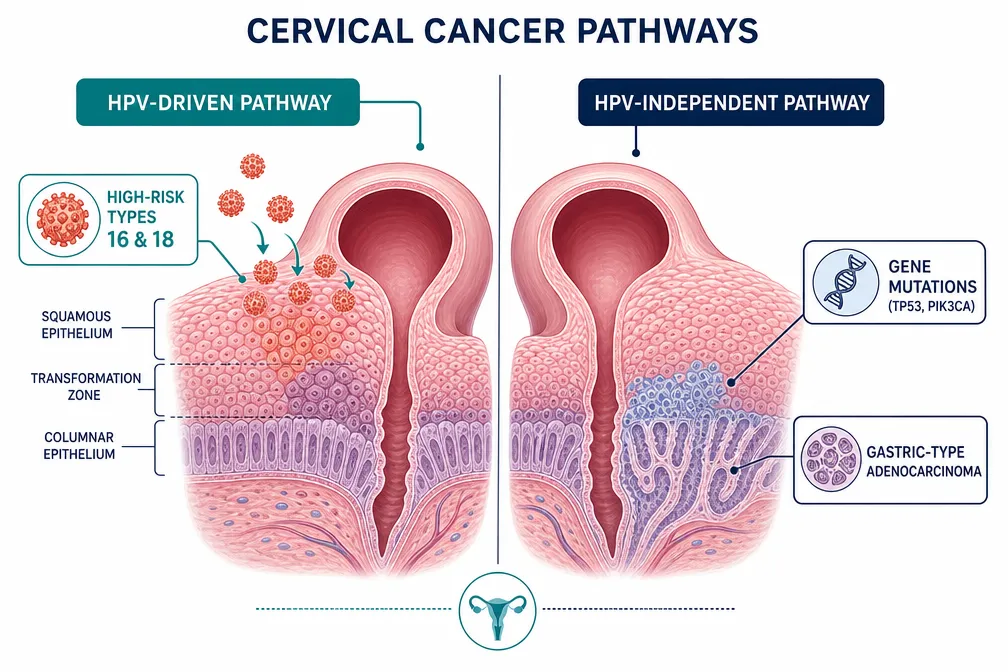
HPV is responsible for the overwhelming majority of cervical cancers. High-risk genotypes, especially HPV 16 and 18, integrate their viral DNA into cervical cells, disrupting the genes that normally suppress tumor growth. This triggers the progression from normal cells to cervical intraepithelial neoplasia (CIN) and, in a small proportion of persistent infections, to invasive cancer.
The link between HPV and cervical cancer is one of the strongest established between any virus and any human cancer. That is why HPV-based screening has largely replaced the older Pap smear in many countries: a negative HPV test predicts extremely low cervical cancer risk over the following three years. One large NIH-supported study of over one million women found that three-year cervical cancer risk after a negative HPV test was roughly 11 per 100,000 women, about half the already-low risk after a negative Pap test alone.
For a broader look at which cancers HPV is linked to and how that connection works, the article on HPV and cancer: which cancers are linked, how it happens, and how it’s prevented covers the full picture.
Can You Get Cervical Cancer without HPV? What the Evidence Shows
The short answer is yes, though the numbers are smaller than many published estimates suggest.
Large global reviews report that 5.5 to 11 percent of cervical cancers test negative for HPV. That range, however, includes a substantial proportion of cases where HPV was present but not detected, due to low viral copy numbers, sample degradation, assay limitations, or the tumor being misclassified as cervical when it actually originated in the endometrium. When researchers retest initially HPV-negative tumors using sensitive PCR methods, more than half either turn HPV-positive or get reclassified as non-cervical primaries.
After accounting for those false negatives, truly HPV-independent cervical cancers likely represent around 3 to 8 percent of all cases.
The World Health Organization’s 5th edition classification formally recognizes HPV-independent squamous cell carcinoma of the cervix as a distinct entity, estimating its prevalence at roughly 5 to 7 percent of cervical squamous cancers. This is not a rounding error or a testing artifact, it is a real, if uncommon, category of disease.
What Drives HPV-Independent Cervical Cancers?
Without a virus to blame, what causes these tumors? Molecular studies point to somatic gene mutations, particularly in TP53, PIK3CA, and CDKN2A, as the likely drivers. These are the same genes disrupted in many other non-viral cancers. The carcinogenic pathway appears to be entirely separate from the viral oncogene mechanism that drives HPV-related disease.
HPV-independent cervical cancers are disproportionately glandular tumors. While most squamous cell cervical cancers are HPV-positive, roughly 15 to 20 percent of cervical adenocarcinomas lack detectable HPV. Specific subtypes, gastric-type adenocarcinoma and other rare glandular histologies, are now recognized as distinct HPV-independent entities with their own molecular profiles and clinical behavior.
HPV-Negative Cervical Cancer: True vs. False Negative
This distinction matters clinically. Not every “HPV-negative” cervical cancer result means the cancer is truly HPV-independent.
Common reasons for a false-negative HPV result in a confirmed cervical cancer:
- Low viral copy numbers in the tumor tissue
- Sample quality problems at collection or processing
- Infection with an HPV type not covered by the assay being used
- The tumor is actually an endometrial cancer that has extended into the cervix and been mislabeled
- Laboratory or assay limitations
True HPV-independent cervical cancers, by contrast, remain HPV-negative even on repeat sensitive testing and show the distinct molecular mutations described above. Pathologists increasingly rely on immunohistochemistry and molecular profiling, not just HPV testing, to make this distinction accurately.
Who Is at Higher Risk for HPV-Independent Cervical Cancer?
Because the cause is not fully understood, risk factors for truly HPV-independent cervical cancer are less clearly defined than for HPV-driven disease. Current evidence points to several groups:
- People with a history of abnormal Pap or cervical screening results, since any cervical abnormality warrants closer follow-up regardless of HPV status.
- Immunocompromised individuals, including those living with HIV or who have had organ transplants, who may have reduced capacity to suppress abnormal cell changes through any pathway.
- People who present with symptoms such as abnormal vaginal bleeding, pelvic pain, or unusual discharge, since HPV-independent tumors are rarely caught by screening and more often found symptom-first.
- Those with a family history of gynecologic cancers, given that gene mutation pathways (TP53, for example) can have hereditary components.
How HPV-Independent Cervical Cancer Is Diagnosed
There is no specific screening test for HPV-independent cervical cancer. That is the core clinical challenge.
HPV-based screening will not flag these tumors, because there is no HPV DNA to detect. The older Pap smear is similarly limited for glandular subtypes, which are harder to sample reliably from the cervical canal. Gastric-type adenocarcinoma, one of the recognized HPV-independent subtypes, is particularly difficult to detect through routine cytology.
In practice, diagnosis usually begins with symptoms: abnormal vaginal bleeding (especially between periods or after intercourse), unusual discharge, or pelvic pain. These symptoms prompt colposcopy, biopsy, and imaging. Pathologists then use histologic evaluation, immunohistochemistry, and molecular testing to confirm the tumor’s origin and type.

This is also why the article on what can cause genital warts and cervical cancer is worth reading alongside this one, understanding which HPV types drive which conditions clarifies why some cervical pathology falls entirely outside the HPV framework.
Prognosis: Does HPV Status Affect Outcomes?
HPV-negative cervical cancer tends to have a worse prognosis than HPV-positive disease. This is not simply because the tumors are rarer or harder to detect, though both of those things are true. Cohort analyses show that HPV-negative cervical cancers are more likely to present at an advanced FIGO stage, with greater lymphatic invasion, compared to HPV-driven tumors.
HPV-independent adenocarcinomas in particular are associated with aggressive behavior and reduced survival rates. Gastric-type adenocarcinoma, for example, is recognized as one of the most clinically challenging cervical cancer subtypes.
The worse outcomes likely reflect a combination of later detection (because screening misses them) and intrinsically more aggressive tumor biology.
What This Means for Screening and Vaccination
HPV vaccination does not prevent HPV-independent cervical cancers. The vaccines, including the nine-valent Gardasil 9, work by generating immunity against specific HPV genotypes. If a cancer has no HPV involvement, the vaccine has no mechanism to prevent it.
Similarly, HPV-based cervical screening will not detect these tumors. This does not mean screening is unhelpful, quite the opposite. Because HPV-driven disease accounts for over 90 percent of cervical cancers, HPV-based screening dramatically reduces overall cervical cancer risk. A negative HPV test is genuinely reassuring. It just cannot guarantee zero risk, because of the small HPV-independent fraction.
The practical implication: do not skip screening because you tested HPV-negative. And do not ignore symptoms, abnormal bleeding, pain, or unusual discharge, on the assumption that your HPV status rules out cervical cancer.
If you are thinking about vaccination as part of your overall protection strategy, the guide on the HPV vaccine for men, who should get it and whether it helps if you already have HPV addresses how vaccine protection works across different groups.
For those exploring complementary approaches alongside conventional care, the overview of AHCC and cervical cancer: what to know summarizes the current evidence on AHCC as an adjunct, though it is not a substitute for standard screening or treatment.
Frequently Asked Questions
If I tested HPV-negative, does that mean I cannot get cervical cancer?
A negative HPV test means your short-term cervical cancer risk is very low, but not zero. Truly HPV-independent cervical cancers exist, though they account for only a small fraction of all cases. Continue attending routine cervical screening on schedule, and report any symptoms such as abnormal bleeding to your doctor.
Can HPV come back after clearing, and could a reactivation be missed?
HPV can reactivate after a period of undetectability, particularly if your immune system is suppressed. This is one reason some “HPV-negative” cervical cancers may actually involve latent or low-copy HPV that standard assays did not detect. The article on whether HPV can come back without being sexually active explains the reactivation question in detail.
Are there specific symptoms that suggest HPV-independent cervical cancer?
The symptoms are the same as for any cervical cancer: abnormal vaginal bleeding (between periods, after sex, or after menopause), unusual vaginal discharge, or pelvic pain. Because HPV-independent tumors are not caught by screening, symptoms are often the first, and sometimes only, warning sign. Any of these should prompt a prompt conversation with your doctor.
Does having a rare cervical cancer subtype change treatment options?
It can. HPV-independent adenocarcinomas, including gastric-type, often behave more aggressively and may not respond the same way to treatments designed around HPV-driven disease. Pathologic subtyping through biopsy and molecular testing is increasingly important for guiding treatment decisions. Your oncology team will use those results to plan the most appropriate approach.
Should I still get the HPV vaccine if HPV-independent cervical cancer exists?
Yes. The vaccine protects against the HPV types responsible for more than 90 percent of cervical cancers. The existence of a small HPV-independent fraction does not reduce the vaccine’s value, it prevents the vast majority of cervical cancer risk. Cell changes are easiest to prevent before they start, and that is exactly what vaccination addresses.