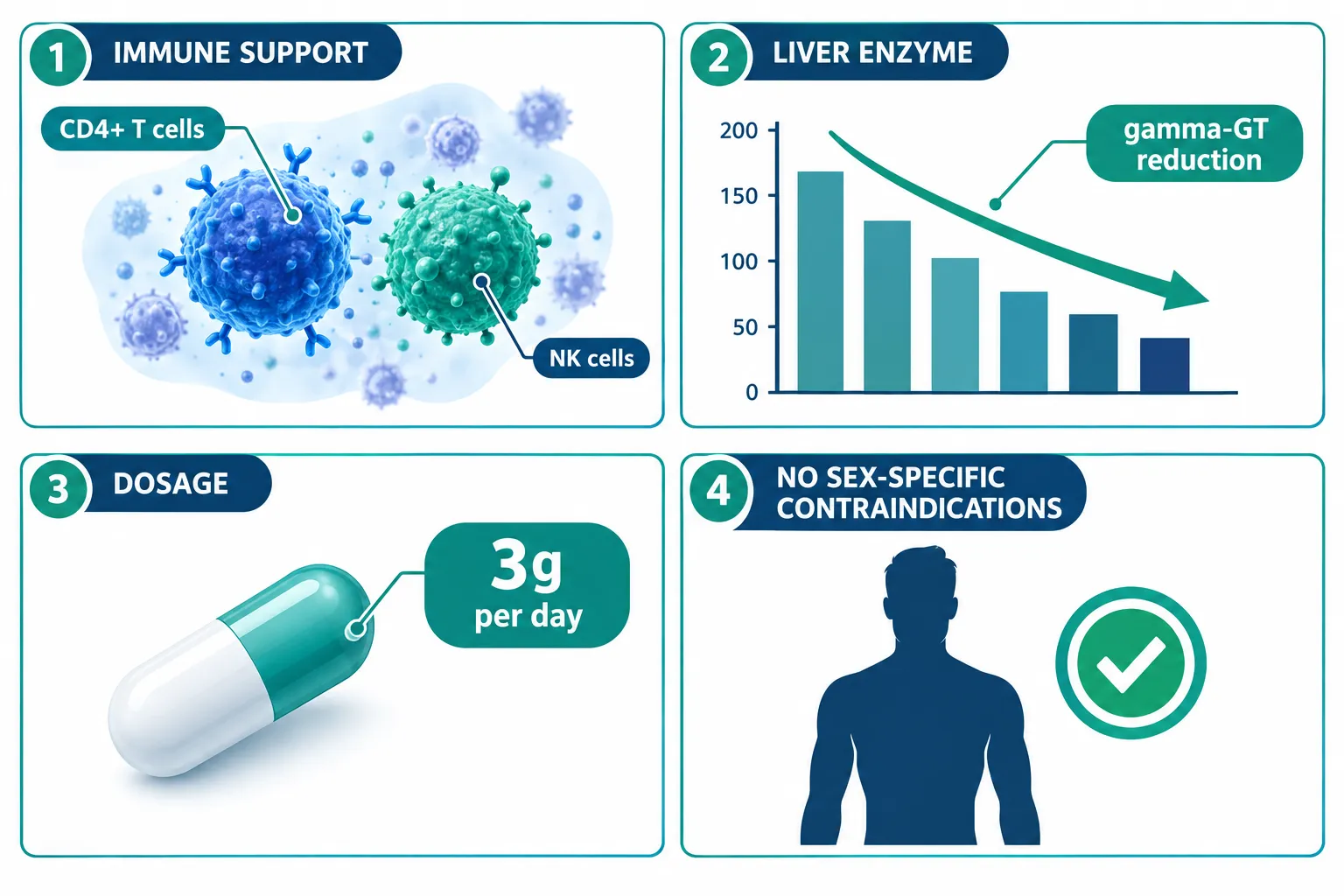
Men can take AHCC. There are no sex-specific contraindications in the published research, and several clinical trials have enrolled male participants without reporting any male-specific safety concerns. If you’re a man considering AHCC, whether for HPV, immune support, or as an adjunct during cancer treatment, the evidence gives a reasonably clear picture of what it can and cannot do.
Key Takeaways
- AHCC is a mushroom-derived immune supplement with no documented male-specific contraindications in human studies.
- Clinical trials have included men at doses ranging from 1 g to 9 g per day, with mild gastrointestinal side effects being the most commonly reported issue.
- The most studied dose for immune support is 3 g per day; most tolerability data extends up to 6 months at that level.
- Men with autoimmune conditions, severe liver disease, or those on immunosuppressant medications should discuss AHCC with a physician before starting.
- Direct evidence for AHCC clearing HPV in men is limited, though ongoing trials include male participants and results are expected in the coming years.
What Is AHCC, and Why Are Men Asking About It?
AHCC stands for Active Hexose Correlated Compound. It’s a standardized extract derived from the cultured mycelia of Lentinula edodes, the shiitake mushroom, and it’s one of the more extensively studied specialty immune supplements available without a prescription. More than 30 human clinical studies and over 100 preclinical studies have examined it.
Most of the public conversation about AHCC has centered on women, largely because the most-cited clinical trials focused on clearing high-risk HPV infections in women. That framing has left a lot of men wondering whether AHCC is even relevant to them, or safe for them to take.
The short answer: yes, men can take AHCC, and the research base is broader than the HPV-in-women narrative suggests. To understand what the evidence actually shows, it helps to look at what AHCC is and how it works before getting into the male-specific data.
Is AHCC Safe for Men? What Clinical Studies Show
The safety profile of AHCC in men is well-characterized at commonly used doses, and the data are reassuring.
A Phase I safety study gave 26 healthy adult volunteers a high dose of 9 g per day of liquid AHCC for 14 days. About 20% of participants reported mild, transient effects, nausea, bloating, diarrhea, headache, fatigue, or foot cramps. No significant laboratory abnormalities appeared. Overall tolerability was 85%. That study used a dose roughly three times higher than what most people take for immune support, which gives a meaningful safety margin for typical adult use, including men.
At the doses most commonly used in research, 3 g per day, AHCC has been taken for up to 9 years in some study populations without major safety signals. Aggregated clinical data classify it as “possibly safe” at 4.5-6 g per day for up to 6 months, and at 3 g per day for considerably longer periods.
One study focused specifically on a male cohort: 30 men with chronic, non-viral abnormal liver function took either 1 g or 3 g of AHCC per day over several weeks. Both doses produced significant reductions in liver enzymes, including gamma-GT, with no serious adverse events. That trial is notable because it directly addresses a concern some men have, whether AHCC is hard on the liver. The data suggest the opposite.
For a full breakdown of what side effects have been documented across studies, the AHCC side effects review covers the clinical data in detail.
One caution worth stating plainly: men with severe liver disease, active autoimmune conditions, or those taking potent immunosuppressant medications, such as those used after organ transplantation, should speak with their physician before adding AHCC. The concern is not that AHCC is known to cause harm in these groups, but that specific safety data in these populations are limited.
Can Men Take AHCC for HPV?
HPV testing in men is not routine. There’s no approved swab test equivalent to a Pap smear, and most men with HPV never know they have it. That creates a real practical problem: if you’re a man who knows you’ve been exposed to a high-risk HPV type, through a partner’s diagnosis, for example, there’s no standard clinical tool to confirm clearance.
The HPV clearance research that put AHCC on the map was conducted in women with persistent high-risk HPV infections. A Phase II trial found that AHCC at 3 g once daily helped clear HPV in a substantial proportion of participants. The supplement was well tolerated, with no adverse events above grade 1 and no meaningful safety differences compared to placebo. The researchers explicitly noted that, given this safety profile and the absence of reliable HPV testing tools in men, AHCC could reasonably be considered for men with known HPV exposure.
Direct male HPV clearance data are still limited. That’s an honest gap in the evidence. What exists is a strong safety record, a plausible immune mechanism, and a growing clinical interest in extending this research to men.
The AHCC for HPV evidence review covers the full trial data, including what the Phase II results actually showed and what they didn’t.
Who Should Be More Cautious About Taking AHCC?
Most healthy adult men can take AHCC within studied dose ranges without significant concern. But a few groups warrant more careful thought before starting:
- Men on immunosuppressant therapy, including those who have received organ transplants or are being treated for autoimmune disease, because AHCC modulates immune function, and combining it with immunosuppressants has not been well studied.
- Men with severe or active liver disease, not because AHCC harms the liver (the liver enzyme data suggest the opposite), but because the specific population of men with serious hepatic impairment hasn’t been studied at length.
- Men undergoing active cancer treatment, not to avoid AHCC, but to coordinate with their oncologist. An NCI-associated Phase II trial is currently testing AHCC alongside standard chemoradiation in HPV-positive head and neck squamous cell carcinoma, with male participants explicitly included. That trial is measuring safety, tolerability, and immune outcomes. A separate randomized controlled trial initiated in 2025 is investigating AHCC as an immune modulator in cancer patients receiving checkpoint inhibitor therapy. Results from both are pending, but the fact that these trials are enrolling men in oncology settings signals that AHCC use in male cancer patients is being formally evaluated.
Can Men Take AHCC for Immune Support Generally?
Outside of HPV and cancer contexts, some men consider AHCC for general immune support, particularly as they age or after illness. The evidence here is mixed but not negative.
Immune-function studies in healthy adults, including men, show that AHCC at 3 g per day can modulate immune markers. Some trials report increased frequencies of CD4+ and CD8+ T cells producing interferon-gamma and TNF-alpha in adults aged 50 or older after 30 to 60 days of use. Other studies find neutral effects on NK-cell activity. The inconsistency across trials is worth naming honestly: AHCC is not a guaranteed immune booster. What the data do consistently show is good tolerability.
A review in the Natural Medicine Journal concluded that AHCC has demonstrated clinical effects and safety in patients with malignancies and in healthy subjects, including improved quality of life and favorable changes in cytokine and lymphocyte populations in some cohorts, while emphasizing that evidence remains preliminary and larger trials are needed.
For a broader look at what the research supports and what it doesn’t, the AHCC benefits evidence review is a useful reference.

What Dose of AHCC Do Men Typically Use?
Most human studies have used 3 g per day as the standard immune-support dose, often taken as a single dose on an empty stomach. Some trials have used lower doses (1 g per day) for specific applications like liver enzyme reduction. The Phase I safety data suggest that doses up to 9 g per day are tolerable short-term, though there’s no clinical rationale for men to use doses that high outside of a research setting.
AHCC is available in capsule and liquid form. The capsule form is more common in over-the-counter products. Dosing guidance on product labels varies, so checking that a product uses a standardized extract, and that the dose aligns with what was studied, matters more than brand name alone. The detailed breakdown of what’s in AHCC explains what to look for in a product.
Frequently Asked Questions
Does AHCC affect testosterone or male hormones?
No human study has reported AHCC affecting testosterone levels or other male sex hormones. The supplement’s mechanism is immunological, it acts on innate immune pathways, not the endocrine system. There is no known hormonal interaction in the published literature.
Can men take AHCC alongside other supplements?
AHCC has been studied alongside standard medical care without notable interactions in most trials. The main area of caution is combining it with immunosuppressant drugs, where the interaction hasn’t been adequately studied. For common supplements like vitamin D, zinc, or probiotics, no interaction data suggest a problem, but discussing your full supplement list with a physician is always the more careful approach.
How long does it take for AHCC to have an effect in men?
Most immune-function studies that showed measurable changes in T-cell populations or cytokine markers ran for 30 to 60 days. HPV clearance trials in women ran for several months. There’s no specific male timeline data, but expecting results in under four weeks is not supported by the evidence. Results vary person to person, and immune status plays a significant role.
Is AHCC the same as taking a regular mushroom supplement?
No. AHCC is a specific standardized extract of cultured shiitake mycelia, not a whole-mushroom powder or a general mushroom blend. The active compounds, including alpha-glucans, are produced through a specific fermentation process. Generic mushroom supplements are not interchangeable with the AHCC extract used in clinical trials. The AHCC mushroom extract explainer covers this distinction clearly.
Should men with HPV-related head and neck cancer consider AHCC?
This is an active area of clinical research. An ongoing trial is specifically testing AHCC in HPV-positive head and neck squamous cell carcinoma patients receiving chemoradiation, with male eligibility criteria included. The trial is measuring safety and tolerability as primary endpoints. If you’re in this situation, the right step is to ask your oncologist whether participation in an active trial is an option, or whether AHCC fits within your current treatment plan.