
AHCC is generally well tolerated by most healthy adults. The side effects that do appear in clinical studies are mostly mild and gastrointestinal, nausea, bloating, loose stools, and they tend to resolve on their own. That said, AHCC side effects and what studies show about them are worth understanding before you add this supplement to your routine, especially if you are taking other medications or managing a health condition.
Key Takeaways
- Most reported AHCC side effects are mild: nausea, diarrhea, bloating, fatigue, and headache
- At doses of 3-6 g/day, clinical studies classify AHCC as “possibly safe” for up to several years in healthy adults
- Allergic reactions are rare but documented, rash, dizziness, and breathing difficulty require stopping the supplement immediately
- People who are pregnant, nursing, immunocompromised, or have liver or kidney disease should not use AHCC without medical supervision
- AHCC’s interaction with chemotherapy and other cancer therapies is still being studied; always tell your oncology team before using it
What Are the Most Common AHCC Side Effects?
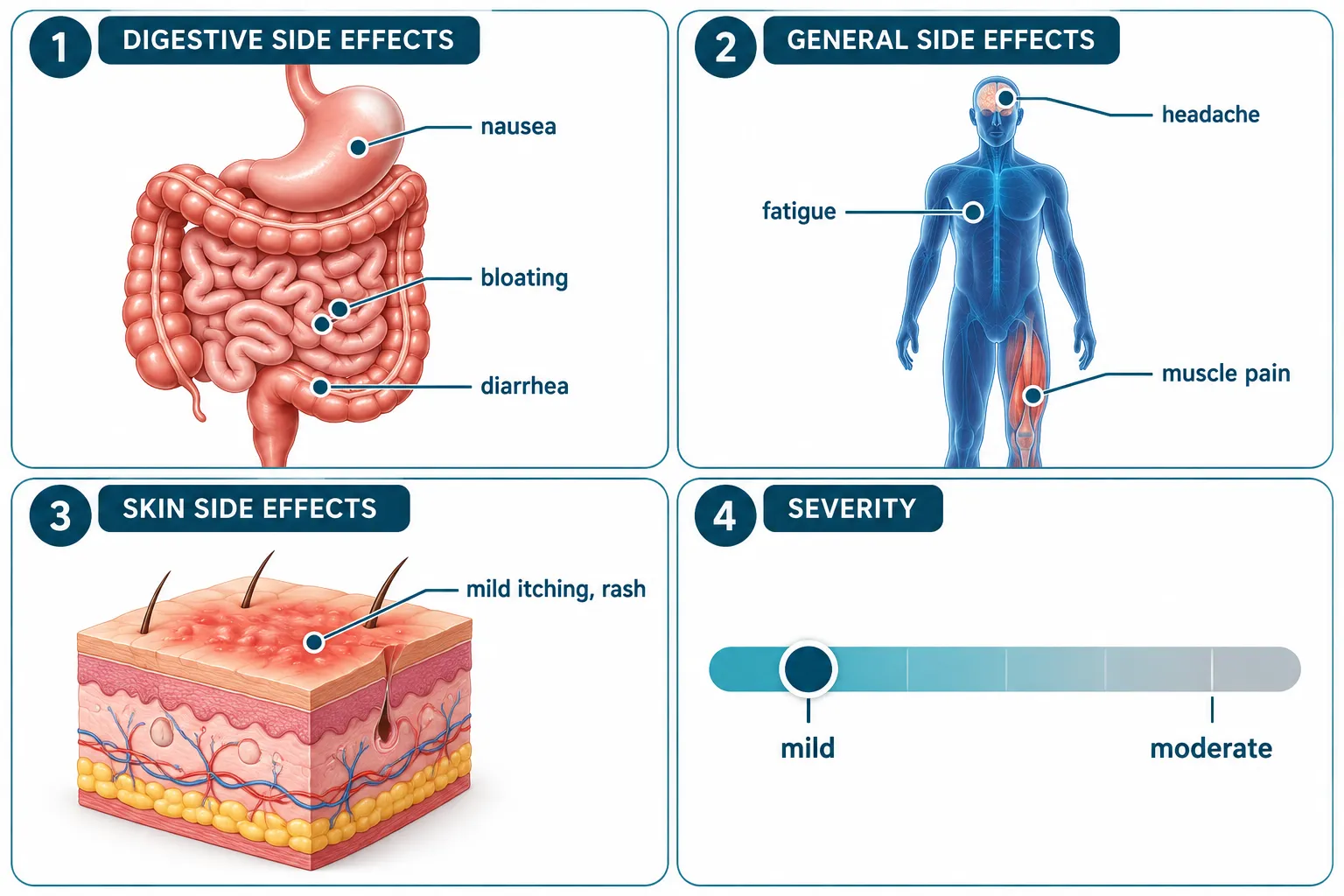
The most frequently reported side effects in AHCC clinical trials are gastrointestinal. In a Phase I safety study using a high dose of 9 g/day liquid AHCC in healthy adults, 20% of participants experienced at least one adverse effect. The list included nausea, diarrhea, bloating, headache, fatigue, and foot cramps. Seven percent of participants stopped taking AHCC because of nausea, but no clinically significant changes in laboratory values were found in any participant.
At lower doses, the picture is more favorable. Major clinical reference databases currently classify AHCC as “possibly safe” at oral doses of 4.5-6 g/day for up to six months, and at 3 g/day for up to nine years, with most reported side effects being mild gastrointestinal complaints and fatigue.
The side effects most consistently documented across multiple studies are:
- Nausea
- Diarrhea or loose stools
- Bloating and gas
- Fatigue
- Headache
- Mild itching (pruritus)
- Heartburn
In a study of early-stage prostate cancer patients taking 4.5 g/day for six months, itching and diarrhea were the most notable non-serious reactions. These resolved without requiring treatment changes. For a broader look at what AHCC is and how it works before evaluating its risks, the overview of what is actually in AHCC explains its active compounds in plain terms.
What Studies Show About AHCC Side Effects in Cancer Patients

Cancer patients represent a significant portion of the population studied in AHCC trials, and the findings here are nuanced.
In a randomized trial involving breast and gynecologic cancer patients, AHCC was associated with a meaningful reduction in chemotherapy-related nausea and vomiting compared to placebo, a notable finding. However, the same trial found a higher incidence of moderate to severe muscle pain in the AHCC group. One participant developed an allergic reaction with rash and dizziness that resolved completely with antihistamine treatment. No other serious AHCC-related adverse events were reported in that cohort.
A separate study in patients with unresectable pancreatic ductal adenocarcinoma receiving gemcitabine chemotherapy found that AHCC supplementation was linked to a lower rate of taste disorders (17% vs. 56% in controls) and better inflammatory and nutritional markers. No new serious toxicities attributable to AHCC were reported.
In a hepatocellular carcinoma study following 29 postoperative patients given AHCC after curative hepatectomy, no AHCC-related grade 3 or higher toxicity occurred. A single case of high fever was attributed to surgery, not the supplement.
Memorial Sloan Kettering Cancer Center’s integrative medicine database notes diarrhea and mild itching as notable side effects and specifically advises patients to inform their oncology team before using AHCC, due to potential interactions with cancer therapies. This matters because an ongoing National Cancer Institute-registered trial is actively monitoring for additive or unexpected adverse effects when AHCC is combined with chemoradiation, outcome data are not yet available, but the fact that investigators are specifically tracking grade 3 neutropenia and ototoxicity signals that the question is open, not settled.
If you are researching AHCC specifically in the context of cancer, the AHCC and cancer overview covers the current evidence in more detail.
Who’s at Higher Risk for AHCC Side Effects?
Most healthy adults tolerate AHCC without significant problems. But several groups face a less certain safety profile based on current evidence:
- Pregnant or nursing people: Safety data in this population is essentially absent. Current evidence summaries explicitly flag this as a gap, and use is not recommended without direct medical supervision.
- People with severe liver or kidney disease: AHCC is metabolized through pathways that may be affected by organ impairment. No dedicated safety data exists for this group.
- People with mushroom allergies: AHCC is derived from a hybrid of shiitake mushroom mycelium. Allergic reactions, though rare, have been documented, rash, dizziness, and difficulty breathing are the reported signals.
- People receiving chemotherapy, radiation, or immunotherapy: The interaction profile is incompletely characterized. Until the active clinical trials report results, medical supervision is the baseline requirement, not an optional precaution.
- Young children: Safety testing in pediatric populations is limited, and no standard dosing guidance exists.
Does AHCC Interact With Medications?
This is where the evidence thins out noticeably. AHCC is an immune-modulating supplement, which means it has the potential to amplify or interfere with therapies that also target immune function, including immunosuppressants used after organ transplantation and some cancer treatments.
No large-scale drug interaction studies have been published as of 2026. What exists are case reports, small trials, and expert cautions rather than definitive data.
The practical guidance from clinical databases is consistent: if you are taking any prescription medication, particularly immunosuppressants, chemotherapy agents, or anticoagulants, discuss AHCC with your prescribing physician before starting it. This is not a formality. The immune-modulating mechanism that makes AHCC interesting in HPV and cancer research is the same mechanism that could theoretically interfere with drugs designed to suppress immune activity.
For context on how AHCC is being studied specifically for HPV, the AHCC for HPV evidence review covers the clinical trial landscape in detail.
How Do AHCC Side Effects Compare Across Doses?
The dose matters. The data on this is reasonably consistent across studies:
| Dose Range | Duration Studied | Safety Classification | Common Side Effects |
|---|---|---|---|
| 3 g/day | Up to 9 years | Possibly safe | Mild GI complaints, fatigue |
| 4.5-6 g/day | Up to 6 months | Possibly safe | Itching, diarrhea, nausea |
| 9 g/day (liquid) | Short-term (Phase I) | 20% adverse effects; 7% discontinued | Nausea, diarrhea, bloating, headache, fatigue |
Higher doses produce more side effects. The 9 g/day liquid formulation used in the Phase I study is substantially higher than what most commercial products recommend. Standard oral capsule doses in most clinical trials fall in the 3-6 g/day range, where the side effect profile is considerably milder.
The AHCC benefits overview covers what the evidence supports at these doses, which is useful context when weighing potential side effects against potential benefit.
What AHCC Side Effects Studies Still Don’t Tell Us
The overall safety picture is reassuring for short-term use in healthy adults. But the gaps in the research are real and worth naming plainly.
The total number of rigorous, long-term clinical trials remains small. Most studies have enrolled fewer than 100 participants. High-quality safety data for AHCC used in combination with chemotherapy, radiation, or immunotherapy is limited, the active NCI-registered trial mentioned earlier is specifically designed to fill part of this gap, but results are pending.
Long-term safety beyond nine years has not been formally studied. Safety in young children, pregnant or nursing people, and those with severe organ disease has not been adequately tested. These are not theoretical concerns, they are documented gaps in the literature.
The Natural Standard systematic review of AHCC reaches the same conclusion: available trials consistently show a low incidence of serious adverse events, but the evidence base is not yet large enough to rule out rare or long-term harms with confidence.
If you are considering AHCC specifically for HPV-related reasons, the AHCC and HPV clinical evidence page covers what the trials have actually measured and what remains unproven. For women specifically, the AHCC benefits for women fact vs. hype review addresses the evidence in that context directly.
Frequently Asked Questions
Can AHCC cause an allergic reaction?
Yes, though it is rare. One documented case in a clinical trial involved rash and dizziness that resolved fully with antihistamine treatment. Because AHCC is derived from shiitake mushroom mycelium, anyone with a known mushroom allergy should avoid it. If you develop a rash, dizziness, or difficulty breathing after taking AHCC, stop immediately and seek medical evaluation.
Is AHCC safe to take every day long-term?
Clinical data supports daily use at 3 g/day for up to nine years without serious adverse events in healthy adults. At higher doses (4.5-6 g/day), the studied duration is up to six months. Beyond those parameters, the evidence is limited. Long-term daily use at higher doses has not been formally evaluated for safety.
Can AHCC be taken alongside chemotherapy?
This is an open question in 2026. Some small trials suggest AHCC may reduce certain chemotherapy side effects, but the interaction profile is not fully characterized. An active NCI-registered trial is specifically evaluating this. Tell your oncology team before combining AHCC with any cancer treatment, this is not optional.
Does AHCC affect liver function?
In the Phase I safety study at 9 g/day, no clinically significant laboratory abnormalities, including liver enzyme changes, were observed. However, people with pre-existing severe liver disease have not been adequately studied, and current evidence summaries flag this population as a gap. Talk to your doctor if you have any liver condition before using AHCC.
How quickly do AHCC side effects appear?
Most reported side effects, particularly nausea and gastrointestinal symptoms, appear within the first few days to weeks of starting AHCC, especially at higher doses. In the Phase I study, participants who discontinued due to nausea did so early in the trial period. If mild GI symptoms persist beyond two weeks, that warrants a conversation with your doctor.
Is AHCC safe during pregnancy?
There is no adequate safety data for AHCC use during pregnancy or while nursing. Current evidence summaries explicitly identify this as a gap. Use during pregnancy is not recommended without direct medical supervision.