
There is no clinical safety data confirming that AHCC is safe to take during pregnancy. That is not a reason to panic if you have already taken it, but it is a clear reason to stop and talk to your OB-GYN before continuing. The question “is AHCC safe during pregnancy?” does not yet have a reassuring answer from human research, and that gap matters.
Key Takeaways
- No human clinical trials have tested AHCC in pregnant people; all major trials systematically exclude pregnancy.
- Animal reproductive studies suggest no obvious harm, but animal data cannot replace human safety data.
- AHCC is an immune-modulating supplement, and immune modulation during pregnancy carries theoretical risks that have not been ruled out.
- Most pharmacists, supplement monographs, and drug-information databases flag pregnancy as a caution or avoidance category for AHCC.
- The practical guidance in 2026 remains consistent: discuss AHCC with your healthcare provider before taking it while pregnant or breastfeeding.
What Is AHCC and Why Are People Taking It During Pregnancy?
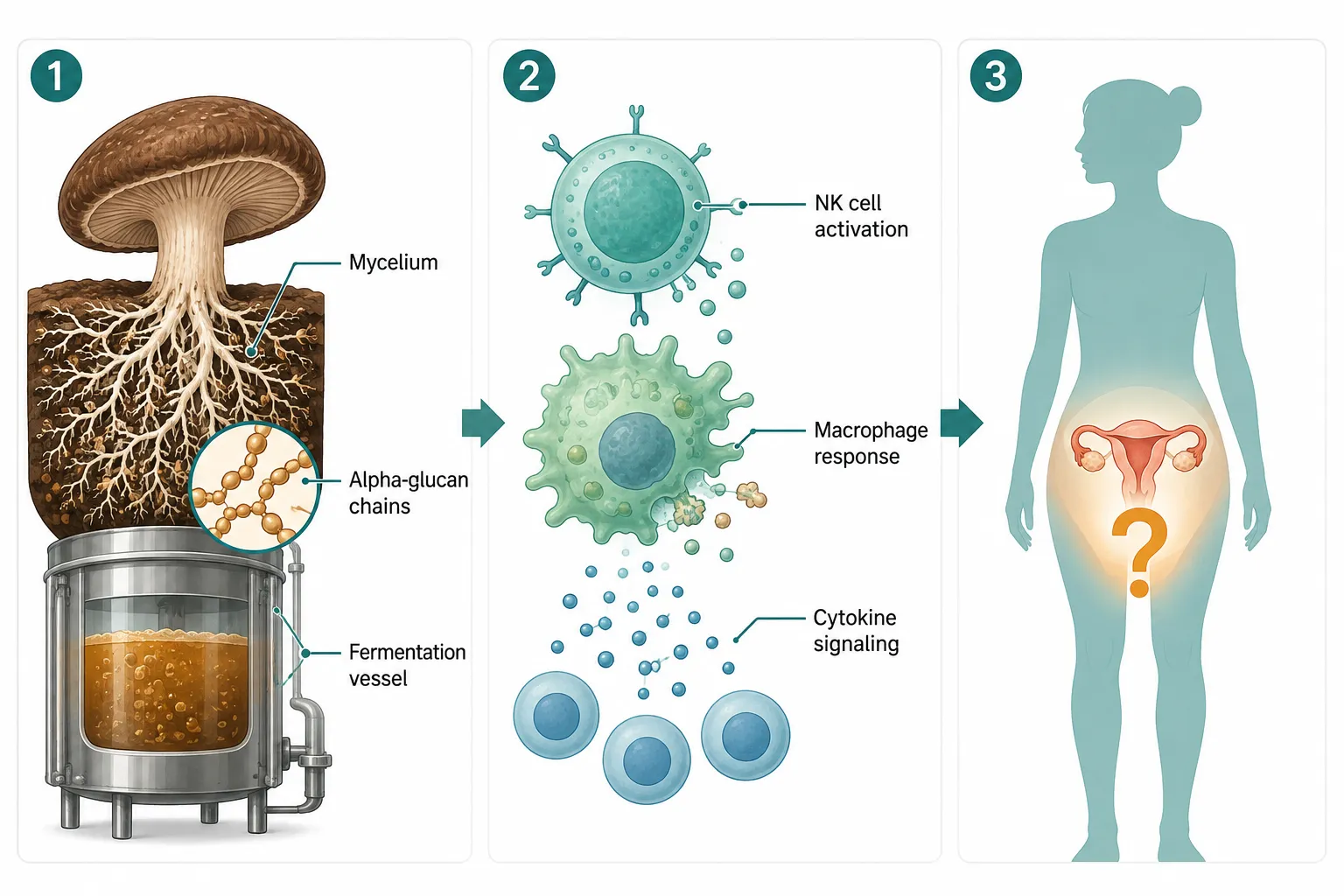
AHCC (Active Hexose Correlated Compound) is a standardized extract derived from the mycelium of shiitake mushrooms (Lentinula edodes). It is produced through a proprietary fermentation process that yields a mixture of alpha-glucans, polysaccharides, amino acids, and minerals. The AHCC mushroom extract overview explains the production process in more detail.
People take AHCC primarily for its proposed immune-supporting effects. In the context of HPV, some research has explored whether AHCC can help the immune system clear persistent infections, a topic covered in the AHCC and HPV evidence review. Because HPV is common in people of reproductive age, it is not surprising that some pregnant people ask whether they can continue taking AHCC after a positive HPV result or while trying to support their immune system during pregnancy.
The concern is understandable. Pregnancy can feel like a time when immune support matters most. But the reasoning that makes AHCC appealing outside of pregnancy is exactly what makes its use during pregnancy complicated.
Why the Safety Question Is Harder Than It Looks
AHCC is not a simple vitamin or mineral supplement. It acts as an immune modulator, meaning it does not just “boost” immunity in a general sense, but actively influences how specific immune pathways respond. It has been shown in laboratory and clinical settings to increase natural killer (NK) cell activity, stimulate macrophage function, and alter cytokine signaling.
That mechanism is relevant during pregnancy for a specific reason. Pregnancy requires a carefully regulated immune environment. The maternal immune system must tolerate the fetus, which is genetically distinct from the mother, while still defending against genuine infections. NK cells and cytokine balance are central to that regulation. Disrupting either, even with a well-intentioned supplement, is a theoretical risk that has not been studied in pregnant humans.
This is not a claim that AHCC causes harm during pregnancy. The honest answer is that no one knows, because the studies have not been done.
What the Animal Data Shows, and What It Doesn’t
Some preclinical animal studies have looked at reproductive outcomes with AHCC exposure. These studies have not shown obvious teratogenicity (birth defects) or embryotoxicity at standard doses in rodent models. That is modestly reassuring.
It is not enough to declare AHCC safe in human pregnancy. Rodent reproductive models do not reliably predict human outcomes for immune-modulating compounds. The doses used, the timing of exposure, and the immune physiology of rodents differ enough from humans that animal data functions as a starting point for investigation, not a conclusion.
The gap between “no obvious harm in mice” and “confirmed safe for human pregnancy” is where AHCC currently sits.
What Clinical Trials Tell Us, Which Is Almost Nothing
Every significant human clinical trial of AHCC, including the trials that have examined its effects on HPV clearance, has excluded pregnant and breastfeeding participants. This is standard practice for early-phase supplement and drug trials, but it has a consequence: after decades of research, there is still no direct human safety data for AHCC use during pregnancy.
Drug-information databases and supplement monographs that pharmacists and clinicians consult consistently categorize AHCC under pregnancy as “not studied” or “insufficient data to assess safety.” As of 2026, that classification has not changed. Recent drug-information updates continue to recommend avoidance during pregnancy, not because harm has been demonstrated, but because safety has not been established.
The AHCC benefits overview for women notes this limitation specifically in the context of female reproductive health.
Who Should Be Especially Cautious

The general caution applies to all pregnant people, but certain groups face a higher baseline complexity when considering AHCC:
- People with persistent high-risk HPV who were taking AHCC before pregnancy and are uncertain whether to continue, this decision needs direct input from an OB-GYN, not a supplement label.
- Immunocompromised pregnant people (such as those living with HIV or on immunosuppressive therapy) where adding an immune modulator without clinical oversight carries additional unpredictability.
- People in the first trimester, when organogenesis is occurring and the fetal immune environment is most sensitive to external influences.
- People who are breastfeeding, where transfer of AHCC compounds into breast milk has not been studied and infant exposure cannot be ruled out.
Is AHCC Safe During Pregnancy If Taken Before You Knew You Were Pregnant?
This is one of the most common real-world scenarios. Taking AHCC for a few days or weeks before realizing you were pregnant is unlikely to represent a significant exposure, based on what is known about its pharmacokinetics and the absence of teratogenicity signals in animal data.
That said, the appropriate step is to mention it to your OB-GYN at your next visit, not because alarm is warranted, but because your provider should have a complete picture of what supplements you have taken. Cell changes related to HPV and early pregnancy are both areas where your doctor will want accurate information. The HPV in women guide covers how HPV is monitored during pregnancy, which is relevant context if that is part of your situation.
What Experts and Guidelines Actually Recommend
No major health organization, not the WHO, ACOG, NIH, or CDC, has issued a specific recommendation for or against AHCC during pregnancy, because the compound has not been evaluated in that context at the institutional level. The guidance that exists comes from pharmacist-facing drug information databases and supplement monographs, which uniformly advise avoidance or consultation with a healthcare provider.
The practical consensus among clinicians who are familiar with AHCC is consistent: the absence of safety data, combined with the immune-modulating mechanism, is sufficient reason to avoid it during pregnancy unless a provider has reviewed the specific situation and determined otherwise.
This is not a permanent prohibition. It is a “we don’t know enough yet” position, and in pregnancy, that is a meaningful reason to wait.
Frequently Asked Questions
Can AHCC affect fetal development?
There is no evidence from human studies that AHCC causes fetal harm, but there is also no evidence that it does not. Animal studies have not shown teratogenic effects at standard doses. Until human pregnancy safety data exists, the risk cannot be quantified either way.
Is AHCC safe to take while breastfeeding?
The same data gap applies to breastfeeding. Whether AHCC compounds transfer into breast milk and at what levels has not been studied. Most clinical guidance treats breastfeeding with the same caution as pregnancy for this reason.
Should I stop AHCC immediately if I find out I am pregnant?
Yes, stopping is the reasonable step. Then mention it to your OB-GYN at your next appointment. There is no evidence that brief prior exposure causes harm, but continuing without medical review is not advisable given the lack of safety data.
Are there any immune-supporting supplements that are considered safe during pregnancy?
Some supplements, such as vitamin C, vitamin D, and zinc, have established safety profiles in pregnancy when taken at appropriate doses. These are not equivalent to AHCC in mechanism, but they are options your provider can discuss with you. Any supplement decision during pregnancy should go through your OB-GYN.
Does AHCC interact with prenatal vitamins?
No known interactions between AHCC and standard prenatal vitamins have been documented. However, the absence of documented interactions is partly because AHCC has not been studied in pregnant populations at all, so interaction data is simply absent, not confirmed safe.
If AHCC helps clear HPV, why not take it during pregnancy when HPV is a concern?
HPV management during pregnancy follows specific protocols that do not typically involve supplement intervention. Colposcopy timing, biopsy decisions, and treatment of any cervical dysplasia are adjusted based on gestational stage and the principle of deferring non-urgent procedures when possible. Adding an unstudied immune modulator to that picture introduces variables your provider cannot account for. The AHCC and cervical cancer overview addresses the HPV-cervical health connection in more depth.
The Practical Position for 2026
The answer to “is AHCC safe during pregnancy?” is not “no, it is dangerous.” It is “we do not have the data to say yes.” That distinction matters, but it leads to the same practical outcome: do not take AHCC during pregnancy without your OB-GYN’s explicit input.
If you were taking AHCC to support HPV clearance before becoming pregnant, that conversation with your provider is worth having specifically, they can review your cervical screening history, assess where you are in your HPV monitoring schedule, and help you understand what the evidence shows about AHCC’s effects on HPV so you can make an informed decision about resuming it after delivery or while breastfeeding.
The evidence on AHCC is still developing. Human pregnancy safety trials may eventually fill this gap. Until they do, the most defensible position is to pause, inform your provider, and make the decision with someone who knows your full clinical picture.