Nearly all cervical cancers, more than 99%, are caused by persistent infection with human papillomavirus. That single fact is the foundation of everything else on this page: understanding it means understanding why cervical cancer is largely preventable, and what screening and vaccination actually do.
This is the cervical cancer HPV infection explained in plain terms: the virus, the pathway from infection to cancer, who faces higher risk, and what current evidence says about interrupting that process at every stage.
Key Takeaways
- HPV types 16 and 18 together cause approximately 70% of all cervical cancers worldwide.
- Most HPV infections clear on their own within one to two years and never progress to cancer.
- Persistent high-risk HPV infection, not a single exposure, is what drives cervical cell changes.
- Regular screening catches abnormal cells (dysplasia) before they become cancer; that is exactly what it is designed to do.
- Vaccination before HPV exposure dramatically reduces the risk of the types most linked to cervical cancer.
How Does HPV Actually Cause Cervical Cancer?
HPV is a family of more than 200 related viruses. Most types cause no lasting harm. A smaller group, classified as high-risk genotypes, can, under specific circumstances, trigger the cell changes that lead to cervical cancer.
The high-risk types most closely linked to cervical cancer are HPV 16 and HPV 18. Type 16 alone accounts for roughly 50% of cervical cancer cases globally. Types 31, 33, 45, 52, and 58 account for most of the remaining cases.
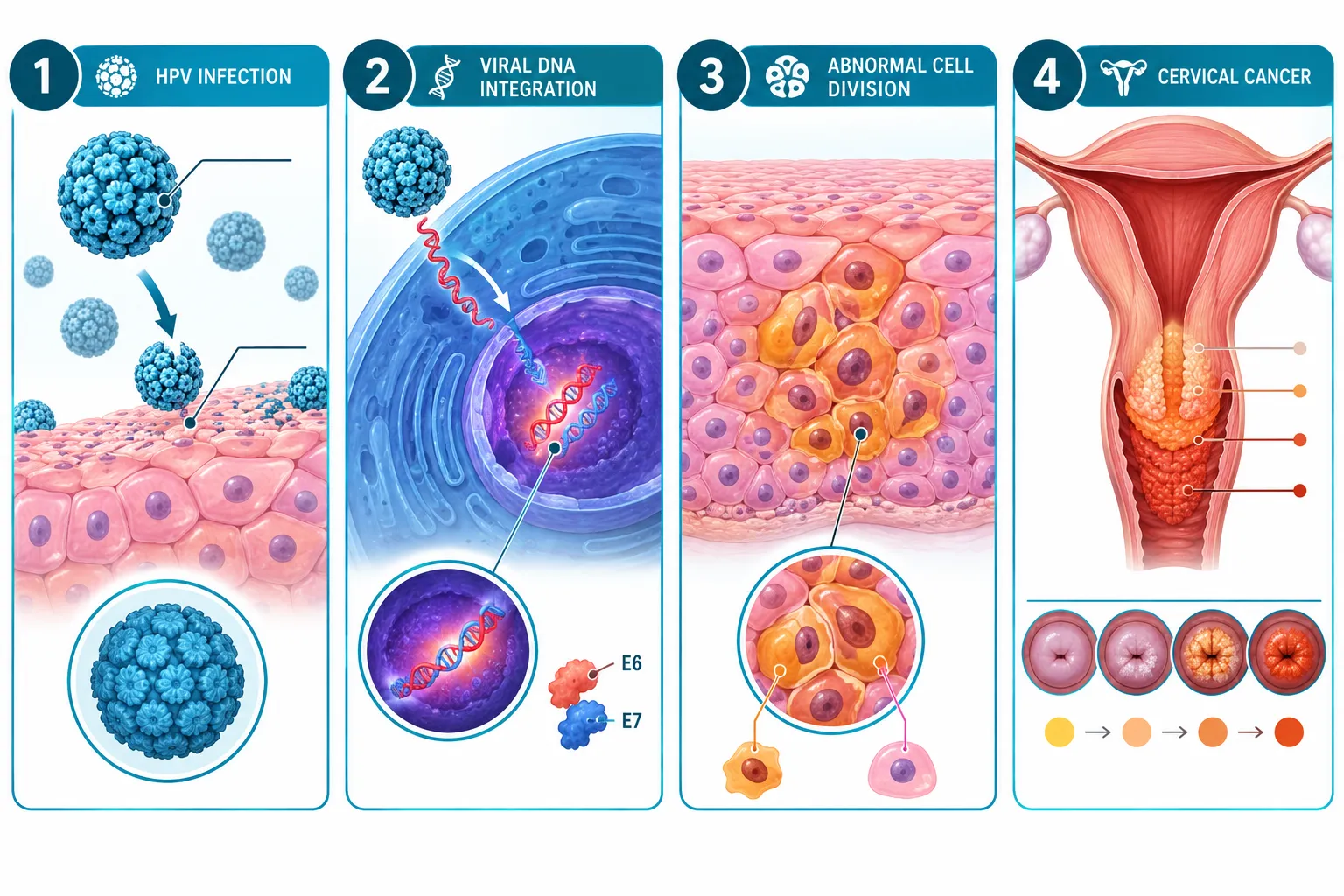
The mechanism works like this. When a high-risk HPV type infects the transformation zone of the cervix, the area where two types of cells meet, the virus can insert its genetic material into the host cell’s DNA. Two viral proteins, E6 and E7, then interfere with the cell’s normal tumor-suppressor functions. This disruption allows abnormal cells to grow and divide unchecked. Over time, without immune clearance or clinical intervention, those abnormal cells can progress through stages of cervical intraepithelial neoplasia (CIN 1, CIN 2, CIN 3) toward invasive cancer.
That progression is slow. It typically takes 10 to 15 years from initial infection to invasive cervical cancer. That window is the entire basis of screening.
For a broader look at which cancers HPV is linked to beyond the cervix, the HPV and cancer overview on HPVGuide.org covers the full picture.
Does Every HPV Infection Lead to Cervical Cancer?
No. The vast majority of HPV infections, including infections with high-risk types, clear on their own within one to two years. The immune system recognizes and eliminates the virus in most cases, leaving no lasting cell damage.
What matters clinically is persistence. When a high-risk HPV infection does not clear, and the virus continues to replicate in cervical cells over months and years, the risk of developing abnormal cell changes rises significantly. Even then, not every persistent infection progresses. CIN 1 (mild dysplasia) regresses spontaneously in more than half of cases. CIN 2 regresses in roughly 40% of cases without treatment.
The concern is CIN 3, high-grade dysplasia, and the subset of persistent infections that reach it. That is the stage where active treatment is most clearly indicated, and where the 10-to-15-year window becomes clinically important.
To understand how this compares across different HPV types, the HPV types guide explaining low-risk and high-risk genotypes breaks down what the numbers actually mean.
What Are the Symptoms of HPV-Related Cervical Changes?
Early cervical cell changes caused by HPV typically produce no symptoms at all. That is not a reassuring statement meant to minimize the issue, it is the medical reason why screening exists. By the time symptoms appear, cancer may already be at an advanced stage.
Symptoms that can indicate more advanced cervical disease include:
- Unusual vaginal bleeding, between periods, after sex, or after menopause
- Pelvic pain not related to menstruation
- Watery or blood-tinged vaginal discharge with an unusual odor
- Pain during sex
None of these symptoms confirm cervical cancer on their own, and all have other common causes. But any of these warrant a prompt conversation with a clinician, not a wait-and-see approach.
For a comprehensive look at how HPV presents in women across different stages, the HPV in women guide covering symptoms, screening, and cervical risk covers what to expect at each step.
Who’s at Higher Risk for HPV-Related Cervical Cancer?
Cervical cancer risk is not evenly distributed. These groups face meaningfully higher risk:
- People who are immunocompromised, including those living with HIV and organ transplant recipients, are less able to clear persistent HPV infections, and their cell changes can progress faster than in immunocompetent individuals.
- Smokers, tobacco use impairs local immune function in cervical tissue and is independently associated with higher rates of high-grade dysplasia and cervical cancer.
- People who have never been screened or have had long gaps in screening, the 10-to-15-year progression window means missed screening cycles can allow CIN 3 to develop undetected.
- Unvaccinated people in age groups where vaccination was available, those who missed the HPV vaccine are exposed to the full risk from types 16 and 18 that vaccinated cohorts are largely protected against.
How Is Cervical Cancer Screened and Diagnosed?
Screening is the single most effective tool for preventing cervical cancer deaths. It works by catching abnormal cells, not cancer, before they progress.

The standard screening tools are:
- HPV test, detects the presence of high-risk HPV DNA in cervical cells. This is now the primary recommended screening method in most high-income countries, including updated EU guidance from 2026 that positions HPV testing as the first-line tool.
- Pap smear (cytology), examines cells for abnormal changes. Still used alongside HPV testing in co-testing protocols, and as a follow-up triage tool after a positive HPV result.
- Colposcopy, a closer examination of the cervix using magnification, performed when screening results are abnormal (ASC-US, LSIL, HSIL). A biopsy is taken during colposcopy to confirm the grade of any cell changes.
Screening intervals are shifting. In populations with high vaccination coverage, expert bodies in 2026 are actively debating extending HPV screening intervals, for example, moving from three-year to five-year cycles for vaccinated cohorts, because the baseline risk in those groups is substantially lower. This de-intensification debate is ongoing; current recommendations vary by country and individual risk profile.
One meaningful development in 2026 is the expansion of HPV self-sampling. In the UK and several other countries, home-testing kits that allow people to collect their own cervical sample are moving into routine practice. The evidence shows self-sampling has comparable accuracy to clinician-collected samples for HPV detection, and it substantially improves uptake among people who avoid clinic-based screening.
A question that comes up often: can you get cervical cancer without having HPV? The answer is yes, but it is rare, the evidence on cervical cancer without HPV infection explains the small subset of cases where HPV is not detected.
How Does Vaccination Interrupt the HPV-to-Cancer Pathway?
Vaccination works by preventing the initial HPV infection, specifically, the high-risk types that drive most cervical cancers. It does not treat an existing infection, but it blocks the starting point of the entire progression described above.
Current HPV vaccines cover at minimum types 16 and 18. The 9-valent vaccine (Gardasil 9) also covers types 31, 33, 45, 52, and 58, extending protection to the types responsible for an additional 15-20% of cervical cancers.
The population-level evidence is now substantial. Data from England published in 2026 showed record-low cervical cancer mortality in cohorts who received the HPV vaccine as adolescents, a direct, measurable outcome of the vaccination program introduced in 2008. The WHO’s cervical cancer elimination strategy targets 90% vaccination coverage in girls by age 15 as one of its three core pillars.
Vaccination is most effective before sexual debut, when exposure to HPV has not yet occurred. In the U.S., the standard schedule recommends two doses for those vaccinated before age 15, and three doses for those starting at 15 or older. Catch-up vaccination is recommended through age 26, and shared clinical decision-making applies for ages 27-45.
The HPV vaccine is not recommended during pregnancy. If you are pregnant and unvaccinated, vaccination should wait until after delivery.
Cervical Cancer HPV Infection Explained: Where Treatment Fits In
When screening identifies CIN 2 or CIN 3, treatment removes or destroys the abnormal tissue before it can progress to invasive cancer. The most common procedures are LEEP (loop electrosurgical excision procedure) and cold knife conization, both of which excise the affected area of the transformation zone.
For invasive cervical cancer, treatment depends on the stage at diagnosis. Early-stage disease (Stage I, IIA) is typically treated with surgery, radiation, or a combination. Later-stage disease involves concurrent chemoradiation. Staging now incorporates imaging and, in updated 2025 clinical guidelines, reflects a more nuanced understanding of HPV’s role in tumor biology.
Some people ask about complementary approaches alongside conventional treatment. The AHCC and cervical cancer overview covers what the current evidence does and does not support for that specific supplement.
The Global Picture: How Close Is Elimination?
The WHO set a target of fewer than 4 cases of cervical cancer per 100,000 women per year as the threshold for elimination. Several high-income countries with strong vaccination and screening programs are approaching that threshold. Australia is projected to reach it within this decade.
The gap between high- and low-income countries remains large. More than 85% of cervical cancer deaths occur in low- and middle-income countries where screening access and vaccination coverage are limited. Closing that gap, through HPV self-sampling, single-visit screen-and-treat approaches, and expanded vaccine access, is the central challenge of the elimination agenda.
The pathway from HPV infection to cervical cancer is well understood. The tools to interrupt it at every stage exist. The work now is making sure those tools reach everyone who needs them.
Frequently Asked Questions
If I tested positive for high-risk HPV, does that mean I’ll get cervical cancer?
No. A positive high-risk HPV result means the virus is present, it does not mean cancer is present or that it will develop. Most high-risk HPV infections clear within one to two years. What your clinician will do next is monitor your cervical cells through follow-up testing or colposcopy to check whether any cell changes are occurring.
How long does it take for HPV to cause cervical cancer?
The typical progression from initial HPV infection to invasive cervical cancer takes 10 to 15 years, and most infections never reach that point. That long timeline is why regular screening is effective, it creates multiple opportunities to detect and treat cell changes well before cancer develops.
Can HPV come back after it has cleared?
Once the immune system clears an HPV infection, it typically develops some immunity to that specific type. However, HPV is not a single virus, there are multiple high-risk types, and clearing one does not protect against others. A new positive result years later may reflect a different type, or in some cases, a latent infection that was below detectable levels.
Does the HPV vaccine help if I already have HPV?
The vaccine does not treat an existing infection or reverse cell changes that have already occurred. It does protect against the HPV types it covers that you have not yet been exposed to. Vaccination is still worth discussing with your doctor even if you have had a prior HPV diagnosis, because you may not have been exposed to all the types the vaccine covers.
What is the difference between a Pap smear result and an HPV test result?
A Pap smear looks at the cells themselves, it reports whether they appear normal or show changes (ASC-US, LSIL, HSIL). An HPV test looks for the virus’s genetic material, regardless of whether cell changes are visible yet. The two tests answer different questions, which is why co-testing (both together) or HPV-primary testing with cytology triage is used in most current screening protocols.