HPV can be found in saliva, that part is documented. What matters more is what that actually means for your risk, because finding viral DNA in a fluid is not the same as proving that fluid is an efficient transmission route. The evidence in 2026 is clear: saliva is not a primary way HPV spreads, but it is not a zero-risk route either, and the details matter.
Key Takeaways
- HPV spreads primarily through direct skin-to-skin sexual contact, not through saliva or shared utensils.
- HPV DNA has been detected in saliva, particularly in people with both oral and genital infections, but its presence does not make saliva an efficient transmission vehicle.
- Deep, open-mouth kissing carries a small, real risk when one partner has an active oral HPV infection, casual kissing and sharing drinks do not.
- Oral sex is the main driver of oral HPV infection, not kissing or everyday saliva contact.
- HPV vaccination reduces the risk of the high-risk types most associated with oral and oropharyngeal cancers, including HPV-16.
How HPV Actually Spreads, and Where Saliva Fits In
HPV is a skin-contact virus. It passes from one person to another through direct contact with infected epithelial tissue, the kind of tissue that lines the genitals, anus, mouth, and throat. That is why genital-to-genital contact and oral-genital sex are the dominant transmission routes. Saliva, by contrast, is not the vehicle the virus relies on.
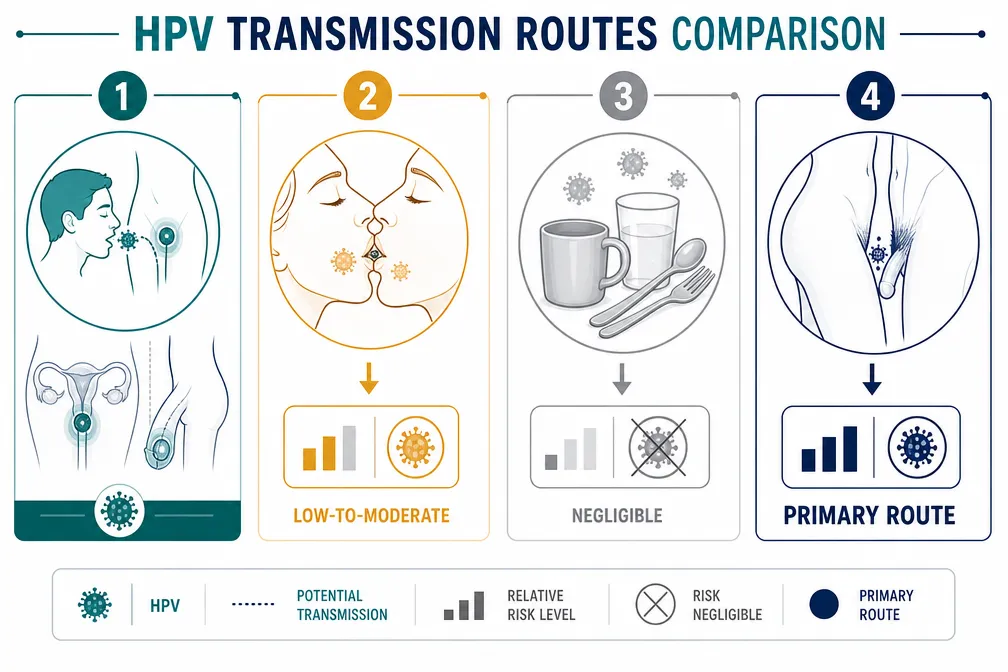
To understand how HPV spreads across different types of contact, it helps to separate what the virus needs to establish infection from what simply carries detectable viral DNA. Studies have found HPV DNA in the saliva of roughly one in five women with a history of oral sex, with high-risk types, especially HPV-16, appearing more often in those who also had a genital infection. That is a meaningful finding. It tells us the virus can be present in the oral cavity and can shed into saliva. It does not tell us that swallowing or exchanging saliva reliably transmits the infection.
Think of it this way: a virus can be present in a fluid without that fluid being the route that matters clinically.
Can HPV be Transferred Through Saliva During Kissing?
This is the question most people are actually asking, and the honest answer is: possibly, in specific circumstances, but the risk is low and not the main concern.
Several epidemiological studies have found an association between open-mouth (French) kissing and oral HPV infection. One widely cited study linked both oral sex and open-mouthed kissing to increased odds of oral HPV, with oral sex carrying a substantially higher risk. A 2019 clinical review concluded that open-mouth kissing is associated with oral HPV transmission based on available evidence, but also explicitly stated that clinicians should not advise people to avoid open-mouth kissing beyond standard safer-sex guidance. That framing matters: the risk exists, but it is not large enough to change everyday behavior.
The biological mechanism that makes kissing a plausible route is specific: HPV would need to be actively shedding in the oral cavity of one partner, and there would need to be a mucosal entry point, a small cut, sore, or area of irritated tissue, in the other. Intact, healthy oral mucosa is a reasonable barrier. Casual kissing with a closed mouth carries no meaningful documented risk.
Sharing utensils, drinking from the same glass, or being sneezed on does not transmit HPV. The virus does not survive well on surfaces and does not spread through respiratory droplets the way influenza does.
Oral Sex Is the Real Risk Factor for Oral HPV
If you are thinking about HPV and the mouth, oral sex is where the evidence consistently points. Oral HPV infection, particularly with HPV-16, the type most strongly linked to oropharyngeal cancer, is epidemiologically tied to oral sexual behavior, especially with multiple partners over time.
This matters because the connection between HPV and certain cancers is real and worth understanding clearly. HPV-16 and HPV-18 are classified as high-risk genotypes. Most oral HPV infections, like most genital infections, clear on their own within one to two years. A small proportion persist, and persistent high-risk infection in the oropharynx is what drives the rising rates of HPV-associated throat cancer seen over recent decades.
The takeaway is not alarm, it is proportion. Oral sex carries a meaningful risk of oral HPV transmission. Kissing carries a small risk under specific conditions. Sharing a coffee cup carries no documented risk worth acting on.
Who Is at Higher Risk for Oral HPV Infection?
Some people are more likely to acquire or retain an oral HPV infection than others:
- People with multiple oral sex partners, the number of lifetime oral sex partners is the strongest independent predictor of oral HPV infection in epidemiological studies.
- Immunocompromised individuals, people living with HIV, organ transplant recipients on immunosuppressive therapy, or anyone with a weakened immune response are less able to clear HPV naturally, making persistent infection more likely.
- Unvaccinated adults, particularly those who were not vaccinated before their first sexual exposure, since the HPV vaccine does not clear an existing infection but does protect against the types not yet encountered.
- Smokers, tobacco use is associated with impaired mucosal immunity and higher rates of persistent oral HPV infection.
What About HPV in Saliva in Non-Sexual Contexts?
There is one specific non-sexual context where saliva-based HPV transmission is documented: mother-to-infant transmission. Research on oral HPV in infants shows that most early infections are acquired either during delivery or later through close contact, including mouth-to-mouth contact, with a parent or caregiver who has an oral infection. This is a biologically distinct situation from adult-to-adult casual contact, involving prolonged close mucosal exposure in a newborn with an immature immune system.
For adults in non-sexual everyday contact, family members, coworkers, friends, saliva-based HPV transmission is not a documented concern. You do not need to avoid sharing food with a family member because of HPV.
Recurrent respiratory papillomatosis (RRP), a rare condition caused by low-risk HPV types 6 and 11, can in some cases be transmitted through kissing in adults. This is uncommon, and it involves the same principle: active mucosal infection, close contact, and a point of entry.
Does HPV Vaccination Reduce Oral HPV Risk?
Yes. The HPV vaccine protects against the genotypes it covers regardless of the route of exposure, genital, oral, or otherwise. Since HPV-16 is responsible for the majority of HPV-associated oropharyngeal cancers, vaccination against HPV-16 is directly relevant to oral HPV risk.
The HPV vaccine guide covers the full schedule and age recommendations in detail. For men specifically, the evidence on HPV vaccination and existing infection is worth reading if you are deciding whether to vaccinate after a diagnosis.
The vaccine does not treat an existing infection. What it does is prevent new infections with the types it targets, which is meaningful if you have been exposed to one HPV type but not yet to others.
Can HPV be Transferred Through Saliva, Practical Guidance
The evidence supports a few clear conclusions:
- Casual saliva contact (kissing with a closed mouth, sharing drinks, utensils) is not a meaningful HPV transmission route.
- Deep kissing carries a small risk when one partner has active oral HPV shedding, but this risk is low enough that clinical guidelines do not recommend avoiding it.
- Oral sex is the primary driver of oral HPV infection and the behavior most worth discussing with a healthcare provider in the context of HPV risk.
- Using a dental dam or condom for oral sex reduces transmission risk, though it does not eliminate it entirely.
If you have been diagnosed with HPV, genital or oral, that does not mean you need to stop kissing a partner. It means understanding your HPV type and having an informed conversation with your doctor about what monitoring or follow-up is appropriate for your situation.

For a broader picture of what HPV symptoms look like and when to seek evaluation, the HPV symptoms resource covers the range of presentations across different body sites. And if you are thinking about testing, HPV testing, how it works and what results mean explains what is actually measured and what a positive result does and does not tell you.
Frequently Asked Questions
Can you get HPV from sharing a drink or utensils?
No documented evidence supports HPV transmission through shared utensils, cups, or food. HPV does not survive well on surfaces and does not spread through the kind of brief, indirect contact involved in sharing a drink. This is not a route you need to take precautions against.
If my partner has oral HPV, should I stop kissing them?
Clinical guidelines do not recommend stopping kissing based on an HPV diagnosis. The risk from open-mouth kissing is real but small, and it is not large enough to change everyday behavior. Oral sex carries a substantially higher transmission risk and is the more relevant conversation to have with your doctor.
Can HPV in the mouth cause cancer, and how common is that?
Most oral HPV infections, including high-risk types like HPV-16, clear on their own within one to two years. A small proportion persist, and persistent high-risk infection in the throat is linked to oropharyngeal cancer. This cancer is rising in incidence, but the absolute risk for any individual with an oral HPV infection remains low. Vaccination against HPV-16 and HPV-18 is the most effective prevention tool available.
Is oral HPV tested the same way as genital HPV?
No. There is currently no FDA-approved screening test for oral HPV. Genital HPV testing, such as the Aptima HPV test, is used in the context of cervical screening and is not applied to the oral cavity. If you have concerns about oral HPV, a clinician can examine the mouth and throat and refer for further evaluation if anything appears abnormal.
Can a person spread HPV to a partner through oral sex if they have a genital infection?
Yes, this is documented. People with genital HPV infections can transmit the virus to a partner’s oral cavity through oral sex, and vice versa. Studies have found that high-risk HPV types are significantly more common in the saliva of people who have both oral and genital infections, suggesting cross-site transmission does occur. This is one reason that understanding how HPV spreads between partners is useful regardless of which site is infected.