AHCC mushroom extract is a standardized compound derived from the hybridized mycelium of shiitake mushrooms (Lentinula edodes), developed in Japan in the late 1980s and studied primarily for its effects on immune function. It is not a drug, and it is not approved by the FDA to treat any condition. What it is, and what the research actually shows, is worth understanding carefully, especially if you’ve come across it while researching HPV or cancer support.
Key Takeaways
- AHCC stands for Active Hexose Correlated Compound, a proprietary extract made from shiitake mushroom mycelium through a lengthy fermentation process.
- Its main active components are short-chain alpha-glucans, which differ structurally from the beta-glucans found in most other mushroom supplements.
- The most studied human application is HPV clearance, where a small but rigorous trial showed statistically significant results, though larger trials are still underway.
- AHCC has a well-documented safety profile in human studies, with mild gastrointestinal side effects reported at higher doses.
- It is a supplement, not a treatment. Any use alongside medical care should be discussed with a clinician first.
What Is the AHCC Mushroom Extract, Exactly?
AHCC stands for Active Hexose Correlated Compound. The name sounds technical, but the origin is straightforward: it is produced by culturing the mycelium, the root-like network, of shiitake mushrooms in a liquid medium, then fermenting that culture for an extended period, typically around 45 to 60 days. The fermentation process breaks down the cell walls and converts long-chain polysaccharides into shorter, more bioavailable forms.
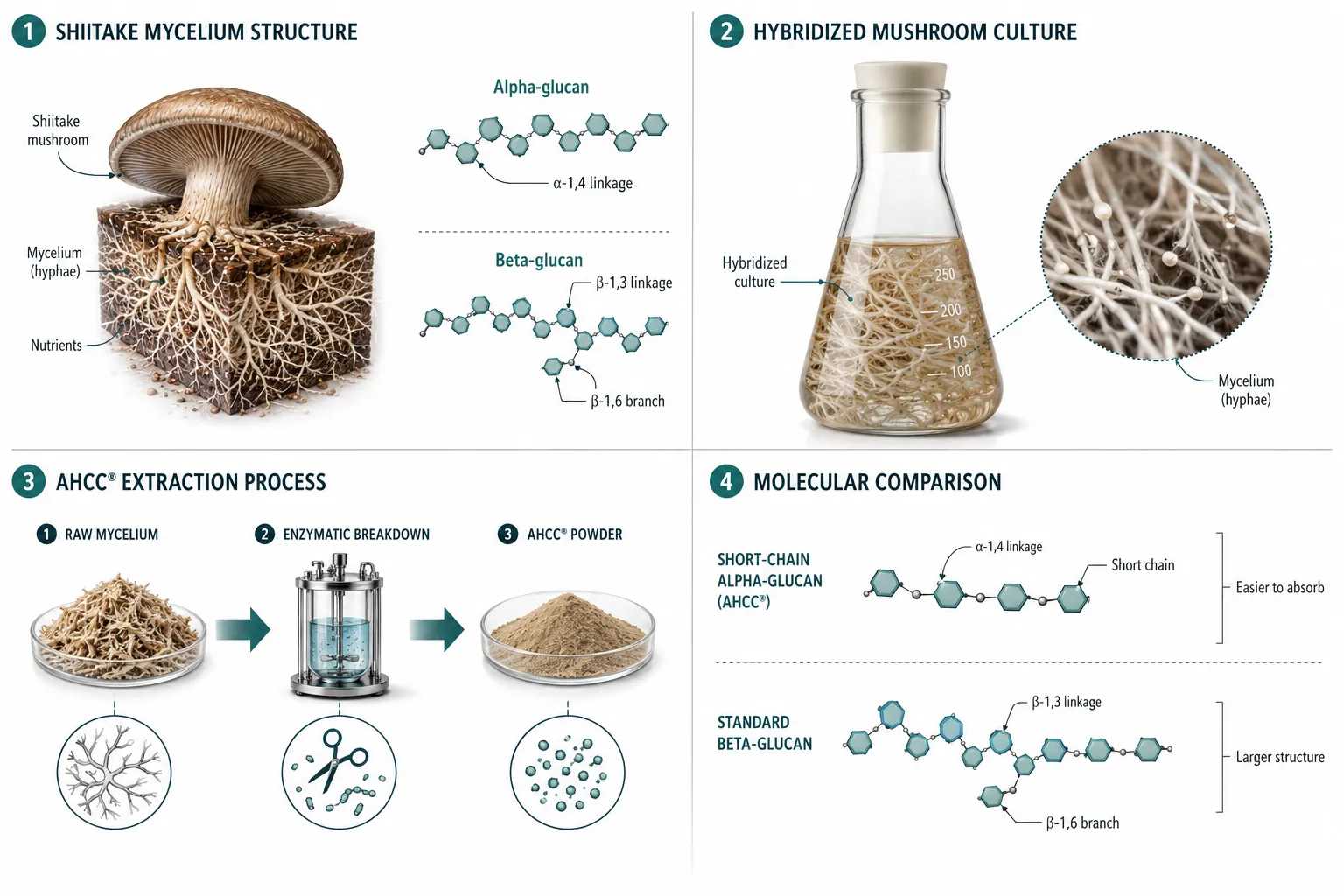
The result is a compound whose primary active constituents are short-chain alpha-1,4-glucans, with a molecular weight of roughly 5,000 daltons. This is a key structural distinction. Most mushroom supplements, reishi, turkey tail, lion’s mane, are standardized for beta-glucans. AHCC’s alpha-glucan profile is different, and researchers believe this difference accounts for its particular interaction with immune receptors, specifically pattern recognition receptors on dendritic cells and natural killer (NK) cells.
AHCC is a proprietary product, manufactured by Amino Up Co., Ltd. in Japan and sold under that brand name or in licensed supplement products. It is not a generic “mushroom extract.” The specific fermentation protocol and the resulting molecular profile are what define it. This matters when evaluating research: studies conducted on AHCC used this specific compound, not shiitake powder or other mushroom products.
For a broader overview of AHCC research and what it may or may not do, the AHCC, What to Know guide covers the wider evidence landscape.
How AHCC Affects the Immune System
The immune effects of AHCC have been studied in both healthy adults and people with compromised immunity. The consistent finding across human trials is an increase in NK cell activity, the immune cells responsible for identifying and destroying virus-infected cells and some tumor cells, along with increases in dendritic cell function and cytokine signaling.
In healthy adults given 3 grams of AHCC daily, studies have documented increased NK cell cytotoxicity within four weeks. In people undergoing chemotherapy, AHCC has been studied as a supportive agent to reduce immune suppression, with some trials showing maintained white blood cell counts compared to placebo groups.
The mechanism is not fully mapped. Current evidence points to AHCC binding toll-like receptors (TLRs) on immune cells, triggering an upregulation of innate immune activity. Emerging research also suggests a gut-liver axis effect: AHCC appears to alter gut microbiome composition in ways that may reduce liver inflammation, which has implications for nonalcoholic fatty liver disease (NAFLD) models and liver cancer recurrence prevention.
What this does not mean is that AHCC “boosts” immunity in a generalized, unqualified way. Immune modulation is more precise than that phrase implies. The effect appears to be most relevant when immune function is suppressed or when a specific pathogen, like a persistent virus, needs a more active innate response to clear.
The AHCC benefits overview goes into more detail on these immune pathways and what the human data actually shows.
What Is the AHCC Mushroom Extract Used For in HPV Research?
This is where the evidence gets most specific, and most relevant if you’ve arrived here after an HPV diagnosis.
The most cited human trial on AHCC and HPV was led by Dr. Judith Smith at the University of Texas Health Science Center. In that randomized, double-blind, placebo-controlled trial, women with confirmed persistent high-risk HPV infections received 3 grams of AHCC daily for up to six months. The AHCC group showed a statistically significant rate of HPV clearance compared to placebo, with some participants clearing the infection entirely, confirmed by negative HPV DNA testing.
Persistent high-risk HPV, particularly types 16 and 18, is the primary driver of cervical dysplasia and cervical cancer. Most HPV infections clear on their own within one to two years, but persistent infections are the ones that require monitoring. The question the AHCC trial was trying to answer is whether immune support could help clear infections that weren’t resolving naturally.
The results were promising. They were not conclusive at scale. A larger Phase II trial is currently underway, and separately, the National Cancer Institute has sponsored a Phase II trial examining AHCC in HPV-positive head and neck cancer patients, a population where high-risk HPV, particularly type 16, drives oropharyngeal cancers.
If you’ve had an abnormal Pap result and are researching AHCC as a potential support option, the AHCC for HPV evidence guide explains what the trial data shows and where the gaps remain. And the abnormal Pap smear guide explains what ASC-US, LSIL, and HSIL results actually mean for your follow-up care.
Who May Be Most Interested in AHCC
AHCC research has focused on several specific groups. These are not the only people who ask about it, but they represent the populations where the evidence is most directly applicable.
- People with persistent high-risk HPV infections, particularly those whose infections haven’t cleared after 12 to 24 months of monitoring, and who want to support immune clearance alongside standard screening.
- Immunocompromised individuals, including people living with HIV, organ transplant recipients on immunosuppressive therapy, and those undergoing chemotherapy, where maintaining NK cell function is a documented concern.
- People with a history of abnormal Pap results, especially those with LSIL or HSIL findings linked to persistent HPV, who are in active surveillance and looking for adjunctive options.
- Women in perimenopause or post-menopause, immune function shifts with hormonal changes, and some research has looked at AHCC’s effects in this group specifically. The AHCC benefits for women guide covers this angle in more detail.
Dosing, Safety, and What to Know Before Taking It
Human studies have used doses ranging from 1 gram to 6 grams daily, with 3 grams per day being the most common dose in HPV-related trials. AHCC is typically taken on an empty stomach, as food appears to reduce absorption.
The safety profile across published human trials is favorable. The most commonly reported side effects are mild gastrointestinal symptoms, nausea, loose stools, and bloating, at higher doses. No serious adverse events have been attributed to AHCC in published clinical trials to date.
Two important caveats apply. First, AHCC is a supplement, not a drug, and is not regulated for efficacy by the FDA. Quality can vary between products that claim to contain AHCC. Second, because AHCC modulates immune activity, anyone on immunosuppressive medications, including transplant recipients or people with autoimmune conditions, should discuss it with their doctor before starting. Stimulating NK cell activity in someone whose immune response is intentionally suppressed carries real clinical considerations.
AHCC has also been studied in the context of liver cancer (hepatocellular carcinoma, or HCC) recurrence prevention after surgical resection. Japanese trials showed a reduction in recurrence rates in patients taking AHCC post-surgery compared to controls. This is a separate line of evidence from the HPV data, and the AHCC and cancer research overview covers it in depth.
For HPV-specific context, including what types like 16 and 18 actually do and how high-risk HPV is classified, the HPV types guide explains the distinction between low-risk and high-risk strains clearly.
Frequently Asked Questions
Is AHCC the same as a regular shiitake mushroom supplement?
No. AHCC is made specifically from shiitake mycelium using a proprietary fermentation process that produces short-chain alpha-glucans. Standard shiitake supplements are standardized for beta-glucans and have a different molecular structure. The research on AHCC does not apply to other mushroom products.
Can AHCC replace standard HPV monitoring or treatment?
No. AHCC is studied as a supportive agent alongside standard care, not as a replacement for it. If you have a persistent high-risk HPV infection or abnormal cervical cells, regular screening, Pap smears, HPV co-testing, colposcopy if indicated, remains the standard of care. Cell changes are easiest to manage before they progress, and that is what monitoring is for.
How long does it take to see an effect from AHCC in HPV trials?
In the University of Texas trial, clearance was assessed at three and six months. Some participants showed clearance at the three-month mark; others required the full six months. There is no guaranteed timeline, and response varies based on immune status, viral load, and HPV type.
Does AHCC interact with any medications?
No significant drug interactions have been identified in published trials, but AHCC’s immune-modulating effects mean it warrants caution in people taking immunosuppressants. Talk to your doctor if you are on cyclosporine, tacrolimus, corticosteroids, or any biologic therapy before adding AHCC.
Is AHCC relevant for men with HPV?
AHCC’s immune mechanism is not sex-specific. The published HPV trials have focused on women with cervical HPV, but the underlying immune response being targeted, NK cell activity, innate immune clearance, applies to HPV infection regardless of anatomical site. Formal trials in men are limited. The HPV in men guide covers what HPV looks like and means for men specifically.
Where does AHCC research go from here?
The most important near-term data will come from the ongoing Phase II trials, the larger HPV clearance trial and the NCI-sponsored trial in HPV-positive head and neck cancer patients. Results from those studies will either strengthen the case for AHCC as an adjunctive immune support tool or reveal that the earlier results don’t hold at scale. That data is expected within the next few years.