
AHCC doesn’t cure HPV. That’s the honest starting point. What the evidence actually shows is more nuanced, a small but growing body of clinical research suggesting that AHCC, a mushroom-derived supplement, may support immune clearance of high-risk HPV in some people, with the most credible data coming from a Phase II randomized controlled trial. Understanding what that means, and what it doesn’t, matters before you make any decisions.
Key Takeaways
- AHCC is an alpha-glucan compound derived from shiitake mushroom mycelia, studied specifically for its effect on HPV clearance.
- A Phase II randomized trial showed statistically significant HPV clearance in women taking 3 g/day of AHCC compared to placebo, but the trial was small.
- No major clinical guideline currently recommends AHCC as a standard treatment for HPV.
- AHCC appears well tolerated at studied doses, with no serious adverse events reported across trials.
- The evidence is promising but not yet definitive, ongoing trials in 2026 are working to confirm or refute these early findings.
What Is AHCC, and Why Is It Being Studied for HPV?
AHCC stands for Active Hexose Correlated Compound. It’s extracted from the mycelia of shiitake mushrooms (Lentinula edodes) and is classified as a functional food supplement, not a pharmaceutical drug. Its primary studied mechanism is immune modulation, specifically, it appears to increase natural killer (NK) cell activity and enhance interferon production, both of which are central to how the body clears viral infections.

HPV clearance is almost entirely immune-mediated. There is no antiviral drug approved to eliminate HPV from the body. The immune system does the work, which is why researchers began asking whether a compound that measurably activates immune pathways could accelerate that process.
That question is the foundation of every AHCC and HPV study published to date. For a broader overview of how HPV behaves in the body, the plain-English guide to human papillomavirus, its types, risks, and prevention covers the basics clearly.
What the Clinical Trials Actually Found
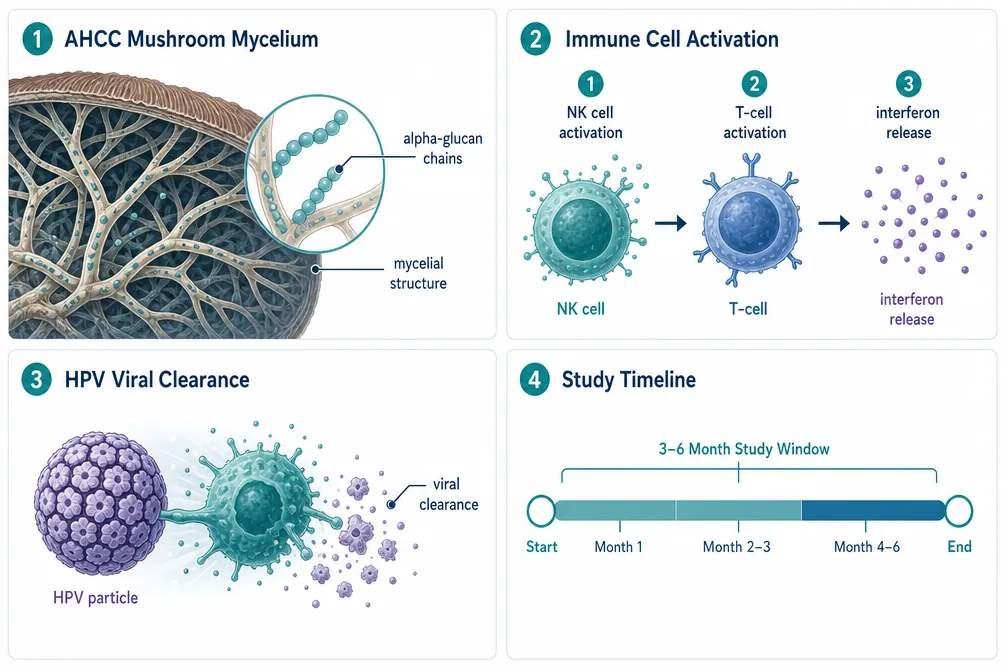
The most cited study is a Phase II randomized, double-blind, placebo-controlled trial conducted at Houston Methodist Hospital (registered as NCT02405533). Researchers enrolled women with confirmed high-risk HPV infections, the types linked to cervical dysplasia and cancer, including HPV 16 and HPV 18, and assigned them to either 3 g/day of AHCC or placebo for up to six months.
The results showed a statistically significant difference in HPV clearance rates between the AHCC group and the placebo group. Approximately 60% of participants in the AHCC arm cleared their infection, compared to a much lower rate in the placebo group. That’s a meaningful gap on paper.
Here’s what matters about interpreting it: the trial was small. Small trials can show real effects, but they can also reflect statistical noise. The investigators themselves emphasized this limitation repeatedly, and the study was explicitly designed as a preliminary efficacy signal, not a definitive answer.
A prospective observational study published in 2024 (Martinelli) reported similarly high clearance rates, but it was non-randomized, which means selection bias can’t be ruled out. A Chinese multicenter randomized trial (NCT04633330) is underway to provide broader validation across a different population.
As of 2026, a retrospective multicenter study (NCT06752083) is also examining how AHCC interacts with HPV vaccination, an important question, since vaccination and immune-mediated clearance may work through complementary mechanisms.
One additional trial worth noting: the NCI has listed a Phase II trial (NCT06693323) evaluating AHCC in HPV-positive head and neck cancer, an indication that research interest has expanded beyond cervical HPV.
How AHCC Is Thought to Work Against HPV
AHCC doesn’t attack the HPV virus directly. Its proposed mechanism runs through the immune system. Specifically, studies suggest AHCC:
- Increases NK cell activity, which is the immune system’s first-line response to virus-infected cells
- Upregulates interferon production, particularly interferon-alpha and interferon-gamma, which signal immune cells to target viral infections
- Enhances T-cell function, supporting the adaptive immune response that clears persistent infections
HPV persistence, the failure of the immune system to clear the virus within one to two years, is what drives the risk of cervical dysplasia and, eventually, cancer. Most high-risk HPV infections do clear on their own. The question AHCC research is trying to answer is whether immune support can improve clearance in the subset of people whose infections persist.
This mechanism also explains why researchers are particularly interested in AHCC for immunocompromised populations, where natural clearance rates are lower. The AHCC benefits for women page covers how this immune-support mechanism is being studied in female-specific contexts.
Who Has Been Studied, and Who Hasn’t
The existing trials have focused almost exclusively on women with high-risk HPV detected on cervical testing, typically women with normal or mildly abnormal Pap results (ASC-US or LSIL) who tested positive for high-risk genotypes. That’s a specific, relatively narrow population.
Groups not yet well represented in AHCC and HPV research:
- Men with HPV (anal, penile, or oropharyngeal)
- People with moderate-to-severe cervical dysplasia (HSIL)
- Immunocompromised individuals, including those living with HIV or on immunosuppressive therapy
- Adolescents and people under 25
- People with low-risk HPV types (6 and 11) causing genital warts
This matters practically. If you’re a man with HPV, or you have HSIL on a colposcopy result, the existing AHCC trial data doesn’t speak directly to your situation. For HPV in men specifically, the HPV in men: symptoms, risks, testing, and what it means page addresses what monitoring and management look like.
Who Might Be Most Interested in AHCC for HPV
Certain groups are more likely to be weighing AHCC as an option, not because the evidence is stronger for them, but because their circumstances make the question more pressing.
- People with persistent high-risk HPV who have had two or more positive tests over 12+ months and are watching for dysplasia
- People with mildly abnormal Pap results (ASC-US, LSIL) who are in active surveillance and want to support clearance
- Immunocompromised individuals whose natural clearance rates are lower, though this group has the least trial data
- People who have received the HPV vaccine and want to know whether AHCC adds anything, an open question the NCT06752083 trial is designed to address
If you’ve had an abnormal Pap result and want to understand what surveillance involves, the abnormal Pap smear guide explains what to expect from follow-up testing and colposcopy.
Safety Profile and Practical Considerations
Across the trials conducted to date, AHCC at 3 g/day has been generally well tolerated. No serious adverse events have been reported in published studies. The most commonly noted side effects are mild gastrointestinal symptoms, nausea or loose stools, in a small number of participants.
A few practical points worth knowing:
- The studied dose is 3 grams per day, typically taken on an empty stomach
- Trial durations have ranged from three to six months
- AHCC is sold as a supplement, not a prescription drug, quality and standardization vary by manufacturer
- No regulatory agency has approved AHCC as a treatment for HPV
The durability of clearance is an open question. Some participants in the Houston Methodist trial who cleared HPV during the study period showed re-detection at follow-up, raising the question of whether clearance was sustained or temporary. That’s not unique to AHCC, HPV can reactivate from latency, but it’s a limitation the evidence hasn’t yet resolved.
For a broader look at what AHCC research covers beyond HPV, the AHCC benefits overview covers its studied applications across immune conditions.
What the Evidence Doesn’t Show
This is where honest reporting matters. The evidence does not show that:
- AHCC is a proven treatment for HPV
- AHCC prevents HPV-related cancers
- AHCC is effective for people with HSIL or confirmed dysplasia
- AHCC replaces screening, colposcopy, or treatment for precancerous lesions
No clinical guideline, not from the CDC, ACOG, or WHO, currently recommends AHCC as part of HPV management. The research is promising enough to justify continued investigation, which is exactly why multiple trials are ongoing. But promising early data and clinical recommendation are different things.
If you have high-risk HPV and are considering AHCC, the most important step is to keep your scheduled screening appointments. Cell changes are easiest to treat before they progress, that’s what regular Pap and HPV co-testing is for. The HPV testing guide explains how co-testing works and what different results mean.
AHCC for HPV: What the Evidence Shows, A Realistic Summary
The honest answer to “does AHCC work for HPV?” is: the evidence shows it might help some people clear high-risk HPV, based on a small but methodologically credible randomized trial and supported by mechanistic data on immune activation. The effect size is notable. The sample sizes are not yet large enough to be definitive.
That’s not a dismissal. It’s the actual state of the science as of 2026. Ongoing multicenter trials will either strengthen or complicate these findings. Until that data exists, AHCC sits in a category of interventions with biological plausibility and preliminary positive signals, not proven treatments.
Talk to your doctor before starting AHCC, particularly if you are immunocompromised, pregnant, or managing an active dysplasia diagnosis. The supplement doesn’t replace the clinical pathway, it may, if future trials confirm the early data, eventually become part of it.
Frequently Asked Questions
Can AHCC clear HPV completely?
Some participants in the Phase II trial did test negative for HPV after taking AHCC for three to six months. However, re-detection occurred in some cases at follow-up, and the trial was small. “Clearance” in these studies means the virus was undetectable on testing, not necessarily that it’s permanently eliminated from the body.
Is AHCC safe to take alongside HPV treatment or monitoring?
Based on current trial data, AHCC at 3 g/day appears well tolerated with no reported serious drug interactions. That said, no large-scale safety study has examined AHCC alongside specific HPV treatments like LEEP or cryotherapy. Discuss it with your clinician before adding it to your regimen.
Does AHCC work for HPV types 16 and 18 specifically?
The Houston Methodist trial enrolled women with confirmed high-risk HPV, which includes types 16 and 18. The trial did not consistently stratify outcomes by specific genotype, so whether AHCC performs differently for type 16 versus 18 versus other high-risk types isn’t yet clear from the published data.
Should AHCC replace regular Pap smears or HPV testing?
No. AHCC is a supplement being studied as a potential immune support tool, it is not a diagnostic test or a substitute for screening. Regular Pap and HPV co-testing remains the standard way to catch cervical cell changes early, regardless of what supplements you’re taking.
Where does AHCC research go from here?
As of 2026, multiple trials are active: a Chinese multicenter randomized trial (NCT04633330), a retrospective study on AHCC combined with HPV vaccination (NCT06752083), and an NCI-listed Phase II trial in HPV-positive head and neck cancer (NCT06693323). These studies will provide larger, more diverse datasets that either confirm or refine the early positive signals.
Conclusion
The evidence on AHCC for HPV is real, limited, and still developing. A Phase II randomized trial showed a meaningful clearance signal. The mechanism, immune activation through NK cells and interferon pathways, is biologically coherent. The safety profile at 3 g/day is reassuring. And multiple ongoing trials suggest the scientific community considers the question worth answering rigorously.
What you can do right now: keep your HPV screening on schedule, discuss AHCC with your doctor if you’re considering it (especially if you’re immunocompromised or managing dysplasia), and follow the trial data as it develops. The AHCC for HPV full evidence review covers the research in greater depth if you want the complete picture. And if you’re tracking HPV’s potential link to cervical outcomes, the AHCC and cervical cancer overview addresses what the research shows specifically for that risk pathway.
The evidence shows promise. It doesn’t yet show proof. That distinction is worth holding onto.