AHCC is a standardized extract made from the cultured mycelia of shiitake mushrooms (Lentinula edodes), developed in Japan in the 1980s and now sold globally as an immune-support nutraceutical. If you’ve come across it while researching HPV clearance, cancer support, or general immune health, here’s what the evidence actually shows, and where the gaps still are.
Key Takeaways
- AHCC is derived from shiitake mushroom mycelia and is rich in alpha-glucan polysaccharides that appear to modulate immune activity.
- Human studies show AHCC consistently changes immune cell populations, particularly natural killer (NK) cells, but most trials are small and use surrogate endpoints rather than hard clinical outcomes.
- A Phase II clinical trial found that 3 g/day of AHCC for six months led to high-risk HPV clearance in 58.8% of women with persistent infections.
- AHCC is generally well tolerated at commonly studied doses, with no dose-limiting toxicities reported in Phase I safety work.
- Larger confirmatory trials are still needed before AHCC can be considered a standard clinical recommendation for any condition.
Table of Contents
What Is AHCC, Exactly?
AHCC stands for Active Hexose Correlated Compound. The name is a legacy of its original Japanese development and doesn’t map neatly onto modern biochemical naming conventions, what matters more is what it actually contains.
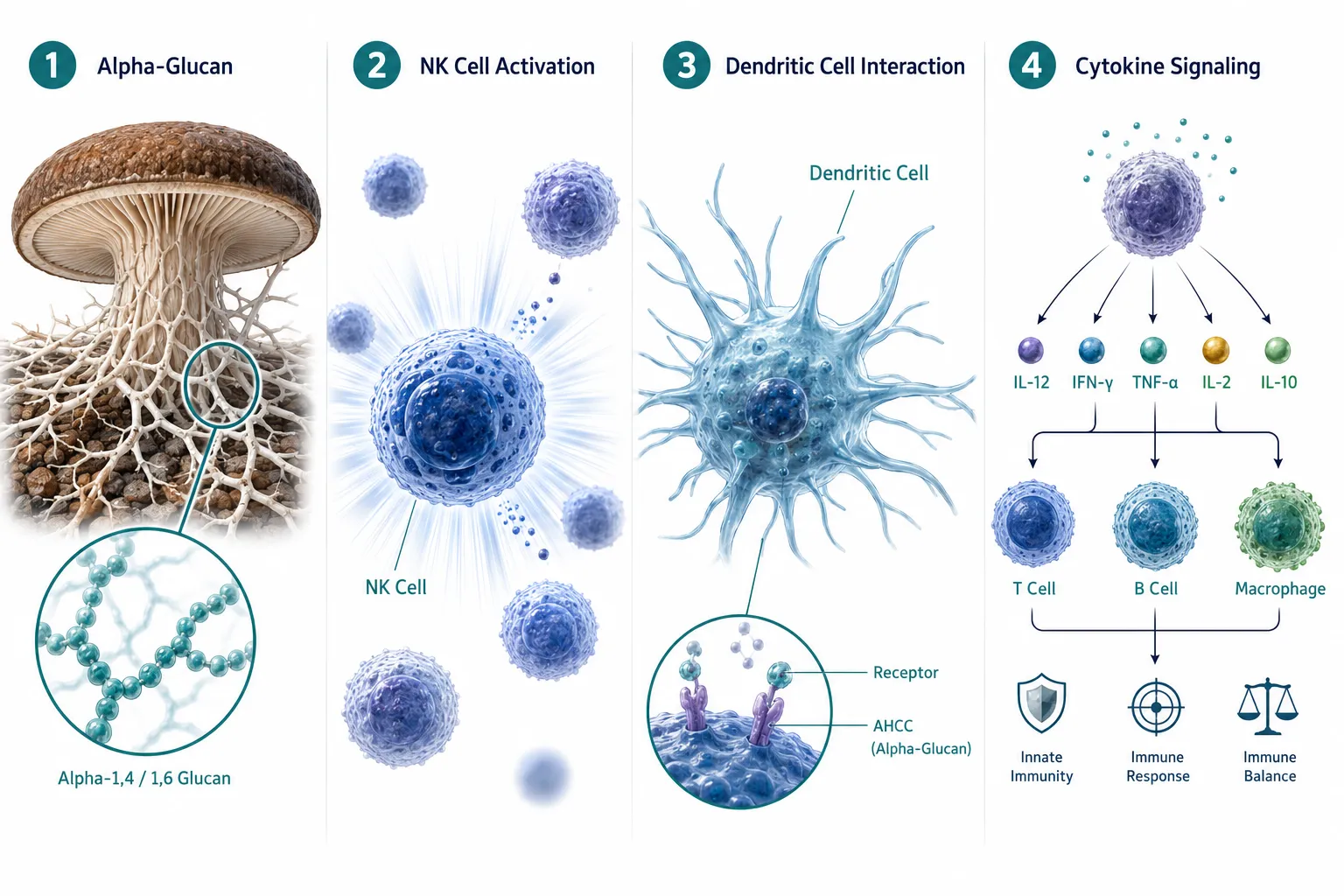
The extract comes from the mycelia, the root-like threads, of Lentinula edodes, the shiitake mushroom. Those mycelia are cultured in liquid medium, then processed and standardized to contain a consistent concentration of alpha-glucans, a family of polysaccharide compounds. Alpha-glucans are the biologically active fraction most researchers focus on, though AHCC also contains other polysaccharides, amino acids, and minerals.
This matters because not all mushroom extracts are the same. Many commercial mushroom supplements are made from the fruiting body (the cap and stem you’d eat), not the mycelia. AHCC’s manufacturing process is proprietary and specific, the alpha-glucan profile in AHCC differs structurally from the beta-glucans more commonly found in other mushroom products.
AHCC is sold in capsule and powder form under several brand names. Doses used in clinical research have ranged from 1 g to 6 g per day, with 3 g/day being the most studied dose in recent trials.
For a broader look at how immune-modulating supplements fit into HPV management, the AHCC overview on HPVGuide.org covers the landscape in more detail.
How Does AHCC Work in the Body?
AHCC’s proposed mechanism centers on the innate immune system, the part of your immune response that reacts quickly to threats without needing prior exposure to a specific pathogen.
Human and preclinical studies consistently show three main effects. First, AHCC increases the activity and number of natural killer (NK) cells, which are front-line immune cells that destroy virus-infected cells and some tumor cells without requiring prior sensitization. Second, it alters dendritic cell counts and function, dendritic cells are the immune system’s scouts, processing foreign material and presenting it to T cells to trigger a targeted response. Third, AHCC influences cytokine production, the chemical signaling that coordinates immune activity across different cell types.
These aren’t theoretical effects. Double-blind, placebo-controlled trials in healthy volunteers have documented increases in dendritic cell subsets after AHCC supplementation. Preclinical work showed that AHCC supplementation increased survival in mice exposed to lethal infectious challenges, providing early mechanistic rationale for human trials.
The honest caveat: most human studies measure these immune cell changes as surrogate endpoints. Seeing more NK cells in a blood sample is not the same as proving that those cells are clearing a specific infection or preventing a specific disease outcome. The gap between immune biomarker changes and hard clinical results is where most of the uncertainty lives.
What Does the Research Say About AHCC and HPV?
This is the question most people searching for AHCC are really asking. The short answer: there is one well-designed Phase II trial with genuinely notable results, and the research community is waiting for larger confirmatory studies.
The trial enrolled 50 women over age 30 with persistent high-risk HPV infections, meaning infections that had not cleared on their own over time. Participants received either 3 g/day of AHCC for six months followed by placebo, or placebo for 12 months in a crossover design. The primary endpoint was durable HPV negativity, defined as testing negative for HPV RNA and DNA six to twelve months after stopping AHCC.
The results: 63.6% of women in the AHCC arm achieved HPV negativity during treatment. Of those, 64.3% maintained that negativity 12 months after stopping. The overall clearance rate across all women who ever received AHCC, including crossover participants, was 58.8%.
For context, persistent high-risk HPV infections are the ones that carry meaningful risk for cervical cell changes. If you’ve had an abnormal Pap smear result and your clinician mentioned persistent HPV, that’s the category this trial was studying.
A 2026 clinical commentary highlighted these results and described AHCC as a potential adjunctive option for immune-mediated HPV clearance in women with long-standing infections, while explicitly stressing that larger confirmatory trials are needed before it becomes a clinical standard.
The deeper detail on this trial, including how it was designed and what the crossover data showed, is covered in the AHCC for HPV evidence review.
Who Might Be Most Interested in AHCC?
AHCC research has focused on a few specific populations. Understanding which groups have been studied, and which haven’t, helps set realistic expectations.
People with persistent high-risk HPV infections. The Phase II trial specifically recruited women over 30 whose infections hadn’t cleared spontaneously. Women in this group, particularly those with a history of abnormal Pap results, represent the population with the most direct clinical data.
People undergoing cancer treatment. A randomized trial is currently in progress evaluating AHCC as an immune modulator added to cancer immunotherapy, with endpoints including progression-free survival and overall survival in patients receiving immune checkpoint inhibitors. Results are not yet available. Separately, at the 2026 ASCO Annual Meeting, researchers presented Phase II data from a multicenter trial in 230 patients with pancreatic ductal adenocarcinoma across eight Japanese institutions; full peer-reviewed publication is pending.
Immunocompromised individuals. People with HIV, organ transplant recipients on immunosuppressive therapy, and others with reduced immune function are populations where immune-modulating supplements are frequently studied. AHCC’s NK cell effects are particularly relevant here, though specific trial data in these groups remains limited.
Healthy adults seeking general immune support. Phase I safety studies in healthy adults report that AHCC is generally well tolerated at commonly used doses without dose-limiting toxicities. A new pilot trial in Indonesia, scheduled to start in June 2026, will test whether AHCC reduces febrile days and respiratory infections in healthy children aged 2-4, a population and endpoint that would add meaningfully to the evidence base.
For a detailed look at how AHCC evidence applies specifically to women’s health outcomes, the AHCC benefits for women overview covers that angle directly.
Is AHCC Safe?
Based on available data, yes, AHCC appears to be well tolerated at the doses used in research. Phase I safety studies in healthy adults found no dose-limiting toxicities. The most commonly reported side effects in trials have been mild gastrointestinal symptoms, and these were not significantly different from placebo groups in blinded studies.
That said, “generally safe in healthy adults at studied doses” is not the same as “safe for everyone in any context.” A few practical points:
- AHCC has not been rigorously studied in pregnancy. If you are pregnant, do not start any new supplement without discussing it with your provider first.
- People taking immunosuppressive medications, including transplant recipients, should talk to their specialist before using any immune-modulating supplement, since theoretically enhancing immune activity could interact with drugs designed to suppress it.
- Quality control matters. AHCC is a proprietary extract; not all products labeled “AHCC” are manufactured to the same standard. The clinical trials used specific standardized preparations.
Frequently Asked Questions
Does AHCC cure HPV?
No. The Phase II trial showed that 3 g/day of AHCC was associated with HPV clearance in 58.8% of women with persistent high-risk infections, but clearance in a clinical trial is not the same as a cure, and this was a single trial of 50 participants. The evidence is promising enough to warrant larger studies, not strong enough to call AHCC a proven HPV treatment. Your best next step is discussing persistent HPV with a clinician who can review your specific Pap and HPV test history.
How long does AHCC take to work?
In the HPV Phase II trial, the treatment period was six months at 3 g/day. Most immune biomarker studies show measurable changes in NK cell activity within weeks, but clinically meaningful endpoints, like HPV clearance, took the full six-month course. There is no established timeline that applies universally, and it varies based on immune status and the specific condition being studied.
Can men take AHCC for HPV?
The clinical trial data on AHCC and HPV comes entirely from women. HPV affects men too, the HPV in men overview covers the specific risks and testing considerations, but there are no published randomized trials of AHCC for HPV clearance in men. The immune mechanisms AHCC targets are not sex-specific, but extrapolating from a women-only trial to male HPV infections is not scientifically supported at this point.
Is AHCC the same as other mushroom supplements?
No. AHCC is made from shiitake mycelia using a proprietary culturing process that produces a specific alpha-glucan profile. Most other mushroom supplements, reishi, turkey tail, lion’s mane, are derived from fruiting bodies and contain different polysaccharide profiles, primarily beta-glucans. The research on AHCC does not transfer to other mushroom products, and vice versa.
Where can I learn more about AHCC and cancer?
The AHCC and cancer overview covers the oncology trial data in more detail, including what the current research does and doesn’t show about AHCC as an adjunct to standard cancer treatment.
What This Means for You in 2026
AHCC is a well-characterized nutraceutical with a specific mechanism, a growing body of human trial data, and one standout Phase II result in persistent high-risk HPV. It is not a proven treatment for any condition, and it is not a replacement for standard screening, monitoring, or medical care.
If you have persistent high-risk HPV and are wondering whether AHCC is worth discussing with your clinician, the Phase II data gives you something concrete to bring to that conversation. Cell changes from persistent HPV are easiest to manage before they progress, that’s what regular screening is for, and AHCC does not change that calculus.
The full AHCC benefits review covers the broader range of immune outcomes studied across different populations, which may be useful if you’re evaluating AHCC for reasons beyond HPV.