AHCC is not a single molecule. It’s a standardized extract derived from the cultured mycelia of shiitake mushrooms, and what’s actually in AHCC depends significantly on whether you’re looking at the original proprietary formula or one of the many products that borrow the name.
That distinction matters, especially if you’re considering AHCC as part of an immune support strategy related to an HPV diagnosis. Understanding the composition helps you evaluate what you’re actually taking, and whether a product on a store shelf matches what clinical research has studied.
Key Takeaways
- AHCC is derived from shiitake mushroom mycelia through hot water extraction and enzymatic processing, producing a saccharide-rich extract.
- Oligosaccharides make up approximately 74% of AHCC by composition; alpha-1,4-glucans account for roughly 20% and are considered the primary active fraction.
- Branded AHCC formulations also contain excipients such as plant waxes, cyclodextrin, and microcrystalline cellulose, these are carriers, not active ingredients.
- Many products sold as “AHCC” online are multi-mushroom blends, not the original shiitake-mycelia extract studied in clinical trials.
- Composition has remained broadly stable; no major reformulation of the core extract has been reported as of 2026.
The Core Composition: What’s Actually in AHCC at the Molecular Level
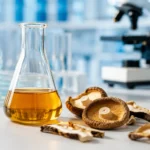
AHCC starts as cultured shiitake (Lentinula edodes) mycelia. The mycelia are processed through hot water extraction and then enzymatically modified, which breaks down larger polysaccharide chains into shorter oligosaccharide fragments. That enzymatic step is what distinguishes AHCC from a standard shiitake extract.
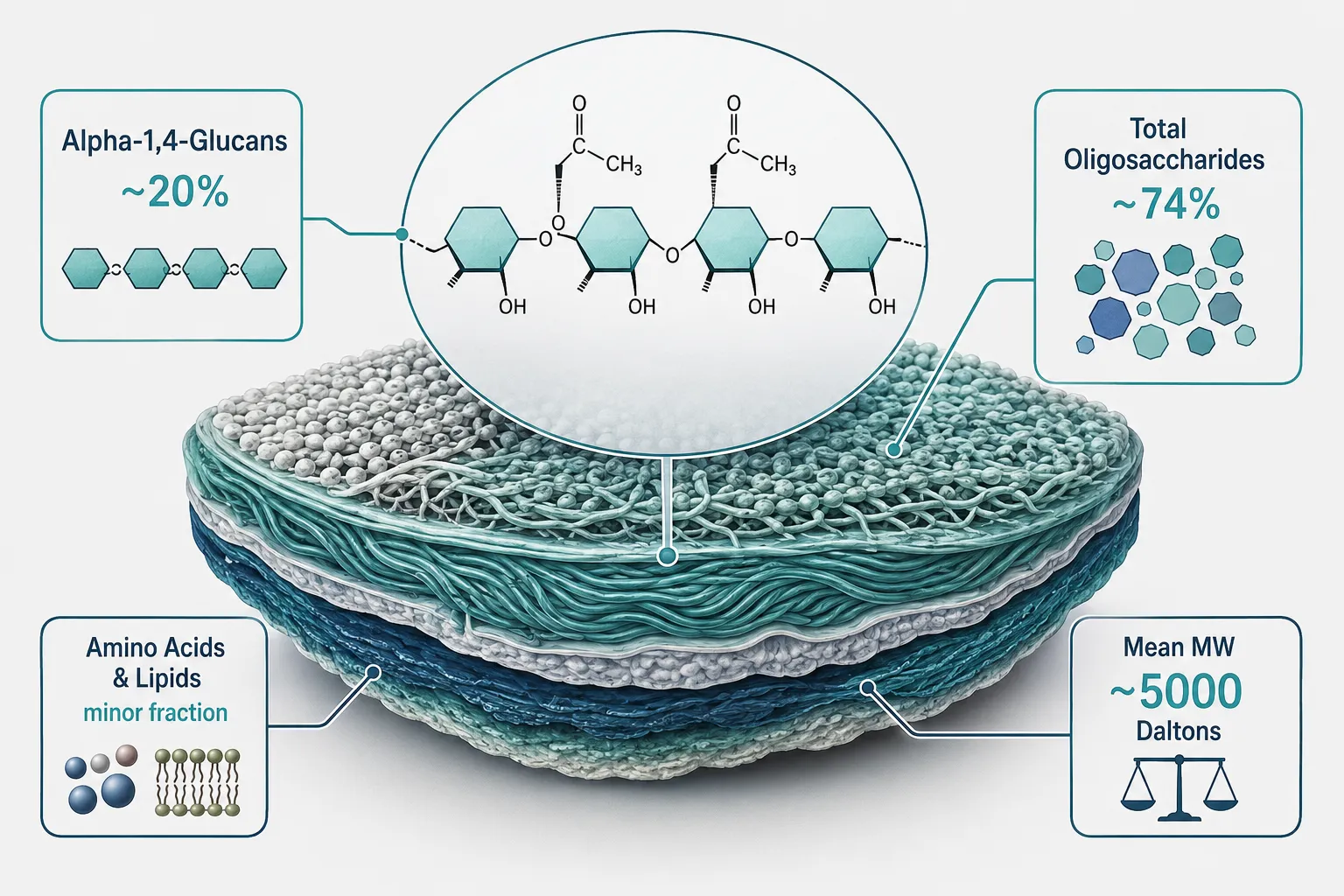
The result is an extract whose composition breaks down roughly like this:
| Fraction | Approximate Share |
|---|---|
| Total oligosaccharides | ~74% |
| Alpha-1,4-glucan oligosaccharides | ~20% |
| Amino acids, minerals, lipids | Remaining fraction |
The alpha-1,4-glucans are the fraction most studied for immune activity. They are partially acetylated, meaning acetyl groups are attached to the glucan chain, and have a mean molecular weight of around 5,000 Daltons. That low molecular weight is intentional: smaller oligosaccharides are thought to be more bioavailable than the larger beta-glucan chains found in whole mushroom powders.
The remaining ~6% of the saccharide fraction includes other sugar compounds, plus small amounts of amino acids and lipids. These are present in every batch but are not considered the primary active components.
One important note: because AHCC is a proprietary supplement rather than a defined pharmaceutical compound, its composition is described in broad classes and percentages. A complete validated chemical profile for every molecule in every batch is not publicly disclosed, and that is standard for this category of product.
For a broader overview of how AHCC fits into immune support research, the AHCC overview on HPVGuide covers the general evidence base.
What’s in the Capsule Beyond the Active Extract
Knowing what’s actually in AHCC also means reading past the active ingredient line. Branded AHCC products, those using the licensed AHCC® trademark from Amino Up, consistently list a proprietary mushroom mycelia extract blend alongside several excipients.
A standard 1-gram AHCC® serving typically contains:
- Mushroom mycelia extract (Lentinula edodes)
- Carnauba wax or candelilla wax (plant-based coating agent)
- Microcrystalline cellulose (filler and flow agent)
- Dextrin and/or alpha-cyclodextrin (carrier polysaccharides)
These excipients are inactive in the pharmacological sense. They stabilize the extract, improve powder flow during manufacturing, and help form the capsule or tablet. None of them are the reason AHCC is studied for immune modulation.
Some professional-grade formulations are more concentrated. A two-capsule daily dose in one professional product provides 1.2 grams of AHCC equivalent to 864 mg of actual mushroom extract, the remainder being those carrier materials.
A newer trend worth knowing: some 2026 formulations combine the AHCC extract with probiotic strains such as Lactobacillus rhamnosus GG and Bifidobacterium animalis lactis, each at 2 billion CFU per serving. These products are pairing the mushroom saccharide fraction with microbiome-modulating ingredients. That may be relevant to your decision if you’re already taking a probiotic, but it also means the product is no longer just AHCC, it’s a combination formula.
If you’re researching AHCC specifically in the context of cervical health, AHCC and cervical cancer research covers the clinical data in more detail.
The Labeling Problem: Not All “AHCC” Products Contain the Same Thing
This is where the answer to “what’s actually in AHCC?” gets more complicated.
The term “AHCC”, which stands for Active Hexose Correlated Compound, is both a trademarked brand name and a generic descriptor that some manufacturers use loosely. The result is a wide range of products with very different compositions.
Authentic AHCC® products use the licensed extract from Amino Up, derived specifically from shiitake mycelia, standardized to the alpha-1,4-glucan fraction described above.
Generic “AHCC” products frequently contain multi-mushroom blends. A high-dose product may list 1,500 mg of “AHCC” made from reishi, chaga, turkey tail, Agaricus blazei, lion’s mane, shiitake, cordyceps, and black fungus, sometimes with added beta-1,3/1,6-D-glucan. That is a mushroom complex, not the shiitake-mycelia extract that clinical trials have studied.
Other UK-market products list 600 mg “Active Hexose Correlated Compound” per capsule sourced from shiitake, reishi, maitake, royal sun mushroom, and chaga. Again, a blend, not the original extract.
Why does this matter? Because the research on AHCC and HPV clearance, immune function, and oncology support was conducted using the standardized shiitake-mycelia extract, not a mushroom medley. If a product’s label doesn’t specify Lentinula edodes mycelia as the source, and doesn’t list alpha-glucan content, you have no way to confirm it matches what was studied.
The AHCC for HPV evidence review covers what the clinical research actually tested and what it found.
Who Is Most Likely Considering AHCC?
Most people asking what’s actually in AHCC are doing so for a specific reason. The supplement is most commonly used by:
- People with a persistent high-risk HPV infection who want to support immune clearance alongside standard monitoring
- Those undergoing cancer treatment or recovery who are exploring integrative immune support
- Immunocompromised individuals, including people living with HIV or organ transplant recipients on immunosuppressants, who are at higher risk for HPV-related complications
- Women with a history of abnormal Pap results who are looking for adjunct options while under colposcopy surveillance
If you fall into any of these groups, the composition question is practical, not academic. You need to know whether the product you’re buying contains the fraction that research has examined, and at what dose. The AHCC benefits for women page addresses how dosing and product selection apply specifically to women managing HPV-related concerns.
Does Composition Change Across Brands or Over Time?
The core composition of authentic AHCC® has remained stable. As of 2026, no major reformulation of the primary extract has been reported. The saccharide percentages, the molecular weight range, and the shiitake-mycelia source have been consistent across regulatory and clinical summaries for years.
What does vary is the dose per serving across brands, the excipient list, and, critically, whether a product is the genuine licensed extract or a generic mushroom blend using the AHCC name. A Canadian-market product, for example, specifies 40% polysaccharides and 25% alpha-glucans in its medicinal ingredient declaration, which aligns with the expected composition of authentic AHCC. A product that doesn’t list alpha-glucan content at all should prompt closer scrutiny.
Memorial Sloan Kettering Cancer Center characterizes AHCC as an extract of shiitake mycelia rich in alpha-1,4-glucan oligosaccharides used for immune modulation, while also noting that evidence for direct anticancer benefit remains limited. That framing, immune modulation, not treatment, is the accurate context for what this supplement does.
For a broader look at how AHCC fits into the HPV evidence landscape, the AHCC benefits overview is a useful starting point.
Frequently Asked Questions
Is AHCC the same as a standard shiitake mushroom supplement?
No. AHCC is produced from shiitake mycelia, the root-like network of the fungus, not the fruiting body, and undergoes enzymatic processing that reduces polysaccharide chain length. That processing step creates the low-molecular-weight alpha-1,4-glucan oligosaccharides that distinguish AHCC from a whole-mushroom or standard shiitake extract.
How much alpha-glucan should a genuine AHCC product contain?
Most authentic AHCC® formulations provide between 18% and 25% alpha-glucans relative to the total extract weight. A 1-gram serving should contain roughly 180-250 mg of alpha-glucans. If a product doesn’t disclose this figure, you can’t confirm it matches the studied extract.
Can AHCC be combined with other supplements safely?
Most formulations are taken alongside standard supplements without reported interactions, but this varies depending on your health status and any medications you’re taking. If you’re immunocompromised or undergoing cancer treatment, talk to your doctor before adding AHCC, not because it’s high-risk, but because your clinical team needs a complete picture of what you’re taking.
Does the source mushroom species affect what’s in the product?
Yes, meaningfully. The alpha-1,4-glucan fraction specific to AHCC comes from Lentinula edodes mycelia processed by a defined method. Products sourced from reishi, chaga, or other species will have different saccharide profiles, including beta-glucans rather than the alpha-1,4-glucan fraction, and have not been studied in the same clinical trials.
Is AHCC regulated as a drug or a supplement?
AHCC is classified as a nutritional supplement in most markets, including the US, UK, and Canada. It is not an approved pharmaceutical. That means manufacturing standards, labeling requirements, and quality controls vary by country and brand, which is one more reason to verify that a product specifies its active fraction and source mushroom before purchasing.