
AHCC is one of the most searched supplements in women’s HPV care right now, and the gap between what the marketing claims and what the clinical evidence actually shows is significant. Understanding that gap is what lets you make a genuinely informed decision, rather than one driven by hope or fear.
Key Takeaways
- AHCC is a mushroom-derived supplement studied primarily for immune modulation, not as a direct antiviral agent
- The strongest human evidence comes from one small phase II trial in women with high-risk HPV; results were promising but not definitive
- No major clinical guideline, from the CDC, WHO, or ACOG, currently recommends AHCC as part of HPV management
- AHCC appears generally well tolerated in short-term use, but long-term safety data and pregnancy data are sparse
- It may be reasonable to consider as an adjunct for some women, but it does not replace cervical screening or vaccination
What Is AHCC, and Why Are Women Asking About It?
AHCC stands for Active Hexose Correlated Compound. It is derived from the mycelium, the root-like structure, of shiitake mushrooms, and it contains a specific type of polysaccharide called alpha-glucan. That compound is thought to support immune function by activating natural killer (NK) cells and other components of the innate immune system.
The reason women are searching for it is straightforward: a persistent high-risk HPV result is unsettling, and the standard clinical answer, “wait and see if your immune system clears it”, can feel passive. AHCC is marketed as something you can actively do. That emotional logic is understandable. Whether the evidence supports it is a different question.
For a broader look at how HPV behaves in women and what the actual clinical picture looks like, the HPV in Women guide covering symptoms, screening, and cervical risk is a useful starting point.
What Does the Clinical Evidence Actually Show?
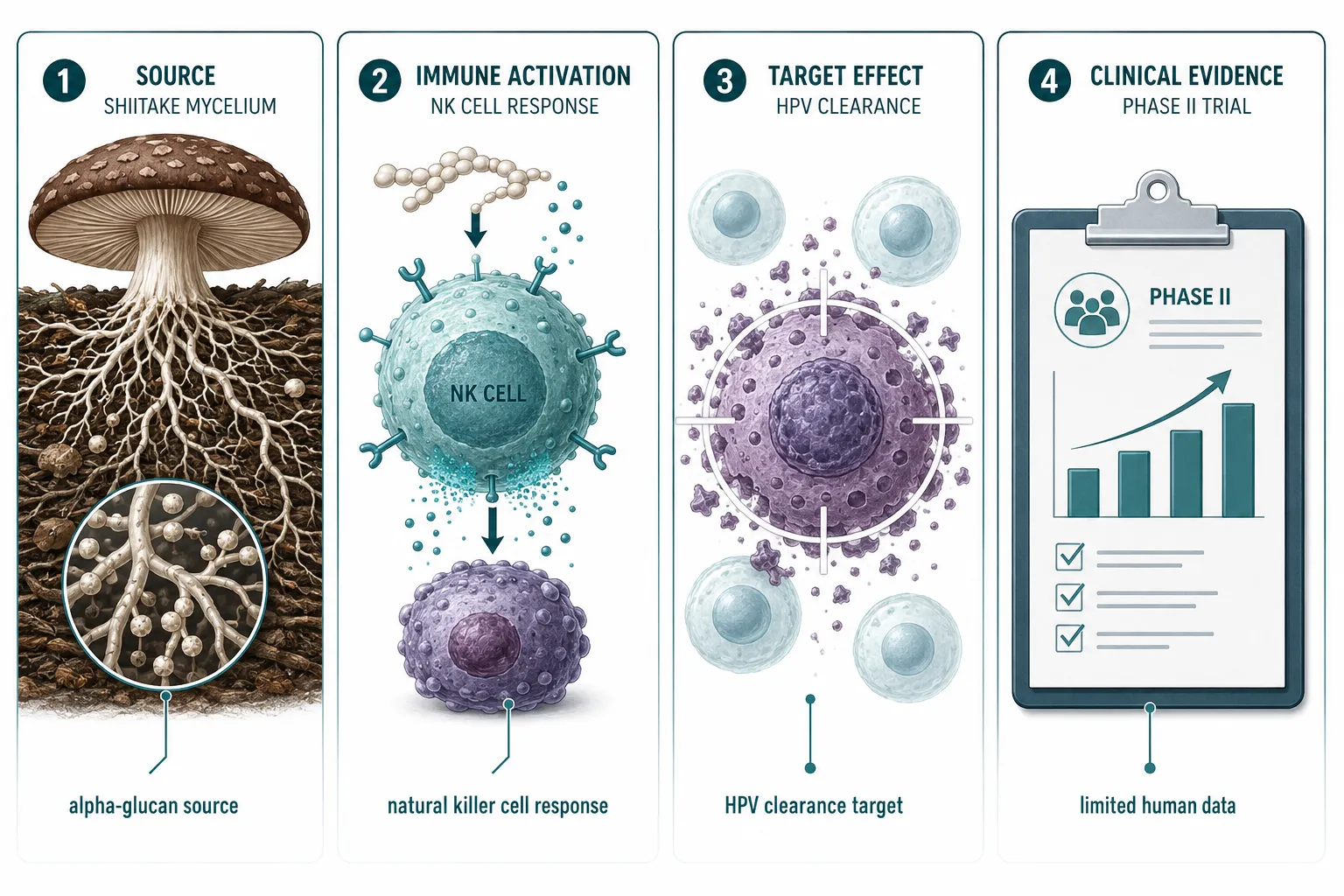
The most-cited human study is a phase II clinical trial led by researchers at the University of Texas Health Science Center. It enrolled women with confirmed high-risk HPV infections and tested AHCC supplementation, typically 3 grams daily, over several months. The results showed a statistically significant rate of HPV clearance in the treatment group compared to placebo.
That sounds compelling. Here is what to hold alongside it: the trial was small, with a limited number of participants. Phase II trials are designed to test whether something is worth studying further, not to confirm that a treatment works. The results have not yet been replicated in a large, multi-center, phase III trial.
The proposed mechanism is immune modulation, AHCC appears to enhance the activity of NK cells and dendritic cells, which are part of the immune response that the body uses to clear HPV naturally. It is not believed to act as a direct antiviral. That distinction matters: it means AHCC may support what your immune system is already trying to do, rather than targeting the virus directly.
For a detailed breakdown of what the evidence shows and where it stops, the AHCC for HPV article covering the evidence and its limits goes deeper on the trial data.
Separating AHCC Benefits for Women: Fact vs. Hype
Evidence snapshot (2026):Promising phase II data for HPV clearance. No phase III confirmation. No guideline endorsement. Generally safe in short-term use. Not a replacement for screening.
The marketing around AHCC often outpaces the science. Here is where the evidence is solid, where it is thin, and where it is essentially absent.
Where the evidence is reasonable:
- Immune modulation in laboratory and animal studies is well-documented
- The phase II HPV trial produced genuine, peer-reviewed results, not just testimonials
- Short-term tolerability is supported; most reported side effects are mild gastrointestinal symptoms
Where the evidence is thin:
- Long-term use data in humans is limited
- The dose used in HPV-focused research (typically 3 grams daily of a specific formulation) is not always what is sold in retail products
- Replication in larger trials has not yet occurred as of 2026
Where the evidence is essentially absent:
- Broad “women’s wellness” claims, hormonal balance, fertility support, energy, are not supported by clinical trial data
- AHCC has not been studied as a treatment for cervical dysplasia (CIN lesions) independent of HPV clearance
- Claims about cancer prevention in healthy women without HPV are not backed by human trial data
The AHCC benefits overview covers the broader evidence base, including studies outside the HPV context.
Who Might Reasonably Consider AHCC, and Who Should Be Cautious

AHCC is not appropriate for everyone, and “generally well tolerated” does not mean risk-free for all groups.
Women who might reasonably discuss AHCC with their clinician:
- Those with confirmed persistent high-risk HPV (types 16, 18, 31, 33, or 45) who are under active surveillance and want to support immune clearance
- Women with mildly abnormal Pap results (ASC-US or LSIL) who are in a watchful-waiting period and looking for adjunct options
- Those who have already optimized foundational immune health (sleep, nutrition, smoking cessation) and want to add a studied supplement
Women who should be cautious or avoid AHCC without medical guidance:
- Pregnant women or those trying to conceive, pregnancy safety data is sparse, and this is not a minor caveat
- Women who are immunocompromised, including those on immunosuppressive therapy after organ transplant, stimulating NK cell activity in these contexts requires medical oversight
- Women taking chemotherapy or immunotherapy, potential interactions have not been adequately studied
If you are managing a more advanced finding, HSIL, a positive colposcopy, or a biopsy result, AHCC is not a substitute for the treatment your clinician recommends. Cell changes at that stage are easiest to address before they progress, and that is what colposcopy and treatment protocols are designed for.
What Major Guidelines Say (and Don’t Say)
No major health authority, not the CDC, not WHO, not ACOG, currently recommends AHCC as part of HPV management or cervical cancer prevention. That is not a dismissal of the research; it reflects the standard of evidence required before a guideline changes.
Guidelines move slowly on purpose. A single phase II trial, however well-designed, is not sufficient to change clinical recommendations. The evidence is evolving, and several ongoing trials may produce the phase III data needed to shift that picture. As of 2026, the honest answer is: we do not yet know enough to say AHCC works reliably in a clinical population.
That does not make it irrational to consider. It means you should hold realistic expectations, and keep your cervical screening appointments regardless. The AHCC and cervical cancer overview covers what the research says specifically in that context.
Dose, Duration, and What to Look For in a Product
The dose used in the most-cited HPV research is 3 grams per day of a standardized AHCC extract, taken for a minimum of several months. This is not a short-term supplement trial, the studies that showed clearance effects ran for six months or longer.
Retail products vary considerably. Some contain lower doses, different extraction methods, or fillers that were not part of the research formulation. If you are going to try AHCC based on the HPV evidence, the formulation and dose matter. Ask your clinician or pharmacist to help you identify a product that matches what was studied.
Cost is also a real factor. At 3 grams daily, AHCC is not inexpensive, and the evidence does not yet support calling it a proven treatment. That context belongs in the decision.
Frequently Asked Questions
Can AHCC clear HPV on its own?
The phase II trial showed higher clearance rates in women taking AHCC compared to placebo, but the study was small and has not been replicated at scale. AHCC is not a proven cure for HPV. Most high-risk HPV infections clear on their own within one to two years through normal immune function, with or without supplementation.
Does AHCC replace Pap smears or colposcopy?
No. Cervical screening detects cell changes that may not cause any symptoms, that is the entire point of it. AHCC does not detect or treat existing dysplasia. If you have an abnormal Pap result or a positive HPV test, your screening schedule stays the same regardless of whether you take AHCC.
Is AHCC safe to take long-term?
Short-term use appears well tolerated in healthy adults. Long-term safety data in humans is limited. Pregnancy safety has not been established. If you are immunocompromised or on any immunomodulating medication, discuss AHCC with your doctor before starting it.
Are there other supplements with better evidence for HPV clearance?
Folate, vitamin D, and a few other micronutrients have been studied in relation to HPV persistence, but none has strong phase II trial data comparable to AHCC in this specific context. Correcting a genuine deficiency, especially vitamin D, is reasonable and supported by general immune health evidence. The AHCC what to know overview covers how it compares to other supplement options.
Should I tell my gynecologist I’m taking AHCC?
Yes. Your clinician needs a complete picture of everything you are taking, including supplements. AHCC may interact with immunosuppressive drugs or affect how certain lab results are interpreted. It also helps your doctor track whether any changes in your HPV status coincide with supplementation, which is useful information.
Where This Leaves You
AHCC benefits for women, fact vs. hype, comes down to this: the fact is a small but real clinical signal in HPV clearance research, a reasonable short-term safety profile, and a plausible immune mechanism. The hype is everything layered on top of that: the broad wellness claims, the certainty in marketing language, and the implication that it replaces medical care.
If you have persistent high-risk HPV and are in a watchful-waiting period, talking to your clinician about AHCC as an adjunct, at the studied dose, from a standardized product, is a reasonable conversation to have. Go in with accurate expectations: this is a supplement with early-stage evidence, not a proven treatment. Keep your screening appointments. That is what catches problems early enough to address them.
For more on the full AHCC evidence landscape, the AHCC category page brings together the site’s coverage in one place.