
AHCC does not treat cervical cancer. That distinction matters, because the supplement is being studied for something narrower and earlier in the disease process, clearing persistent high-risk HPV infections before they can progress to cervical cell changes.
If you’ve been reading about AHCC and cervical cancer and wondering whether it’s worth trying, here’s what the evidence actually shows in 2026, where it falls short, and what questions to bring to your doctor.
Key Takeaways
- AHCC is a mushroom-derived supplement studied for its effect on persistent high-risk HPV, not as a treatment for cervical cancer itself.
- Early clinical trials show some women with persistent HPV infections achieved viral clearance while taking AHCC, but the evidence is still limited.
- No study has shown AHCC directly kills cervical cancer cells or reduces tumor burden.
- AHCC is not approved or recommended by any major health guideline as a standard HPV or cervical cancer intervention.
- It may be worth discussing with your doctor as a complementary option if you have confirmed persistent high-risk HPV, not as a replacement for screening or medical care.
What AHCC Actually Is, and What It Isn’t
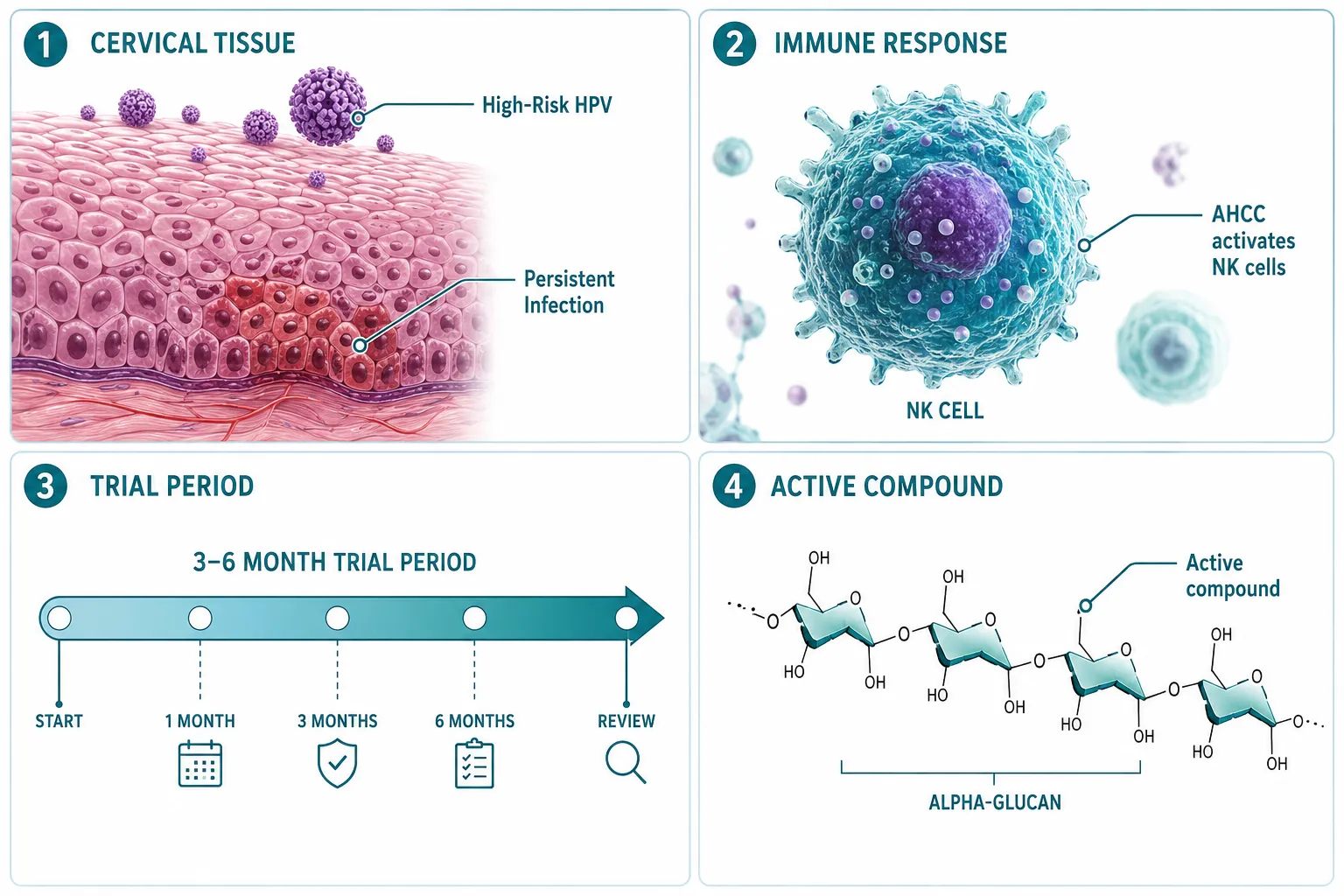
AHCC stands for Active Hexose Correlated Compound. It’s derived from the mycelia of shiitake mushrooms and contains a specific type of alpha-glucan polysaccharide that appears to modulate immune function, particularly natural killer (NK) cell activity and cytokine response.
It is a dietary supplement, not a pharmaceutical. That means it isn’t subject to the same clinical trial requirements as a drug, and it isn’t regulated for efficacy by the FDA.
The reason it’s discussed alongside cervical cancer at all is indirect: cervical cancer is caused almost entirely by persistent infection with high-risk HPV types, particularly HPV 16 and HPV 18. If AHCC can help the immune system clear those infections, the theory goes, it may reduce the downstream risk of cervical cell changes progressing toward cancer. For a broader overview of how HPV connects to cancer development, the guide on HPV and cancer, which cancers are linked, how it happens, and how it’s prevented explains the full picture.
AHCC does not attack cancer cells. There is no evidence from human studies that it shrinks tumors, improves survival in cervical cancer patients, or replaces any standard oncology treatment.
What the Clinical Evidence Shows on AHCC and Cervical Cancer Risk
The most cited human data comes from a Phase II randomized trial led by researchers at the University of Texas Health Science Center. Women with confirmed persistent high-risk HPV infections were randomized to receive AHCC (3g daily) or placebo over several months. A meaningful proportion of the AHCC group achieved HPV clearance, defined as undetectable viral DNA, compared to the placebo group.
Follow-up work looked at whether clearance was durable. In women who cleared the virus during the trial, most maintained negative HPV status after stopping supplementation, suggesting the immune response wasn’t just suppressing viral replication temporarily.
A 2024 observational study added another layer: women with low-grade squamous intraepithelial lesions (LSIL) who took AHCC alongside Lactobacillus crispatus, a probiotic strain associated with a healthy cervical microbiome, showed higher rates of LSIL regression compared to historical controls. This is preliminary, and observational data can’t establish causation, but it points toward a possible synergistic effect worth studying further.
What the evidence does not show:
- No direct anti-tumor effect on cervical cancer cells
- No randomized trial data in women with HSIL, CIN 2/3, or diagnosed cervical cancer
- No comparison against standard-of-care colposcopy or LEEP procedures
The honest read of the data: AHCC shows a plausible, biologically grounded signal for helping clear persistent high-risk HPV. The cervical cancer connection is real but indirect, it runs through HPV clearance, not through any direct effect on malignant cells. For a fuller breakdown of what AHCC does and doesn’t do, the AHCC for HPV guide covers the mechanism and trial data in detail.
Who’s at Higher Risk for Persistent HPV and Cervical Progression
Most HPV infections clear within one to two years without any intervention. Persistent infection, the kind that raises cervical cancer risk, is more likely in certain groups:
- Immunocompromised individuals: People living with HIV, organ transplant recipients on immunosuppressive therapy, or anyone with a significantly weakened immune system clear HPV more slowly and face higher rates of cervical dysplasia.
- Smokers: Smoking impairs local cervical immune response and is independently associated with higher rates of HPV persistence and cervical cancer.
- People with a history of abnormal Pap results: Prior LSIL, HSIL, or ASC-US findings indicate the cervix has already shown a response to HPV, ongoing monitoring is essential in this group.
- Unvaccinated adults: Those who haven’t received the HPV vaccine remain susceptible to new high-risk type infections, including HPV 16 and 18, which together account for roughly 70% of cervical cancers.
If you fall into one of these groups and have a confirmed persistent high-risk HPV result, that’s the context in which AHCC is most relevant to discuss with your doctor. The HPV in women guide covers how HPV behaves differently across these risk groups.
Dosing, Safety, and What Trials Actually Used
The Phase II trial used 3 grams of AHCC daily, taken on an empty stomach. This is higher than the dose found in most over-the-counter supplements, which typically range from 500mg to 1g per capsule.
Human studies to date have not identified serious safety concerns. The most commonly reported side effects are mild gastrointestinal symptoms, nausea, loose stools, or stomach discomfort, which tend to resolve or diminish over time. No significant drug interactions have been formally identified, though this hasn’t been studied comprehensively.
One practical gap: supplement-grade AHCC products vary in their alpha-glucan concentration and standardization. The compound used in clinical trials was a specific pharmaceutical-grade preparation. Whether commercial products deliver equivalent bioavailability is genuinely unknown.
As of mid-2026, no major health body, not the WHO, CDC, ACOG, or NCI, has issued a guideline recommending AHCC for HPV management or cervical cancer prevention. It remains outside standard clinical practice. For a broader look at what AHCC is and how it’s manufactured, the AHCC overview provides useful context.
How AHCC Fits Into Cervical Cancer Screening, and What It Doesn’t Replace
Cervical cancer is one of the most preventable cancers when screening catches cell changes early. Pap smears detect abnormal cells at the LSIL or HSIL stage, before they become invasive cancer. Colposcopy and biopsy confirm the grade of dysplasia. LEEP or cone biopsy removes abnormal tissue when needed. Cell changes are easiest to treat before they progress, that’s what screening is for.
AHCC doesn’t replace any of this. If you have an abnormal Pap result, the appropriate response is to follow your clinician’s colposcopy recommendation, not to start a supplement and wait. What AHCC might offer, if the trial data holds up in larger studies, is immune support during the watchful waiting period for someone with confirmed persistent HPV who hasn’t yet developed dysplasia.
If you’ve received an abnormal Pap result and aren’t sure what the next steps involve, the abnormal Pap smear guide walks through what to expect at each stage.
The AHCC benefits for women page covers additional contexts in which the supplement is being studied, beyond HPV clearance specifically.
Frequently Asked Questions
Can AHCC cure cervical cancer?
No. There is no evidence from any human study that AHCC treats, reduces, or cures cervical cancer. The research to date focuses on clearing persistent high-risk HPV infections before dysplasia develops, a much earlier point in the disease process.
Is it safe to take AHCC alongside standard HPV monitoring or treatment?
Based on current human trial data, AHCC appears well-tolerated with no major safety signals. That said, if you’re undergoing colposcopy, LEEP, or any active treatment for cervical dysplasia, talk to your gynecologist before adding any supplement, they need the full picture of what you’re taking.
How long does AHCC need to be taken to see an effect on HPV?
The Phase II trial ran for several months, with participants taking 3g daily. There’s no established minimum duration, and results varied between individuals. This isn’t a supplement where a two-week trial tells you much, if it’s being considered at all, it’s typically over a three-to-six month period under medical supervision.
Does the HPV vaccine make AHCC unnecessary?
They address different things. The HPV vaccine prevents new infections with the types it covers, including HPV 16 and 18. AHCC is being studied for clearing infections that are already established. If you’re unvaccinated and don’t yet have HPV, vaccination is the evidence-based preventive step, not AHCC.
Where does AHCC fit if I have LSIL on my Pap result?
LSIL often regresses on its own, particularly in younger women with intact immune function. Some clinicians are beginning to discuss AHCC as a possible adjunct during watchful waiting for LSIL, based on the 2024 observational data. This is not yet a guideline-supported recommendation, it’s a conversation to have with your doctor based on your specific situation, HPV type, and immune status.
What to Do With This Information
If you have confirmed persistent high-risk HPV and are in a watchful-waiting phase, AHCC is a reasonable topic to raise with your gynecologist or infectious disease specialist. Bring the trial data, ask about the dose used in research versus what’s in commercial products, and make sure it fits alongside your current monitoring plan.
If you have an abnormal Pap result showing HSIL or are already in treatment for cervical dysplasia, the priority is following your clinician’s recommended care pathway. AHCC is not a substitute for colposcopy, biopsy, or excisional treatment when those are indicated.
The evidence is promising but early. Larger, better-powered trials are needed before AHCC becomes a standard recommendation. What’s clear right now is where it fits, and where it doesn’t.